Flexible Metallic Conduit Market Size, Share & Demand Report By Type (Liquid-Tight Flexible Metallic Conduit, Steel Flexible Metallic Conduit, Aluminum Flexible Metallic Conduit, Reduced Wall Flexible Metallic Conduit), By Application (Industrial Manufacturing, Renewable Energy Installations, Commercial Construction, Transportation Infrastructure, Data Centers & Telecommunications), By End Use (Industrial, Commercial, Residential, Utilities & Energy) By Region & Segment Forecasts, 2026–2034
USD 3950
Market Overview
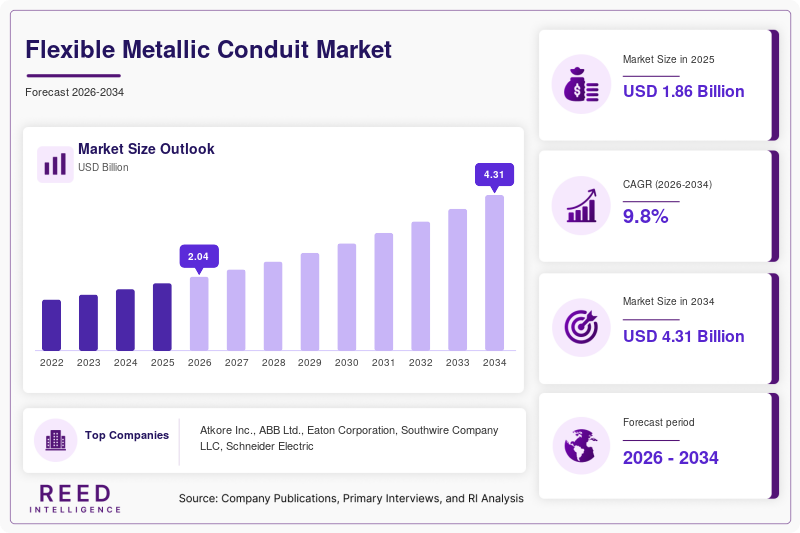
The global Flexible Metallic Conduit Market size was valued at USD 1.86 billion in 2026 and is projected to reach USD 3.92 billion by 2034, expanding at a CAGR of 9.8% during the forecast period from 2026 to 2034. Flexible metallic conduits are widely used for protecting electrical wiring systems in industrial plants, commercial buildings, transportation infrastructure, renewable energy installations, and residential applications. These conduits provide superior mechanical protection, flexibility, corrosion resistance, and safety against environmental hazards. Rising investments in industrial automation and smart infrastructure development continue to support demand across developed and emerging economies.
One of the major global factors supporting market expansion is the rapid modernization of power distribution and industrial electrical systems. Governments and private companies are investing heavily in advanced manufacturing plants, renewable energy facilities, metro rail projects, and data centers. Flexible metallic conduits are increasingly preferred in these projects because they simplify installation in confined spaces and improve cable management efficiency. The growing use of automation equipment and robotics in manufacturing facilities is also creating higher demand for durable conduit systems that can withstand vibration, heat, and moisture.
Key Highlights
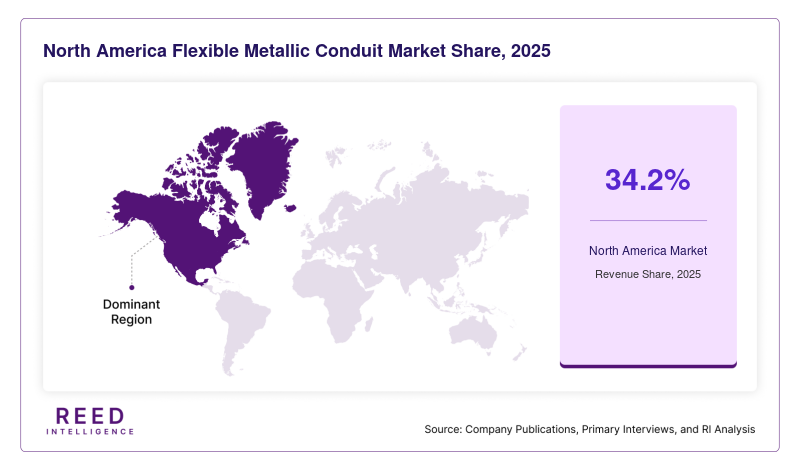
- North America dominated the market with a 34.2% share in 2025.
- Asia Pacific is expected to grow at the fastest CAGR of 11.2% during 2026–2034.
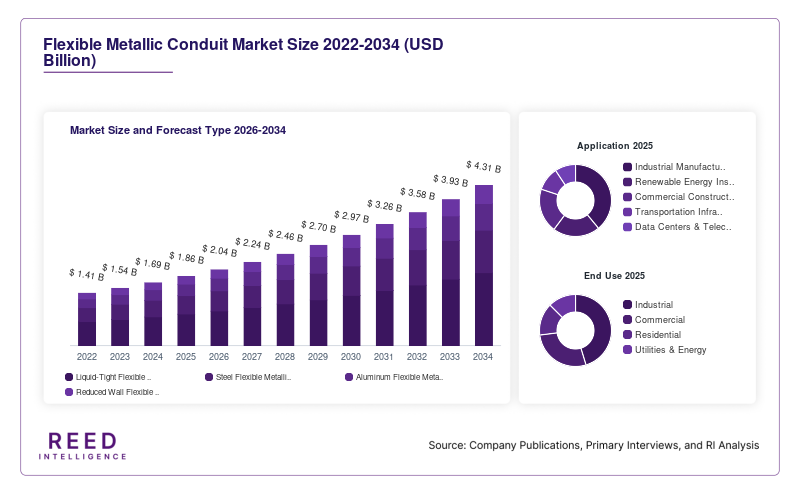
- By type, liquid-tight flexible metallic conduit accounted for the largest share of 39.6%, while aluminum flexible conduit is projected to grow at a CAGR of 10.9%.
- By application, industrial manufacturing led with a 42.1% share, whereas renewable energy installations are expected to expand at a CAGR of 11.7%.
- The United States remained the dominant country, with market values of USD 620 million in 2024 and USD 685 million in 2025.
Market Trends
Rising Integration of Flexible Metallic Conduits in Renewable Energy Infrastructure
The growing deployment of renewable energy projects has emerged as a significant trend in the Flexible Metallic Conduit Market. Solar farms, wind energy facilities, and battery storage systems require durable electrical protection solutions capable of operating under harsh environmental conditions. Flexible metallic conduits are increasingly used in photovoltaic systems and wind turbine installations because they provide resistance against moisture, corrosion, and temperature fluctuations. Countries across Asia Pacific, Europe, and North America are expanding renewable power generation capacities to reduce dependence on fossil fuels, which is creating strong demand for conduit systems in energy transmission and distribution applications.
Manufacturers are also developing lightweight and high-performance conduit materials suitable for outdoor installations and underground applications. The adoption of smart grid technologies and electric vehicle charging infrastructure further supports this trend. Utility companies prefer flexible metallic conduits due to their easy installation and lower maintenance requirements in renewable energy projects. Increasing investments in sustainable infrastructure and clean energy transition programs are expected to maintain long-term demand momentum for advanced conduit solutions.
Increasing Adoption of Industrial Automation and Smart Manufacturing Systems
Industrial automation and digital manufacturing transformation are accelerating the use of flexible metallic conduits across production facilities worldwide. Modern manufacturing plants rely heavily on automated machinery, robotics, sensors, and industrial control systems that require secure cable management and electrical protection. Flexible metallic conduits are preferred because they allow movement and vibration resistance while maintaining cable safety in complex industrial environments. Industries such as automotive, food processing, pharmaceuticals, electronics, and chemicals are investing in automated production lines, increasing the need for efficient conduit systems.
The expansion of Industry 4.0 initiatives is encouraging factories to upgrade existing electrical infrastructure with flexible and durable wiring solutions. Smart factories require organized and protected electrical systems to minimize operational downtime and improve productivity. Flexible metallic conduits also support easier maintenance and modifications in dynamic production environments. The increasing construction of automated warehouses and logistics facilities is contributing to additional demand, particularly in emerging economies where industrialization rates continue to rise steadily.
Market Drivers
Expansion of Construction and Commercial Infrastructure Activities
Rapid urbanization and infrastructure development activities across major economies are driving the demand for flexible metallic conduits. Commercial complexes, hospitals, airports, metro stations, and high-rise residential buildings require extensive electrical wiring systems that comply with strict safety regulations. Flexible metallic conduits are increasingly used in these projects because they offer enhanced cable protection and installation flexibility. Growing investments in smart city initiatives and public infrastructure modernization are further supporting market growth.
Construction companies are adopting advanced electrical systems that require efficient conduit management to ensure operational reliability and fire safety. In addition, rising refurbishment and retrofitting activities in aging commercial buildings are generating replacement demand for modern conduit systems. Emerging economies in Asia Pacific and the Middle East are witnessing strong construction growth due to population expansion and industrial development. These factors are expected to sustain long-term demand for flexible metallic conduits in both new installations and renovation projects.
Growing Focus on Electrical Safety Standards and Regulatory Compliance
Increasing awareness regarding workplace safety and electrical hazard prevention has become a major growth driver for the Flexible Metallic Conduit Market. Governments and regulatory authorities across developed economies have implemented strict safety standards related to industrial electrical installations and cable protection systems. Flexible metallic conduits help reduce risks associated with wire damage, fire hazards, and equipment failures, making them essential components in industrial and commercial applications.
Industries operating in hazardous environments, such as oil and gas, mining, marine, and chemical processing, require certified conduit systems capable of withstanding harsh operating conditions. Flexible metallic conduits provide high mechanical strength and electromagnetic shielding, supporting compliance with international safety requirements. Companies are increasingly prioritizing preventive maintenance and safe electrical infrastructure to avoid production disruptions and financial losses. Rising investments in secure industrial operations and energy-efficient electrical systems are expected to contribute significantly to market expansion throughout the forecast period.
Market Restraint
Volatility in Raw Material Prices and Availability Challenges
Fluctuating prices of raw materials such as steel, aluminum, and specialty alloys continue to restrain growth in the Flexible Metallic Conduit Market. Manufacturers depend heavily on metal supplies for conduit production, and sudden changes in commodity prices can directly impact manufacturing costs and profit margins. Global supply chain disruptions, transportation bottlenecks, and geopolitical uncertainties have increased procurement challenges for conduit producers in recent years. Small and medium-sized manufacturers often face greater pressure due to limited purchasing capabilities and higher operational expenses.
The rising cost of energy and industrial processing further affects pricing structures across the market. In some regions, end users shift toward low-cost non-metallic conduit alternatives to reduce installation expenses, particularly in residential applications. Volatile metal prices also make long-term pricing agreements difficult for suppliers and contractors. Delays in infrastructure and industrial projects caused by economic uncertainty may reduce procurement volumes temporarily. These factors collectively create challenges for market participants seeking stable growth and consistent profitability in highly competitive regional markets.
Market Opportunities
Increasing Investments in Data Centers and Digital Infrastructure
The rapid expansion of data centers and digital communication infrastructure presents a strong opportunity for the Flexible Metallic Conduit Market. Cloud computing, artificial intelligence, edge computing, and growing internet penetration are driving large-scale investments in hyperscale data centers worldwide. These facilities require highly reliable electrical systems with advanced cable protection to support uninterrupted operations. Flexible metallic conduits are increasingly used in server rooms, power distribution units, and backup energy systems because they provide durability, heat resistance, and organized cable routing.
Technology companies and colocation providers are constructing new data center facilities across North America, Europe, Asia Pacific, and the Middle East to meet rising digital storage and connectivity requirements. The growing demand for 5G infrastructure and smart communication networks is further supporting conduit adoption. Manufacturers have opportunities to develop specialized conduit systems designed for high-density digital infrastructure environments. The increasing focus on energy-efficient and scalable electrical installations is expected to create long-term business opportunities for conduit suppliers.
Growth Potential in Electric Vehicle Charging Infrastructure
The global transition toward electric mobility is creating substantial opportunities for flexible metallic conduit manufacturers. Governments worldwide are promoting electric vehicle adoption through subsidies, charging infrastructure investments, and carbon reduction initiatives. Electric vehicle charging stations require reliable electrical protection systems capable of handling high-voltage wiring and outdoor environmental exposure. Flexible metallic conduits are becoming a preferred solution due to their resistance to moisture, vibration, and mechanical stress.
Public charging stations, commercial parking facilities, residential charging units, and fleet charging hubs are expanding rapidly across developed and emerging economies. The increasing deployment of fast-charging networks along highways and urban transportation corridors is generating additional demand for durable conduit systems. Manufacturers are focusing on product innovation to improve flexibility, corrosion resistance, and installation efficiency for electric vehicle infrastructure projects. The long-term expansion of sustainable transportation ecosystems is expected to create significant revenue opportunities for market participants during the forecast period.
Segmental Analysis
By Type
Liquid-tight flexible metallic conduit accounted for the largest share of 39.6% in 2024 due to its extensive use in industrial and outdoor electrical applications. These conduits provide superior resistance against moisture, oils, dust, and corrosive materials, making them highly suitable for manufacturing facilities, renewable energy systems, and transportation infrastructure. Industrial operators prefer liquid-tight conduits because they help maintain electrical safety and reduce maintenance requirements in demanding operating environments. Growth in industrial automation and smart manufacturing projects has further increased the use of these conduit systems in robotics, machine tools, and processing equipment.
Aluminum flexible metallic conduit is projected to witness the fastest CAGR of 10.9% during the forecast period owing to its lightweight structure and corrosion-resistant properties. Industries increasingly prefer aluminum conduits for commercial buildings, data centers, and renewable energy projects because they simplify installation and reduce transportation costs. The rising focus on energy-efficient infrastructure and sustainable construction practices is encouraging adoption of lightweight conduit materials. In addition, growing demand for modular electrical systems in modern construction projects is expected to accelerate the use of aluminum-based conduit solutions across developed and emerging economies.
By Application
Industrial manufacturing dominated the Flexible Metallic Conduit Market with a 42.1% revenue share in 2024. Manufacturing facilities require advanced cable protection systems capable of operating under vibration, heat, and mechanical stress conditions. Flexible metallic conduits are widely used in automated production lines, robotics systems, control panels, and machine installations. The increasing adoption of Industry 4.0 technologies and smart factory solutions has significantly expanded conduit demand across automotive, electronics, pharmaceuticals, and food processing industries. Companies continue to invest in modernizing electrical infrastructure to improve productivity and operational safety.
Renewable energy installations are expected to register the fastest CAGR of 11.7% during the forecast period. Solar power plants, wind energy facilities, and battery storage systems require durable conduit solutions capable of withstanding extreme environmental conditions. Flexible metallic conduits provide enhanced protection for power cables and electrical systems exposed to outdoor environments. Governments worldwide are increasing investments in clean energy projects and grid modernization programs, creating substantial growth opportunities for conduit manufacturers. Expansion of electric vehicle charging infrastructure and energy storage systems is also contributing to rising conduit demand in renewable energy applications.
By End Use
The industrial sector held the dominant market share of 45.3% in 2024 due to rising investments in automation, manufacturing expansion, and energy infrastructure modernization. Industrial facilities rely heavily on secure electrical systems to support uninterrupted operations and worker safety. Flexible metallic conduits are commonly used in chemical processing plants, oil and gas facilities, mining operations, and heavy manufacturing units where cable protection is essential. Increasing implementation of predictive maintenance systems and automated machinery has strengthened demand for high-performance conduit solutions across industrial applications.
The commercial sector is anticipated to grow at the fastest CAGR of 10.8% during the forecast period because of rising construction of commercial buildings, hospitals, airports, retail centers, and data centers. Modern commercial infrastructure requires advanced electrical wiring systems that support safety compliance and efficient cable management. Flexible metallic conduits are preferred in commercial projects due to their installation flexibility and long operational lifespan. The expansion of smart buildings and digital infrastructure projects is further driving demand for conduit systems capable of supporting complex electrical and communication networks in urban environments.
Regional Analysis
North America
North America accounted for 34.2% of the global Flexible Metallic Conduit Market share in 2025 and is expected to maintain stable growth at a CAGR of 8.7% through 2034. The region benefits from extensive industrial automation, mature construction activity, and strong investments in energy infrastructure modernization. Demand for flexible metallic conduits remains high across commercial buildings, manufacturing plants, transportation systems, and data centers. Strict electrical safety standards and regulatory compliance requirements also encourage the adoption of advanced conduit systems across industrial and commercial sectors.
The United States remains the dominant country in the regional market due to large-scale investments in smart manufacturing, renewable energy projects, and digital infrastructure. The country continues to witness strong expansion in data centers and electric vehicle charging networks, supporting higher conduit demand. Rising renovation activities in aging industrial facilities and commercial properties further contribute to market growth. In addition, the increasing use of robotics and automation technologies in manufacturing operations has strengthened the requirement for flexible and durable electrical protection systems.
Europe
Europe represented approximately 26.4% of the global Flexible Metallic Conduit Market in 2025 and is projected to grow at a CAGR of 8.9% during the forecast period. The region has a well-established industrial base and strong emphasis on energy efficiency and workplace safety. Flexible metallic conduits are widely used in automotive manufacturing, railway systems, renewable energy facilities, and commercial infrastructure projects. Government initiatives promoting sustainable buildings and industrial modernization are expected to support consistent market demand across European economies.
Germany emerged as the leading country within the European market due to its strong manufacturing sector and technological advancement in industrial automation. The country has increased investments in electric mobility infrastructure, factory automation, and renewable energy integration, which has boosted demand for advanced conduit systems. In addition, modernization of transportation infrastructure and growing adoption of smart factory technologies are creating favorable opportunities for conduit manufacturers. The presence of established electrical equipment producers further strengthens regional supply chain capabilities.
Asia Pacific
Asia Pacific held a market share of 24.8% in 2025 and is anticipated to register the fastest CAGR of 11.2% between 2026 and 2034. Rapid urbanization, industrialization, and infrastructure development activities across China, India, Southeast Asia, and Japan continue to support strong market expansion. Governments are investing heavily in metro rail projects, industrial corridors, renewable energy facilities, and smart city initiatives, creating substantial demand for electrical protection systems. Flexible metallic conduits are increasingly used in manufacturing plants, power generation facilities, and commercial construction projects throughout the region.
China remains the dominant country in the Asia Pacific market due to its large industrial base and ongoing infrastructure investments. The country has expanded production capacities in electronics, automotive manufacturing, and renewable energy sectors, increasing the requirement for advanced cable management systems. Growing investments in industrial automation and robotics further contribute to conduit demand. In India, rapid urban infrastructure development and expansion of commercial real estate projects are supporting additional market growth opportunities for both domestic and international manufacturers.
Middle East & Africa
The Middle East & Africa region accounted for nearly 8.1% of the global Flexible Metallic Conduit Market share in 2025 and is expected to grow at a CAGR of 9.4% through 2034. Large-scale infrastructure projects, industrial diversification programs, and rising investments in energy and utility sectors are supporting market development across the region. Flexible metallic conduits are increasingly used in oil and gas facilities, airports, commercial buildings, and transportation infrastructure due to their durability and resistance to harsh environmental conditions.
Saudi Arabia emerged as the leading country in the regional market because of its ongoing industrial and infrastructure transformation initiatives. Government-backed smart city developments, renewable energy projects, and construction of advanced industrial zones are generating demand for modern electrical systems. The expansion of petrochemical and manufacturing industries further contributes to conduit consumption. In the United Arab Emirates, increasing investments in commercial real estate and transportation infrastructure are creating additional opportunities for flexible metallic conduit suppliers and installation contractors.
Latin America
Latin America captured approximately 6.5% of the global Flexible Metallic Conduit Market in 2025 and is projected to expand at a CAGR of 8.5% during the forecast period. The region is witnessing gradual industrial recovery and increasing investments in commercial infrastructure, mining operations, and energy projects. Flexible metallic conduits are gaining adoption in industrial facilities and utility installations where mechanical protection and corrosion resistance are critical. Expanding urban populations and improving electricity access are also supporting market demand.
Brazil remains the dominant country in the Latin American market due to its growing industrial activities and infrastructure modernization efforts. Investments in renewable energy generation, transportation systems, and manufacturing facilities continue to support conduit demand across multiple sectors. The mining industry also represents an important application area because of the need for durable electrical protection systems in harsh operating environments. Additionally, increasing foreign investments in industrial and commercial construction projects are expected to create favorable growth opportunities across the region.
Competitive Landscape
The Flexible Metallic Conduit Market is characterized by the presence of established international manufacturers and regional suppliers competing on product quality, pricing, distribution capabilities, and technological innovation. Leading companies are focusing on expanding production capacities, introducing corrosion-resistant conduit systems, and strengthening partnerships with electrical contractors and infrastructure developers. Strategic acquisitions and product portfolio diversification remain common growth strategies among major market participants.
Atkore Inc. continues to maintain a leading position in the market due to its extensive product portfolio and strong distribution network across North America and Europe. The company has invested in advanced manufacturing technologies to improve product durability and operational efficiency. ABB Ltd., Eaton Corporation, Southwire Company, and Schneider Electric are also actively expanding their conduit product offerings to address rising demand from industrial automation and renewable energy sectors.
Recent developments in the market include the launch of lightweight aluminum conduit systems for commercial applications, expansion of manufacturing facilities in Asia Pacific, and strategic collaborations focused on electric vehicle infrastructure projects. Companies are also increasing investments in research and development to enhance flexibility, fire resistance, and environmental sustainability of conduit materials.
Key Players
- Atkore Inc.
- ABB Ltd.
- Eaton Corporation
- Southwire Company LLC
- Schneider Electric
- Anamet Electrical Inc.
- Electri-Flex Company
- HellermannTyton
- AFC Cable Systems
- Delikon Electric Flexible Conduit
- Kaiphone Technology Co. Ltd.
- Hangzhou EVT Electrical Co. Ltd.
- Flexa GmbH
- Bahra Electric
- Shanghai Weyer Electric Co. Ltd.
Recent Developments
- In February 2025, Atkore Inc. expanded its flexible conduit manufacturing facility in the United States to increase production capacity for industrial automation applications.
- In July 2025, ABB Ltd. introduced a new range of corrosion-resistant flexible metallic conduits designed for renewable energy and offshore infrastructure projects.
- In October 2025, Southwire Company announced a strategic partnership with electric vehicle charging infrastructure developers to supply advanced conduit systems for fast-charging networks.
- In January 2026, Eaton Corporation launched lightweight aluminum flexible conduit products targeting commercial building and data center installations.
- In March 2026, Schneider Electric expanded its distribution operations in Asia Pacific to strengthen supply chain support for industrial electrical infrastructure projects.
Flexible Metallic Conduit Market Segments
Type
- Liquid-Tight Flexible Metallic Conduit
- Steel Flexible Metallic Conduit
- Aluminum Flexible Metallic Conduit
- Reduced Wall Flexible Metallic Conduit
Application
- Industrial Manufacturing
- Renewable Energy Installations
- Commercial Construction
- Transportation Infrastructure
- Data Centers & Telecommunications
End Use
- Industrial
- Commercial
- Residential
- Utilities & Energy
By Region
- North America
- Europe
- APAC
- Middle East and Africa
- LATAM