Flint Glass Market Size, Share & Demand Report By Type (Soda-Lime Flint Glass, Lead Flint Glass, Specialty Flint Glass), By Application (Packaging, Optical Glass, Tableware, Others), By End-Use Industry (Food & Beverages, Pharmaceuticals, Cosmetics & Personal Care, Electronics), By Manufacturing Process (Float Glass Process, Blown Glass Process), By Region & Segment Forecasts, 2026–2034
USD 3950
Market Overview
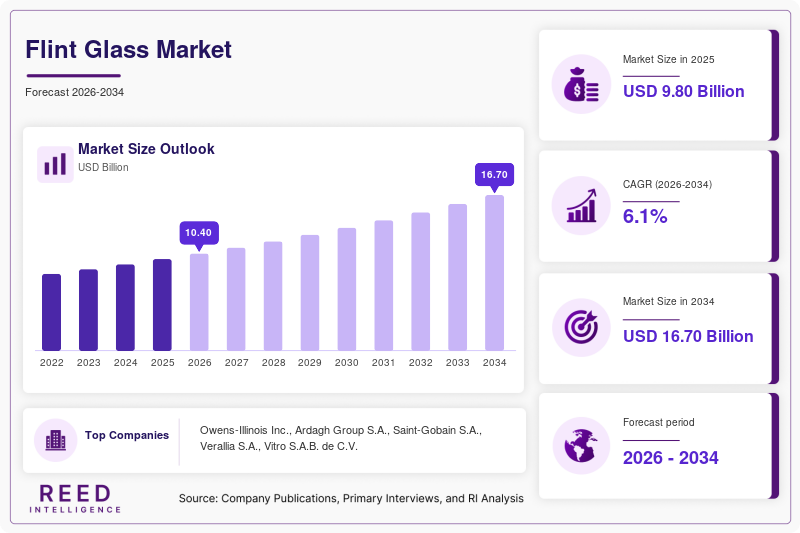
The Flint Glass Market was valued at approximately USD 9.8 billion in 2026 and is projected to reach USD 15.7 billion by 2034, expanding at a CAGR of 6.1% during the forecast period (2026–2034). The market’s steady growth trajectory is primarily supported by the increasing demand for high-clarity, premium-quality glass in packaging, optics, and specialty applications. A significant global factor contributing to this growth is the rising preference for recyclable and aesthetically appealing packaging solutions, particularly in the beverage and cosmetics industries, where flint glass is widely utilized due to its superior transparency and chemical stability.
The increasing focus on sustainability and circular economy practices has reinforced the adoption of flint glass, as it is fully recyclable without loss of quality. Additionally, advancements in glass manufacturing technologies, including energy-efficient furnaces and improved raw material processing, have enhanced production efficiency and reduced environmental impact, further supporting market expansion.
Key Highlights
- Dominant region: Europe accounted for 34.2% market share in 2025, while Asia Pacific is projected to grow at a CAGR of 7.4% during 2026–2034.
- Leading subsegments: Packaging led the application segment with 46.8% share in 2025, while optical glass is projected to grow at a CAGR of 6.9%.
- Dominant country: Germany recorded market values of USD 1.05 billion in 2024 and USD 1.11 billion in 2025, driven by advanced manufacturing and export demand.
Market Trends
Premiumization in Glass Packaging
The demand for high-end packaging solutions has been steadily rising across the beverage, cosmetics, and pharmaceutical industries. Flint glass, known for its exceptional clarity and aesthetic appeal, is increasingly being used for premium product packaging. Brands are leveraging transparent glass to enhance product visibility and consumer trust, particularly in luxury and organic product segments.
Technological Advancements in Glass Manufacturing
The adoption of advanced melting technologies, automation, and digital monitoring systems has transformed flint glass production. Manufacturers are focusing on reducing energy consumption and emissions while improving product consistency. These innovations are enabling the production of lightweight yet durable flint glass, aligning with sustainability goals and cost efficiency.
Market Drivers
Increasing Demand for Sustainable Packaging
The global shift toward environmentally friendly packaging solutions is a major driver for the Flint Glass Market. Flint glass is 100% recyclable and can be reused multiple times without degradation in quality. This makes it a preferred material for companies aiming to reduce their environmental footprint. Governments and regulatory bodies are also promoting the use of recyclable materials, further accelerating market growth.
Growth in Beverage and Cosmetics Industries
The expanding beverage and cosmetics sectors are significantly contributing to the demand for flint glass. Alcoholic beverages, perfumes, and skincare products often require high-quality, transparent packaging to maintain brand image and product integrity. The rising consumption of premium beverages and personal care products has led to increased adoption of flint glass packaging solutions.
Market Restraint
High Energy Consumption in Production
Flint glass manufacturing is energy-intensive, requiring high temperatures for melting raw materials. This results in elevated production costs and carbon emissions. Fluctuations in energy prices and stringent environmental regulations pose challenges for manufacturers, potentially limiting market growth.
Market Opportunities
Expansion in Emerging Economies
Rapid industrialization and urbanization in emerging economies present significant growth opportunities for the Flint Glass Market. Increasing disposable income and changing consumer preferences are driving demand for packaged goods, particularly in Asia Pacific and Latin America.
Innovation in Lightweight Glass Products
The development of lightweight flint glass products offers a promising opportunity for manufacturers. Lightweight glass reduces transportation costs and carbon emissions while maintaining product strength and quality. This innovation is expected to gain traction across multiple industries, including food and beverage packaging.
Segmental Analysis
By Type
The flint glass market is segmented into soda-lime flint glass, lead flint glass, and specialty flint glass.
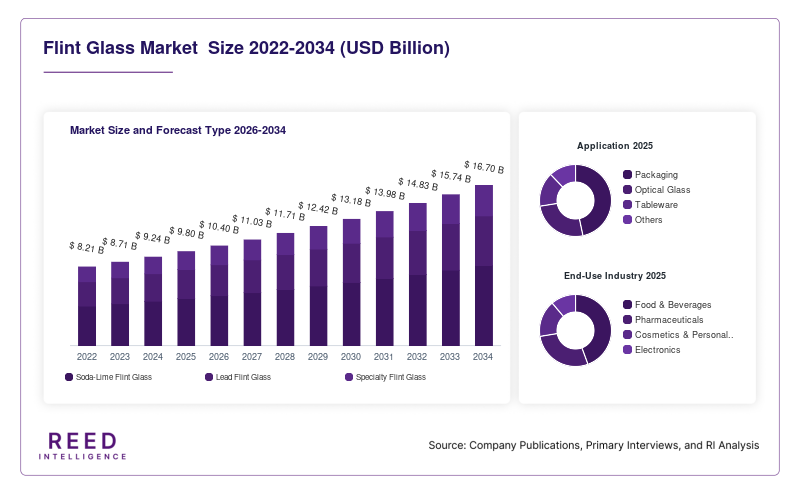
- Dominant subsegment: Soda-lime flint glass held 58.4% share in 2025, owing to its widespread use in packaging and cost-effectiveness.
- Fastest-growing subsegment: Specialty flint glass is expected to grow at a CAGR of 6.8%, driven by increasing demand in optical and high-tech applications.
By Application
The market is segmented into packaging, optics, tableware, and others.
- Dominant subsegment: Packaging accounted for 46.8% share in 2025, supported by strong demand from the beverage and cosmetics industries.
- Fastest-growing subsegment: Optical applications are projected to grow at a CAGR of 6.9%, driven by advancements in precision optics and electronics.
By End-Use Industry
The market includes food & beverages, pharmaceuticals, cosmetics, and electronics.
- Dominant subsegment: Food & beverages held 42.1% share in 2025, due to high consumption of packaged products.
- Fastest-growing subsegment: Electronics is expected to grow at a CAGR of 7.1%, driven by increasing demand for high-quality optical components.
By Manufacturing Process
The market is segmented into float glass process and blown glass process.
- Dominant subsegment: Float glass process accounted for 63.5% share in 2025, due to its efficiency and scalability.
- Fastest-growing subsegment: Blown glass process is projected to grow at a CAGR of 6.5%, driven by demand for customized and decorative glass products.
Regional Analysis
North America
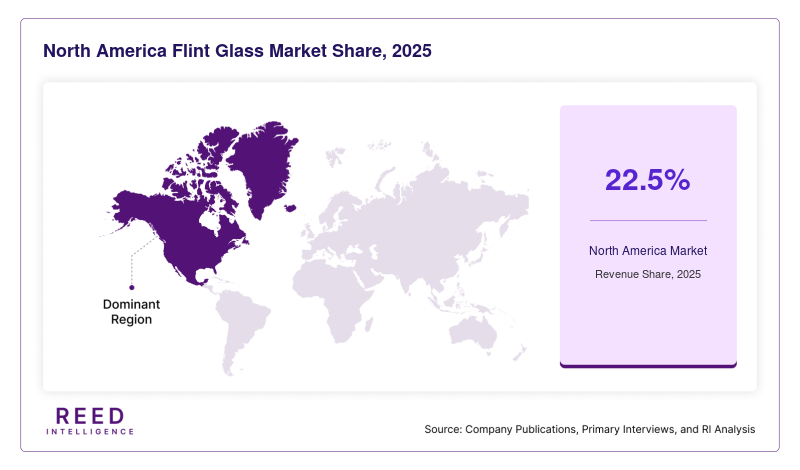
North America held 22.5% of the Flint Glass Market share in 2025 and is expected to grow at a CAGR of 5.6% during the forecast period. The region’s growth is driven by strong demand from the beverage and pharmaceutical industries. The United States remains the dominant country, supported by advanced manufacturing infrastructure and increasing demand for sustainable packaging solutions.
Europe
Europe accounted for 34.2% market share in 2025 and will grow at a CAGR of 5.9% through 2034. The region’s well-established glass manufacturing industry and strict environmental regulations are key growth factors. Germany leads the regional market due to its strong industrial base and export-oriented production capabilities.
Asia Pacific
Asia Pacific represented 27.8% of the market in 2025 and is projected to grow at the fastest CAGR of 7.4%. The region’s growth is fueled by rising urbanization, increasing consumption of packaged goods, and expanding manufacturing activities. China dominates the market, driven by large-scale production and growing domestic demand.
Middle East & Africa
The Middle East & Africa held 7.6% market share in 2025 and is expected to grow at a CAGR of 5.3%. The region’s growth is supported by increasing investments in infrastructure and the expansion of the food and beverage sector. Saudi Arabia leads the market due to its growing industrial base.
Latin America
Latin America accounted for 7.9% of the market in 2025 and will grow at a CAGR of 5.7%. The region benefits from rising demand for packaged food and beverages. Brazil dominates the market, driven by its large consumer base and expanding manufacturing sector.
Competitive Landscape
The Flint Glass Market is moderately fragmented, with several global and regional players competing on product quality, innovation, and pricing. The market leader, Owens-Illinois, maintains a strong position through its extensive manufacturing network and focus on sustainable glass solutions.
The company has recently invested in energy-efficient furnace technologies to reduce emissions and improve operational efficiency. Other key players such as Saint-Gobain and Ardagh Group are focusing on expanding their product portfolios and enhancing production capabilities. Companies are also engaging in strategic partnerships and acquisitions to strengthen their market presence and cater to evolving customer demands. Innovation in lightweight glass and advanced manufacturing processes remains a key competitive strategy. Additionally, regional players are gaining traction by offering cost-effective solutions and catering to local market needs, contributing to the overall competitiveness of the market.
Key Players List
- Owens-Illinois Inc.
- Ardagh Group S.A.
- Saint-Gobain S.A.
- Verallia S.A.
- Vitro S.A.B. de C.V.
- Nihon Yamamura Glass Co., Ltd.
- Piramal Glass Private Limited
- Gerresheimer AG
- Beatson Clark
- Stolzle Glass Group
- Vidrala S.A.
- Sisecam Group
- Hindusthan National Glass & Industries Limited
- Bormioli Rocco
- Zignago Vetro S.p.A.
Recent Developments
- In 2025, leading manufacturers introduced energy-efficient glass furnaces to reduce carbon emissions and operational costs.
- Several companies expanded their production facilities in Asia Pacific to meet rising regional demand.
- Strategic partnerships between glass manufacturers and beverage companies were formed to develop sustainable packaging solutions.
- Investments in lightweight glass technology increased, aiming to improve transportation efficiency and reduce environmental impact.
- New product launches focused on high-clarity and premium-quality flint glass for luxury packaging applications.
Flint Glass Market Segments
Type
- Soda-Lime Flint Glass
- Lead Flint Glass
- Specialty Flint Glass
Application
- Packaging
- Optical Glass
- Tableware
- Others
End-Use Industry
- Food & Beverages
- Pharmaceuticals
- Cosmetics & Personal Care
- Electronics
Manufacturing Process
- Float Glass Process
- Blown Glass Process
By Region
- North America
- Europe
- APAC
- Middle East and Africa
- LATAM