Flow Diverters Market Size, Share & Demand Report By Product Type (Pipeline Flow Diverters, Surface-Modified Flow Diverters), By Application (Intracranial Aneurysms, Peripheral Aneurysms), By End-Use (Hospitals, Ambulatory Surgical Centers), By Region & Segment Forecasts, 2026–2034
USD 3950
Market Overview
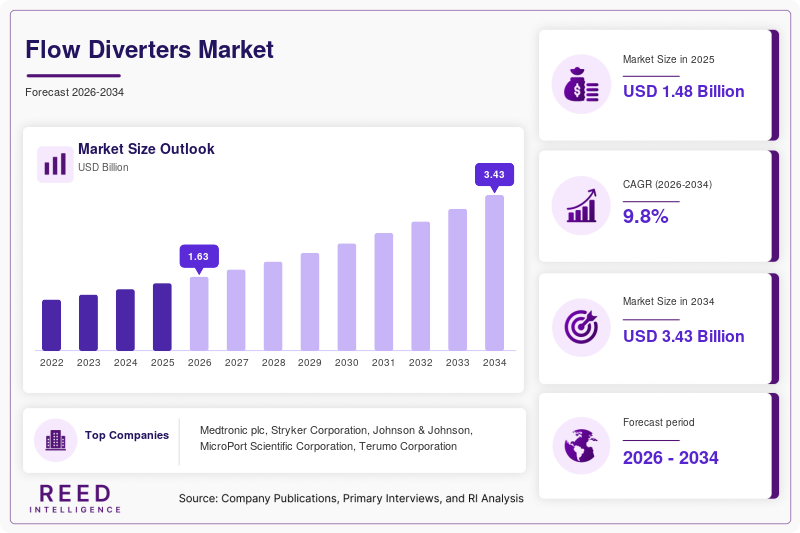
The global Flow Diverters Market size was valued at USD 1.48 billion in 2026 and is projected to reach USD 3.12 billion by 2034, expanding at a compound annual growth rate (CAGR) of 9.8% during 2026–2034. The market growth is primarily supported by the increasing prevalence of intracranial aneurysms and the rising demand for minimally invasive neurovascular procedures. Flow diverters, designed to redirect blood flow away from aneurysms and promote vessel healing, have become a preferred alternative to traditional surgical clipping due to lower procedural risks and shorter recovery times.
A key global factor supporting market expansion is the growing adoption of advanced neurointerventional techniques across developed and emerging economies. Healthcare systems are increasingly investing in specialized neurology centers and catheter-based technologies, which has significantly improved access to flow diversion therapies. Additionally, the rising geriatric population—more susceptible to vascular disorders—continues to fuel demand.
Key Highlights
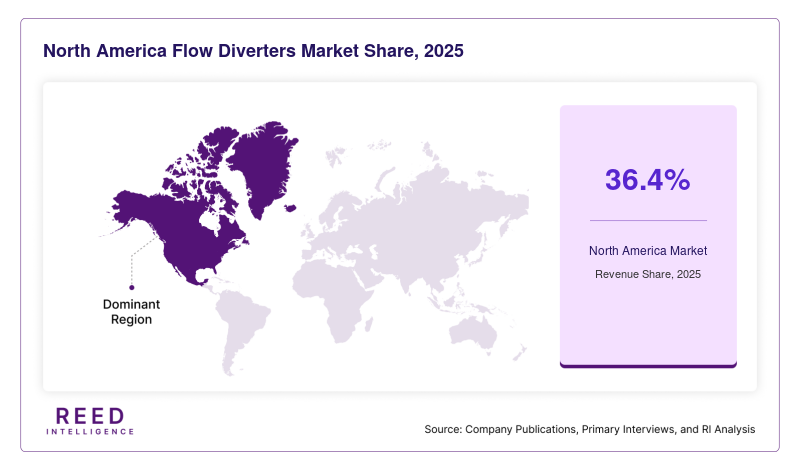
- North America dominated the market with a 36.4% share in 2025.
- Asia Pacific is expected to grow at the fastest CAGR of 11.6% during 2026–2034.
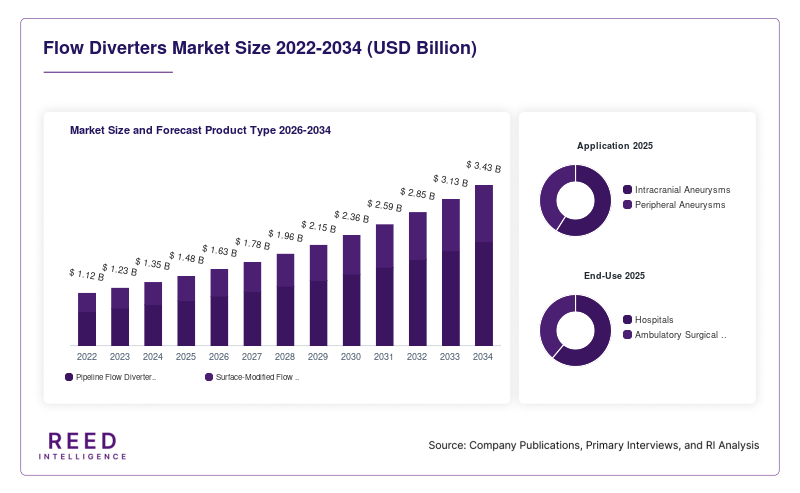
- By product type, pipeline flow diverters accounted for the largest share of 52.8%.
- while surface-modified flow diverters are projected to grow at a CAGR of 12.7%.
- By application, intracranial aneurysms led with a 68.9% share, whereas peripheral aneurysms are expected to expand at a CAGR of 10.9%.
- The United States remained the dominant country, with market values of USD 540 million in 2024 and USD 595 million in 2025.
Market Trends
Increasing Shift Toward Minimally Invasive Neurovascular Procedures
A notable trend shaping the Flow Diverters Market is the increasing preference for minimally invasive treatment approaches in neurovascular care. Patients and healthcare providers are moving away from open surgical techniques toward catheter-based interventions due to lower complication rates, reduced hospital stays, and faster recovery. Flow diverters are particularly suited for complex aneurysms that are difficult to treat with coiling or clipping. As awareness grows among clinicians regarding long-term efficacy and safety, the adoption rate is steadily rising. Furthermore, hospitals are expanding their interventional radiology and neurosurgery departments, which enhances the availability of such procedures. This shift is expected to sustain demand, especially in developed healthcare systems where advanced imaging and surgical infrastructure are widely accessible.
Technological Advancements in Device Design and Materials
The market is experiencing rapid innovation in device engineering, focusing on improving deliverability, flexibility, and patient safety. Manufacturers are developing flow diverters with enhanced mesh density and surface modifications to reduce thrombogenic risks. Newer devices incorporate anti-thrombotic coatings and improved radial strength, enabling better vessel wall apposition and aneurysm occlusion. These innovations are particularly important in treating small or distal aneurysms, where precision is critical. Additionally, integration with advanced imaging systems allows physicians to achieve accurate placement, improving clinical outcomes. Continuous research and development activities are expected to lead to next-generation products that expand the scope of applications and increase physician confidence in adopting these devices.
Market Drivers
Rising Incidence of Intracranial Aneurysms and Neurovascular Disorders
The increasing prevalence of intracranial aneurysms is a major driver for the Flow Diverters Market. Lifestyle factors such as hypertension, smoking, and aging contribute to the growing incidence of vascular abnormalities. Early diagnosis through advanced imaging techniques has also increased the number of identified cases, leading to higher treatment volumes. Flow diverters provide an effective solution for complex and wide-neck aneurysms, which are often unsuitable for traditional treatments. As healthcare systems focus on early intervention and preventive care, the demand for advanced treatment options continues to rise. This trend is especially prominent in developed regions where screening programs and diagnostic capabilities are well established.
Expansion of Healthcare Infrastructure and Specialized Centers
The global expansion of healthcare infrastructure, particularly in emerging economies, is driving the adoption of flow diverters. Governments and private organizations are investing in advanced medical facilities, including neurology and interventional radiology departments. The establishment of specialized stroke and neurovascular centers has improved access to cutting-edge treatments. Training programs for physicians and increased awareness of minimally invasive procedures further support market growth. In addition, favorable reimbursement policies in developed regions encourage hospitals to adopt advanced devices. As more healthcare providers gain the capability to perform complex neurointerventions, the demand for flow diverters is expected to grow steadily.
Market Restraint
High Cost of Devices and Procedures
One of the primary restraints in the Flow Diverters Market is the high cost associated with both the devices and the procedures. Flow diverters are technologically advanced implants that require precision manufacturing and stringent quality standards, leading to higher pricing compared to traditional treatment options. In addition, the procedures require specialized equipment, trained professionals, and advanced imaging systems, which further increase overall treatment costs. This cost burden can limit adoption in price-sensitive markets, particularly in low- and middle-income countries where healthcare budgets are constrained.
The high cost also impacts patient access, as not all healthcare systems provide adequate reimbursement for these procedures. In regions with limited insurance coverage, patients may opt for less expensive alternatives, even if they are less effective. Hospitals may also face budget constraints when procuring advanced devices, which can slow market penetration. For example, smaller healthcare facilities may not have the resources to invest in neurointerventional infrastructure, restricting the availability of flow diversion therapies. Addressing these cost-related challenges through pricing strategies, local manufacturing, and reimbursement reforms will be crucial for broader market expansion.
Market Opportunities
Growing Adoption in Emerging Markets
Emerging markets present significant growth opportunities for the Flow Diverters Market due to improving healthcare infrastructure and increasing awareness of advanced treatment options. Countries in Asia Pacific, Latin America, and parts of the Middle East are investing in modern medical technologies and expanding access to specialized care. Rising disposable incomes and government initiatives to enhance healthcare quality are also contributing to market growth. As more hospitals adopt neurointerventional capabilities, the demand for flow diverters is expected to increase. Additionally, collaborations between global manufacturers and local distributors can facilitate market entry and improve product availability in these regions.
Development of Next-Generation Flow Diverters
The development of next-generation flow diverters offers a promising opportunity for market expansion. Innovations such as bioresorbable materials, enhanced biocompatibility, and improved delivery systems are expected to address current limitations and expand the scope of applications. These advanced devices can potentially reduce complications, improve patient outcomes, and enable treatment of more complex cases. Research into personalized medical devices tailored to patient-specific anatomy is also gaining traction. As regulatory bodies approve new products, manufacturers can capitalize on these advancements to strengthen their market position. Continuous innovation will play a key role in driving long-term growth and differentiation in the competitive landscape.
Segmental Analysis
By Product Type
Pipeline flow diverters dominated the Flow Diverters Market in 2024, accounting for approximately 52.8% of the total market share. These devices are widely used due to their proven clinical effectiveness in treating complex intracranial aneurysms. Their design allows for optimal blood flow redirection and promotes natural vessel healing, making them a preferred choice among physicians. The strong adoption of pipeline flow diverters is also supported by extensive clinical data demonstrating their safety and efficacy. Additionally, their availability across major healthcare systems and established reimbursement policies further contribute to their dominance. The increasing number of neurointerventional procedures globally continues to drive demand for this segment.
Surface-modified flow diverters are expected to be the fastest-growing subsegment, with a projected CAGR of 12.7% during the forecast period. These devices incorporate advanced coatings that reduce thrombogenicity and improve biocompatibility, addressing key challenges associated with traditional flow diverters. The growing focus on patient safety and improved clinical outcomes is driving the adoption of these advanced devices. Furthermore, ongoing research and development activities are leading to the introduction of innovative products with enhanced performance characteristics. As regulatory approvals for these devices increase, their adoption is expected to expand rapidly across both developed and emerging markets.
By Application
Intracranial aneurysms represented the largest application segment in 2024, accounting for 68.9% of the Flow Diverters Market. The high prevalence of intracranial aneurysms and the effectiveness of flow diverters in treating complex cases are key factors driving this segment. Flow diverters offer a minimally invasive alternative to traditional surgical methods, reducing patient risk and recovery time. The increasing use of advanced imaging techniques for early diagnosis further supports the growth of this segment. Additionally, the growing awareness among healthcare professionals regarding the benefits of flow diversion therapy contributes to its widespread adoption.
Peripheral aneurysms are expected to be the fastest-growing application segment, with a CAGR of 10.9% during the forecast period. The rising incidence of peripheral vascular diseases and the expanding use of flow diverters beyond neurovascular applications are driving this growth. Technological advancements in device design enable their use in a wider range of anatomical locations, increasing their applicability. Furthermore, the growing focus on minimally invasive treatments in vascular surgery is supporting the adoption of flow diverters for peripheral aneurysms. As clinical evidence supporting their use continues to grow, this segment is expected to witness significant expansion.
By End-Use
Hospitals dominated the Flow Diverters Market in 2024, accounting for approximately 61.5% of the total market share. Hospitals are the primary settings for complex neurovascular procedures, equipped with advanced imaging systems and specialized surgical teams. The availability of comprehensive healthcare services and the ability to handle complications make hospitals the preferred choice for flow diverter procedures. Additionally, favorable reimbursement policies and the presence of skilled professionals further support the dominance of this segment. The increasing number of hospital-based neurointerventional procedures globally continues to drive demand.
Ambulatory surgical centers are projected to be the fastest-growing end-use segment, with a CAGR of 11.3% during the forecast period. These centers offer cost-effective alternatives to hospital-based procedures, with shorter patient stays and reduced operational costs. The growing focus on outpatient care and advancements in minimally invasive techniques are driving the adoption of flow diverters in these settings. Additionally, the increasing number of ambulatory centers equipped with advanced medical technologies is supporting market growth. As healthcare systems aim to improve efficiency and reduce costs, the adoption of flow diverters in ambulatory settings is expected to increase significantly.
Regional Analysis
North America
North America accounted for the largest share of the Flow Diverters Market in 2025, contributing approximately 36.4% of global revenue. The region is expected to grow at a steady CAGR of 8.9% during the forecast period. The dominance of North America is attributed to advanced healthcare infrastructure, high healthcare expenditure, and early adoption of innovative medical technologies. The presence of leading market players and ongoing research activities further support market growth. Additionally, favorable reimbursement policies and strong regulatory frameworks enable faster adoption of new devices.
The United States remains the dominant country in this region, driven by a high prevalence of intracranial aneurysms and well-established neurovascular treatment centers. A unique growth factor is the strong emphasis on clinical research and trials, which accelerates the introduction of advanced flow diverters. Continuous investments in healthcare technology and training programs for specialists further enhance the adoption rate across the country.
Europe
Europe held a significant share of the global Flow Diverters Market in 2025, accounting for approximately 27.1%, and is projected to grow at a CAGR of 9.1% during 2026–2034. The region benefits from a well-developed healthcare system and increasing awareness of minimally invasive procedures. Government initiatives to improve healthcare access and quality also contribute to market expansion. The presence of skilled healthcare professionals and advanced diagnostic facilities further supports the adoption of flow diverters.
Germany is the leading country in Europe, owing to its strong healthcare infrastructure and high investment in medical technology. A unique growth factor in this region is the increasing collaboration between research institutions and medical device manufacturers. These partnerships facilitate innovation and accelerate the development of advanced treatment solutions, driving market growth.
Asia Pacific
Asia Pacific is the fastest-growing region in the Flow Diverters Market, with a projected CAGR of 11.6% during the forecast period and a market share of 21.3% in 2025. Rapid urbanization, increasing healthcare expenditure, and growing awareness of advanced medical treatments are key factors driving growth. The expansion of healthcare infrastructure and the rising number of specialized hospitals further contribute to market development.
China dominates the Asia Pacific market due to its large patient population and increasing investments in healthcare modernization. A unique growth factor is the government's focus on improving access to advanced medical technologies in both urban and rural areas. This has led to increased adoption of minimally invasive procedures, including flow diversion therapies.
Middle East & Africa
The Middle East & Africa region accounted for approximately 8.2% of the global Flow Diverters Market in 2025 and is expected to grow at a CAGR of 9.4% during the forecast period. The market is driven by improving healthcare infrastructure and increasing investments in medical technology. Rising awareness of advanced treatment options and the growing burden of neurovascular diseases also support market growth.
Saudi Arabia is the dominant country in this region, supported by government initiatives to enhance healthcare quality and infrastructure. A unique growth factor is the increasing number of partnerships between international medical device companies and local healthcare providers. These collaborations help improve access to advanced technologies and drive market expansion.
Latin America
Latin America held a market share of approximately 7.0% in 2025 and is projected to grow at a CAGR of 9.7% during the forecast period. The region is witnessing steady growth due to improving healthcare systems and increasing awareness of minimally invasive procedures. Government efforts to expand healthcare coverage and infrastructure also contribute to market development.
Brazil leads the Latin American market, driven by a growing healthcare sector and increasing investments in advanced medical technologies. A unique growth factor is the rising number of training programs for healthcare professionals, which enhances the adoption of flow diverters. As expertise in neurointerventional procedures increases, the market is expected to grow steadily.
Competitive Landscape
The Flow Diverters Market is characterized by moderate competition, with several global and regional players focusing on innovation and product development. Leading companies are investing heavily in research and development to introduce advanced devices with improved safety and performance. Strategic collaborations, mergers, and acquisitions are common strategies adopted by market participants to strengthen their market presence.
Medtronic plc is considered a leading player in the market, driven by its extensive product portfolio and strong global presence. The company has recently introduced advanced flow diverters with enhanced deliverability and improved clinical outcomes, reinforcing its competitive position. Other key players are also focusing on expanding their product offerings and entering emerging markets to capitalize on growth opportunities. Continuous innovation and regulatory approvals for new devices are expected to intensify competition in the coming years.
Key Players List
- Medtronic plc
- Stryker Corporation
- Johnson & Johnson
- MicroPort Scientific Corporation
- Terumo Corporation
- Penumbra, Inc.
- Balt Group
- Acandis GmbH
- Phenox GmbH
- Integer Holdings Corporation
- InspireMD Inc.
- Merit Medical Systems
- B. Braun Melsungen AG
- Cook Medical
- Lepu Medical Technology
Recent Developments
- In 2025, Medtronic plc launched a next-generation flow diverter with enhanced flexibility and improved deployment accuracy.
- In 2024, Stryker Corporation expanded its neurovascular portfolio through the acquisition of a specialized medical device company.
- In 2025, Terumo Corporation received regulatory approval for a new surface-modified flow diverter designed to reduce thrombosis risk
Flow Diverters Market Segments
Product Type
- Pipeline Flow Diverters
- Surface-Modified Flow Diverters
Application
- Intracranial Aneurysms
- Peripheral Aneurysms
End-Use
- Hospitals
- Ambulatory Surgical Centers
By Region
- North America
- Europe
- APAC
- Middle East and Africa
- LATAM