Fludioxonil Market Size, Share & Demand Report By Application (Seed Treatment, Foliar Spray, Soil Treatment), By Crop Type (Cereals & Grains, Fruits & Vegetables, Oilseeds & Pulses), By Formulation (Suspension Concentrate, Water-Dispersible Granules, Wettable Powder), By Mode of Application (Seed Coating, Soil Application, Foliar Application), By Region & Segment Forecasts, 2026–2034
USD 3950
Market Overview
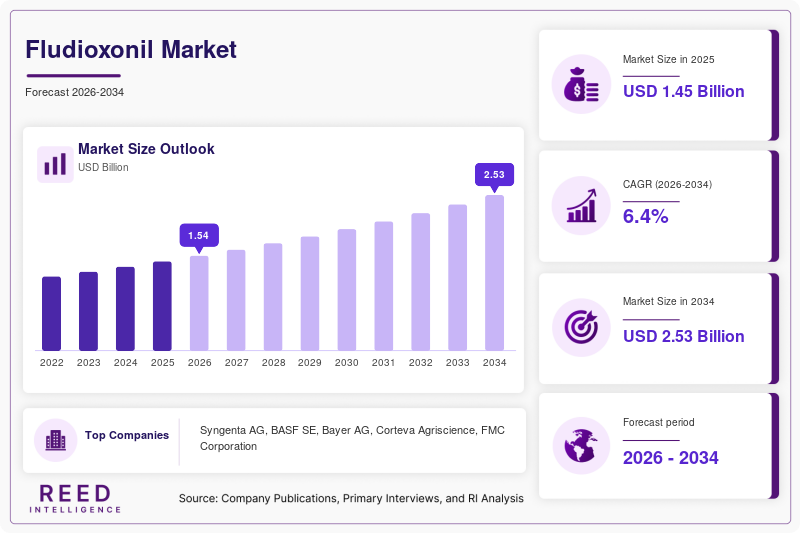
The global Fludioxonil Market size was valued at approximately USD 1.45 billion in 2026 and is projected to reach USD 2.38 billion by 2034, expanding at a CAGR of 6.4% during the forecast period (2026–2034). The market growth is supported by the increasing demand for advanced crop protection solutions to reduce post-harvest losses and improve agricultural productivity across major farming economies.
A key global factor driving the Fludioxonil Market is the rising need for effective fungicides to combat crop diseases in high-value crops such as fruits, vegetables, and cereals. The shift toward intensive farming practices and increasing food demand due to population growth has led to higher adoption of fungicides with broad-spectrum efficacy. Fludioxonil, known for its strong protective properties against fungal pathogens, continues to gain traction in both pre-harvest and post-harvest applications.
Key Highlights:
- North America dominated the market with a share of 34.2% in 2025, while Asia Pacific is expected to grow at the fastest CAGR of 7.3%.
- Seed treatment emerged as the leading application segment with 38.6% share, while foliar spray is projected to grow at a CAGR of 6.9%.
- Cereals & grains led the crop type segment with 41.8% share, while fruits & vegetables are expected to grow at 7.1% CAGR.
- The United States recorded market values of USD 420 million in 2024 and USD 445 million in 2025.
Market Trends
Increasing Adoption of Seed Treatment Technologies
The Fludioxonil Market is witnessing a growing shift toward seed treatment applications due to their cost-effectiveness and targeted disease control. Seed treatment ensures early-stage protection against soil-borne and seed-borne fungal pathogens, reducing the need for multiple foliar applications. Farmers are increasingly adopting treated seeds to enhance germination rates and crop yield. This trend is further supported by advancements in seed coating technologies, which allow precise delivery of fungicides such as fludioxonil. As sustainable agriculture gains importance, seed treatment is being viewed as an efficient method to minimize chemical usage while maximizing output.
Expansion of Integrated Pest Management (IPM) Practices
The integration of fludioxonil into Integrated Pest Management (IPM) programs is another notable trend shaping the market. IPM emphasizes the use of multiple strategies, including biological, chemical, and cultural practices, to manage crop diseases effectively. Fludioxonil is increasingly being used in combination with other fungicides to reduce resistance development and enhance efficacy. This trend aligns with regulatory pressures to limit excessive pesticide use while maintaining crop health. The growing awareness among farmers regarding resistance management and sustainable farming practices is expected to accelerate the adoption of fludioxonil within IPM frameworks.
Market Drivers
Rising Demand for High-Quality Agricultural Output
The increasing global demand for high-quality agricultural produce is a major driver of the Fludioxonil Market. Consumers are becoming more conscious of food quality, leading to stricter standards for crop appearance and shelf life. Fludioxonil plays a critical role in protecting crops from fungal infections that can reduce quality and market value. This demand is particularly strong in export-oriented agricultural sectors, where compliance with international quality standards is essential. As a result, farmers are investing in advanced fungicides to ensure consistent crop quality and reduce losses.
Growth in Commercial Farming and Agribusiness
The expansion of commercial farming and large-scale agribusiness operations is significantly contributing to the growth of the Fludioxonil Market. Large farms require efficient and reliable crop protection solutions to manage extensive cultivation areas. Fludioxonil offers broad-spectrum activity and compatibility with various crops, making it suitable for large-scale applications. Additionally, agribusiness companies are increasingly promoting advanced crop protection products through distribution networks and advisory services. This trend is particularly evident in developing regions, where modernization of agriculture is driving the adoption of high-performance fungicides.
Market Restraint
Stringent Regulatory Frameworks and Environmental Concerns
The Fludioxonil Market faces challenges due to stringent regulatory frameworks governing pesticide usage. Regulatory authorities in several regions have implemented strict guidelines regarding the approval, usage, and residue levels of fungicides. These regulations are aimed at minimizing environmental impact and ensuring food safety. However, compliance with such regulations can increase the cost of product development and limit market entry for new formulations.
Environmental concerns related to chemical pesticide usage also pose a restraint. There is growing scrutiny regarding the potential impact of fungicides on soil health, water resources, and non-target organisms. This has led to increased demand for organic and bio-based alternatives, which may limit the growth of synthetic fungicides such as fludioxonil. Additionally, regulatory delays and restrictions in certain markets can hinder product availability and adoption, affecting overall market growth.
Market Opportunities
Expansion in Emerging Agricultural Markets
Emerging economies present significant growth opportunities for the Fludioxonil Market. Countries in Asia Pacific, Latin America, and Africa are experiencing rapid agricultural development, driven by increasing food demand and government initiatives to enhance productivity. These regions offer untapped potential for fungicide adoption, particularly in high-value crops. Investments in agricultural infrastructure and farmer education programs are expected to boost awareness and usage of advanced crop protection solutions, including fludioxonil.
Development of Advanced Formulations
The development of advanced fludioxonil formulations represents another key opportunity. Innovations such as microencapsulation and combination products are improving the effectiveness and safety profile of fungicides. These formulations enhance stability, reduce environmental impact, and provide controlled release of active ingredients. Manufacturers are focusing on research and development to create products that meet regulatory standards while delivering superior performance. This trend is expected to drive product differentiation and open new avenues for market expansion.
Segmental Analysis
By Application
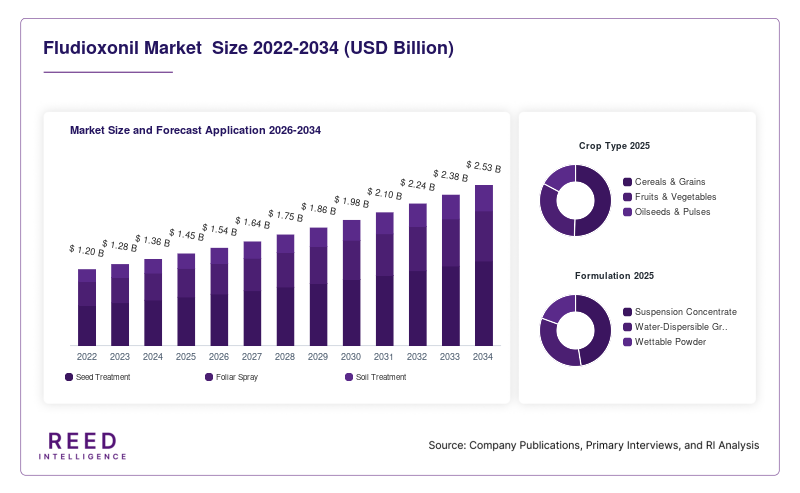
Seed treatment dominated the Fludioxonil Market with a 38.6% share in 2025, owing to its effectiveness in protecting crops during early growth stages.
Foliar spray is expected to grow at a CAGR of 6.9%, driven by its ability to provide targeted protection against fungal infections during later growth stages.
By Crop Type
Cereals & grains accounted for 41.8% of the market share in 2025 due to their large cultivation area and high demand.
Fruits & vegetables are projected to grow at a CAGR of 7.1%, supported by increasing demand for high-quality produce and export opportunities.
By Formulation
Suspension concentrate dominated the market with a 44.3% share in 2025 due to its ease of application and effectiveness.
Water-dispersible granules are expected to grow at a CAGR of 6.8%, driven by their improved stability and reduced environmental impact.
By Mode of Application
Seed coating led the market with a 36.9% share in 2025 due to its efficiency in delivering fungicides directly to seeds.
Soil treatment is anticipated to grow at a CAGR of 6.6%, supported by its effectiveness in controlling soil-borne pathogens.
Regional Analysis
North America
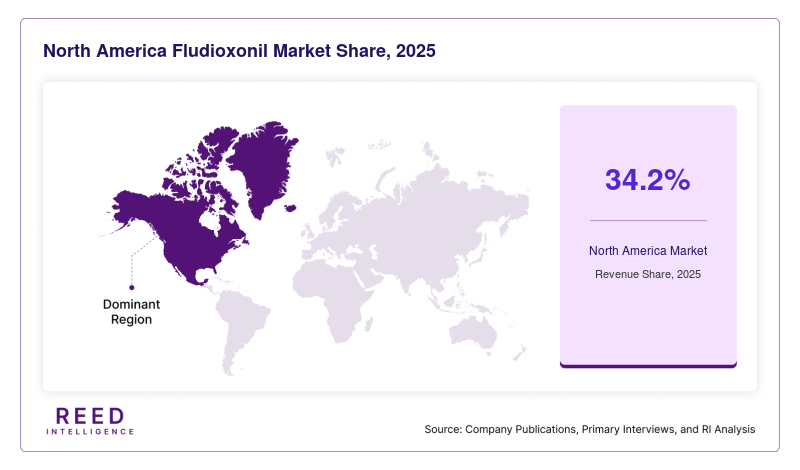
North America accounted for 34.2% of the Fludioxonil Market share in 2025 and is expected to grow at a CAGR of 5.9% during the forecast period.
The United States dominated the regional market due to its advanced agricultural practices and strong adoption of crop protection technologies. The presence of large-scale commercial farms and high demand for quality produce has driven the use of fungicides such as fludioxonil. Additionally, technological integration in farming, including precision agriculture, has supported efficient fungicide application.
Europe
Europe held a 27.6% share of the Fludioxonil Market in 2025 and is projected to grow at a CAGR of 5.7% through 2034.
Germany emerged as the dominant country, supported by its well-established agricultural sector and focus on sustainable farming practices. The region’s emphasis on food safety and quality standards has driven the adoption of effective fungicides. Regulatory frameworks also encourage the use of controlled and efficient crop protection solutions.
Asia Pacific
Asia Pacific captured 22.8% of the market share in 2025 and is anticipated to grow at the fastest CAGR of 7.3%.
China led the regional market, driven by its large agricultural base and increasing demand for food security. The adoption of modern farming techniques and government initiatives to improve crop yield have significantly contributed to market growth. Rising awareness among farmers regarding crop protection is also a key factor.
Middle East & Africa
The Middle East & Africa region accounted for 8.1% of the market share in 2025 and is expected to grow at a CAGR of 6.1%.
South Africa dominated the region due to its developed agricultural sector and export-oriented farming practices. The need to protect crops from fungal diseases in challenging climatic conditions has increased the demand for effective fungicides.
Latin America
Latin America held a 7.3% share of the Fludioxonil Market in 2025 and is projected to grow at a CAGR of 6.5%.
Brazil led the regional market, supported by its extensive agricultural activities and strong export demand for crops such as soybeans and fruits. The adoption of advanced crop protection solutions is increasing to maintain productivity and meet international quality standards.
Competitive Landscape
The Fludioxonil Market is moderately consolidated, with key players focusing on product innovation and strategic partnerships. Leading companies are investing in research and development to enhance product efficiency and comply with regulatory standards.
A major market leader is Syngenta AG, which continues to strengthen its position through advanced fungicide formulations and global distribution networks. The company recently introduced an improved fludioxonil-based seed treatment solution to enhance crop protection and yield.
Other players are also focusing on expanding their presence in emerging markets and developing sustainable solutions to meet evolving agricultural needs.
Key Players List
- Syngenta AG
- BASF SE
- Bayer AG
- Corteva Agriscience
- FMC Corporation
- UPL Limited
- Nufarm Limited
- Sumitomo Chemical Co., Ltd.
- ADAMA Ltd.
- Nippon Soda Co., Ltd.
- Isagro S.p.A.
- Arysta LifeScience Corporation
- American Vanguard Corporation
- Rotam CropSciences Ltd.
- PI Industries Ltd.
Recent Developments
- 2025: Syngenta AG launched a new fludioxonil-based seed treatment formulation for enhanced crop protection.
- 2024: BASF SE expanded its fungicide portfolio with improved formulations targeting resistance management.
- 2025: UPL Limited introduced a combination fungicide product integrating fludioxonil for broader efficacy.
- 2024: Corteva Agriscience invested in R&D to develop sustainable crop protection solutions.
- 2025: ADAMA Ltd. expanded its distribution network in emerging markets to increase product accessibility.
Fludioxonil Market Segments
Application
- Seed Treatment
- Foliar Spray
- Soil Treatment
Crop Type
- Cereals & Grains
- Fruits & Vegetables
- Oilseeds & Pulses
Formulation
- Suspension Concentrate
- Water-Dispersible Granules
- Wettable Powder
Mode of Application
- Seed Coating
- Soil Application
- Foliar Application
By Region
- North America
- Europe
- APAC
- Middle East and Africa
- LATAM