Fluorescence Guided Surgery System Market Size, Share & Demand Report By Product Type (Imaging Systems, Fluorescence Imaging Software, Fluorescent Dyes & Contrast Agents, Accessories), By Application (Cardiovascular Surgery, Neurosurgery, Gastrointestinal Surgery, Plastic & Reconstructive Surgery, Others), By End Use (Hospitals, Ambulatory Surgical Centers, Specialty Clinics, Academic & Research Institutes), By Region & Segment Forecasts, 2026–2034
USD 3950
Market Overview
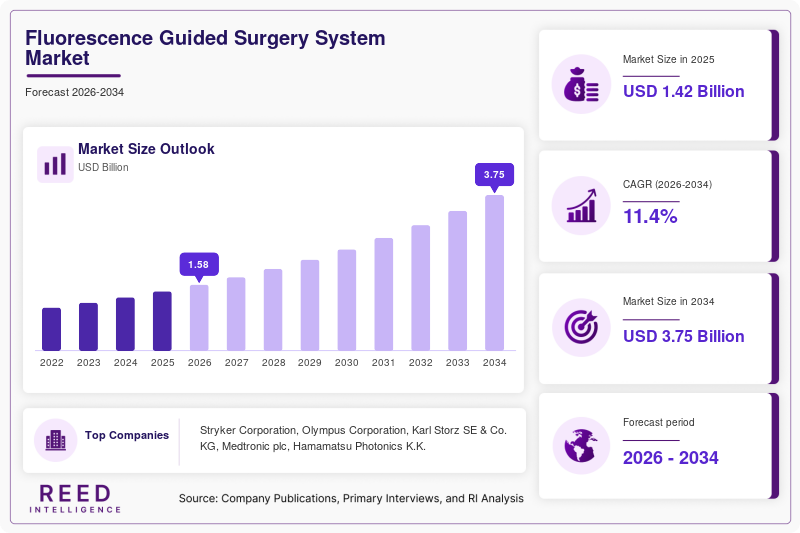
The global Fluorescence Guided Surgery System Market size was valued at USD 1.42 billion in 2026 and is projected to reach USD 3.38 billion by 2034, expanding at a CAGR of 11.4% during 2026–2034. The market is witnessing sustained growth as healthcare providers increasingly adopt advanced intraoperative imaging technologies that improve surgical precision and support better clinical outcomes. Fluorescence-guided surgery systems enable surgeons to visualize anatomical structures, blood flow, tumor margins, and lymphatic pathways in real time, reducing procedural complexity and enhancing decision-making during operations.
A major global factor supporting market expansion is the growing incidence of cancer and chronic diseases requiring complex surgical interventions. Hospitals and specialty surgical centers are investing in image-guided technologies to improve resection accuracy, reduce complications, and shorten patient recovery periods. The increasing integration of fluorescence imaging with minimally invasive and robotic-assisted surgical platforms is further strengthening market demand across developed and emerging healthcare systems.
Key Highlights
- North America dominated the market with a 37.4% share in 2025.
- while Asia Pacific is expected to grow at the fastest CAGR of 13.2% during 2026–2034.
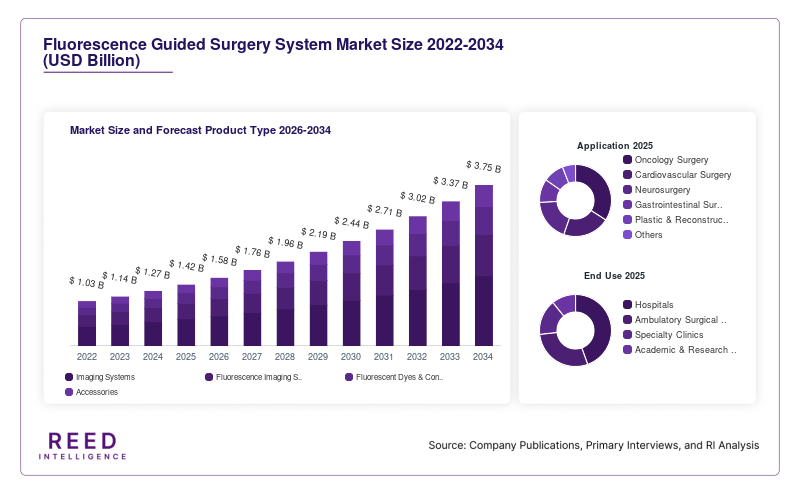
- By product type, Imaging Systems accounted for the largest share of 46.8%.
- while Fluorescence Imaging Software is projected to grow at a CAGR of 13.8%.
- By application, Oncology Surgery led with a 42.6% share.
- whereas Cardiovascular Surgery is expected to expand at a CAGR of 12.9%.
- By end use, Hospitals represented the largest share of 64.1%.
- while Ambulatory Surgical Centers are forecast to grow at a CAGR of 12.5%.
- The United States remained the dominant country, with market values of USD 462 million in 2024 and USD 518 million in 2025.
Market Trends
Integration of Fluorescence Imaging with Robotic-Assisted Surgical Platforms
The adoption of robotic-assisted surgery is creating a significant transformation in the Fluorescence Guided Surgery System Market. Healthcare providers are increasingly integrating fluorescence imaging capabilities into robotic systems to improve visualization during minimally invasive procedures. This integration allows surgeons to identify critical anatomical structures, assess tissue perfusion, and detect tumor margins with greater accuracy. The combination of robotic precision and fluorescence visualization supports improved procedural outcomes and reduces the risk of surgical complications. Hospitals investing in advanced operating rooms are prioritizing systems that combine multiple imaging functionalities within a single platform. As robotic surgery adoption continues across oncology, urology, gynecology, and cardiovascular procedures, demand for fluorescence-guided imaging technologies is expected to increase steadily throughout the forecast period.
Growing Clinical Adoption Across Multiple Surgical Specialties
Fluorescence-guided imaging is expanding beyond traditional oncology applications and gaining acceptance across a wider range of surgical disciplines. Surgeons are increasingly using these systems in cardiovascular, gastrointestinal, reconstructive, and neurosurgical procedures. Improved clinical evidence demonstrating enhanced visualization and intraoperative decision support is encouraging broader utilization. Healthcare facilities are recognizing the value of fluorescence imaging in reducing revision surgeries and improving patient outcomes. In addition, ongoing development of targeted fluorescent agents is expanding the scope of clinical applications. The increasing availability of specialty-specific imaging solutions is helping healthcare providers address unique procedural requirements, contributing to wider market penetration and long-term industry growth.
Market Drivers
Rising Prevalence of Cancer and Demand for Precision Surgery
The growing global burden of cancer is a major factor driving demand in the Fluorescence Guided Surgery System Market. Surgeons increasingly require technologies that enable accurate identification of tumor boundaries and residual malignant tissues during operations. Fluorescence-guided systems provide real-time visualization capabilities that support complete tumor resection while preserving healthy tissue. This capability is particularly important in breast, brain, colorectal, and liver cancer surgeries where surgical precision directly influences patient outcomes. Healthcare systems are focusing on technologies that improve treatment effectiveness and reduce recurrence rates. As cancer incidence continues to rise worldwide and healthcare providers adopt precision medicine approaches, the demand for advanced fluorescence-guided surgical technologies is expected to strengthen significantly.
Expansion of Minimally Invasive Surgical Procedures
The increasing preference for minimally invasive surgeries is contributing substantially to market growth. Patients and healthcare providers favor minimally invasive techniques because they often result in reduced blood loss, shorter hospital stays, and faster recovery times. Fluorescence-guided systems enhance these procedures by providing detailed visualization that may not be achievable through conventional imaging methods alone. Surgeons performing laparoscopic and robotic-assisted operations benefit from improved tissue differentiation and vascular assessment. Furthermore, technological advancements have improved system compatibility with minimally invasive surgical platforms. As healthcare institutions continue expanding minimally invasive surgery programs and investing in advanced operating room technologies, adoption of fluorescence-guided systems is expected to accelerate across multiple clinical specialties.
Market Restraint
High System Costs and Limited Adoption in Resource-Constrained Healthcare Settings
The high acquisition and operational costs associated with fluorescence-guided surgery systems remain a notable challenge for market expansion. Advanced imaging platforms often require significant capital investment, specialized infrastructure, software integration, and ongoing maintenance. In addition, healthcare facilities may need to allocate resources for surgeon training and workflow optimization before achieving full utilization benefits. Smaller hospitals and healthcare centers in developing economies frequently face budget limitations that restrict adoption of advanced imaging technologies. Reimbursement variations across healthcare systems also influence purchasing decisions and can delay technology implementation. For example, regional hospitals with limited surgical volumes may find it difficult to justify investment in premium fluorescence imaging platforms despite potential clinical advantages. These financial barriers may slow adoption rates in certain markets and create disparities in access to advanced surgical imaging technologies. Nevertheless, manufacturers are working toward cost-efficient solutions that could gradually improve affordability and support broader market penetration over the forecast period.
Market Opportunities
Development of Targeted Fluorescent Contrast Agents
The development of next-generation targeted fluorescent contrast agents presents a significant growth opportunity for the Fluorescence Guided Surgery System Market. Researchers and biotechnology companies are focusing on molecular imaging agents designed to selectively bind to specific cancer cells and disease markers. These innovations can improve surgical accuracy by enabling clearer differentiation between healthy and diseased tissues during procedures. As clinical trials continue to demonstrate promising results, healthcare providers are expected to adopt advanced imaging agents that enhance diagnostic confidence and treatment effectiveness. The growing emphasis on personalized medicine is also supporting demand for targeted imaging solutions. Commercialization of innovative fluorescent agents is likely to create new revenue streams for manufacturers and expand the clinical utility of fluorescence-guided surgical systems.
Growing Healthcare Infrastructure Investments in Emerging Economies
Emerging economies present substantial opportunities for market participants due to ongoing healthcare modernization initiatives. Governments and private healthcare organizations are increasing investments in advanced medical technologies to improve healthcare quality and accessibility. New hospital construction projects, expansion of specialty surgical centers, and increasing healthcare expenditure are creating favorable conditions for adoption of fluorescence-guided surgical systems. Countries across Asia Pacific, Latin America, and parts of the Middle East are actively upgrading surgical infrastructure and introducing advanced imaging technologies. Rising awareness among healthcare professionals regarding the clinical benefits of fluorescence-guided procedures is further supporting demand. As healthcare systems continue to evolve and access to advanced surgical technologies improves, emerging markets are expected to contribute significantly to future industry growth.
Segmental Analysis
By Product Type
Imaging Systems represented the dominant product category and accounted for approximately 46.8% of the market share in 2024. These systems form the core component of fluorescence-guided surgery procedures and are widely adopted across hospitals and specialty surgical centers. Demand remains strong because imaging systems provide real-time visualization capabilities that support surgical decision-making and improve procedural accuracy. Technological advancements have led to enhanced image resolution, improved sensitivity, and greater compatibility with minimally invasive surgical platforms. Healthcare facilities prioritize investment in advanced imaging systems because they offer broad applicability across oncology, cardiovascular, gastrointestinal, and reconstructive procedures. The ability to support multiple surgical specialties has reinforced the leadership position of imaging systems within the overall market landscape.
Fluorescence Imaging Software is expected to emerge as the fastest-growing subsegment, registering a CAGR of 13.8% during the forecast period. Increasing demand for image processing, analytical tools, and workflow integration solutions is driving adoption. Software platforms provide surgeons with enhanced visualization capabilities, quantitative assessments, and improved interpretation of fluorescence signals during procedures. Healthcare organizations are increasingly seeking integrated digital solutions that improve operating room efficiency and support data-driven decision-making. Advances in artificial intelligence and machine learning are further enhancing software functionality, enabling improved image interpretation and clinical support. As healthcare providers continue digital transformation initiatives, fluorescence imaging software is expected to experience strong growth across global markets.
By Application
Oncology Surgery accounted for the largest market share of approximately 42.6% in 2024. The high prevalence of cancer and increasing emphasis on complete tumor resection have significantly contributed to segment dominance. Fluorescence-guided imaging assists surgeons in identifying tumor margins and detecting residual malignant tissues that may not be visible through conventional visualization methods. This capability supports improved surgical precision and may reduce the likelihood of cancer recurrence. The growing use of fluorescence-guided techniques in breast cancer, brain tumor, colorectal cancer, and liver cancer procedures continues to strengthen demand. Expanding clinical evidence supporting improved surgical outcomes has encouraged broader adoption across oncology-focused healthcare facilities worldwide.
Cardiovascular Surgery is anticipated to register the fastest CAGR of 12.9% during 2026–2034. Surgeons increasingly utilize fluorescence imaging technologies to evaluate tissue perfusion, assess vascular structures, and support intraoperative decision-making. The rising prevalence of cardiovascular diseases and growing demand for advanced surgical interventions are creating favorable conditions for market expansion. Healthcare providers are recognizing the value of fluorescence-guided visualization in improving procedural safety and reducing complications associated with complex cardiovascular procedures. Technological innovations that provide enhanced visualization of blood flow and vessel integrity are further accelerating adoption. As cardiovascular surgery volumes continue increasing globally, demand for fluorescence-guided imaging solutions is expected to grow substantially.
By End Use
Hospitals held the dominant market position and accounted for approximately 64.1% of total revenue in 2024. Large hospitals perform a substantial volume of complex surgical procedures and often possess the financial resources necessary to invest in advanced imaging technologies. These facilities typically serve as primary centers for oncology, cardiovascular, and minimally invasive surgeries, creating strong demand for fluorescence-guided systems. Hospitals also benefit from multidisciplinary surgical teams and specialized operating rooms capable of supporting advanced imaging integration. Continuous investments in surgical infrastructure and technology modernization initiatives have reinforced the leading position of hospitals within the global market. The growing emphasis on precision surgery and patient outcome improvement further supports adoption across hospital settings.
Ambulatory Surgical Centers are projected to be the fastest-growing end-use segment, expanding at a CAGR of 12.5% through 2034. The shift toward outpatient procedures and cost-efficient healthcare delivery models is encouraging adoption of advanced imaging technologies in these facilities. Ambulatory centers are increasingly performing minimally invasive procedures that benefit from enhanced visualization and surgical precision. Improvements in compact imaging systems and workflow-friendly technologies are making fluorescence-guided solutions more accessible to outpatient environments. Healthcare providers are also seeking technologies that improve procedural efficiency and patient satisfaction while reducing overall treatment costs. These factors are expected to drive strong growth within the ambulatory surgical center segment throughout the forecast period.
Regional Analysis
North America
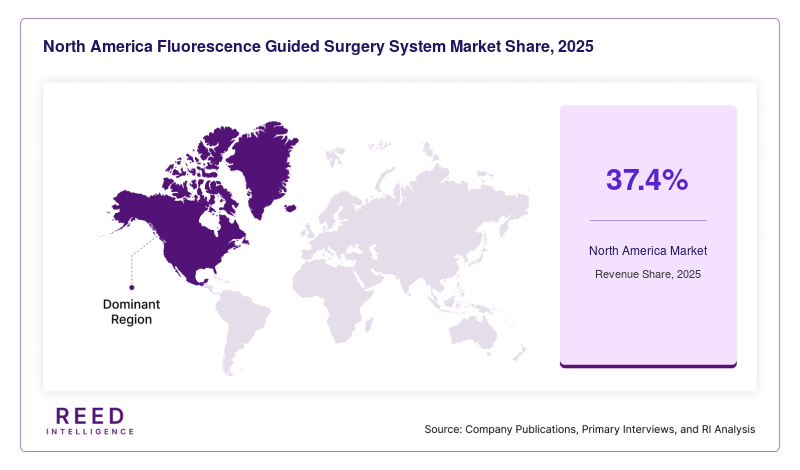
North America accounted for approximately 37.4% of the global Fluorescence Guided Surgery System Market in 2025, making it the largest regional market. The region benefits from strong healthcare infrastructure, high adoption of advanced surgical technologies, and significant investments in medical innovation. The presence of leading manufacturers and established reimbursement systems supports widespread utilization of fluorescence-guided procedures. The regional market is projected to expand at a CAGR of 10.6% through 2034 as hospitals continue upgrading operating room capabilities and integrating advanced imaging technologies into surgical workflows.
The United States remains the dominant contributor to regional revenue generation. A key growth factor is the increasing use of fluorescence-guided imaging in cancer surgery and robotic-assisted procedures. Healthcare providers continue investing in precision surgical technologies to improve clinical outcomes and reduce postoperative complications. Growing research collaborations between healthcare institutions and technology developers are also supporting continuous innovation across the market.
Europe
Europe represented approximately 28.1% of the global market in 2025 and continues to be a major contributor to industry growth. The region benefits from strong public healthcare systems, growing investments in surgical innovation, and increasing adoption of image-guided procedures. Healthcare facilities across major European countries are integrating fluorescence-guided technologies into routine surgical practice. The market is anticipated to register a CAGR of 10.8% during the forecast period as demand for advanced visualization systems continues to increase.
Germany serves as the leading country within the European market. A unique growth factor is the region's strong focus on clinical research and medical technology development. Hospitals and academic institutions actively participate in evaluating new fluorescence imaging applications and contrast agents. This collaborative ecosystem supports technology advancement and encourages adoption across multiple surgical specialties.
Asia Pacific
Asia Pacific held approximately 22.3% of the global market in 2025 and is expected to register the fastest growth rate, with a projected CAGR of 13.2% through 2034. Rapid healthcare infrastructure development, expanding surgical volumes, and increasing awareness regarding advanced imaging technologies are driving market expansion. Healthcare providers are increasingly adopting fluorescence-guided systems to improve surgical accuracy and support better patient outcomes. The growing burden of chronic diseases and cancer is further stimulating demand across the region.
China dominates the regional market owing to large patient populations and substantial healthcare investments. A key growth factor is the government's continued support for healthcare modernization and advanced medical technology adoption. Expansion of tertiary care hospitals and increasing procurement of sophisticated surgical equipment are creating strong opportunities for manufacturers operating within the region.
Middle East & Africa
The Middle East & Africa accounted for approximately 6.1% of global market revenue in 2025. Although smaller in size compared with other regions, the market is demonstrating steady development supported by healthcare infrastructure improvements and increasing access to specialized surgical services. Countries across the Gulf region are investing in advanced healthcare facilities and introducing modern surgical technologies. The market is expected to grow at a CAGR of 9.7% during the forecast period.
Saudi Arabia remains the dominant country within the regional market. A unique growth factor is the implementation of healthcare diversification programs that emphasize modernization and technology adoption. Investments in specialty hospitals and advanced surgical centers are creating favorable conditions for fluorescence-guided imaging systems. Rising medical tourism activities are also contributing to increased demand for advanced surgical technologies.
Latin America
Latin America captured approximately 6.1% of the global market in 2025 and is expected to experience consistent growth over the forecast period. Expanding healthcare infrastructure, increasing surgical procedure volumes, and improving access to advanced medical equipment are supporting market development. Governments and private healthcare providers are investing in modernization initiatives designed to improve treatment quality and healthcare accessibility. The regional market is projected to grow at a CAGR of 10.1% through 2034.
Brazil is the leading country in the Latin American market. A distinctive growth factor is the increasing expansion of private healthcare networks that are investing in advanced surgical imaging solutions. Private hospitals are focusing on technology differentiation and improved patient outcomes, encouraging the adoption of fluorescence-guided surgery systems. Growing awareness among surgeons regarding precision imaging benefits is further supporting regional market growth.
Competitive Landscape
The Fluorescence Guided Surgery System Market is moderately consolidated, with several established medical technology companies competing through innovation, product development, strategic partnerships, and geographic expansion initiatives. Market participants are focusing on improving imaging quality, expanding application portfolios, and integrating fluorescence imaging capabilities with robotic-assisted surgery platforms. Continuous investments in research and development remain a key competitive strategy across the industry.
Stryker Corporation maintains a leading position due to its broad surgical imaging portfolio and strong global distribution network. The company continues to invest in advanced visualization technologies and workflow integration solutions. Recent industry developments include increased focus on artificial intelligence-assisted imaging platforms and expanded collaborations with healthcare institutions to improve surgical precision.
Other significant competitors include Olympus Corporation, Karl Storz SE & Co. KG, Medtronic plc, and Hamamatsu Photonics K.K. These companies are strengthening market presence through product launches, clinical research programs, and expansion into emerging healthcare markets. Competitive activity is expected to intensify as manufacturers pursue opportunities in oncology, cardiovascular surgery, and robotic-assisted surgical applications.
Key Players
- Stryker Corporation
- Olympus Corporation
- Karl Storz SE & Co. KG
- Medtronic plc
- Hamamatsu Photonics K.K.
- Leica Microsystems
- Carl Zeiss Meditec AG
- Shimadzu Corporation
- Quest Medical Imaging B.V.
- Mizuho Medical Co., Ltd.
- Getinge AB
- Fujifilm Holdings Corporation
- Intuitive Surgical, Inc.
- Brainlab AG
- Richard Wolf GmbH
Recent Developments
- A leading medical imaging company introduced a next-generation fluorescence-guided visualization platform with enhanced image sensitivity for oncology and cardiovascular procedures in 2025.
- Several healthcare providers expanded the use of fluorescence-guided imaging within robotic-assisted surgery programs to improve procedural accuracy and support minimally invasive surgical approaches in 2025.
- A major market participant launched advanced software analytics capable of real-time fluorescence image processing and surgical workflow optimization during complex procedures in 2026.
- Multiple manufacturers increased investments in targeted fluorescent contrast agent development to expand clinical applications across cancer and vascular surgeries.
- Strategic collaborations between medical device companies and research institutions accelerated innovation in multimodal surgical imaging technologies and next-generation visualization platforms.
Fluorescence Guided Surgery System Market Segments
Product Type
- Imaging Systems
- Fluorescence Imaging Software
- Fluorescent Dyes & Contrast Agents
- Accessories
Application
- Oncology Surgery
- Cardiovascular Surgery
- Neurosurgery
- Gastrointestinal Surgery
- Plastic & Reconstructive Surgery
- Others
End Use
- Hospitals
- Ambulatory Surgical Centers
- Specialty Clinics
- Academic & Research Institutes
By Region
- North America
- Europe
- APAC
- Middle East and Africa
- LATAM