Fluoropolymer Lined Iso Tanks Market Size, Share & Demand Report By Type (PTFE Lined, PFA Lined, FEP Lined), By Application (Chemical Transportation, Food & Beverage, Pharmaceuticals, Others), By End-Use Industry (Petrochemical, Pharmaceutical, Food Processing, Industrial Chemicals) & Segment Forecasts, 2025–2034
USD 3950
Market Overview
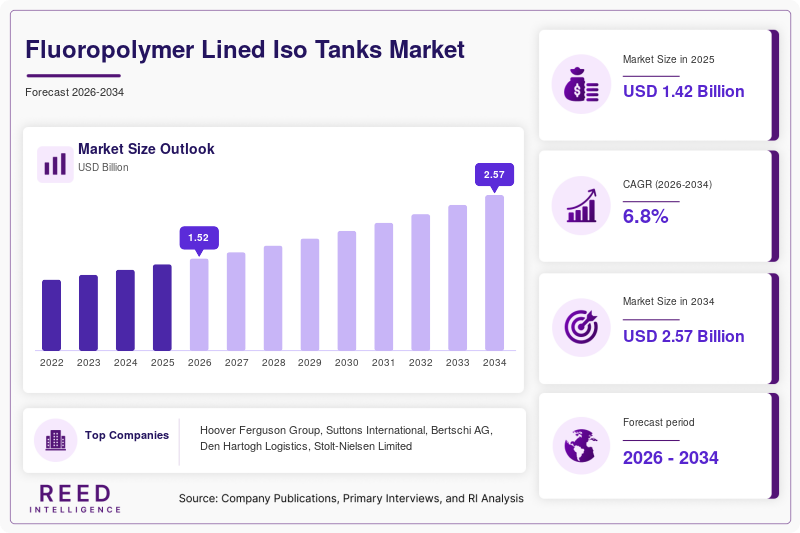
The Fluoropolymer Lined Iso Tanks Market size is estimated at USD 1.42 billion, and it is projected to reach USD 1.55 billion in 2026. Over the forecast period from 2025 to 2034, the market is expected to grow at a compound annual growth rate (CAGR) of 6.8%, reaching approximately USD 2.65 billion by 2034. This growth trajectory reflects increasing industrialization, stringent safety regulations, and the expanding global chemical trade.
Fluoropolymer lined iso tanks are designed to handle aggressive substances such as acids, solvents, and specialty chemicals. These tanks offer superior corrosion resistance, contamination prevention, and extended service life compared to traditional stainless steel containers. Industries such as pharmaceuticals, petrochemicals, and food processing rely on these tanks for maintaining product integrity during transportation.
Key Highlights
- Market size expected to grow from USD 1.42 billion (2025) to USD 2.65 billion (2034), reflecting an absolute increase of over USD 1.2 billion driven by expanding global chemical logistics demand.
- CAGR of 6.8% during 2025–2034, supported by consistent annual volume growth of 5–6% in intermodal chemical transport shipments.
- Rising demand from chemical and pharmaceutical industries, contributing to nearly 58% of total iso tank utilization globally in 2025.
- Increasing regulatory focus on safe chemical transportation, with over 70% of developed markets enforcing strict hazardous material transport compliance standards.
- Growing adoption of reusable and sustainable logistics solutions, with iso tanks reducing packaging waste by up to 80% compared to drum-based transport systems.
Market Trends
Rising Adoption of High-Purity Transport Solutions
The demand for high-purity transport solutions is increasing, especially in pharmaceutical and specialty chemical industries. Fluoropolymer lined iso tanks provide contamination-free transport, which is critical for sensitive materials. Manufacturers are investing in advanced lining technologies such as PTFE and PFA coatings to ensure chemical stability and purity. This trend is particularly evident in regions with strong pharmaceutical production, where regulatory compliance requires stringent handling standards. The shift toward precision manufacturing and specialty chemicals is further accelerating the adoption of high-purity transport systems.
Integration of Smart Monitoring Systems
Another key trend is the integration of smart monitoring technologies in iso tanks. Sensors and IoT-enabled systems are being embedded to monitor temperature, pressure, and chemical integrity in real time. This enhances operational safety and reduces the risk of accidents during transit. Logistics providers are leveraging data analytics to optimize routes and improve asset utilization. The adoption of digital solutions also supports predictive maintenance, reducing downtime and operational costs. As supply chains become more complex, the need for real-time visibility is driving this technological transformation.
Market Drivers
Expansion of Global Chemical Trade
The expansion of global chemical trade is a major driver for the Fluoropolymer Lined Iso Tanks Market. Increasing demand for specialty and bulk chemicals across industries such as agriculture, pharmaceuticals, and manufacturing is boosting cross-border transportation. Fluoropolymer lined iso tanks provide a reliable solution for transporting hazardous and corrosive substances safely over long distances. Emerging markets are witnessing rapid industrialization, which is increasing chemical production and export activities. This trend is driving the need for efficient logistics systems, including advanced iso tanks.
Stringent Safety and Environmental Regulations
Governments and regulatory bodies are implementing stricter guidelines for the transportation of hazardous materials. Compliance with international standards such as ADR, IMDG, and ISO is essential for chemical logistics providers. Fluoropolymer lined iso tanks offer enhanced safety features, including leak resistance and chemical compatibility, making them compliant with these regulations. Companies are increasingly investing in certified transport solutions to avoid penalties and ensure operational continuity. This regulatory push is significantly contributing to market growth.
Market Restraint
High Initial Investment and Maintenance Costs
One of the key restraints in the Fluoropolymer Lined Iso Tanks Market is the high initial investment required for manufacturing and deployment. Fluoropolymer materials such as PTFE and PFA are expensive, and the lining process involves advanced engineering techniques. This increases the overall cost of iso tanks compared to conventional alternatives. Small and medium-sized logistics providers may find it challenging to adopt these solutions due to budget constraints.
Additionally, maintenance and repair of fluoropolymer linings require specialized expertise, which further adds to operational costs. Any damage to the lining can compromise the tank’s integrity, necessitating costly repairs or replacements. This cost factor can limit adoption, particularly in price-sensitive markets. Despite the long-term benefits, the upfront investment remains a barrier for widespread adoption.
Market Opportunities
Growth in Emerging Markets
Emerging economies in Asia Pacific, Latin America, and Africa present significant growth opportunities. Rapid industrialization and increasing chemical production in these regions are driving demand for safe transportation solutions. Governments are investing in infrastructure development, including ports and logistics networks, which supports the adoption of iso tanks. Local manufacturers are also entering the market, offering cost-effective solutions tailored to regional needs. This creates a favorable environment for market expansion.
Development of Advanced Fluoropolymer Materials
Continuous research and development in fluoropolymer technology are creating new opportunities. Innovations such as improved thermal resistance, enhanced flexibility, and reduced weight are making iso tanks more efficient and cost-effective. These advancements are expanding the application scope of lined tanks to new industries, including food processing and biotechnology. Companies that invest in material innovation can gain a competitive advantage by offering superior products with extended lifecycle and lower maintenance requirements.
Segmental Analysis
By Type
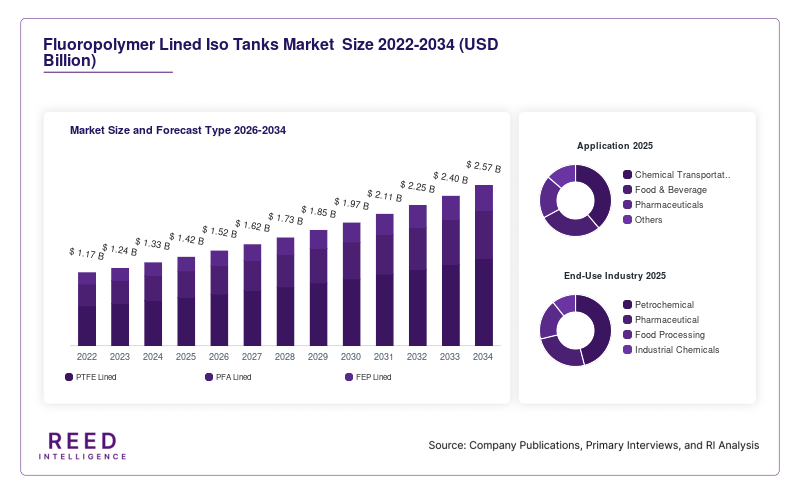
The PTFE-lined iso tanks segment dominated the market in 2024, accounting for approximately 46% of the total share. PTFE offers excellent chemical resistance and thermal stability, making it suitable for transporting highly corrosive substances. Its non-reactive nature ensures product integrity, which is critical for industries such as pharmaceuticals and specialty chemicals. The durability and long service life of PTFE-lined tanks also contribute to their widespread adoption. Companies prefer these tanks due to their ability to handle a wide range of chemicals without degradation.
The PFA-lined iso tanks segment is expected to be the fastest-growing, with a CAGR of 7.5% during the forecast period. PFA offers similar chemical resistance as PTFE but with improved flexibility and transparency. This makes it easier to inspect and maintain the tanks. The increasing demand for high-performance materials in advanced applications is driving the growth of this segment. Industries that require precise handling of sensitive chemicals are increasingly adopting PFA-lined tanks.
By Application
The chemical transportation segment held the largest share in 2024, accounting for 52% of the market. This dominance is attributed to the high demand for safe transport of corrosive and hazardous chemicals. Fluoropolymer lined iso tanks provide superior protection against leaks and contamination, making them ideal for this application. The growth of global chemical trade is further supporting this segment.
The food and beverage segment is expected to grow at the fastest rate, with a CAGR of 7.2%. The need for contamination-free transport of liquid food products is driving this growth. Fluoropolymer linings ensure that there is no interaction between the tank material and the contents. This is particularly important for high-value products such as edible oils and specialty beverages.
By End-Use Industry
The petrochemical industry dominated the market in 2024, with a share of 48%. The transportation of aggressive chemicals such as acids and solvents requires specialized tanks, which drives demand in this segment. The growth of the petrochemical industry, particularly in emerging economies, is contributing to the dominance of this segment.
The pharmaceutical industry is expected to be the fastest-growing segment, with a CAGR of 7.9%. The increasing production of high-purity drugs and specialty chemicals is driving demand for contamination-free transport solutions. Fluoropolymer lined iso tanks are ideal for maintaining the integrity of pharmaceutical products during transit.
Regional Analysis
North America
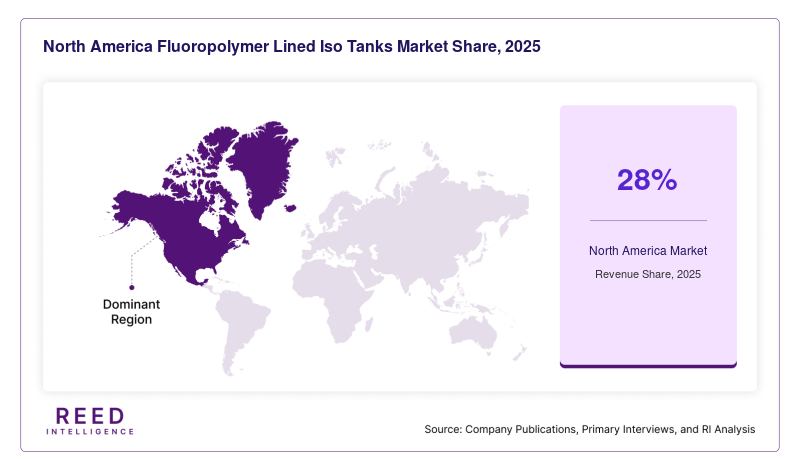
North America accounted for approximately 28% of the market share in 2025 and is projected to grow at a CAGR of 5.9% through 2034. The region benefits from a well-established chemical industry and advanced logistics infrastructure. The presence of major chemical manufacturers and strict regulatory frameworks is driving demand for high-quality transport solutions. The adoption of fluoropolymer lined iso tanks is supported by increasing exports of specialty chemicals and pharmaceuticals.
The United States dominates the regional market due to its large-scale chemical production and export activities. A key growth factor is the rising focus on sustainable logistics solutions. Companies are adopting reusable iso tanks to reduce environmental impact and improve cost efficiency. Additionally, technological advancements in tank monitoring systems are enhancing operational safety and efficiency.
Europe
Europe held around 25% market share in 2025 and is expected to grow at a CAGR of 6.1% during the forecast period. The region’s strong regulatory framework for chemical transportation is a major driver. Countries in the European Union are implementing strict safety standards, which is encouraging the adoption of advanced iso tanks. The region also has a mature chemical industry, contributing to steady demand.
Germany is the leading market in Europe, driven by its robust industrial base and export-oriented economy. A unique growth factor is the emphasis on circular economy practices. Companies are focusing on reusable and recyclable transport solutions, which aligns with environmental regulations. This trend is supporting the adoption of fluoropolymer lined iso tanks.
Asia Pacific
Asia Pacific is the largest regional market, accounting for 32% share in 2025, with a projected CAGR of 7.8%. Rapid industrialization and expanding chemical manufacturing activities are driving growth. Countries such as China and India are major producers of chemicals, creating strong demand for safe transportation solutions. The region is also witnessing increased investments in logistics infrastructure.
China dominates the Asia Pacific market due to its large-scale chemical production capacity. A key growth factor is the expansion of export activities. The country is a major supplier of specialty chemicals to global markets, which requires reliable transport solutions. This is driving the adoption of fluoropolymer lined iso tanks.
Middle East & Africa
The Middle East & Africa region held approximately 8% market share in 2025 and is expected to grow at a CAGR of 6.5%. The region’s growth is driven by the expansion of petrochemical industries. Countries in the Middle East are investing heavily in chemical production, which increases demand for transport solutions.
Saudi Arabia leads the regional market due to its strong petrochemical sector. A unique growth factor is the development of export-oriented industrial zones. These zones require efficient logistics systems to support global trade, which is driving the adoption of advanced iso tanks.
Latin America
Latin America accounted for around 7% market share in 2025 and is projected to grow at a CAGR of 6.2%. The region is witnessing steady growth in chemical and agricultural industries. Increasing trade activities are driving demand for safe transport solutions.
Brazil dominates the Latin American market due to its large agricultural and chemical sectors. A key growth factor is the increasing export of agrochemicals. This requires reliable and contamination-free transport solutions, which is boosting the adoption of fluoropolymer lined iso tanks.
Competitive Landscape
The Fluoropolymer Lined Iso Tanks Market is moderately fragmented, with several global and regional players competing based on product quality, innovation, and pricing. Key companies are focusing on expanding their product portfolios and enhancing their technological capabilities to gain a competitive edge.
One of the leading players in the market is Hoover Ferguson Group, which holds a significant share due to its extensive product offerings and global presence. The company has recently invested in advanced lining technologies to improve tank durability and performance. Other major players are also focusing on strategic partnerships and acquisitions to strengthen their market position.
Companies are increasingly investing in research and development to introduce innovative solutions that meet evolving industry requirements. The integration of smart monitoring systems and advanced materials is becoming a key differentiator in the market.
Key Players
- Hoover Ferguson Group
- Suttons International
- Bertschi AG
- Den Hartogh Logistics
- Stolt-Nielsen Limited
- Bulkhaul Limited
- NewPort Tank Containers
- Meeberg ISO Tanks & Containers
- ITCO (International Tank Container Organisation)
- Hoyer Group
- Sinotrans Limited
- Qingdao LAF Packaging Co.
- Raffles Lease
- EXSIF Worldwide
- VTG Tanktainer
Recent Developments
- In 2024, Hoover Ferguson Group expanded its manufacturing capacity for fluoropolymer lined iso tanks to meet rising global demand.
- In 2023, Suttons International introduced a new range of smart iso tanks equipped with IoT-based monitoring systems.
- In 2024, Bertschi AG partnered with a chemical manufacturer to develop customized lined tanks for high-purity applications.
Fluoropolymer Lined Iso Tanks Market Segments
Type
- PTFE Lined
- PFA Lined
- FEP Lined
Application
- Chemical Transportation
- Food & Beverage
- Pharmaceuticals
- Others
End-Use Industry
- Petrochemical
- Pharmaceutical
- Food Processing
- Industrial Chemicals
By Region
- North America
- Europe
- APAC
- Middle East and Africa
- LATAM