Fluoropolymer Masterbatch Market Size, Share Demand Report By Type (Additive Masterbatch, Color Masterbatch), By Application (Film Extrusion, Injection Molding, Blow Molding), By End-Use Industry (Packaging, Automotive, Electronics, Construction), By Region & Segment Forecasts, 2025–2034
USD 3950
Market Overview
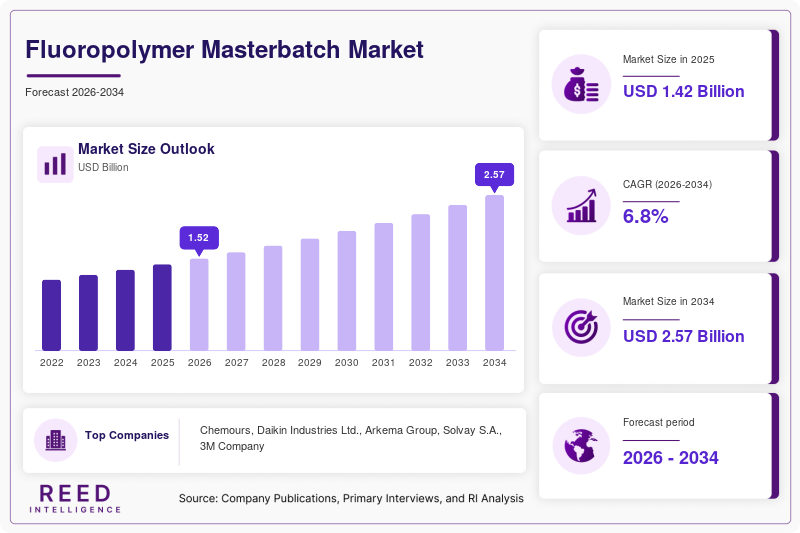
The Fluoropolymer Masterbatch Market size is estimated at USD 1.42 billion and is projected to reach approximately USD 1.52 billion in 2026. Over the forecast period from 2025 to 2034, the market is expected to grow at a compound annual growth rate (CAGR) of 6.8%, reaching a value of around USD 2.75 billion by 2034. This growth trajectory reflects the increasing adoption of fluoropolymer-based additives in applications requiring enhanced durability, chemical resistance, and thermal stability.
Fluoropolymer masterbatches are widely used in plastic processing to improve surface properties, reduce friction, and enhance extrusion efficiency. Their role in improving product quality while reducing manufacturing defects has made them essential in sectors such as packaging, automotive, electronics, and construction. One of the primary growth factors is the rising demand for high-performance plastics in automotive lightweighting, where fluoropolymer additives help improve fuel efficiency and durability. Another factor is the rapid expansion of the packaging industry, particularly flexible packaging, where these masterbatches are used to improve processing speed and product finish. Additionally, increasing investments in electrical and electronics manufacturing are driving the need for materials that offer superior insulation and resistance to heat and chemicals.
Key Highlights
- Market size is projected to grow from USD 1.42 billion in 2025 to USD 2.75 billion by 2034.
This reflects steady expansion driven by rising demand for high-performance polymer additives across industries. - The market is expected to register a CAGR of 6.8% during the forecast period from 2025 to 2034.
This growth rate indicates consistent adoption of fluoropolymer masterbatches in advanced manufacturing processes. - Strong demand is observed from automotive, packaging, and electronics industries globally.
These sectors rely on enhanced material properties such as durability, thermal resistance, and processing efficiency. - There is an increasing focus on high-performance and sustainable polymer solutions in the market.
Manufacturers are investing in eco-friendly formulations and advanced materials to meet evolving regulatory and industry standards.
Market Trends
Increasing Adoption of High-Performance Additives in Polymer Processing
A key trend shaping the Fluoropolymer Masterbatch Market is the growing preference for high-performance additives that enhance processing efficiency and end-product quality. Manufacturers are integrating fluoropolymer masterbatches into production lines to reduce melt fracture, improve surface smoothness, and increase throughput rates. This trend is particularly evident in high-speed extrusion processes used in packaging and wire insulation applications. The ability of fluoropolymer additives to minimize die build-up and reduce energy consumption is encouraging their widespread use. As industries move toward automation and precision manufacturing, the demand for materials that ensure consistency and reliability continues to rise, further reinforcing this trend across global markets.
Shift Toward Sustainable and Environmentally Compatible Formulations
Another notable trend is the shift toward environmentally responsible masterbatch formulations. Companies are investing in research to develop fluoropolymer masterbatches with reduced environmental impact while maintaining performance standards. This includes innovations in low-emission additives and compatibility with recyclable polymers. Regulatory pressures and corporate sustainability goals are encouraging manufacturers to reduce reliance on traditional additives and adopt cleaner alternatives. The trend is gaining traction in regions with strict environmental policies, where companies are prioritizing materials that support circular economy initiatives. This evolution is expected to influence product development strategies and reshape the competitive landscape over the coming years.
Market Drivers
Growing Demand for Lightweight and Durable Materials in Automotive Industry
The automotive sector is a major driver of the Fluoropolymer Masterbatch Market due to the increasing need for lightweight materials that improve fuel efficiency and reduce emissions. Fluoropolymer masterbatches enhance the mechanical and thermal properties of plastic components, making them suitable for under-the-hood applications and exterior parts. As electric vehicles gain traction, the demand for advanced materials with superior insulation and heat resistance is rising. This trend is encouraging manufacturers to incorporate fluoropolymer additives into various automotive components. The ongoing shift toward sustainability and performance optimization in the automotive industry continues to create strong demand for these masterbatches.
Expansion of Packaging Industry and High-Speed Manufacturing Processes
The rapid growth of the packaging industry is another significant driver of market expansion. Fluoropolymer masterbatches are widely used in film extrusion processes to improve clarity, reduce defects, and enhance processing efficiency. With the increasing demand for flexible packaging solutions, especially in food and consumer goods sectors, manufacturers are focusing on improving production speed and product quality. Fluoropolymer additives help achieve these goals by reducing friction and improving flow properties during extrusion. The rise of e-commerce and changing consumer preferences for convenient packaging solutions are further contributing to the growing demand for advanced masterbatch formulations.
Market Restraint
High Cost of Fluoropolymer-Based Additives and Limited Adoption in Cost-Sensitive Markets
One of the primary restraints affecting the Fluoropolymer Masterbatch Market is the relatively high cost associated with fluoropolymer-based additives. Compared to conventional masterbatches, fluoropolymer variants require specialized raw materials and complex manufacturing processes, which increase overall production costs. This cost factor limits their adoption in price-sensitive markets, particularly in developing regions where manufacturers prioritize affordability over performance enhancements. Small and medium-scale enterprises often find it challenging to justify the investment in high-cost additives, especially when operating with tight profit margins. For example, in low-cost packaging applications, manufacturers may opt for alternative additives that offer basic performance at a lower price point. This limitation can restrict market penetration and slow overall growth despite the clear performance benefits offered by fluoropolymer masterbatches.
Market Opportunities
Increasing Demand in Electrical and Electronics Applications
The growing electrical and electronics industry presents a strong opportunity for the Fluoropolymer Masterbatch Market. These masterbatches are used to enhance insulation properties, thermal resistance, and durability in cables, connectors, and electronic components. As the demand for advanced electronic devices continues to rise, manufacturers are seeking materials that can withstand high temperatures and harsh operating conditions. Fluoropolymer additives offer excellent dielectric properties, making them ideal for such applications. The expansion of renewable energy systems and smart infrastructure further increases the need for reliable and high-performance materials, creating new growth avenues for market players.
Development of Customized and Application-Specific Masterbatch Solutions
Another promising opportunity lies in the development of customized masterbatch solutions tailored to specific industry requirements. Manufacturers are increasingly focusing on providing application-specific formulations that address unique processing challenges and performance needs. This includes masterbatches designed for specific polymers, processing conditions, or end-use applications. The ability to offer tailored solutions enhances customer satisfaction and creates differentiation in a competitive market. As industries become more specialized, the demand for customized additives is expected to grow, providing opportunities for innovation and long-term partnerships between manufacturers and end users.
Segmental Analysis
By Type
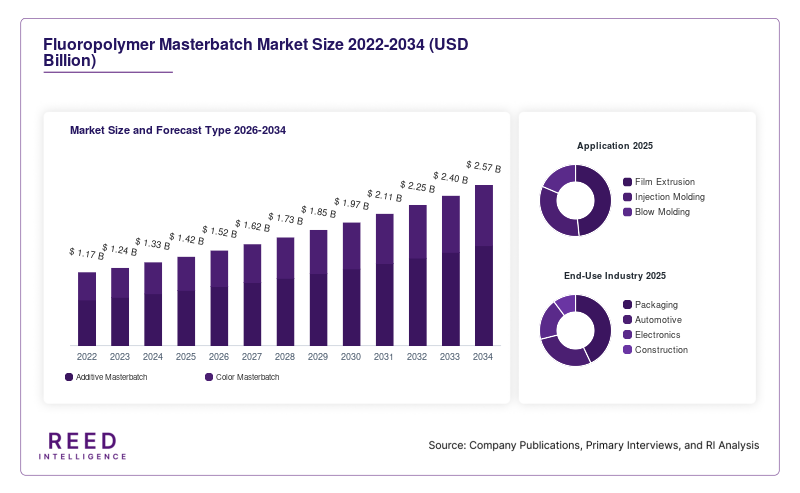
The additive masterbatch segment dominated the market in 2024, accounting for approximately 52% of the total share. This dominance is attributed to the widespread use of additive masterbatches in improving polymer processing and enhancing product properties. Fluoropolymer-based additives are particularly effective in reducing melt fracture and improving surface finish, making them essential in high-speed manufacturing processes. Industries such as packaging and automotive rely heavily on these masterbatches to achieve consistent quality and performance. The versatility of additive masterbatches and their compatibility with various polymers contribute to their strong market position.
The color masterbatch segment is expected to be the fastest-growing, with a projected CAGR of 7.2% during the forecast period. Growth is driven by increasing demand for aesthetically appealing products in consumer goods and packaging industries. Manufacturers are focusing on developing color masterbatches that offer both visual appeal and functional benefits. The integration of fluoropolymer additives in color masterbatches enhances dispersion and processing efficiency, making them suitable for high-performance applications.
By Application
The film extrusion segment held the largest market share in 2024, accounting for around 48%. This segment benefits from the extensive use of fluoropolymer masterbatches in improving film quality and processing efficiency. These masterbatches help reduce defects such as sharkskin and melt fracture, which are common in high-speed extrusion processes. The growing demand for flexible packaging and high-quality films is driving the adoption of fluoropolymer additives in this segment.
The injection molding segment is expected to grow at the fastest rate, with a CAGR of 7.0%. The increasing use of injection-molded components in automotive and electronics industries is driving demand for high-performance materials. Fluoropolymer masterbatches enhance flow properties and reduce cycle times, making them ideal for injection molding applications. This growth is further supported by advancements in molding technologies and increasing demand for precision components.
By End-Use Industry
The packaging industry dominated the market in 2024, accounting for approximately 45% of the total share. The demand for high-quality, durable, and visually appealing packaging solutions is driving the use of fluoropolymer masterbatches. These additives improve processing efficiency and product quality, making them essential in packaging applications. The rise of e-commerce and changing consumer preferences are further contributing to the growth of this segment.
The electronics industry is expected to be the fastest-growing segment, with a CAGR of 7.6%. The increasing demand for advanced electronic devices and components is driving the need for high-performance materials. Fluoropolymer masterbatches offer excellent thermal and electrical properties, making them suitable for electronic applications. The expansion of smart technologies and renewable energy systems is further supporting growth in this segment.
Regional Analysis
North America
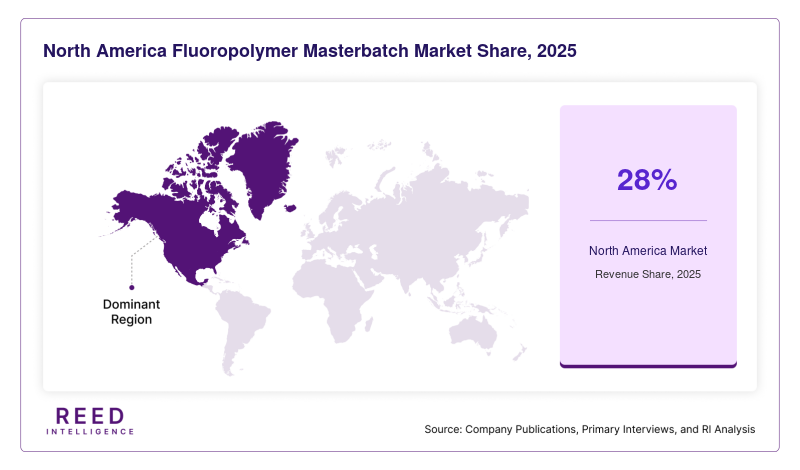
North America accounted for approximately 28% of the global Fluoropolymer Masterbatch Market share in 2025 and is projected to grow at a CAGR of 6.2% during the forecast period. The region benefits from a well-established industrial base and strong demand from automotive and electronics sectors. Technological advancements and the presence of leading manufacturers contribute to steady market growth, supported by ongoing investments in high-performance materials.
The United States dominates the regional market due to its advanced manufacturing capabilities and focus on innovation. A key growth factor is the increasing adoption of electric vehicles, which require high-performance materials for battery systems and wiring. This demand is driving the use of fluoropolymer masterbatches in various automotive applications.
Europe
Europe held around 24% market share in 2025 and is expected to grow at a CAGR of 5.9% through 2034. The region is characterized by stringent environmental regulations and a strong emphasis on sustainability. These factors are influencing the adoption of advanced and eco-friendly masterbatch solutions across industries, particularly in packaging and automotive sectors.
Germany leads the European market, driven by its robust automotive industry and focus on engineering excellence. A unique growth factor is the increasing demand for recyclable and sustainable materials, which is encouraging the development and use of environmentally compatible fluoropolymer masterbatches.
Asia Pacific
Asia Pacific emerged as the largest regional market, accounting for 34% share in 2025, and is projected to grow at a CAGR of 7.5%. Rapid industrialization, expanding manufacturing activities, and increasing demand for consumer goods are key factors driving market growth. The region’s cost advantages and large production base further support its dominance.
China is the leading country in the region, supported by its extensive manufacturing infrastructure. A major growth factor is the booming electronics industry, which requires high-performance materials for components and devices. This demand is significantly contributing to the adoption of fluoropolymer masterbatches.
Middle East & Africa
The Middle East & Africa region held approximately 7% market share in 2025 and is expected to grow at a CAGR of 5.5%. The market is driven by infrastructure development and increasing investments in industrial sectors. Demand for durable and high-performance materials is gradually rising across construction and packaging industries.
Saudi Arabia dominates the regional market due to its expanding petrochemical sector. A unique growth factor is the availability of raw materials, which supports local production and reduces dependency on imports, thereby encouraging market growth.
Latin America
Latin America accounted for about 7% market share in 2025 and is projected to grow at a CAGR of 5.8%. The region is witnessing steady growth in packaging and automotive industries, which are key consumers of fluoropolymer masterbatches. Economic development and increasing industrial activities are contributing to market expansion.
Brazil leads the regional market, supported by its strong manufacturing base. A significant growth factor is the increasing demand for flexible packaging solutions, which is driving the adoption of advanced masterbatch technologies in the region.
Competitive Landscape
The Fluoropolymer Masterbatch Market is moderately competitive, with several global and regional players focusing on product innovation and strategic partnerships. Companies are investing in research and development to create advanced formulations that meet evolving industry requirements. The market is characterized by the presence of established players with strong distribution networks and technical expertise.
Among the leading companies, Chemours is considered a key market leader due to its extensive product portfolio and focus on innovation. The company recently introduced a new range of fluoropolymer additives designed to improve processing efficiency and reduce environmental impact. Other major players are also focusing on expanding their production capacities and entering emerging markets to strengthen their market position. Strategic collaborations and mergers are common strategies used to enhance market presence and gain a competitive edge.
Key Players List
- Chemours
- Daikin Industries Ltd.
- Arkema Group
- Solvay S.A.
- 3M Company
- Clariant AG
- Ampacet Corporation
- A. Schulman (LyondellBasell)
- Plastika Kritis S.A.
- PolyOne Corporation (Avient)
- RTP Company
- Tosaf Group
- Hubron International
- GCR Group
- Plastiblends India Ltd.
Recent Developments
- In 2024, Chemours launched a new fluoropolymer masterbatch designed for high-speed extrusion applications, improving efficiency and reducing defects.
- In 2023, Arkema expanded its production capacity in Asia to meet rising demand from the packaging and electronics industries.
- In 2024, Clariant introduced a sustainable masterbatch solution aimed at reducing environmental impact while maintaining performance standards.
Fluoropolymer Masterbatch Market Segments
Type
- Additive Masterbatch
- Color Masterbatch
Application
- Film Extrusion
- Injection Molding
- Blow Molding
End-Use Industry
- Packaging
- Automotive
- Electronics
- Construction
By Region
- North America
- Europe
- APAC
- Middle East and Africa
- LATAM