Fluvoxamine Market Size, Share & Demand Report By Formulation (Immediate-Release, Extended-Release), By Application (Obsessive-Compulsive Disorder, Depression, Anxiety Disorders, Others), By Distribution Channel (Hospital Pharmacies, Retail Pharmacies, Online Pharmacies), By End User (Hospitals, Specialty Clinics, Homecare Settings), By Region & Segment Forecasts, 2025–2034
USD 3950
Market Overview
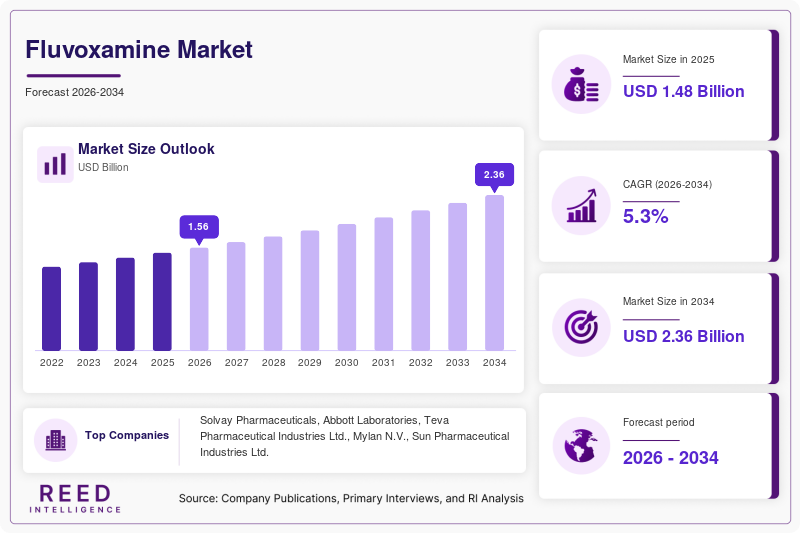
The global Fluvoxamine Market was valued at approximately USD 1.48 billion in 2025 and is projected to reach USD 2.36 billion by 2034, expanding at a CAGR of 5.3% during the forecast period (2025–2034). Fluvoxamine, a selective serotonin reuptake inhibitor (SSRI), is widely prescribed for conditions such as obsessive-compulsive disorder (OCD), depression, and anxiety disorders. Its established clinical efficacy and cost-effectiveness have supported its sustained adoption across developed and emerging healthcare systems.
One key global factor driving market expansion has been the rising prevalence of mental health disorders. Increasing awareness campaigns, better diagnosis rates, and growing acceptance of psychiatric treatment have significantly expanded the patient pool. In addition, healthcare providers are emphasizing early intervention strategies, which is contributing to consistent demand for established SSRIs such as fluvoxamine.
Key Highlights:
- North America dominated the market with a 38.6% share in 2025, while Asia Pacific is expected to register the fastest CAGR of 6.4% during the forecast period.
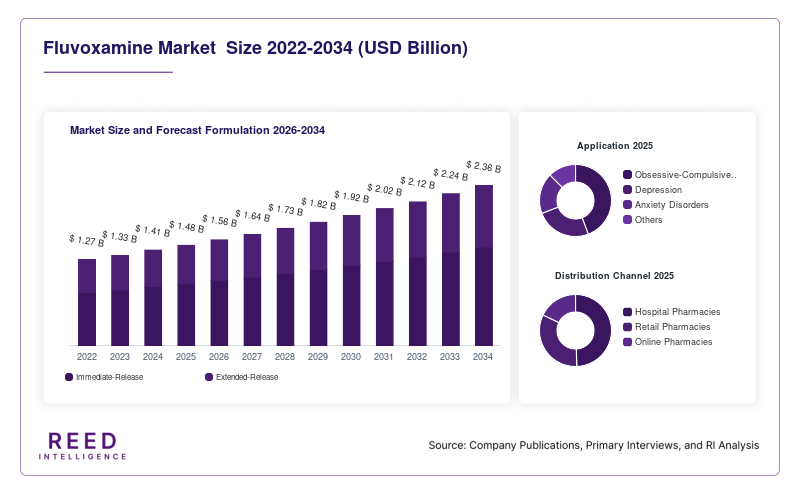
- Among segments, immediate-release formulations led with a 57.2% share in 2024, while extended-release formulations are projected to grow at a CAGR of 6.1%.
- By application, obsessive-compulsive disorder (OCD) held the largest share, whereas anxiety disorders are expected to grow fastest at a CAGR of 5.9%.
- The U.S. accounted for a market value of USD 520 million in 2024, rising to USD 545 million in 2025.
Market Trends
Expansion of Off-Label Applications
The use of fluvoxamine beyond its traditional indications has gained momentum in recent years. Clinicians are increasingly exploring its potential in treating conditions such as social anxiety disorder, post-traumatic stress disorder (PTSD), and certain inflammatory-related disorders. This trend is supported by emerging clinical insights and growing acceptance of repurposed drugs, which allow healthcare systems to maximize the value of existing therapies.
Shift Toward Digital Mental Health Integration
The integration of pharmacotherapy with digital mental health platforms is reshaping treatment delivery. Fluvoxamine prescriptions are increasingly complemented by telemedicine consultations, mobile-based therapy tracking, and remote patient monitoring tools. This trend enhances treatment adherence and allows physicians to personalize dosage adjustments based on real-time patient data. As digital health ecosystems expand, they are expected to improve patient engagement and broaden access to fluvoxamine-based therapies, especially in underserved regions.
Market Drivers
Rising Global Burden of Mental Health Disorders
The increasing incidence of psychiatric conditions such as OCD, depression, and anxiety disorders has been a primary driver of the Fluvoxamine Market. Urbanization, lifestyle stress, and social pressures have contributed to higher diagnosis rates globally. Governments and healthcare organizations are also prioritizing mental health initiatives, which is leading to improved access to medications and boosting overall market demand.
Cost-Effectiveness of Generic SSRIs
Fluvoxamine is widely available in generic form, making it a cost-effective treatment option compared to newer antidepressants. This affordability has made it particularly attractive in low- and middle-income countries, where healthcare budgets are constrained. The widespread availability of generics ensures consistent supply and accessibility, supporting long-term market growth.
Market Restraint
Availability of Alternative Antidepressants
The presence of a wide range of alternative antidepressants poses a significant challenge to the Fluvoxamine Market. Newer SSRIs and serotonin-norepinephrine reuptake inhibitors (SNRIs) often offer improved side-effect profiles, faster onset of action, or broader therapeutic indications. Physicians may prefer these alternatives based on individual patient needs, which can limit fluvoxamine’s adoption in certain cases.
Additionally, patient preference for newer therapies and ongoing pharmaceutical innovation contribute to competitive pressure. While fluvoxamine remains effective, its market share is influenced by evolving prescribing patterns and clinical guidelines that may prioritize newer drug classes. This dynamic landscape may restrain growth, particularly in developed markets where access to advanced therapies is higher.
Market Opportunities
Growth in Emerging Healthcare Markets
Expanding healthcare infrastructure in emerging economies presents a significant opportunity for the Fluvoxamine Market. Countries in Asia Pacific, Latin America, and Africa are increasing investments in mental health services, improving access to diagnosis and treatment. As awareness rises, demand for affordable and proven medications such as fluvoxamine is expected to grow steadily.
Development of Novel Formulations
Pharmaceutical companies are exploring new formulations of fluvoxamine to enhance patient compliance and therapeutic outcomes. Extended-release versions and combination therapies are gaining attention, as they can reduce dosing frequency and improve tolerability. These innovations are expected to create new revenue streams and expand the drug’s application across diverse patient populations.
Segmental Analysis
By Formulation
Immediate-release formulations dominated the Fluvoxamine Market, accounting for 57.2% of the market share in 2024. These formulations have been widely prescribed due to their established efficacy, flexibility in dosing, and broad availability in both developed and emerging markets.
Extended-release formulations are expected to grow at the fastest CAGR of 6.1% during the forecast period. Their ability to improve patient compliance by reducing dosing frequency will drive adoption. Additionally, enhanced tolerability profiles will support their increased use in long-term treatment plans.
By Application
Obsessive-compulsive disorder (OCD) held the largest share of the market in 2024, driven by fluvoxamine’s strong clinical efficacy in managing this condition. The drug has been widely recommended as a first-line treatment for OCD in several clinical guidelines.
Anxiety disorders are projected to be the fastest-growing segment, with a CAGR of 5.9%. Increasing recognition of anxiety-related conditions and improved diagnostic capabilities will drive demand. The growing emphasis on mental well-being is expected to further boost this segment.
By Distribution Channel
Hospital pharmacies accounted for the largest share in 2024, as they are primary points of prescription fulfillment for psychiatric medications. These pharmacies benefit from direct physician recommendations and integrated healthcare services.
Online pharmacies are expected to grow at the fastest CAGR of 6.5%. The convenience of home delivery, competitive pricing, and increasing adoption of digital healthcare platforms will drive growth in this segment.
By End User
Hospitals dominated the market in 2024, supported by their role in diagnosing and treating severe psychiatric conditions. The presence of specialized healthcare professionals ensures accurate prescription and monitoring of fluvoxamine therapy.
Homecare settings are projected to witness the fastest growth, with a CAGR of 6.2%. Increasing preference for outpatient treatment and remote monitoring solutions will drive this segment. Patients are increasingly opting for home-based care due to convenience and reduced healthcare costs.
Regional Analysis
North America
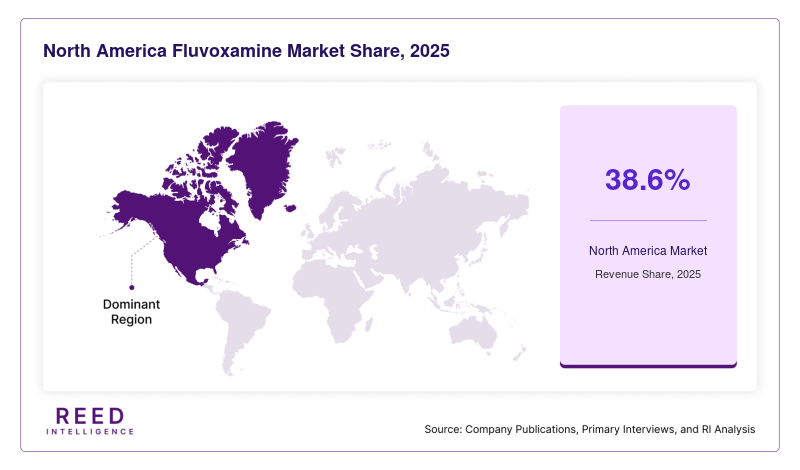
North America accounted for 38.6% of the global Fluvoxamine Market share in 2025 and is expected to grow at a CAGR of 4.8% during the forecast period. The region’s growth is supported by advanced healthcare systems, high awareness of mental health conditions, and strong insurance coverage for psychiatric treatments.
The United States dominated the regional market due to its well-established pharmaceutical industry and high diagnosis rates of OCD and anxiety disorders. The country’s emphasis on mental health awareness campaigns and early intervention programs has driven consistent demand for SSRIs, including fluvoxamine.
Europe
Europe held a 27.4% market share in 2025 and is projected to expand at a CAGR of 5.0% through 2034. The region benefits from universal healthcare systems and strong regulatory frameworks that ensure the availability of essential psychiatric medications.
Germany emerged as the leading country in this region, driven by its robust healthcare infrastructure and high healthcare expenditure. The country’s focus on mental health research and treatment accessibility has supported the steady adoption of fluvoxamine.
Asia Pacific
Asia Pacific represented 19.8% of the global market in 2025 and is anticipated to grow at the fastest CAGR of 6.4% during the forecast period. Rapid urbanization, increasing mental health awareness, and expanding healthcare access are key factors driving growth.
China led the regional market due to its large population base and increasing government focus on mental health services. Initiatives to integrate mental health care into primary healthcare systems have significantly boosted the demand for antidepressant medications.
Middle East & Africa
The Middle East & Africa accounted for 7.2% of the market in 2025 and is expected to grow at a CAGR of 5.6%. Improving healthcare infrastructure and rising awareness of mental health issues are contributing to market expansion in this region.
Saudi Arabia dominated the market, supported by government initiatives to modernize healthcare systems and increase access to psychiatric care. The country’s investments in healthcare facilities and professional training have facilitated the adoption of fluvoxamine.
Latin America
Latin America held a 7.0% market share in 2025 and is projected to grow at a CAGR of 5.7% during the forecast period. Increasing healthcare spending and growing awareness of mental health disorders are key growth drivers.
Brazil led the regional market due to its large patient population and improving access to healthcare services. Government initiatives aimed at expanding mental health programs have contributed to the rising demand for SSRIs, including fluvoxamine.
Competitive Landscape
The Fluvoxamine Market is characterized by the presence of several global and regional pharmaceutical companies focusing on generic drug production and distribution. Competition is primarily based on pricing, product availability, and distribution networks.
A leading player in the market has maintained its position through strong manufacturing capabilities and a wide distribution network. The company recently expanded its production capacity to meet rising global demand and enhance supply chain efficiency.
Other major players are focusing on strategic collaborations, regulatory approvals, and product portfolio expansion to strengthen their market presence. The competitive landscape remains moderately fragmented, with companies investing in research to explore new therapeutic applications and formulations of fluvoxamine.
Key Players List
- Solvay Pharmaceuticals
- Abbott Laboratories
- Teva Pharmaceutical Industries Ltd.
- Mylan N.V.
- Sun Pharmaceutical Industries Ltd.
- Lupin Limited
- Aurobindo Pharma Limited
- Zydus Lifesciences Ltd.
- Torrent Pharmaceuticals Ltd.
- Hikma Pharmaceuticals PLC
- Cipla Limited
- Dr. Reddy’s Laboratories Ltd.
- Glenmark Pharmaceuticals Ltd.
- Alkem Laboratories Ltd.
- Apotex Inc.
Recent Developments
- In 2024, a leading pharmaceutical company expanded its fluvoxamine production facilities to address increasing global demand.
- In 2023, several manufacturers received regulatory approvals for generic fluvoxamine formulations in emerging markets.
- In 2025, a key player launched an extended-release version to improve patient compliance and treatment outcomes.
- Strategic partnerships between pharmaceutical firms and digital health platforms have increased accessibility to mental health treatments.
Fluvoxamine Market Segments
Formulation
- Immediate-Release
- Extended-Release
Application
- Obsessive-Compulsive Disorder (OCD)
- Depression
- Anxiety Disorders
- Others
Distribution Channel
- Hospital Pharmacies
- Retail Pharmacies
- Online Pharmacies
End User
- Hospitals
- Specialty Clinics
- Homecare Settings
By Region
- North America
- Europe
- APAC
- Middle East and Africa
- LATAM