Flying Taxi Market Size, Share & Demand Report By Type (Multi-Rotor, Fixed-Wing Hybrid, Tilt-Wing), By Application (Passenger Transportation, Cargo Transportation, Emergency Services), By End-Use (Commercial, Government & Defense, Private), By Region & Segment Forecasts, 2025–2034
USD 3950
Market Overview
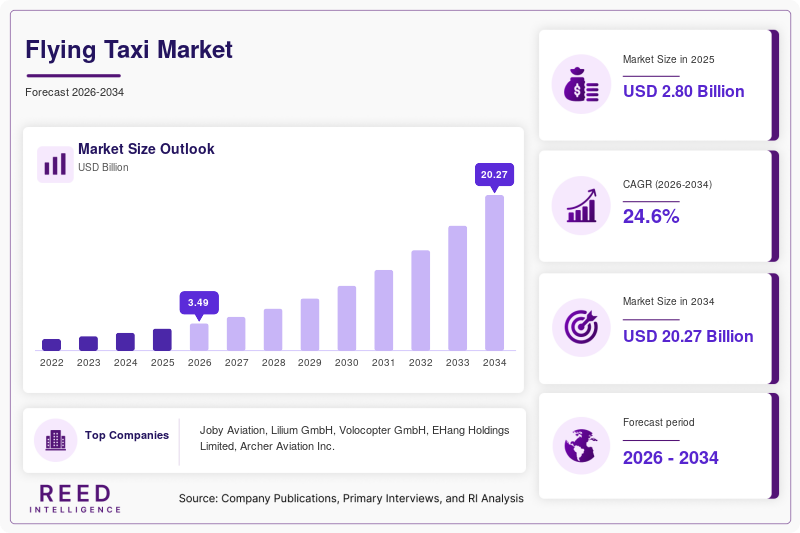
The Flying Taxi Market size is estimated at USD 2.8 billion, supported by pilot deployments and prototype commercialization. By 2026, the market is expected to reach USD 3.9 billion, reflecting increasing investments from aerospace companies, startups, and mobility providers. Over the forecast period from 2025 to 2034, the market is projected to expand at a CAGR of 24.6%, reaching approximately USD 28.7 billion by 2034.
Several factors are contributing to this rapid growth. First, the increasing demand for efficient urban transportation solutions is pushing governments and private players to explore alternatives to traditional road-based mobility. Flying taxis, particularly electric vertical takeoff and landing (eVTOL) aircraft, offer reduced travel time and lower congestion in densely populated cities. Second, technological advancements in battery systems and lightweight materials are improving operational efficiency and range, making flying taxis more commercially viable. Third, supportive regulatory frameworks and public-private partnerships are accelerating infrastructure development, including vertiports and air traffic management systems.
Key Highlights
- Market size is estimated at USD 2.8 billion in 2025 and is expected to grow to USD 3.9 billion in 2026. This reflects strong early-stage commercialization and increasing pilot deployments across major urban regions.
- The market is projected to reach USD 28.7 billion by 2034, expanding at a CAGR of 24.6% from 2025 to 2034. This growth is driven by scaling operations and broader adoption of urban air mobility solutions.
- Growing demand for efficient urban mobility solutions is a key factor supporting market expansion. Flying taxis help reduce traffic congestion and significantly cut travel time in densely populated cities.
- Advancements in eVTOL technology and battery efficiency are improving flight range, safety, and cost-effectiveness. These innovations are making flying taxi services more practical for commercial use.
Market Trends
Integration of Autonomous Flight Systems
One of the key trends shaping the flying taxi market is the integration of autonomous flight systems. Companies are investing heavily in artificial intelligence and machine learning technologies to enable pilotless operations. Autonomous systems can enhance operational efficiency by reducing human error and lowering labor costs associated with trained pilots. This trend is particularly important for scaling operations in high-demand urban areas where rapid turnaround times are essential. Additionally, autonomous navigation systems are being tested in controlled environments, with gradual regulatory approvals expected over the next decade. As these technologies mature, they are likely to improve safety standards and increase public confidence in flying taxi services.
Development of Urban Air Mobility Infrastructure
Another significant trend is the development of dedicated infrastructure for urban air mobility. Governments and private stakeholders are collaborating to build vertiports, charging stations, and air traffic management systems tailored for flying taxis. These infrastructure projects are essential for ensuring seamless integration with existing transportation networks. Smart city initiatives are also incorporating flying taxi operations into their long-term mobility plans. The establishment of standardized infrastructure is expected to reduce operational bottlenecks and support large-scale deployment. This trend is further supported by investments in digital platforms for booking, routing, and fleet management, which enhance user experience and operational efficiency.
Market Drivers
Increasing Urban Congestion and Demand for Faster Transportation
Rapid urbanization has led to severe traffic congestion in major cities worldwide, creating a strong demand for faster and more efficient transportation solutions. Flying taxis provide a viable alternative by significantly reducing travel time compared to ground-based vehicles. For example, a commute that typically takes one hour by car can be reduced to 10–15 minutes using a flying taxi. This efficiency is particularly beneficial for business travelers and emergency services. As urban populations continue to grow, the need for innovative mobility solutions is expected to drive the adoption of flying taxis. Governments are also recognizing the potential of aerial mobility to alleviate pressure on existing infrastructure.
Technological Advancements in Electric Propulsion and Battery Systems
Advancements in electric propulsion systems and battery technology are another major driver of market growth. Modern eVTOL aircraft are designed to be energy-efficient, with improved battery density and faster charging capabilities. These innovations enable longer flight ranges and lower operational costs, making flying taxi services more commercially viable. Additionally, the use of lightweight composite materials enhances performance and reduces energy consumption. Continuous research and development efforts are focused on improving safety, reliability, and cost efficiency. As technology evolves, it is expected to play a crucial role in accelerating the commercialization and adoption of flying taxis.
Market Restraint
Regulatory and Safety Challenges
Despite significant growth potential, the flying taxi market faces substantial regulatory and safety challenges. Aviation authorities require rigorous testing and certification processes to ensure the safety of new aircraft technologies. These processes can be time-consuming and costly, delaying market entry for many companies. Additionally, the lack of standardized regulations across different countries creates complexities for global operations. Safety concerns related to autonomous systems and air traffic management also pose challenges, particularly in densely populated urban areas. For instance, integrating flying taxis into existing airspace requires advanced coordination with traditional aviation systems. These challenges can slow down market growth and limit scalability in the short term. However, ongoing collaboration between industry stakeholders and regulatory bodies is expected to address these issues over time.
Market Opportunities
Expansion in Emerging Economies
Emerging economies present significant growth opportunities for the flying taxi market. Rapid urbanization, increasing disposable income, and growing demand for advanced transportation solutions are driving interest in these regions. Countries in Asia Pacific and Latin America are investing in smart city projects that include urban air mobility as a key component. The relatively lower cost of infrastructure development in these regions also makes it easier to implement new technologies. Additionally, partnerships between local governments and international companies are facilitating knowledge transfer and accelerating deployment. As awareness and acceptance of flying taxis increase, emerging markets are expected to become major contributors to overall market growth.
Integration with Ride-Sharing Platforms
The integration of flying taxis with existing ride-sharing platforms offers another promising opportunity. Mobility service providers are exploring ways to incorporate aerial transportation into their digital ecosystems, enabling seamless multimodal travel. For example, users could book a flying taxi as part of a longer journey that includes ground transportation. This integration enhances convenience and improves user experience, making flying taxis more accessible to a wider audience. Additionally, data analytics and real-time tracking can optimize routes and reduce operational costs. As ride-sharing platforms continue to expand, their collaboration with flying taxi operators is expected to drive market adoption and revenue growth.
Segmental Analysis
By Type
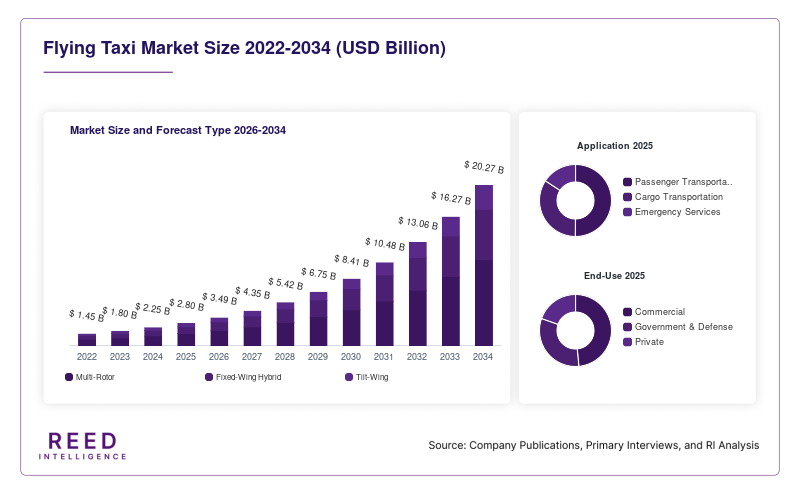
The multi-rotor segment dominated the flying taxi market in 2024, accounting for approximately 48% of the total market share. Multi-rotor eVTOL aircraft are widely preferred due to their simpler design, ease of operation, and ability to perform vertical takeoff and landing in confined spaces. These characteristics make them suitable for urban environments where space is limited. Additionally, multi-rotor systems offer better stability and control, which enhances safety during operations. Manufacturers are focusing on improving battery efficiency and payload capacity to further strengthen the position of this segment. The widespread adoption of multi-rotor designs is expected to continue in the near term.
The fixed-wing hybrid segment is expected to be the fastest-growing segment, with a projected CAGR of 26.8% during the forecast period. These aircraft combine the benefits of fixed-wing and rotary-wing designs, enabling longer flight ranges and higher speeds. This makes them suitable for intercity travel and longer-distance operations. The growing demand for efficient regional transportation is driving the adoption of fixed-wing hybrid flying taxis. Additionally, advancements in propulsion systems and aerodynamics are enhancing the performance of these aircraft, contributing to their rapid growth.
By Application
The passenger transportation segment held the largest share of the flying taxi market in 2024, accounting for approximately 62% of total revenue. This dominance is driven by the increasing demand for faster and more convenient urban travel solutions. Flying taxis are particularly attractive for business travelers and high-income individuals who value time efficiency. Service providers are focusing on enhancing user experience through digital platforms and seamless booking systems. The development of vertiports and integration with existing transportation networks further supports the growth of this segment.
The cargo transportation segment is expected to be the fastest-growing segment, with a CAGR of 25.9% over the forecast period. The rising demand for rapid delivery services, particularly in e-commerce and logistics, is driving this growth. Flying taxis offer a cost-effective and time-efficient solution for transporting goods in urban areas. Additionally, advancements in autonomous systems enable unmanned cargo operations, reducing labor costs and improving efficiency. As the logistics industry continues to evolve, the adoption of flying taxis for cargo transportation is expected to increase significantly.
By End-Use
The commercial segment dominated the flying taxi market in 2024, accounting for approximately 55% of the total market share. This segment includes ride-sharing services, tourism, and corporate transportation. The increasing adoption of flying taxis by mobility service providers is a key factor driving growth in this segment. Companies are investing in fleet expansion and infrastructure development to meet growing demand. The commercial segment is also benefiting from partnerships with technology providers, which enhance operational efficiency and scalability.
The government and defense segment is expected to be the fastest-growing segment, with a projected CAGR of 24.7% during the forecast period. Governments are exploring the use of flying taxis for emergency services, surveillance, and disaster management. These applications require reliable and efficient transportation solutions, which flying taxis can provide. Additionally, defense organizations are investing in advanced aerial mobility technologies to enhance their operational capabilities. The increasing focus on public safety and emergency response is expected to drive growth in this segment.
Regional Analysis
North America
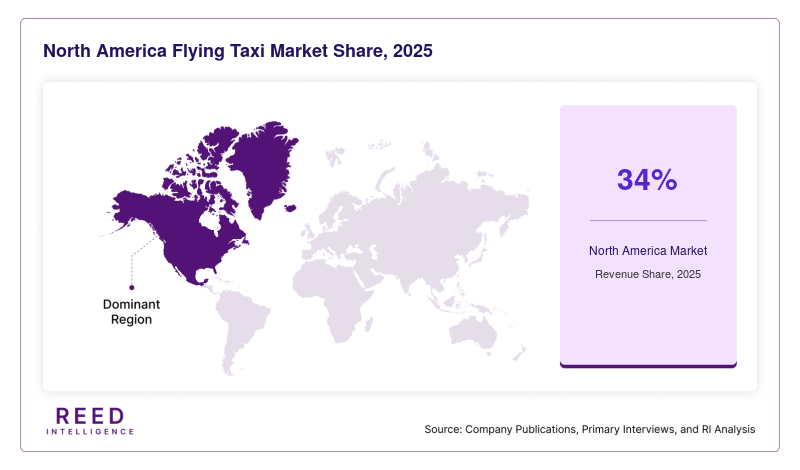
North America held a significant share of the flying taxi market in 2025, accounting for approximately 34% of global revenue. The region is expected to maintain its leadership position, with a projected CAGR of 23.8% during the forecast period. Strong investments in research and development, coupled with early adoption of advanced technologies, are key factors driving market growth. The presence of established aerospace companies and supportive regulatory frameworks further enhance the region's market outlook.
The United States dominates the North American market due to its advanced aviation infrastructure and strong innovation ecosystem. A unique growth factor in this region is the increasing collaboration between technology firms and aerospace manufacturers. These partnerships are accelerating the development of autonomous systems and enabling faster commercialization of flying taxi services.
Europe
Europe accounted for around 26% of the global market share in 2025 and is expected to grow at a CAGR of 22.9% through 2034. The region's focus on sustainability and environmental regulations is driving the adoption of electric flying taxis. Governments are actively supporting urban air mobility initiatives through funding and policy development, which is contributing to market expansion.
Germany is a leading country in the European flying taxi market, supported by its strong engineering capabilities and innovation-driven economy. A unique growth factor in this region is the emphasis on reducing carbon emissions in urban transportation. This focus is encouraging the adoption of electric propulsion systems and promoting the development of eco-friendly mobility solutions.
Asia Pacific
Asia Pacific held approximately 22% of the market share in 2025 and is projected to register the highest CAGR of 27.1% during the forecast period. Rapid urbanization and increasing population density are key factors driving demand for advanced transportation solutions in the region. Governments are investing heavily in smart city projects, which include urban air mobility as a core component.
China leads the Asia Pacific market, driven by strong government support and significant investments in technology development. A unique growth factor in this region is the large-scale implementation of pilot projects in major cities. These initiatives are helping to validate the feasibility of flying taxi operations and accelerate market adoption.
Middle East & Africa
The Middle East & Africa region accounted for about 10% of the global market share in 2025 and is expected to grow at a CAGR of 24.2% through 2034. The region is witnessing increasing interest in innovative transportation solutions, particularly in urban centers with high traffic congestion. Investments in infrastructure and tourism are also contributing to market growth.
The United Arab Emirates is a dominant country in this region, driven by its focus on technological innovation and smart city development. A unique growth factor is the government's proactive approach to adopting futuristic mobility solutions. Initiatives such as pilot programs and partnerships with global companies are accelerating the deployment of flying taxi services.
Latin America
Latin America held approximately 8% of the market share in 2025 and is projected to grow at a CAGR of 21.7% during the forecast period. The region is gradually adopting urban air mobility solutions, supported by increasing urbanization and economic development. Government initiatives aimed at improving transportation infrastructure are also contributing to market growth.
Brazil leads the Latin American market, driven by its large urban population and growing demand for efficient transportation solutions. A unique growth factor in this region is the increasing involvement of private investors in mobility projects. These investments are supporting the development of infrastructure and enabling the introduction of flying taxi services.
Competitive Landscape
The flying taxi market is characterized by intense competition, with several established aerospace companies and emerging startups vying for market share. The top five companies include Joby Aviation, Lilium GmbH, Volocopter GmbH, EHang Holdings Limited, and Archer Aviation Inc. Among these, Joby Aviation is considered a market leader due to its advanced eVTOL technology and strong investment portfolio.
Companies are focusing on strategic partnerships, technological innovation, and regulatory approvals to gain a competitive edge. For instance, several players have entered into collaborations with ride-sharing platforms and infrastructure developers to accelerate commercialization. Recent developments include successful test flights, certification milestones, and new funding rounds. These activities are contributing to the rapid evolution of the competitive landscape and driving market growth.
Key Players
- Joby Aviation
- Lilium GmbH
- Volocopter GmbH
- EHang Holdings Limited
- Archer Aviation Inc.
- Vertical Aerospace Ltd.
- Beta Technologies
- Wisk Aero LLC
- Hyundai Motor Group
- Airbus SE
- Boeing Company
- Embraer SA
- Bell Textron Inc.
- Pipistrel Aircraft
- Overair Inc.
Recent Developments
- In 2025, a leading flying taxi company completed a successful pilot program in a major metropolitan city, demonstrating the feasibility of urban air mobility services.
- In 2026, a strategic partnership was announced between a mobility platform and an eVTOL manufacturer to integrate flying taxi services into existing ride-sharing applications.
- A major aerospace company achieved a key certification milestone for its eVTOL aircraft, bringing it closer to commercial deployment.
Flying Taxi Market Segments
Type
- Multi-Rotor
- Fixed-Wing Hybrid
- Tilt-Wing
Application
- Passenger Transportation
- Cargo Transportation
- Emergency Services
End-Use
- Commercial
- Government & Defense
- Private
By Region
- North America
- Europe
- APAC
- Middle East and Africa
- LATAM