Foam Nickel Market Size, Share & Trends Analysis Report By Product Type (Continuous Band-Shaped Nickel Foam, High-Intensity & Ultra-Intense Binding Force Nickel Foam), By Application (Electrode Materials, Fuel Cells & Electrolyzers, Filtration & Catalysis), By End Use (Energy Storage, Hydrogen & Fuel Cells, Chemical Processing, Electronics & EMI) and By Region (North America, Europe, APAC, Middle East and Africa, LATAM) Forecasts, 2026–2034
USD 3950
Foam Nickel Market Size
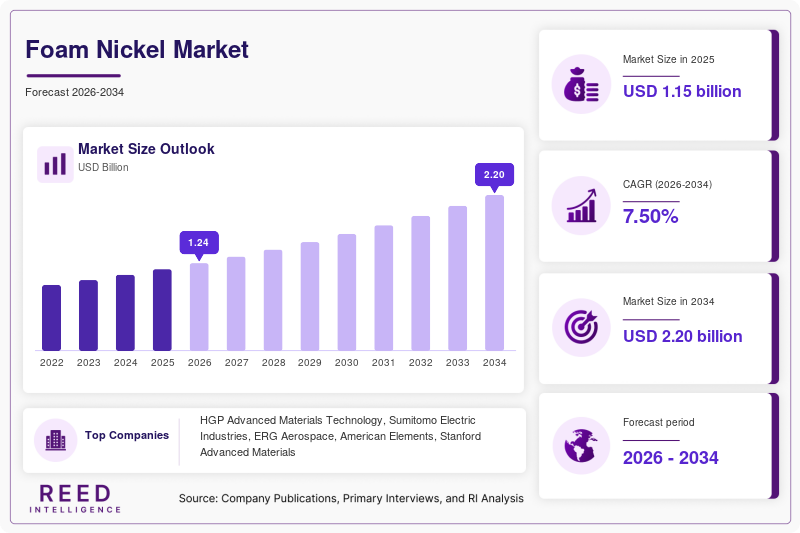
The global Foam Nickel Market size was valued at USD 1.15 billion in 2025 and is projected to grow from USD 1.24 billion in 2026 to USD 2.20 billion by 2034, registering a CAGR of 7.50% during the forecast period from 2026 to 2034.
Foam nickel is a three-dimensional porous nickel material characterized by high open porosity, electrical conductivity, corrosion resistance and a large internal surface area. These characteristics make it useful as a current collector, electrode substrate, catalyst support, gas-diffusion structure and filtration medium. Commercial suppliers offer foam nickel in sheets, rolls, plates and customized geometries with controlled thickness, pore size, porosity and density. Stanford Advanced Materials, for example, lists nickel foam with porosity ranging from 60% to 98% and thicknesses from 0.5 to 10 mm.
Historically, nickel foam has been closely associated with nickel-metal-hydride and nickel-cadmium batteries, fuel cells and electrochemical electrodes. Its role is now broadening as porous nickel becomes a platform for alkaline water electrolysis, electrocatalysis and advanced energy-storage devices. A 2026 review describes nickel foam as a long-established substrate for hydrogen-evolution catalysts and highlights its potential for industrial alkaline electrolysis.
Recent research is particularly important because it is moving nickel foam from a passive substrate toward an engineered functional electrode. Studies published in 2026 have examined surface polishing, thickness optimization, catalyst deposition and hierarchical pore structures to improve hydrogen evolution, oxygen evolution, mass transport and bubble removal.
This broadening application base supports the market's projected expansion, although nickel prices, alternative porous materials and the need for consistent pore structure remain important commercial constraints.
Foam Nickel Market Drivers
Expansion of Electrochemical Hydrogen Production Is Increasing Demand for Porous Nickel Structures
Nickel foam is becoming increasingly relevant to alkaline and anion-exchange-membrane water electrolysis because its interconnected pores provide pathways for electrolyte movement, gas-bubble release and catalyst loading. The material can also function as a conductive, self-supporting catalyst substrate, reducing dependence on binders.
A 2026 review of nickel-foam-based hydrogen-evolution systems identifies nickel foam as a widely used platform for self-supported catalysts and discusses its transition toward industrial alkaline water electrolysis. Research published in August 2026 found that increasing nickel-foam thickness improved alkaline electrolysis performance because the porous structure promoted bubble detachment and higher hydrogen-production rates.
Another 2026 study engineered nickel foam through surface polishing and reported improved catalyst coating, wettability and membrane-electrode contact. In a 13 cm² AEM electrolyzer, the engineered nickel-foam configuration achieved higher current density than the untreated foam configuration and maintained stability for more than 155 hours.
The commercial mechanism is therefore shifting from selling nickel foam simply as a conductive substrate toward supplying controlled pore architecture for high-current electrochemical equipment. Suppliers able to provide consistent thickness, PPI, porosity and surface quality can capture higher-value applications.
High Surface Area and Conductivity Support Advanced Electrodes
The interconnected three-dimensional structure of nickel foam creates a large active surface area while retaining electrical conductivity. This combination allows active materials to be deposited directly onto the foam, creating binder-free or self-supported electrodes.
Research published in 2025 demonstrated CoFeP-Ni(OH)₂ deposited directly on nickel foam for asymmetric supercapacitors, while a 2026 study developed Ni₃S₂/MoS₂@MXene structures on nickel foam to improve ion and electron transport.
The same architecture is useful in batteries and other electrochemical systems because the porous framework can provide pathways for electrolyte penetration and active-material attachment. American Elements states that its battery-grade nickel foam is being used in battery-development programs involving public research institutions and private companies.
This creates demand for different foam specifications rather than a single standardized product. Battery manufacturers may prioritize surface area and mechanical integrity, while electrolyzer developers can prioritize pore structure, thickness, wettability and corrosion performance.
Nickel Foam Is Expanding Into Electrocatalysis and Specialized Chemical Processing
Nickel foam's role is expanding beyond conventional batteries and fuel cells. A 2026 review in The Chemical Record describes nickel foam as a versatile electrode for electro-organic synthesis, including oxidation, hydrogenation and reduction reactions. Its high surface area and conductive structure allow relatively high current densities while providing a mechanically stable electrode.
Research is also examining nickel foam for seawater electrolysis, oxygen evolution and hydrogen evolution. A January 2026 study developed Ni(OH)₂/NiOOH structures directly on nickel foam and reported enhanced electrolysis performance and corrosion resistance in unpurified seawater.
The commercial implication is diversification. Demand does not need to depend entirely on rechargeable batteries: catalytic conversion, electrolysis, filtration and chemical processing can use the same underlying porous-metal manufacturing capabilities. This supports higher-value customized foam products with application-specific pore size, thickness and surface treatment.
Foam Nickel Market Restraints
Nickel Price Exposure Can Increase Material Costs
Nickel foam is fundamentally a nickel-intensive product, so changes in nickel prices directly affect manufacturing economics. The porous structure reduces the material mass compared with a solid nickel sheet, but nickel remains the principal feedstock.
This becomes important for applications where foam competes against cheaper porous metals or coated substrates. Manufacturers must balance nickel purity, mechanical strength and pore architecture against the customer's target cost.
The pressure is particularly relevant in high-volume energy applications. If an electrode can achieve equivalent electrochemical performance using stainless steel, nickel-coated steel, carbon materials or other engineered porous structures, customers may have an economic incentive to switch.
Consequently, foam-nickel producers need to demonstrate performance benefits rather than compete solely on material cost.
Alternative Substrates and Electrochemical Limitations Restrict Some Applications
Nickel foam is not universally suitable for every electrochemical environment. For example, nickel is unsuitable for conventional acidic PEM electrolyzers where titanium is generally used because nickel is vulnerable to corrosion under acidic operating conditions.
Research has also identified limitations when nickel foam is used as a supercapacitor substrate. A 2024 study found that nickel itself can undergo redox reactions in alkaline media, potentially influencing measured electrochemical performance and complicating comparisons between active materials.
These issues limit the addressable market in some applications and require suppliers to develop coated, surface-treated or application-specific products. They also create opportunities for competing porous materials.
Foam Nickel Market Opportunities
Engineered Nickel Foam for High-Current Electrolysis
The move toward high-current-density alkaline electrolysis creates an opportunity for engineered foam rather than conventional commodity foam. Research published in 2026 showed that pore structure and foam thickness affect bubble removal, transport resistance and electrolysis efficiency. One study identified an approximately 3 mm thickness as an effective balance between electrochemical surface area, conduction and bubble transport under its test conditions.
Suppliers can therefore differentiate through PPI, thickness, porosity, surface roughness, wettability and catalyst compatibility. This creates opportunities for custom electrode substrates designed for specific electrolyzer architectures.
Battery and Supercapacitor Electrode Platforms
Nickel foam remains relevant as a three-dimensional current collector for nickel-based batteries and supercapacitors. Its conductive structure permits direct growth or deposition of active materials, while its open pores allow electrolyte access.
Research in 2025 and 2026 continues to use nickel foam for high-performance supercapacitor electrodes, including Ni-Co sulfides, nickel-cobalt phosphates and MXene-based structures.
The commercial opportunity is particularly strong in specialized and high-power applications where mechanical bonding, current collection and active-surface accessibility matter more than simply minimizing substrate cost.
Customized Porous Metal Components
Foam nickel can be supplied in different pore densities, thicknesses and geometries. Manufacturers already offer sheets, belts, blocks and customized components, while suppliers such as Huayan describe applications spanning energy storage, electrolysis, filtration, aerospace and thermal management.
Customization allows suppliers to move away from commodity-sheet competition. A customer can specify pore size, density, thickness, dimensions and surface treatment according to the intended flow, heat-transfer or electrochemical requirements.
Segmental Analysis
By Product Type
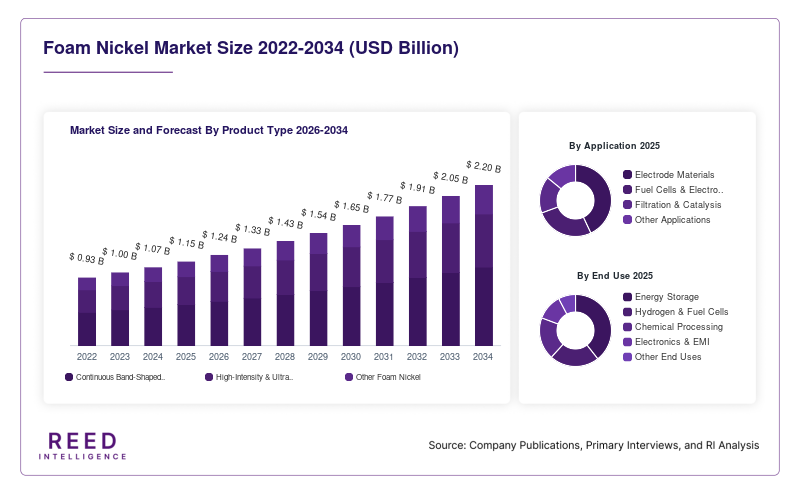
Continuous Band-Shaped Nickel Foam represents approximately 46% of the global market in 2025, making it the dominant product format. Continuous foam is suited to high-throughput applications where manufacturers require consistent width, thickness and pore structure. Battery and electrode manufacturers can integrate continuous material into automated coating, cutting and assembly processes.
High-Intensity & Ultra-Intense Binding Force Nickel Foam represents approximately 32%, serving applications where greater mechanical integrity is required during electrode processing or repeated electrochemical cycling.
Other Foam Nickel accounts for approximately 22% and includes customized sheets, blocks and application-specific structures.
High-Intensity & Ultra-Intense Binding Force Nickel Foam is the fastest-growing product category, with approximately 8.2% CAGR, supported by applications requiring better mechanical stability and resistance to deformation during high-current electrochemical operation.
By Application
Electrode Materials account for approximately 56% of the global market in 2025, supported by nickel-based batteries, supercapacitors and catalyst-loaded electrochemical electrodes. Nickel foam's conductivity, porosity and large surface area make it a widely used substrate for directly deposited active materials.
Fuel Cells & Electrolyzers represent approximately 25%. The segment is becoming increasingly important as nickel foam is used as an electrode substrate, catalyst support and porous transport structure in alkaline and AEM electrolysis.
Filtration & Catalysis accounts for approximately 12%, while other applications contribute 7%.
Fuel Cells & Electrolyzers are the fastest-growing application segment, with approximately 9.1% CAGR through 2034. The increase is supported by continuing research into high-current alkaline electrolysis, catalyst integration and improved bubble transport.
By End Use
Energy Storage represents approximately 48% of the market in 2025. Nickel foam is used as a current collector and substrate in nickel-based batteries and advanced supercapacitor electrodes.
Hydrogen & Fuel Cells account for approximately 28% and represent the fastest-growing end-use category, with approximately 9.5% CAGR. Research increasingly focuses on engineered nickel foam for alkaline electrolysis, hydrogen evolution and oxygen evolution.
Chemical Processing represents approximately 11%, supported by electro-organic synthesis, catalytic conversion and related processes.
Electronics & EMI accounts for approximately 8%, while other end uses represent 5%.
Regional Analysis
North America Foam Nickel Market
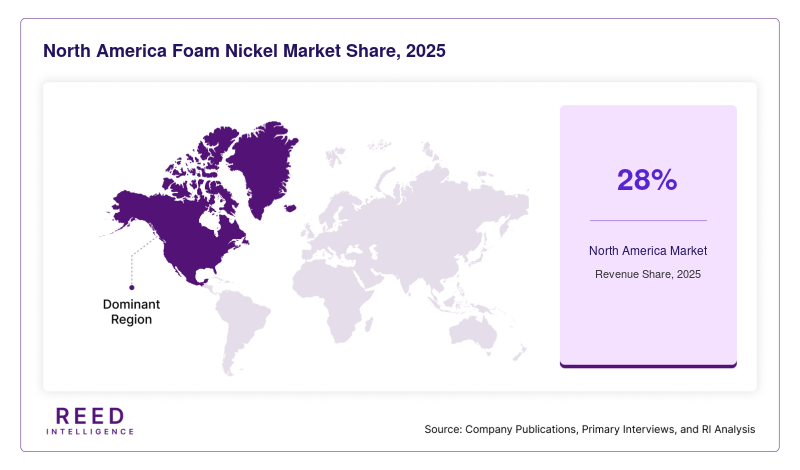
North America represents approximately 28% of the global Foam Nickel Market in 2025, supported by established advanced-materials manufacturing, battery research, fuel-cell development and specialty chemical processing.
The region has an active research ecosystem around nickel foam electrodes. American Elements supplies nickel foam in different porosity and conductivity configurations and reports its use in battery-development programs involving research institutions and private companies.
North American demand is also supported by fuel-cell and hydrogen research. Nickel foam has been investigated as a gas-diffusion-layer material for polymer electrolyte fuel cells, with research reporting more uniform concentration and current distributions compared with conventional carbon-based structures in the modeled system.
The region is projected to grow at approximately 6.5% CAGR through 2034. Demand is increasingly shifting toward engineered electrode materials rather than basic foam sheets.
The main constraints are relatively high manufacturing costs, competition from Asian suppliers and the availability of alternative porous substrates.
Europe Foam Nickel Market
Europe accounts for approximately 24% of the global market in 2025 and is projected to grow at approximately 6.8% CAGR.
The region has a strong research base in electrolysis, fuel cells, electrochemical synthesis and advanced materials. The 2026 Chemical Record review from researchers associated with the Max Planck Institute and Karlsruhe Institute of Technology highlights the established and expanding use of nickel foam in electrosynthesis, including oxidation, hydrogenation and reduction chemistry.
European demand is also supported by hydrogen-development programs and industrial efforts to reduce the cost of electrolysis. Nickel's relatively low cost compared with precious metals makes it attractive for alkaline environments.
However, environmental requirements, manufacturing costs and competition from alternative electrode materials can constrain large-scale deployment. Europe is therefore likely to remain an important market for high-performance and application-specific foam rather than the lowest-cost commodity material.
APAC Foam Nickel Market
APAC represents approximately 37% of the global Foam Nickel Market in 2025 and is the fastest-growing region, with approximately 9.0% CAGR.
The region benefits from extensive battery manufacturing, nickel processing, electrochemical-equipment production and porous-metal manufacturing. China, Japan, South Korea and India are important centers for energy-storage and electrochemical-material development.
Commercial suppliers in China offer nickel foam in multiple porosity, thickness and pore-density configurations, while HGP describes continuous nickel foam production for nickel batteries, fuel cells, filtration and catalysis.
The region is also an important research center for nickel-foam electrolysis. Recent studies from Asian research institutions have investigated surface engineering, catalyst deposition, nickel-foam thickness and hierarchical structures to improve alkaline hydrogen and oxygen evolution.
APAC's commercial advantage comes from integrated supply chains and large-scale manufacturing. Battery and electrochemical equipment producers can source porous nickel close to downstream production.
The main constraints are nickel-price volatility, intense supplier competition and differences in quality consistency between commodity and application-specific grades.
Middle East and Africa Foam Nickel Market
Middle East and Africa represents approximately 5% of the global market in 2025 and is projected to grow at approximately 7.4% CAGR.
Demand remains smaller than in APAC, North America and Europe but can increase as hydrogen projects, industrial filtration and chemical-processing infrastructure develop.
The region's strongest opportunity is linked to hydrogen production. Alkaline electrolysis uses nickel-based electrodes because nickel remains stable in concentrated alkaline electrolytes and is substantially less expensive than precious-metal systems.
The region is also relevant for water treatment and industrial filtration because porous nickel provides a combination of mechanical strength, conductivity and permeability.
Limited local porous-metal manufacturing means much of the material is supplied through imports, creating an opportunity for regional distribution and downstream electrode assembly.
LATAM Foam Nickel Market
LATAM accounts for approximately 6% of the global market in 2025 and is expected to grow at approximately 8.0% CAGR.
The region's demand base includes mining, chemical processing, batteries, electrochemical research and emerging hydrogen projects. Countries with established nickel, chemical and industrial-material industries can provide downstream opportunities for porous-metal products.
Hydrogen and electrochemical applications are likely to represent the principal expansion mechanism because nickel foam can function as a low-cost catalyst support and porous electrode in alkaline systems. Recent research has demonstrated that modifying nickel foam can improve electrolysis performance in both alkaline and saline environments.
LATAM remains constrained by limited large-scale porous-metal manufacturing and dependence on imported specialty materials. Suppliers with regional distribution and technical support can therefore improve market access.
Competitive Landscape
The Foam Nickel Market is relatively specialized, with competition based on pore structure, purity, thickness, mechanical strength, conductivity, surface treatment, consistency and customization capability.
HGP Advanced Materials Technology operates porous-metal production facilities in China and describes continuous nickel foam as a mass-production product for nickel batteries, fuel cells, filtration and catalysis. The company reports annual porous-metal production capacity of approximately 1.2 million units across its manufacturing system.
Huayan Metal Foam supplies nickel foam and related porous materials for energy storage, electrolysis, filtration, thermal management and aerospace. Its manufacturing approach emphasizes control of PPI, density, dimensions and customized processing.
American Elements supplies nickel foam in multiple grades and porosity configurations and reports use in battery-development programs involving government research organizations and private-sector companies.
Key Market Players
- HGP Advanced Materials Technology
- Sumitomo Electric Industries
- ERG Aerospace
- American Elements
- Stanford Advanced Materials
- Novamet Specialty Products
- Alantum
- Huayan Metal Foam
- Yi Yang Foammetal New Material
- Fuel Cell Materials
- MTI Corporation
- Corun
- KANOPY
- Beihai Composite Materials
- Advanced Material Technologies
Recent Market Developments
- September 2026 – Commercial suppliers expanded focus on nickel foam for water electrolysis. Current supplier offerings increasingly specify nickel foam for alkaline and AEM electrolyzers, including controlled thickness, PPI and porosity. This reflects a shift toward electrolysis-grade rather than generic porous nickel.
- August 2026 – Researchers demonstrated the effect of nickel-foam thickness on alkaline electrolysis. The study found that thicker foam improved bubble detachment and hydrogen production, providing evidence that thickness and pore architecture can directly influence electrolyzer performance.
Foam Nickel Market Segments
By Product Type
- Continuous Band-Shaped Nickel Foam
- High-Intensity & Ultra-Intense Binding Force Nickel Foam
- Other Foam Nickel
By Application
- Electrode Materials
- Fuel Cells & Electrolyzers
- Filtration & Catalysis
- Other Applications
By End Use
- Energy Storage
- Hydrogen & Fuel Cells
- Chemical Processing
- Electronics & EMI
- Other End Uses
By Region
- North America
- Europe
- APAC
- Middle East and Africa
- LATAM