Fogging Machine Market Size, Share Demand Report By Product Type (Thermal Fogging Machines, Cold Fogging Machines (ULV)), By Application (Pest Control, Disinfection & Sanitization, Agriculture, Industrial Cleaning), By End-Use Industry (Public Health Agencies, Commercial, Residential, Agriculture), By Power Source (Fuel-Powered, Electric-Powered), By Region & Segment Forecasts, 2026–2034
USD 3950
Market Overview
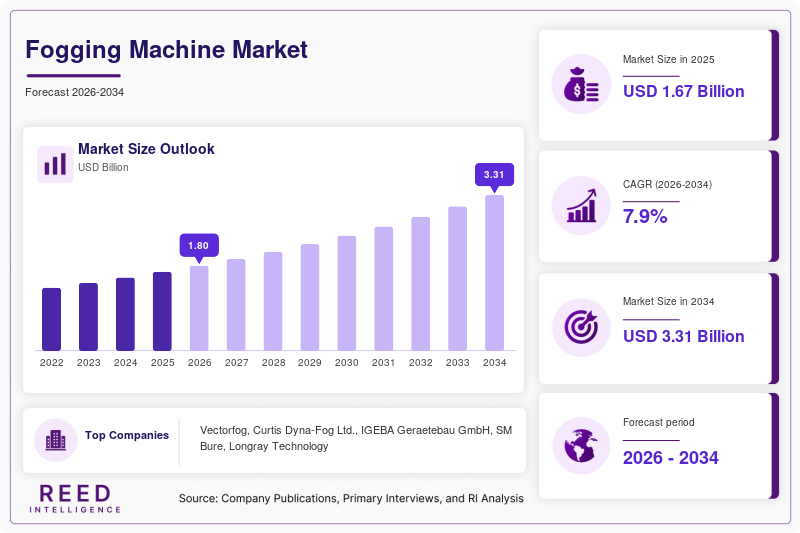
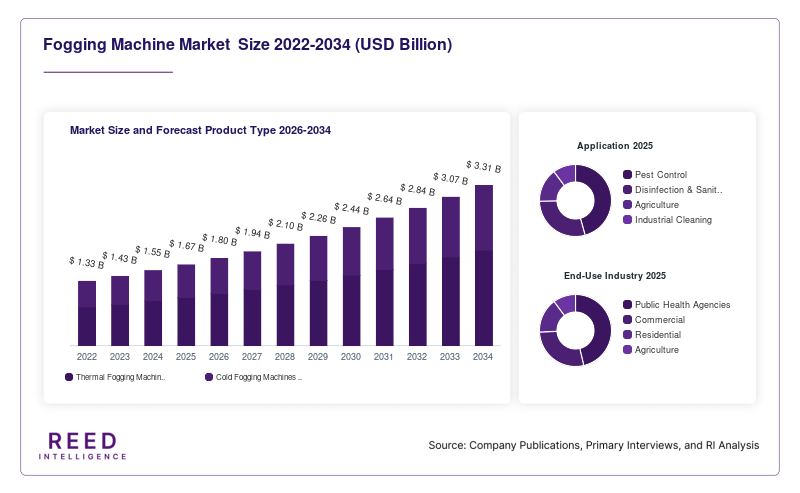
The Fogging Machine Market size was valued at approximately USD 1.67 billion in 2026 and is projected to reach USD 3.08 billion by 2034, expanding at a CAGR of 7.9% during the forecast period (2026–2034). The market is witnessing steady growth due to increasing demand for efficient disinfection, pest control, and sanitation solutions across residential, commercial, and industrial sectors.
A major global factor supporting the growth of the Fogging Machine Market is the heightened awareness of hygiene and disease prevention, particularly following global health concerns and outbreaks. Governments and private organizations are investing in sanitation infrastructure, driving the adoption of fogging machines for large-area disinfection and vector control.
Key Highlights
- Asia Pacific dominated the market with a share of 39.8% in 2025, while Latin America is expected to register the fastest growth at a CAGR of 8.6%.
- By product type, Thermal Fogging Machines held the leading share of 52.4% in 2025, whereas Cold Fogging Machines (ULV) are projected to grow at a CAGR of 8.3%.
- By application, Pest Control accounted for the largest share of 46.7% in 2025, while Disinfection & Sanitization is expected to expand at a CAGR of 8.9%.
- China, the dominant country, recorded a market value of USD 278 million in 2024, which increased to USD 296 million in 2025, supported by large-scale urban sanitation programs.
Market Trends
Increasing Adoption of ULV Cold Fogging Technology
The Fogging Machine Market is experiencing a shift toward ultra-low volume (ULV) cold fogging machines due to their efficiency and reduced chemical usage. These machines produce fine droplets that ensure uniform coverage, making them suitable for indoor applications and sensitive environments such as hospitals and food processing units.
Integration of Smart and Portable Fogging Solutions
Manufacturers are focusing on developing compact, battery-operated, and IoT-enabled fogging machines. These innovations allow real-time monitoring, remote operation, and improved user convenience, supporting wider adoption across residential and commercial settings.
Market Drivers
Rising Demand for Pest Control and Vector Management
The increasing prevalence of vector-borne diseases such as dengue and malaria is driving demand for fogging machines. Municipal bodies and health agencies are deploying fogging equipment for large-scale pest control initiatives, contributing to market growth.
Growth in Commercial and Industrial Sanitation Practices
Industries such as healthcare, hospitality, and food processing are adopting fogging machines to maintain hygiene standards. The need for efficient and time-saving disinfection methods is encouraging widespread usage across various sectors.
Market Restraint
Environmental and Chemical Exposure Concerns
Concerns regarding the environmental impact and potential health risks associated with chemical fogging agents act as a restraint in the Fogging Machine Market. Regulatory guidelines on chemical usage may limit adoption in certain applications.
Market Opportunities
Expansion of Public Health Programs
Government-led public health initiatives focusing on disease prevention and sanitation are creating opportunities for the Fogging Machine Market. Increased funding for vector control programs is expected to drive demand.
Growing Demand in Agricultural Applications
Fogging machines are increasingly being used in agriculture for pest control and crop protection. This presents an opportunity for manufacturers to develop specialized equipment tailored to farming needs.
Segmental Analysis
By Product Type
Thermal fogging machines dominated the Fogging Machine Market with a 52.4% share in 2025, owing to their effectiveness in outdoor pest control applications.
Cold fogging machines (ULV) are projected to grow at a CAGR of 8.3%, supported by their suitability for indoor disinfection and reduced chemical consumption.
By Application
Pest control accounted for the largest share of 46.7% in 2025, driven by increasing demand for vector control solutions in urban and rural areas.
Disinfection & sanitization is expected to grow at a CAGR of 8.9%, supported by rising hygiene awareness and demand in healthcare and commercial sectors.
By End-Use Industry
Public health agencies dominated the market with a 34.5% share in 2025, reflecting widespread use in government-led sanitation programs.
The agriculture sector is anticipated to grow at a CAGR of 8.4%, driven by the need for efficient pest management solutions.
By Power Source
Fuel-powered machines held the dominant share of 58.2% in 2025, due to their high efficiency and suitability for large-scale outdoor operations.
Electric-powered machines are expected to grow at a CAGR of 8.2%, supported by increasing demand for eco-friendly and portable solutions.
Regional Analysis
North America
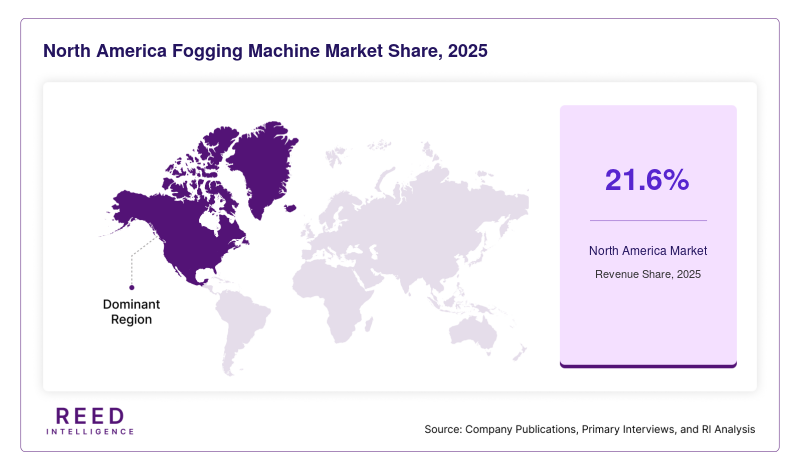
North America accounted for 21.6% of the market share in 2025 and is expected to grow at a CAGR of 7.2% during the forecast period. The United States dominated the region due to its well-established commercial sanitation sector and increasing adoption of advanced disinfection technologies.
Europe
Europe held a 18.9% market share in 2025 and is projected to grow at a CAGR of 7.0%. Germany emerged as the dominant country, supported by stringent hygiene regulations and widespread adoption of sanitation equipment across industries.
Asia Pacific
Asia Pacific led the Fogging Machine Market with a 39.8% share in 2025 and will expand at a CAGR of 8.1%. China dominated the region due to large-scale urbanization and government initiatives for public health and sanitation.
Middle East & Africa
The Middle East & Africa region captured 9.7% of the market share in 2025 and is anticipated to grow at a CAGR of 8.0%. Saudi Arabia led the region, driven by investments in healthcare infrastructure and sanitation programs.
Latin America
Latin America accounted for 10.0% of the market share in 2025 and is expected to grow at the fastest CAGR of 8.6%. Brazil dominated the region due to increasing efforts to control vector-borne diseases and improve public health standards.
Competitive Landscape
The Fogging Machine Market is moderately fragmented, with several global and regional players focusing on product innovation and distribution expansion. Vectorfog is recognized as a leading player, offering a wide range of fogging solutions for pest control and disinfection applications. Curtis Dyna-Fog Ltd. and IGEBA Geraetebau GmbH are prominent companies known for their advanced fogging technologies and strong global presence.
SM Bure contributes significantly with cost-effective solutions catering to emerging markets. Longray Technology is also active, providing diverse product offerings for commercial and industrial use. Companies are increasingly investing in research and development to introduce energy-efficient and environmentally friendly fogging machines. Strategic partnerships and expansion into emerging regions remain key growth strategies in the Fogging Machine Market.
Key Players List
- Vectorfog
- Curtis Dyna-Fog Ltd.
- IGEBA Geraetebau GmbH
- SM Bure
- Longray Technology
- HSC ULV Fogger
- Swingfog (IGEBA brand)
- Guangzhou Konnor Daily Necessities Co., Ltd.
- Zhejiang Ousen Machinery Co., Ltd.
- Taizhou City Luqiao Yaju Machinery Co., Ltd.
- Minfog Technology Co., Ltd.
- B&G Equipment Company
- Tomahawk Power LLC
- Clenaware Systems Ltd.
- PestWest Electronics Ltd.
Recent Developments
- In 2025, Vectorfog launched a new portable ULV fogging machine designed for indoor disinfection.
- Curtis Dyna-Fog introduced an upgraded thermal fogger with improved fuel efficiency.
- IGEBA expanded its product portfolio with smart fogging solutions featuring remote control capabilities.
- Longray Technology increased its production capacity to meet growing global demand.
- Tomahawk Power LLC developed a battery-operated fogging machine targeting residential users.
Fogging Machine Market Segments
Product Type
- Thermal Fogging Machines
- Cold Fogging Machines (ULV)
Application
- Pest Control
- Disinfection & Sanitization
- Agriculture
- Industrial Cleaning
End-Use Industry
- Public Health Agencies
- Commercial
- Residential
- Agriculture
Power Source
- Fuel-Powered
- Electric-Powered
By Region
- North America
- Europe
- APAC
- Middle East and Africa
- LATAM