Foldable Electric Vehicle Market Size, Share & Demand Report By Type (Foldable Electric Scooters, Foldable Electric Bikes, Foldable Microcars), By Battery Type (Lithium-Ion Batteries, Solid-State Batteries, Lead-Acid Batteries), By Application (Personal Commuting, Last-Mile Delivery, Shared Mobility), By End-Use (Individual Consumers, Commercial Users), By Distribution Channel (Online Retail, Specialty Mobility Stores, Automotive Dealerships, Direct-to-Consumer) & Segment Forecasts, 2026–2034
USD 3950
Market Overview
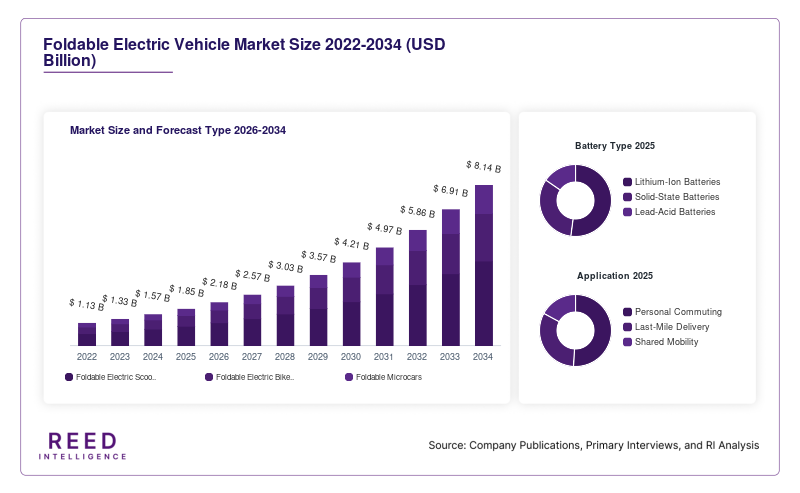
The Foldable Electric Vehicle Market size was valued at approximately USD 1.85 billion in 2026 and is projected to reach USD 6.95 billion by 2034, expanding at a CAGR of 17.9% during the forecast period (2026–2034). The market is gaining traction due to the increasing need for compact, lightweight, and portable mobility solutions, particularly in urban environments with high congestion and limited parking infrastructure.
A key global factor supporting market growth is the accelerated urbanization across emerging and developed economies. As cities become denser, consumers and governments are prioritizing space-efficient transportation solutions. Foldable electric vehicles, including compact e-bikes, scooters, and microcars, offer a practical solution by combining electric mobility with portability and storage convenience.

Key Highlights
- Asia Pacific dominated the market with a 41.3% share in 2025, while Europe is expected to be the fastest-growing region at a CAGR of 19.2%.
- By type, foldable electric scooters led with a 38.7% share, while foldable microcars are projected to grow at a CAGR of 20.5%.
- By battery type, lithium-ion batteries held the largest share, whereas solid-state batteries are expected to grow at a CAGR of 21.3%.
- China, the dominant country, recorded market values of USD 0.58 billion in 2024 and USD 0.67 billion in 2025.
Market Trends
Integration of Smart and Connected Features
The Foldable Electric Vehicle Market is increasingly witnessing the integration of smart technologies such as GPS tracking, mobile app connectivity, and remote diagnostics. Manufacturers are embedding IoT-based systems to enhance user convenience, safety, and performance monitoring. Features such as anti-theft alerts, battery health tracking, and ride analytics are becoming standard, particularly in premium product categories. This trend aligns with the broader shift toward intelligent mobility ecosystems.
Shift Toward Ultra-Lightweight and Modular Designs
There is a growing emphasis on reducing vehicle weight while improving structural durability. Manufacturers are adopting advanced materials such as carbon fiber composites and aerospace-grade aluminum alloys. Modular folding mechanisms are also evolving, allowing users to fold and unfold vehicles in seconds. This trend is particularly significant for last-mile delivery and urban commuters who prioritize portability and ease of storage.
Market Drivers
Rising Demand for Urban Micro-Mobility Solutions
The increasing congestion in urban areas has significantly boosted demand for compact mobility solutions. Foldable electric vehicles provide a flexible alternative to traditional transportation by enabling seamless integration with public transit systems. Consumers are increasingly adopting these vehicles for short-distance commuting due to their convenience, cost efficiency, and minimal parking requirements.
Government Support for Electric Mobility Adoption
Governments across regions are introducing policies and incentives to promote electric mobility. Subsidies, tax benefits, and infrastructure investments are encouraging the adoption of electric vehicles, including foldable variants. Urban mobility initiatives focused on reducing carbon emissions and improving air quality are further supporting market growth.
Market Restraint
Limited Load Capacity and Range Constraints
Despite their advantages, foldable electric vehicles face limitations in terms of load capacity and driving range. These vehicles are primarily designed for short-distance travel and lightweight usage, which restricts their applicability for broader transportation needs. Battery capacity constraints and compact design architectures often result in limited range compared to conventional electric vehicles.
Additionally, concerns regarding durability and stability in certain models may hinder adoption among consumers seeking long-term reliability. The perception of foldable vehicles as secondary or supplementary transportation solutions also affects market penetration. Manufacturers are addressing these challenges through innovation; however, balancing portability with performance remains a critical constraint.
Market Opportunities
Expansion in Last-Mile Delivery Applications
The rapid growth of e-commerce and on-demand delivery services presents a significant opportunity for the Foldable Electric Vehicle Market. Foldable vehicles are well-suited for last-mile delivery due to their compact size and maneuverability in congested urban environments. Logistics companies are increasingly adopting these vehicles to improve delivery efficiency and reduce operational costs.
Emerging Markets Adoption and Infrastructure Development
Developing regions are witnessing increased investments in urban mobility infrastructure. As awareness of electric mobility grows, foldable electric vehicles are expected to gain traction in these markets. Affordable product offerings and localized manufacturing strategies can further accelerate adoption. The expansion of charging infrastructure and supportive regulatory frameworks will play a crucial role in unlocking market potential.
Segmental Analysis
By Type
Foldable electric scooters dominated the Foldable Electric Vehicle Market, accounting for approximately 38.7% share in 2025. Their popularity is attributed to ease of use, affordability, and widespread adoption in urban commuting. Scooters offer a balance between portability and performance, making them a preferred choice among consumers.
Foldable microcars are expected to be the fastest-growing segment, registering a CAGR of 20.5% during the forecast period. These vehicles provide enhanced comfort and safety compared to scooters and bikes. The growing demand for compact yet enclosed transportation solutions is expected to drive segment growth.
By Battery Type
Lithium-ion batteries held the largest share of the market in 2025, accounting for approximately 64.2%. Their high energy density, longer lifecycle, and declining costs have made them the preferred choice for foldable electric vehicles.
Solid-state batteries are projected to grow at the fastest rate, with a CAGR of 21.3%. These batteries offer improved safety, higher energy density, and faster charging capabilities. Their adoption is expected to increase as technology matures and production costs decrease.
By Application
Personal commuting dominated the market with a 56.8% share in 2025, driven by the increasing demand for convenient and eco-friendly transportation options. Consumers are adopting foldable electric vehicles for daily travel, particularly in urban areas.
Last-mile delivery is expected to be the fastest-growing application, with a CAGR of 19.7%. The expansion of e-commerce and on-demand services is driving demand for efficient delivery solutions. Foldable vehicles offer flexibility and cost advantages for logistics operations.
By End-Use
Individual consumers accounted for the largest share of the market in 2025, representing approximately 61.4%. The growing awareness of sustainable mobility and increasing disposable income have contributed to segment growth.
Commercial users are expected to grow at a CAGR of 18.9%. Businesses are increasingly adopting foldable electric vehicles for delivery and mobility services. The focus on reducing operational costs and improving efficiency is driving adoption in this segment.
Regional Analysis
North America
North America accounted for approximately 21.5% of the Foldable Electric Vehicle Market share in 2025 and is projected to grow at a CAGR of 16.8% during 2026–2034. The region’s growth is driven by increasing consumer preference for sustainable and compact transportation solutions in urban centers. The adoption of foldable electric scooters and bikes has been particularly strong in metropolitan areas.
The United States dominated the regional market due to its advanced technological ecosystem and strong presence of innovative mobility startups. The increasing adoption of shared mobility services and integration with public transit systems has contributed to market expansion. Additionally, urban policies promoting low-emission transportation are supporting growth.
Europe
Europe held around 18.9% market share in 2025 and is expected to register the fastest growth at a CAGR of 19.2%. The region’s focus on sustainability and carbon neutrality has accelerated the adoption of electric mobility solutions, including foldable vehicles.
Germany emerged as the dominant country, driven by its strong automotive industry and emphasis on innovation. The adoption of foldable electric vehicles is supported by well-developed cycling infrastructure and government initiatives encouraging eco-friendly transportation. Urban mobility strategies aimed at reducing congestion further enhance market growth.
Asia Pacific
Asia Pacific led the market with a 41.3% share in 2025 and is anticipated to grow at a CAGR of 18.5%. Rapid urbanization, high population density, and increasing demand for affordable mobility solutions have fueled market expansion in the region.
China dominated the regional market due to its large-scale manufacturing capabilities and strong domestic demand. The country’s focus on electric mobility and investments in battery technology have significantly contributed to market growth. The widespread adoption of foldable electric scooters in urban areas further supports market expansion.
Middle East & Africa
The Middle East & Africa accounted for approximately 8.2% of the market share in 2025 and is projected to grow at a CAGR of 15.9%. The market is gradually expanding due to increasing urbanization and the need for efficient transportation solutions.
The United Arab Emirates led the region, driven by its smart city initiatives and investments in sustainable mobility infrastructure. The adoption of foldable electric vehicles is supported by government programs aimed at reducing carbon emissions and enhancing urban mobility.
Latin America
Latin America held around 10.1% share in 2025 and is expected to grow at a CAGR of 16.2%. The region’s market growth is influenced by rising urban congestion and increasing awareness of electric mobility solutions.
Brazil dominated the regional market due to its large urban population and growing demand for cost-effective transportation. The adoption of foldable electric vehicles is supported by improving infrastructure and increasing availability of affordable models.

Competitive Landscape
The Foldable Electric Vehicle Market is moderately fragmented, with several established players and emerging startups competing on innovation, pricing, and product differentiation. Key companies are focusing on enhancing battery performance, reducing weight, and integrating smart features to gain a competitive edge.
A leading player in the market is Xiaomi Corporation, which has strengthened its position through continuous product innovation and global expansion strategies. The company recently introduced a next-generation foldable electric scooter with enhanced battery life and smart connectivity features, catering to urban consumers.
Other players are adopting strategies such as partnerships, mergers, and regional expansion to increase their market presence. The competitive environment is characterized by rapid technological advancements and increasing investment in research and development.
Key Players
- Xiaomi Corporation
- Segway-Ninebot Group
- Razor USA LLC
- Swagtron
- Glion Dolly Inc.
- Brompton Bicycle Ltd.
- Tern Bicycles
- Dahon North America Inc.
- Honda Motor Co., Ltd.
- Toyota Motor Corporation
- Nissan Motor Co., Ltd.
- Ford Motor Company
- General Motors Company
- Gogoro Inc.
- Yadea Technology Group Co., Ltd.
Recent Developments
- In 2025, Xiaomi Corporation launched an advanced foldable electric scooter with AI-based ride optimization features.
- Segway-Ninebot introduced a lightweight foldable e-bike with extended battery range in 2024.
- Honda Motor Co., Ltd. unveiled a prototype foldable micro electric vehicle targeting urban mobility solutions.
- Gogoro Inc. expanded its battery-swapping ecosystem to support compact electric vehicles.
- Yadea Technology Group invested in solid-state battery research to enhance product performance.
Foldable Electric Vehicle Market Segments
Type
- Foldable Electric Scooters
- Foldable Electric Bikes
- Foldable Microcars
Battery Type
- Lithium-Ion Batteries
- Solid-State Batteries
- Lead-Acid Batteries
Application
- Personal Commuting
- Last-Mile Delivery
- Shared Mobility
End-Use
- Individual Consumers
- Commercial Users
Distribution Channel
- Online Retail
- Specialty Mobility Stores
- Automotive Dealerships
- Direct-to-Consumer (D2C)
By Region
- North America
- Europe
- APAC
- Middle East and Africa
- LATAM