Folding Bike Market Size, Share & Demand Report By Product Type (Manual Folding Bikes, Electric Folding Bikes), By Distribution Channel (Offline Retail, Online Retail), By End-Use (Commuter, Recreational) By Region & Segment Forecasts, 2026–2034
USD 3950
Market Overview
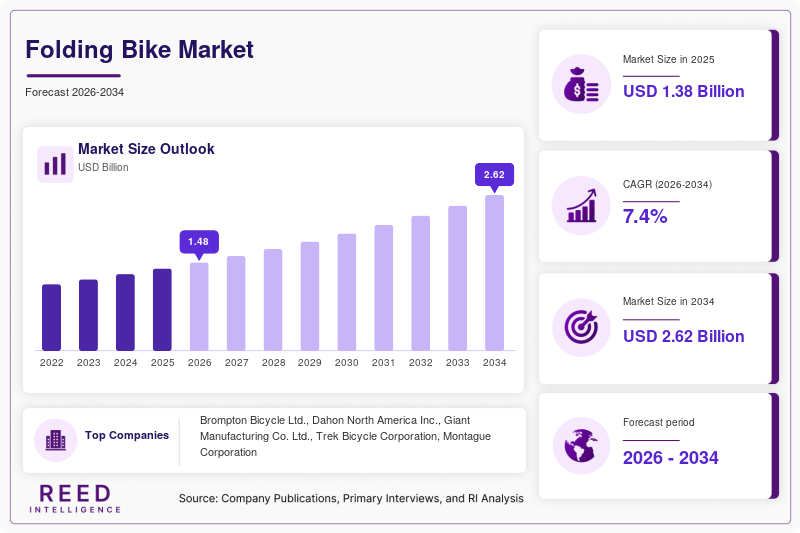
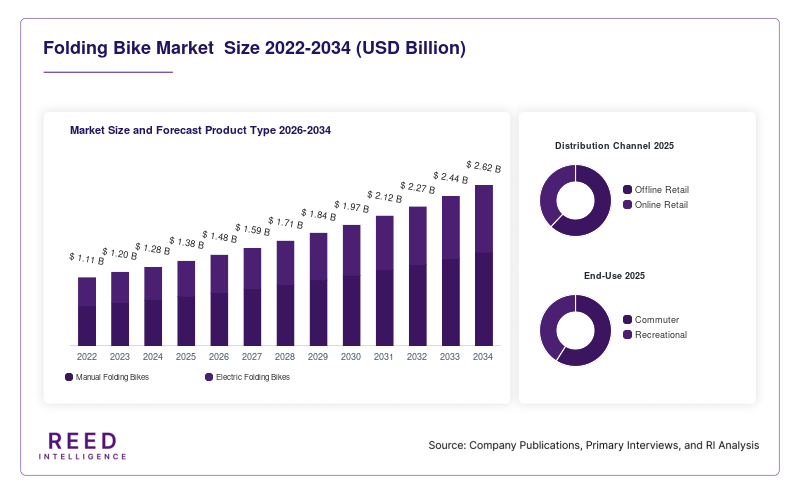
The Folding Bike Market size is estimated at USD 1.48 billion in 2026 and is projected to reach USD 2.62 billion by 2034, expanding at a CAGR of 7.4% during the forecast period (2026–2034). The market continues to gain traction due to increasing urban congestion and the rising demand for compact, flexible mobility solutions. Folding bicycles are becoming an integral part of urban transport ecosystems, especially in densely populated cities where storage space is limited and multimodal commuting is gaining acceptance. The integration of folding bikes with public transportation systems has further strengthened adoption rates, particularly in metropolitan regions.
One key global factor supporting market growth is the shift toward sustainable mobility. Governments across regions are implementing policies to reduce carbon emissions, encouraging cycling infrastructure development and promoting eco-friendly commuting alternatives. Folding bikes, due to their portability and ease of storage, align well with these initiatives, making them a preferred choice for short-distance travel and last-mile connectivity.
Key Highlights
- North America dominated the market with a 32.8% share in 2025.
- Asia Pacific is expected to grow at the fastest CAGR of 9.6% during 2026–2034.
- By product type, manual folding bikes accounted for the largest share of 61.3%, while electric folding bikes are projected to grow at a CAGR of 10.8%.
- By distribution channel, offline retail led with a 58.7% share, whereas online platforms are expected to expand at a CAGR of 9.9%.
- The United States remained the dominant country, with market values of USD 420 million in 2024 and USD 455 million in 2025.
Market Trends
Rising Adoption of Electric Folding Bikes
The increasing demand for electric folding bikes is shaping the Folding Bike Market significantly. Consumers are showing a preference for electric-assisted models due to their convenience in navigating longer distances and hilly terrains. These bikes combine portability with enhanced performance, making them suitable for both urban commuters and recreational users. Advancements in battery technology, including lightweight lithium-ion batteries with extended range, have improved the overall appeal of these products. Additionally, manufacturers are investing in compact motor integration without compromising foldability, which further enhances usability. The growing awareness of health benefits, combined with the need for efficient commuting, is also driving demand. Electric folding bikes are increasingly being adopted by office commuters who seek to reduce travel time while maintaining flexibility in transportation.
Integration with Smart Mobility Ecosystems
Another notable trend in the Folding Bike Market is the integration of folding bikes into smart mobility ecosystems. Urban planners and transportation authorities are focusing on multimodal transport solutions that combine bicycles with buses, trains, and shared mobility platforms. Folding bikes fit well within this framework due to their compact nature, allowing users to carry them onboard public transit. Smart features such as GPS tracking, app-based locking systems, and performance monitoring are also being incorporated into modern folding bikes. These technological enhancements improve user experience and safety, making folding bikes more attractive to tech-savvy consumers. Furthermore, partnerships between bike manufacturers and ride-sharing companies are expanding access to folding bikes, particularly in urban areas with high commuter density.
Market Drivers
Increasing Urbanization and Traffic Congestion
Rapid urbanization across the globe is a major driver for the Folding Bike Market. As cities become more crowded, traffic congestion has emerged as a critical challenge, leading commuters to seek alternative transportation solutions. Folding bikes offer a practical option for navigating congested streets, as they can be easily carried into offices, apartments, or public transport. This flexibility reduces dependency on traditional vehicles and shortens commute times. Governments are also supporting cycling infrastructure development, including dedicated bike lanes and parking facilities, which further encourages adoption. In densely populated cities, where space constraints are a concern, folding bikes provide a convenient and efficient solution for daily commuting.
Growing Environmental Awareness
Rising environmental concerns are another key factor driving the Folding Bike Market. Consumers are becoming more conscious of their carbon footprint and are actively seeking sustainable transportation alternatives. Folding bikes produce zero emissions and require minimal energy compared to motorized vehicles, making them an environmentally friendly option. Governments and environmental organizations are promoting cycling as a means to reduce air pollution and improve urban air quality. Incentives such as tax benefits, subsidies, and cycling campaigns are encouraging individuals to adopt bicycles, including folding variants. This growing emphasis on sustainability is expected to continue driving market growth over the forecast period.
Market Restraint
High Cost and Durability Concerns
One of the primary restraints in the Folding Bike Market is the relatively high cost of advanced models, particularly electric folding bikes. These products often include specialized components such as lightweight frames, compact folding mechanisms, and integrated electronics, which increase manufacturing costs. As a result, they are priced higher than conventional bicycles, limiting their accessibility to price-sensitive consumers. Additionally, concerns regarding durability and maintenance can affect consumer perception. Folding mechanisms, if not designed properly, may wear out over time, leading to potential safety issues. For instance, frequent folding and unfolding can impact structural integrity, especially in lower-quality models. This creates hesitation among buyers, particularly in emerging markets where cost and reliability are critical factors in purchasing decisions.
Market Opportunities
Expansion in Emerging Economies
Emerging economies present significant growth opportunities for the Folding Bike Market. Rapid urbanization, increasing disposable incomes, and expanding middle-class populations are driving demand for convenient and affordable transportation solutions. Countries in Asia Pacific and Latin America are witnessing increased adoption of bicycles as a cost-effective commuting option. Folding bikes, in particular, are gaining popularity due to their space-saving design and versatility. Governments in these regions are investing in cycling infrastructure and promoting eco-friendly transportation, which further supports market expansion. Local manufacturers are also entering the market with competitively priced products, making folding bikes more accessible to a wider consumer base.
Growth of E-commerce and Direct-to-Consumer Channels
The rise of e-commerce platforms is creating new opportunities for the Folding Bike Market. Online sales channels allow manufacturers to reach a broader audience and offer a diverse range of products. Consumers benefit from the convenience of browsing, comparing, and purchasing folding bikes from the comfort of their homes. Detailed product descriptions, customer reviews, and virtual demonstrations enhance the buying experience. Additionally, direct-to-consumer models enable companies to reduce distribution costs and offer competitive pricing. The increasing penetration of smartphones and internet connectivity is further driving online sales, particularly in developing regions. This trend is expected to play a crucial role in market growth during the forecast period.
Segmental Analysis
By Product Type
Manual folding bikes dominated the Folding Bike Market in 2024, accounting for a share of 61.3%. These bikes are widely preferred due to their affordability, lightweight design, and ease of maintenance. Consumers who prioritize simplicity and cost-effectiveness often choose manual models for short-distance commuting. Additionally, these bikes are popular among recreational users who value portability and convenience. The absence of electronic components reduces maintenance requirements, making them a reliable option for a broad range of users.
Electric folding bikes are the fastest-growing subsegment, expected to expand at a CAGR of 10.8% during the forecast period. The growth is driven by increasing demand for enhanced performance and convenience. Electric models offer assisted pedaling, making them suitable for longer commutes and varied terrains. Advancements in battery technology and motor efficiency are improving product performance, further boosting adoption rates.
By Distribution Channel
Offline retail channels held the largest share of 58.7% in 2024, driven by the preference for physical inspection and test rides before purchase. Consumers often rely on in-store experiences to evaluate product quality, comfort, and performance. Retail stores also provide personalized assistance and after-sales services, which enhance customer satisfaction. This segment continues to play a crucial role in market growth, particularly in regions where online penetration is limited.
Online distribution channels are expected to grow at a CAGR of 9.9% during the forecast period. The convenience of online shopping, combined with a wide range of product options, is driving this growth. E-commerce platforms enable consumers to compare prices, read reviews, and access detailed product information, making informed purchasing decisions easier.
By End-Use
The commuter segment dominated the Folding Bike Market in 2024, accounting for a significant share due to increasing urbanization and traffic congestion. Folding bikes are widely used for daily commuting, particularly in cities where space constraints and traffic challenges are prevalent. Their portability allows users to combine cycling with public transportation, making them a practical solution for urban mobility.
The recreational segment is the fastest-growing, with a projected CAGR of 8.7%. The growth is driven by increasing interest in outdoor activities and fitness. Folding bikes are gaining popularity among travelers and adventure enthusiasts due to their compact design and ease of transport. This segment is expected to contribute significantly to market expansion.
Regional Analysis
North America
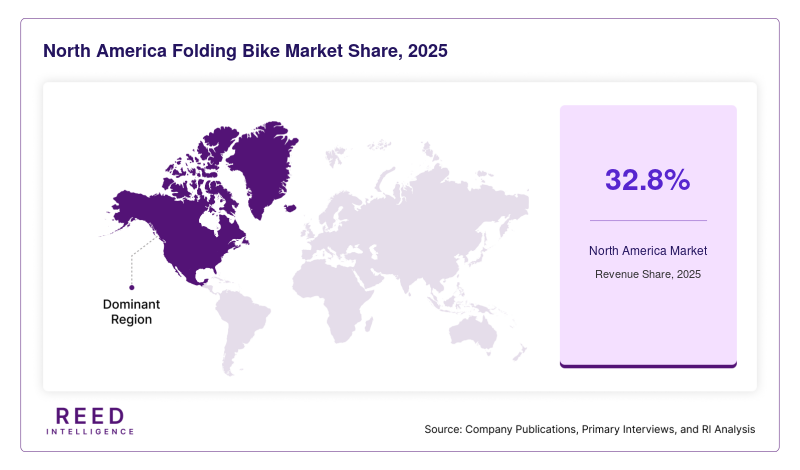
North America accounted for a 32.8% share of the Folding Bike Market in 2025 and is expected to grow at a CAGR of 6.9% during the forecast period. The region benefits from well-developed cycling infrastructure and a strong focus on sustainable transportation. Urban centers are increasingly adopting bike-friendly policies, which support the use of folding bikes for daily commuting. Additionally, the presence of established manufacturers and high consumer awareness contributes to steady market growth.
The United States remains the dominant country in this region, driven by increasing demand for eco-friendly mobility solutions. A key growth factor is the rising adoption of multimodal transportation, where folding bikes are used in combination with public transit systems. This trend is particularly evident in cities with heavy traffic congestion and limited parking space.
Europe
Europe held a significant share of the Folding Bike Market in 2025, accounting for 28.5%, and is projected to grow at a CAGR of 7.1%. The region’s strong cycling culture and government initiatives promoting sustainable transport are key drivers. Countries across Europe are investing heavily in cycling infrastructure, including dedicated bike lanes and parking facilities, which supports market expansion.
Germany leads the market in Europe, supported by a well-established cycling ecosystem and high environmental awareness. A unique growth factor is the integration of folding bikes into daily commuting routines, particularly among urban professionals who rely on efficient and flexible transport options.
Asia Pacific
Asia Pacific is expected to be the fastest-growing region in the Folding Bike Market, with a CAGR of 9.6% during 2026–2034. The region’s rapid urbanization and increasing population density are driving demand for compact mobility solutions. Governments are promoting cycling as a sustainable alternative to reduce traffic congestion and pollution.
China dominates the market in Asia Pacific due to its large population and strong manufacturing base. A key growth factor is the increasing adoption of electric folding bikes, supported by government incentives and advancements in battery technology, which enhance product performance and affordability.
Middle East & Africa
The Middle East & Africa region accounted for a smaller share of the Folding Bike Market in 2025 but is expected to grow at a CAGR of 6.5%. The market is gradually gaining traction as urban areas expand and awareness of sustainable transportation increases. Investments in infrastructure development are also supporting growth.
The United Arab Emirates is a leading market in this region, driven by initiatives to promote eco-friendly transport. A unique growth factor is the development of smart cities, where folding bikes are integrated into modern mobility solutions to enhance urban living standards.
Latin America
Latin America held a moderate share of the Folding Bike Market in 2025 and is projected to grow at a CAGR of 7.3%. The region is witnessing increasing adoption of bicycles as a cost-effective commuting option. Urbanization and rising fuel prices are encouraging consumers to explore alternative transportation methods.
Brazil leads the market in Latin America, supported by growing awareness of environmental sustainability. A key growth factor is the expansion of cycling infrastructure in major cities, which promotes the use of folding bikes for daily commuting and recreational activities.
Competitive Landscape
The Folding Bike Market is characterized by the presence of both established players and emerging companies focusing on innovation and product differentiation. Leading companies are investing in research and development to introduce advanced features such as lightweight materials, improved folding mechanisms, and electric assistance. Strategic partnerships and collaborations are also common, enabling companies to expand their market presence and reach new customer segments.
One of the leading players in the market is Brompton Bicycle Ltd., known for its high-quality folding bikes and strong brand recognition. The company recently introduced a new line of electric folding bikes with enhanced battery performance, reflecting its focus on innovation. Other companies are also adopting similar strategies, emphasizing product development and expansion into emerging markets.
Key Players
- Brompton Bicycle Ltd.
- Dahon North America Inc.
- Giant Manufacturing Co. Ltd.
- Trek Bicycle Corporation
- Montague Corporation
- Tern Bicycles
- Raleigh UK Ltd.
- Bike Friday
- Gocycle
- Decathlon S.A.
- Citizen Bike
- Vilano Bikes
- Schwinn Bicycle Company
- Hummingbird Bike Company
- Oyama Bicycles
Recent Developments
- Brompton Bicycle Ltd. launched an upgraded electric folding bike with improved battery range and lightweight design.
- Tern Bicycles introduced a new compact folding model targeting urban commuters.
- Giant Manufacturing Co. Ltd. expanded its folding bike portfolio with advanced materials for enhanced durability.
Folding Bike Market Segments
Product Type
- Manual Folding Bikes
- Electric Folding Bikes
Distribution Channel
- Offline Retail
- Online Retail
End-Use
- Commuter
- Recreational
By Region
- North America
- Europe
- APAC
- Middle East and Africa
- LATAM