Food Absorbent Pads Market Size, Share, Demand Report By Type (Hard Pads, Soft Pads, Multilayer Composite Pads, Biodegradable Absorbent Pads), By Application (Red Meat, Poultry, Fish and Seafood, Fruits & Vegetables), By Region & Segment Forecasts, 2026–2034
USD 3950
Food Absorbent Pads Market Size
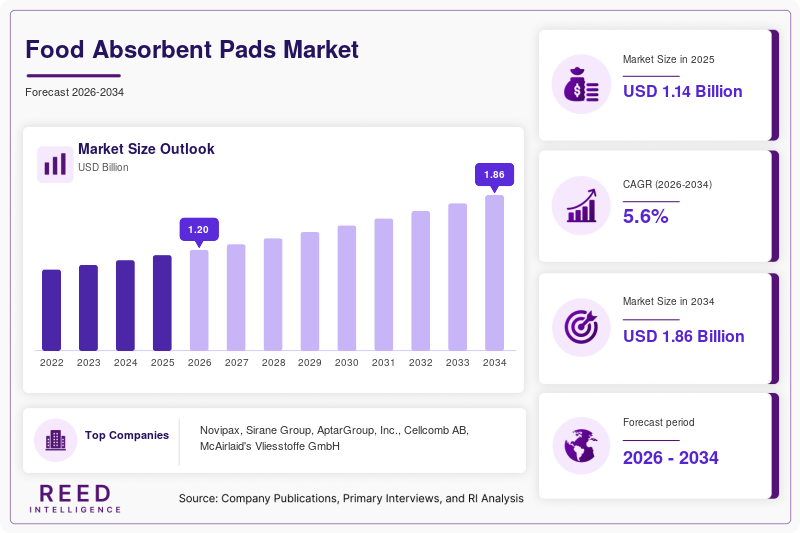
Food Absorbent Pads market size is projected at USD 1.20 billion in 2026 and is expected to hit USD 1.86 billion by 2034 with a CAGR of 5.6%. The market is supported by increasing use of moisture-control packaging for meat, poultry, seafood, and fresh produce. Detailed market data covering product types, application demand, production volumes, regional consumption, and competitive positioning is important for understanding investment opportunities and evolving packaging requirements.
Key takeaways
- North America dominated the global market with approximately 30.4% share in 2025, while Asia Pacific is expected to register the fastest growth at approximately 7.2% CAGR through 2034.
- Soft Pads represented the largest type segment with approximately 37.8% market share in 2025, while biodegradable absorbent pads are expected to be the fastest-growing type at approximately 8.4% CAGR.
- Red Meat represented the leading application with approximately 34.5% market share in 2025, supported by high purge levels generated during refrigerated storage and transportation.
- China is expected to remain an important emerging market, reaching approximately USD 245 million by 2034 at a CAGR of nearly 7.5%.
- India is expected to record a CAGR of approximately 8.1% through 2034, supported by growth in packaged meat, poultry, seafood, modern grocery retail, and cold-chain infrastructure.
The Food Absorbent Pads market includes specialized absorbent packaging inserts designed to capture excess liquid, purge, drip loss, and condensation released by fresh and chilled food products. These pads are generally manufactured using cellulose fibers, airlaid materials, nonwoven substrates, superabsorbent polymers, polyethylene films, and multilayer structures. They are positioned underneath food products inside trays, containers, and other retail packaging formats. Global production was estimated at approximately 12.5 billion units in 2025 and is expected to exceed 19 billion units by 2034. Meat and poultry remain the largest consumption base, while seafood and fresh produce are becoming increasingly important. Soft pads accounted for approximately 37.8% of market value in 2025, while red meat represented around 34.5% of application demand. Increasing penetration of packaged fresh food, modified-atmosphere packaging, refrigerated distribution, and convenience-oriented food formats continues to support market adoption.
Food Absorbent Pads Market Trends
Shift Toward High-Absorption and Thin Pad Technologies
Manufacturers are increasingly developing thinner absorbent pads that provide higher liquid-retention capacity without increasing package thickness. Modern structures combine cellulose, superabsorbent polymers, nonwoven distribution layers, and liquid-barrier films to improve absorption speed and retention under compression. This technology shift is particularly important for automated packaging lines, where pad thickness, positioning accuracy, sealing compatibility, and dimensional stability directly affect production efficiency. Multilayer constructions are gaining adoption in meat, poultry, and seafood applications where higher liquid loads require greater absorption capacity.
Growing Demand for Sustainable Food Packaging
Sustainability is becoming a major technology and purchasing consideration in food packaging. Food processors and retailers are increasingly evaluating cellulose-rich, recyclable, compostable, and reduced-plastic absorbent structures. Bio-based materials are being developed to replace or reduce conventional plastic components while maintaining absorption performance. Sector-specific demand is strongest in fresh meat, seafood, berries, mushrooms, leafy vegetables, and ready-to-cook food products where moisture accumulation can reduce visual quality and increase product losses.
Food Absorbent Pads Drivers
Expansion of Packaged Fresh Food Consumption
Growing consumption of packaged meat, poultry, seafood, and fresh produce is a major driver for food absorbent pads. Food processors and retailers use these products to manage purge liquid, maintain clean package presentation, reduce leakage, and support product quality during refrigerated storage and transportation. Expansion of supermarkets, organized food retail, online grocery delivery, and ready-to-cook products is increasing the number of packaged food units requiring moisture-control solutions.
Food Absorbent Pads Restraints
Raw Material Price Volatility
Fluctuating prices of cellulose pulp, superabsorbent polymers, nonwoven materials, polyethylene films, and specialty adhesives can increase manufacturing costs. Food packaging suppliers operate under strong cost pressure because absorbent pads are high-volume consumable components with relatively low individual unit prices. Sustainable materials can also carry higher production costs, limiting rapid conversion from conventional structures in price-sensitive food packaging markets.
Food Absorbent Pads Opportunities
Development of Bio-Based and Recyclable Absorbent Structures
The transition toward sustainable food packaging creates significant opportunities for manufacturers of bio-based and recyclable absorbent pads. Companies can develop cellulose-based cores, SAP-free structures, compostable materials, and reduced-plastic designs that meet the performance requirements of fresh-food packaging. Additional opportunities exist in premium seafood, fresh-cut produce, meal kits, food delivery, and export-oriented food processing where high absorption and extended distribution periods require specialized pad designs.
Challenges in Food Absorbent Pads
Balancing Absorption Capacity, Cost, and Packaging Compatibility
Manufacturers face the challenge of delivering high absorption and liquid retention while maintaining competitive pricing, low thickness, food-contact suitability, and compatibility with automated packaging equipment. Pad performance can vary according to food type, temperature, liquid viscosity, package geometry, compression, and storage duration. Sustainable materials must also provide comparable performance to conventional products, creating additional formulation and testing requirements.
Food Absorbent Pads Market Segmentation Analysis
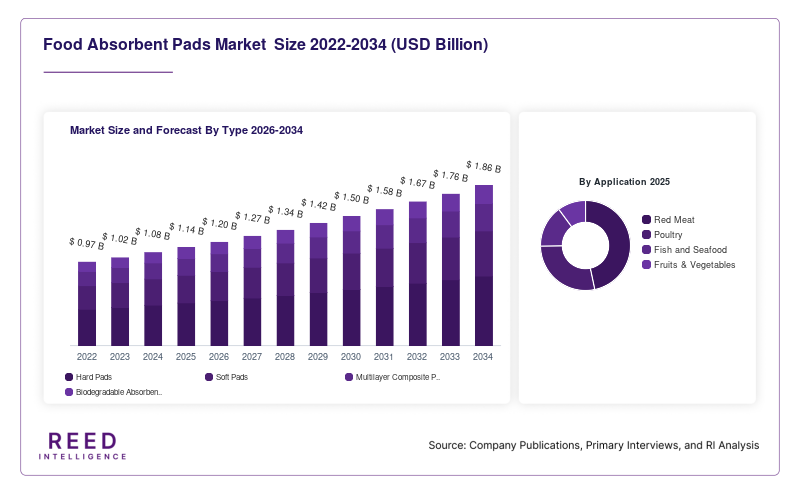
By type, Soft Pads accounted for approximately 37.8% of the global market in 2025, followed by Hard Pads at 29.6%, Multilayer Composite Pads at 23.1%, and Biodegradable Absorbent Pads at 9.5%. By application, Red Meat held approximately 34.5% share, followed by Poultry at 27.8%, Fish and Seafood at 20.7%, and Fruits & Vegetables at 17.0%. Demand patterns are closely linked to purge generation, packaging format, shelf-life requirements, and the scale of chilled-food distribution.
By Type
Hard Pads represented approximately 29.6% of the market in 2025, corresponding to an estimated 3.7 billion units. These pads generally use relatively rigid multilayer constructions designed to maintain dimensional stability during automated packaging and transportation. Typical thickness ranges from approximately 2–6 mm depending on absorption capacity and package design. Hard pads are commonly used for heavier meat portions and applications where structural stability and controlled liquid collection are important. Their strong resistance to compression makes them suitable for high-volume food processing environments.
Soft Pads accounted for approximately 37.8% share in 2025, representing nearly 4.7 billion units. They typically use flexible cellulose, airlaid, or nonwoven absorbent layers combined with moisture-resistant backing. Thickness commonly ranges from approximately 1–4 mm. Soft pads conform more easily to irregular food surfaces and tray geometries, making them widely used for red meat, poultry, fish, and fresh produce. Their flexibility, relatively low material consumption, and suitability for automated placement support their leading market position.
Multilayer Composite Pads represented approximately 23.1% of market demand in 2025, corresponding to nearly 2.9 billion units. These products combine multiple functional layers, including absorbent cores, distribution layers, superabsorbent polymers, and liquid-barrier films. Advanced constructions can provide substantially higher liquid retention than conventional cellulose-only structures. They are particularly suitable for seafood, high-purge meat, poultry, and premium chilled products requiring strong leak prevention and extended storage performance.
Biodegradable Absorbent Pads represented approximately 9.5% of market value in 2025, equivalent to roughly 1.2 billion units. These products use renewable cellulose fibers, plant-derived materials, biodegradable polymers, or reduced-plastic constructions. Product development focuses on achieving high absorption while reducing environmental impact. The segment is expected to record the fastest growth as retailers and food brands increase sustainability requirements and seek alternatives to conventional plastic-intensive packaging structures.
By Application
Red Meat accounted for approximately 34.5% of the global market in 2025, with consumption estimated at around 4.3 billion units. Beef, pork, lamb, and other red meat products can release significant purge during refrigerated storage. Absorbent pads are therefore widely used beneath fresh meat portions in retail trays. Large processors favor pads offering high retention, resistance to compression, and compatibility with modified-atmosphere packaging. Rising demand for packaged fresh meat and premium portion-controlled products is supporting continued adoption.
Poultry represented approximately 27.8% of the market in 2025, corresponding to about 3.5 billion units. Chicken, turkey, and other poultry products frequently require moisture-management solutions because liquid accumulation can negatively affect package appearance and handling. Flexible cellulose and multilayer pads are increasingly used in poultry trays, family packs, marinated products, and ready-to-cook formats. Automated processing and high-volume poultry production make this application an important recurring demand segment.
Fish and Seafood accounted for approximately 20.7% share in 2025, representing roughly 2.6 billion units. Salmon, tuna, shrimp, white fish, shellfish, and other chilled seafood products require effective moisture control during refrigerated transportation. High-retention pads are increasingly used in export packaging and premium retail formats. Expansion of seafood cold chains and longer distribution distances is increasing demand for multilayer products with strong liquid retention and leak-control properties.
Fruits & Vegetables represented approximately 17.0% of market demand in 2025, equivalent to nearly 2.1 billion units. Fresh berries, mushrooms, leafy vegetables, cut fruits, tomatoes, and other high-moisture products can generate condensation and surface moisture inside packages. Thin soft pads and nonwoven structures are preferred for many applications because they occupy limited package space while controlling moisture. Growth in fresh-cut produce and premium retail packaging is creating additional demand.
Food Absorbent Pads Market Regional Analysis
North America Food Absorbent Pads Market
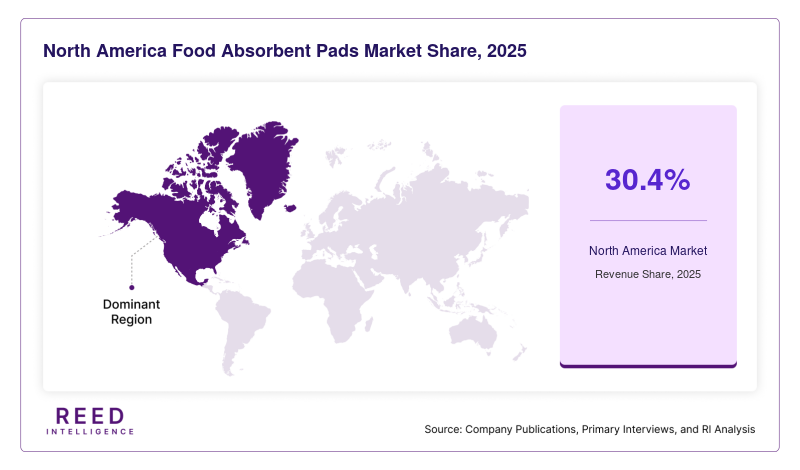
North America held approximately 30.4% market share in 2025 and remained the largest regional market. The United States accounts for the majority of regional demand, supported by extensive packaged meat, poultry, seafood, and fresh-produce distribution. Canada contributes through its processed food and retail packaging industries. Meat and poultry represent the largest regional application, followed by seafood and fresh produce. High adoption of automated packaging and advanced refrigerated distribution supports recurring demand for high-performance absorbent pads.
Europe Food Absorbent Pads Market
Europe represented approximately 26.8% of the global market in 2025. Germany, the United Kingdom, France, Italy, Spain, and the Netherlands are major contributors. The regional market is strongly influenced by food safety requirements, supermarket penetration, advanced cold-chain logistics, and sustainability targets. Meat and poultry remain the largest applications, while seafood and fresh produce are gaining importance. Demand for cellulose-rich and recyclable pad constructions is increasing across premium food packaging programs.
Asia Pacific Food Absorbent Pads Market
Asia Pacific accounted for approximately 25.1% share in 2025 and is projected to be the fastest-growing region through 2034. China, Japan, South Korea, India, and Australia are the primary contributors. China represents the largest market in the region, while India is expected to achieve strong growth as organized food retail, packaged protein consumption, food processing, and cold-chain infrastructure expand. Meat and poultry currently dominate demand, while seafood and fresh produce are experiencing increasing adoption.
Latin America Food Absorbent Pads Market
Latin America contributed approximately 10.2% of global market revenue in 2025. Brazil and Mexico are the principal markets, supported by large meat and poultry processing industries and expanding modern retail channels. Meat applications dominate the regional sector split, followed by seafood and fruits & vegetables. Growth in food exports is increasing the importance of packaging solutions capable of maintaining product quality during long-distance refrigerated transportation.
Middle East & Africa Food Absorbent Pads Market
Middle East & Africa represented approximately 7.5% of global demand in 2025. Saudi Arabia, the UAE, and South Africa are key contributors. Modern grocery retail, growing poultry consumption, imported chilled food, hospitality demand, and investment in food processing are supporting regional adoption. Poultry and red meat account for the largest sector share, while seafood applications are expanding in Gulf markets with developed cold-chain and retail infrastructure.
Top Players in the Food Absorbent Pads Market
- Novipax
- Sirane Group
- AptarGroup, Inc.
- Cellcomb AB
- McAirlaid's Vliesstoffe GmbH
- Gelok International
- Elliott Absorbent Products
- Sealed Air Corporation
- Paper Pak Industries
- Thermasorb
- Tite-Dri Industries
- Absortech Group
Recent Developments in Food Absorbent Pads Market
- February 2024: Sirane Group expanded recyclable absorbent pad solutions for fresh poultry and other protein packaging applications, supporting the industry's transition toward lower-plastic packaging structures.
- June 2024: Novipax expanded its food absorbent pad manufacturing capabilities in North America to address increasing demand from meat, poultry, and seafood processors.
- September 2024: Aptar Food Protection advanced moisture-control solutions designed for chilled seafood and fresh-protein packaging applications.
- March 2025: McAirlaid's Vliesstoffe increased its focus on cellulose-based absorbent materials for sustainable food packaging applications in European markets.
- January 2026: Food packaging manufacturers accelerated development of thinner, higher-retention absorbent pad structures and recyclable material combinations for fresh meat, poultry, seafood, and produce packaging.
Food Absorbent Pads Market Segments
By Type
- Hard Pads
- Soft Pads
- Multilayer Composite Pads
- Biodegradable Absorbent Pads
By Application
- Red Meat
- Poultry
- Fish and Seafood
- Fruits & Vegetables
By Region
- North America
- Europe
- APAC
- Middle East and Africa
- LATAM