Food Blue 5 Market Size, Share & Demand Report By Form (Liquid Food Blue 5, Powder Food Blue 5, Gel Food Blue 5), By Application (Beverages, Confectionery, Bakery Products, Dairy Products), By End User (Beverage Manufacturers, Food Processing Companies, Bakery Producers, Confectionery Manufacturers), By Distribution Channel (Direct Sales, Specialty Ingredient Suppliers, Online B2B Platforms), By Region & Segment Forecasts, 2026–2034
USD 3950
Market Overview
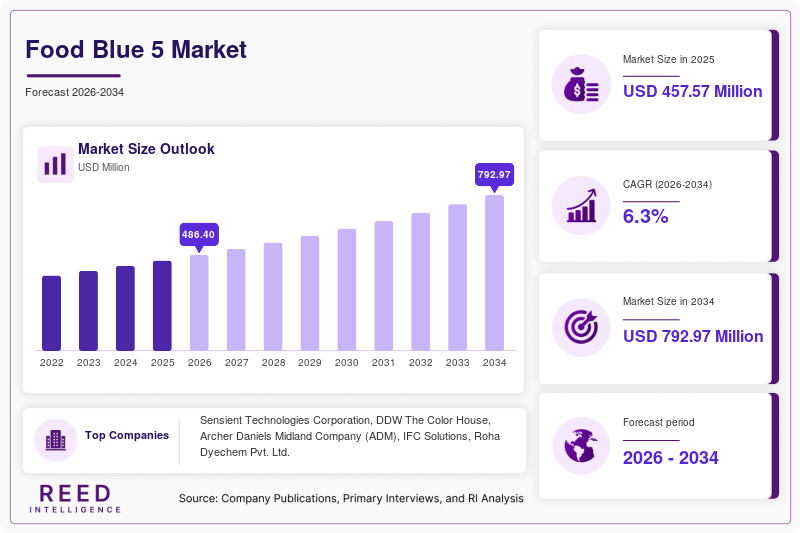
The Food Blue 5 Market size is estimated at USD 486.4 million, and it is projected to reach USD 792.8 million by 2034, registering a CAGR of 6.3% during 2026–2034. A major global factor supporting the growth of the Food Blue 5 Market is the rising consumption of processed and packaged foods with enhanced visual presentation. Food manufacturers are increasingly using certified synthetic color additives to improve product differentiation, brand recognition, and consumer appeal across competitive retail environments.
The market is also benefiting from rapid expansion in confectionery innovation, flavored beverage production, and convenience food manufacturing. Growing urbanization and increasing disposable incomes are further contributing to the adoption of food-grade coloring agents across global food processing industries.
Key Highlights
- Highest share region (2025): North America – 34.8%
- Fastest-growing region CAGR (2026–2034): Asia Pacific – 7.5%
- Leading subsegment (Application): Beverages – 2025 share 36.1%
- Fastest-growing subsegment (Form): Liquid Food Blue 5 – CAGR 7.2%
- Dominant country (2024): United States – USD 0.14 billion
- Dominant country (2025): United States – USD 0.15 billion
Market Trends
Expansion of Vibrant Beverage Formulations
One major trend shaping the Food Blue 5 Market is the increasing demand for colorful energy drinks, flavored waters, sports beverages, and cocktails. Beverage manufacturers are utilizing Food Blue 5 to create visually distinctive products that attract younger consumers and improve shelf visibility.
Growth in Customized Confectionery Products
Another notable trend in the Food Blue 5 Market is the rising popularity of customized confectionery items for seasonal events, celebrations, and themed product launches. Candy and dessert manufacturers are increasingly adopting bright synthetic food colors to create innovative product presentations.
Market Drivers
Rising Consumption of Processed Food Products
The growing consumption of packaged snacks, confectionery, ready-to-eat meals, and bakery products is significantly driving the Food Blue 5 Market. Food manufacturers are incorporating synthetic food colors to maintain visual consistency and improve product attractiveness in highly competitive retail markets.
Increasing Demand from Beverage Manufacturers
The expanding beverage industry is another major driver supporting market growth. Carbonated drinks, flavored syrups, sports drinks, and alcoholic beverages frequently utilize Food Blue 5 to achieve stable and vibrant coloring properties across large-scale production processes.
Market Restraint
Regulatory Concerns Regarding Synthetic Food Additives
One major restraint affecting the Food Blue 5 Market is the increasing regulatory scrutiny regarding artificial food coloring ingredients. Several countries are implementing stricter labeling requirements and usage limitations for synthetic additives, impacting manufacturer compliance costs.
Market Opportunities
Development of Hybrid Natural-Synthetic Formulations
Manufacturers are increasingly investing in hybrid coloring technologies that combine synthetic stability with natural ingredient positioning. This trend is creating growth opportunities for the Food Blue 5 Market by helping producers balance performance and consumer preferences.
Expansion in Emerging Packaged Food Markets
Rapid urbanization and changing dietary habits in developing economies are generating strong opportunities for the market. Expanding retail infrastructure and rising processed food consumption are increasing demand for food-grade color additives across emerging consumer markets.
Segmental Analysis
By Form
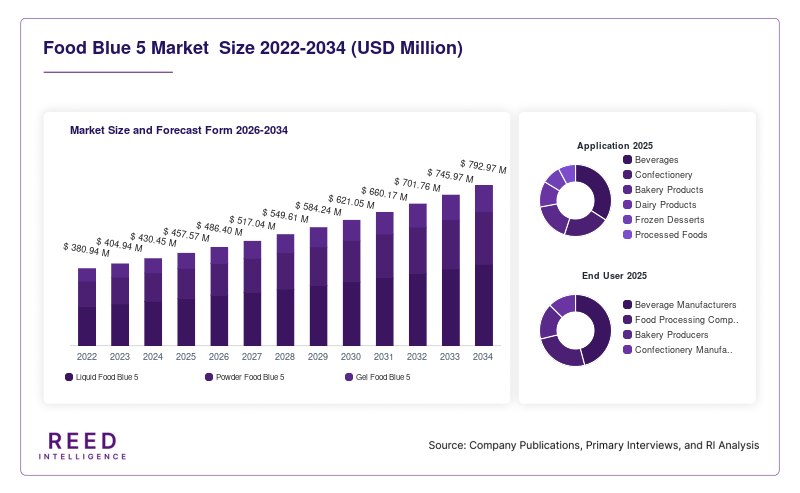
The Food Blue 5 Market is segmented into liquid, powder, and gel forms. Liquid Food Blue 5 dominated with a 48.7% share in 2025 due to its easy mixing capability, consistent dispersion, and broad application across beverage and confectionery manufacturing.
Gel-based Food Blue 5 is projected to grow at the fastest CAGR of 7.2% (2026–2034) due to increasing demand from bakery decoration and specialty dessert applications requiring concentrated color formulations.
By Application
Applications include beverages, confectionery, bakery products, dairy products, frozen desserts, and processed foods. Beverages accounted for 36.1% share in 2025 within the Food Blue 5 Market, driven by high utilization in carbonated drinks, sports beverages, flavored syrups, and alcoholic beverages.
Frozen desserts are expected to grow at the fastest CAGR of 7.0%, supported by increasing product innovation in ice creams, frozen yogurts, and novelty dessert products.
By End User
End users include food processing companies, beverage manufacturers, bakery producers, and confectionery manufacturers. Beverage manufacturers held 39.6% share in 2025 due to continuous production of flavored and visually enhanced drinks across global markets.
Confectionery manufacturers are projected to grow at the fastest CAGR of 6.9% during the forecast period due to increasing demand for colorful candy products and customized sweets for seasonal consumption.
By Distribution Channel
Distribution channels include direct sales, specialty ingredient suppliers, online B2B platforms, and food additive distributors. Direct sales accounted for 44.3% share in 2025 due to long-term procurement agreements between ingredient suppliers and large food manufacturers.
Online B2B platforms are projected to grow at the fastest CAGR of 7.4% during 2026–2034 due to increasing digitization of industrial ingredient procurement systems.
Regional Analysis
North America
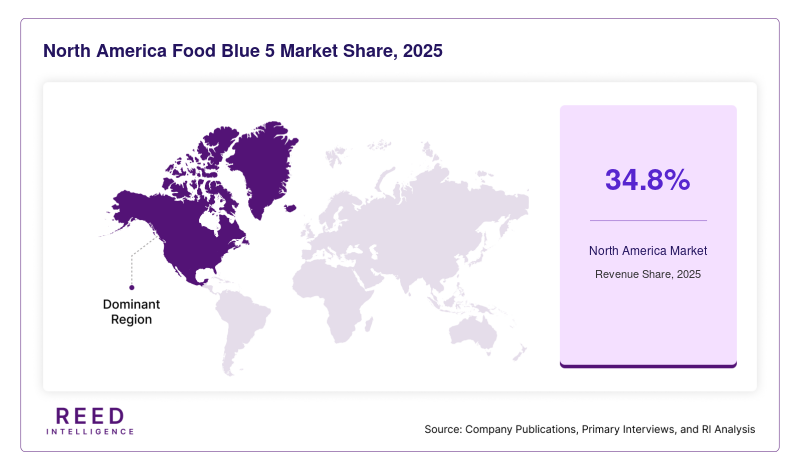
North America accounted for 34.8% share of the Food Blue 5 Market in 2025, supported by high processed food consumption and strong beverage manufacturing industries. The region is expected to grow at a CAGR of 5.9% (2026–2034). The United States dominates due to extensive use of synthetic food colors across confectionery and soft drink manufacturing sectors.
Europe
Europe held 28.3% share in 2025, driven by strong bakery and confectionery industries along with stable demand for packaged food products. The region is projected to grow at a CAGR of 5.7% (2026–2034). Germany leads the regional market due to high industrial food production and increasing innovation in premium confectionery manufacturing.
Asia Pacific
Asia Pacific captured 24.9% share in 2025 and is projected to grow at the fastest CAGR of 7.5% (2026–2034) in the Food Blue 5 Market. China remains the dominant country due to rapid growth in beverage manufacturing, rising packaged food consumption, and expanding retail distribution networks.
Middle East & Africa
Middle East & Africa accounted for 6.3% share in 2025, with a projected CAGR of 6.1% (2026–2034). Growth is supported by increasing demand for confectionery products and rising consumption of flavored beverages. Saudi Arabia dominates the regional market due to expanding processed food imports and growing urban consumer demand.
Latin America
Latin America represented 5.7% share in 2025 and is projected to grow at a CAGR of 5.8% during 2026–2034. Brazil leads the regional market due to increasing beverage production and growing demand for colorful confectionery and bakery products.
Competitive Landscape
The Food Blue 5 Market is moderately consolidated, with major food ingredient manufacturers competing through product consistency, regulatory compliance, and large-scale supply capabilities. Companies are increasingly focusing on high-purity formulations, improved stability characteristics, and customized color solutions for food and beverage manufacturers.
Leading participants in the market include Sensient Technologies Corporation, DDW The Color House, ADM, IFC Solutions, and Roha Dyechem Pvt. Ltd. Sensient Technologies Corporation remains one of the prominent market players due to its diversified food color portfolio and strong distribution network across global food processing industries. Companies are also investing in advanced formulation technologies and regional production expansion strategies to strengthen supply chain efficiency and meet evolving food industry requirements.
Key Players List
- Sensient Technologies Corporation
- DDW The Color House
- Archer Daniels Midland Company (ADM)
- IFC Solutions
- Roha Dyechem Pvt. Ltd.
- GNT Group
- Kalsec Inc.
- DSM-Firmenich
- Naturex S.A.
- BASF SE
- Chr. Hansen Holding A/S
- Döhler Group
- Allied Biotech Corporation
- Dynemic Products Ltd.
- Vinayak Ingredients India Pvt. Ltd.
Recent Developments
- 2025: Several food ingredient manufacturers introduced high-stability Food Blue 5 formulations for beverage applications.
- 2025: Sensient Technologies Corporation expanded synthetic food coloring production capacity in North America.
- 2024: Multiple confectionery manufacturers increased usage of concentrated gel food coloring products for seasonal launches.
- 2024: Roha Dyechem Pvt. Ltd. expanded regional food additive distribution operations in Asia Pacific.
- 2024: Beverage companies introduced visually enhanced sports drinks using advanced synthetic color combinations.
- 2024: Ingredient suppliers increased investments in regulatory-compliant food coloring solutions for international markets.
- 2024: Online industrial ingredient procurement platforms expanded digital sourcing services for food additive manufacturers.
Food Blue 5 Market Segments
Form
- Liquid Food Blue 5
- Powder Food Blue 5
- Gel Food Blue 5
Application
- Beverages
- Confectionery
- Bakery Products
- Dairy Products
- Frozen Desserts
- Processed Foods
End User
- Beverage Manufacturers
- Food Processing Companies
- Bakery Producers
- Confectionery Manufacturers
Distribution Channel
- Direct Sales
- Specialty Ingredient Suppliers
- Online B2B Platforms
- Food Additive Distributors
By Region
- North America
- Europe
- APAC
- Middle East and Africa
- LATAM