Food Firming Agents Market Size, Share & Demand Report By Type (Enzyme-Based Firming Agents, Hydrocolloid-Based Firming Agents, Starch-Based Firming Agents, Others), By Application (Dairy Products, Bakery and Confectionery, Beverages, Plant-Based Foods, Others), By End Use (Foodservice Industry, Household Consumption, Plant-Based Food Manufacturers) By Region & Segment Forecasts, 2026–2034
USD 3950
Market Overview
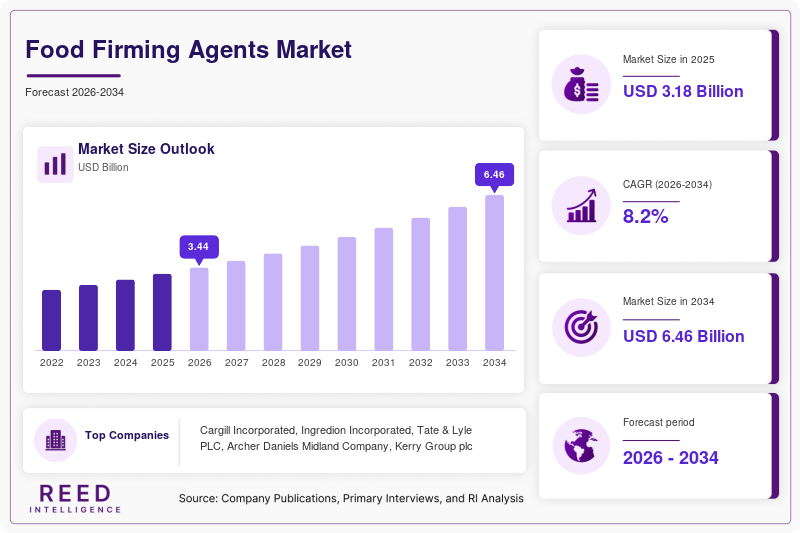
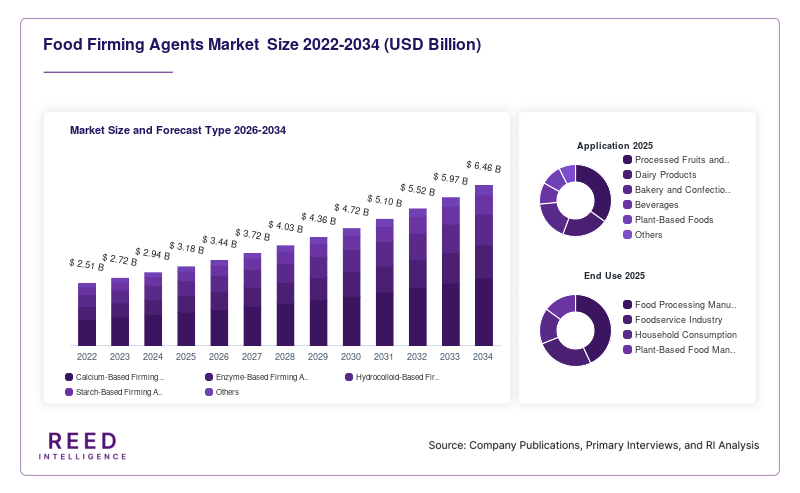
The global Food Firming Agents Market size was valued at USD 3.18 billion in 2026 and is projected to reach USD 5.96 billion by 2034, expanding at a CAGR of 8.2% during the forecast period from 2026 to 2034. The market is experiencing stable growth due to rising demand for processed foods, convenience meals, dairy products, bakery formulations, and canned fruits and vegetables that require improved texture stability and shelf-life performance. Food firming agents are widely used to preserve structural integrity, improve mouthfeel, and maintain product consistency during storage and transportation. Manufacturers are increasingly incorporating calcium salts, enzymes, starch derivatives, and hydrocolloids to enhance firmness across multiple food categories.
A major global factor supporting market expansion is the rapid growth of packaged and ready-to-eat food consumption across urban economies. Consumers increasingly prefer products with longer shelf stability and consistent texture, particularly in frozen foods, confectionery, dairy desserts, and fruit-based products. Food producers are also investing in clean-label formulations that use naturally sourced firming agents to meet evolving regulatory standards and consumer preferences. Technological advancements in ingredient processing and food preservation systems have further strengthened product adoption across industrial food manufacturing facilities.
Key Highlights
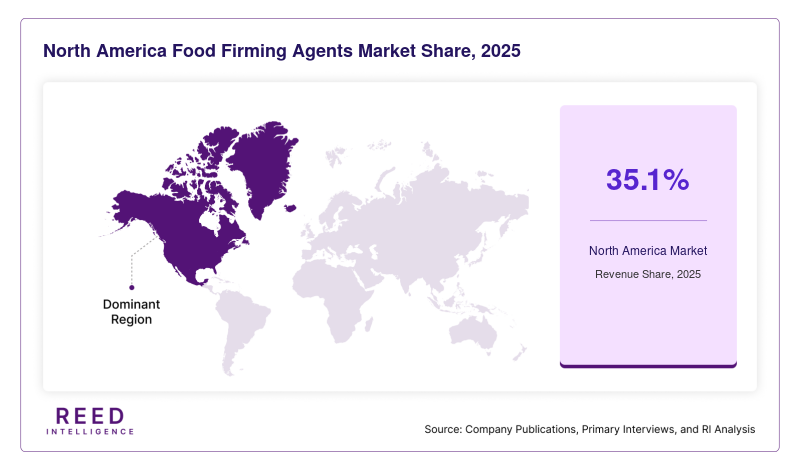
- North America dominated the market with a 35.1% share in 2025.
- Asia Pacific is expected to grow at the fastest CAGR of 10.8% during 2026–2034.
- By type, calcium-based firming agents accounted for the largest share of 39.4%.
- while enzyme-based firming agents are projected to grow at a CAGR of 11.5%.
- By application, processed fruits and vegetables led with a 36.8% share.
- whereas plant-based food applications are expected to expand at a CAGR of 12.1%.
- The United States remained the dominant country, with market values of USD 620 million in 2024 and USD 685 million in 2025.
Market Trends
Rising Preference for Clean-Label and Natural Texture Enhancers
The food industry is increasingly shifting toward clean-label ingredient systems, creating strong demand for naturally derived food firming agents. Consumers are paying closer attention to ingredient transparency and product composition, particularly in packaged foods and beverages. This trend has encouraged manufacturers to replace synthetic additives with natural alternatives such as calcium lactate, pectin, alginate, and citrus fiber. Food processors are reformulating products to maintain texture and firmness while complying with clean-label standards and regulatory guidelines across North America and Europe.
The growing popularity of organic and minimally processed food products has further strengthened this trend. Manufacturers of canned fruits, jams, dairy products, and frozen meals are adopting plant-derived stabilizers to maintain consistency and extend shelf life without affecting flavor quality. Retailers are also prioritizing products with recognizable ingredient lists, prompting suppliers to innovate sustainable and naturally sourced firming solutions. As health-conscious purchasing behavior expands globally, ingredient producers are expected to invest heavily in bio-based and multifunctional texture systems that align with evolving consumer expectations.
Expanding Demand from Plant-Based and Alternative Protein Products
The rapid expansion of plant-based food categories is creating substantial opportunities for food firming agent manufacturers. Alternative protein products often require advanced texture stabilization systems to replicate the firmness and mouthfeel of conventional meat and dairy products. Firming agents are increasingly used in vegan cheese, dairy-free yogurt, plant-based meat substitutes, and protein desserts to improve structural integrity and consumer acceptance.
Manufacturers are introducing customized ingredient blends that support water retention, chewiness, elasticity, and stability in alternative protein formulations. Soy protein, pea protein, and oat-based products particularly require texture enhancement technologies during processing and storage. The increasing number of vegan consumers and flexitarian dietary patterns across Asia Pacific and Europe is accelerating product development activities in this segment. Food technology companies are collaborating with ingredient suppliers to create advanced formulation systems that deliver improved sensory performance while maintaining clean-label compliance. This trend is expected to remain a major contributor to market growth throughout the forecast period.
Market Drivers
Growth in Processed and Convenience Food Consumption
The increasing consumption of processed and convenience foods is one of the primary drivers supporting the growth of the Food Firming Agents Market. Urbanization, changing work patterns, and rising disposable incomes have significantly increased demand for ready-to-eat meals, frozen products, canned vegetables, and packaged snacks. These products require stable texture, extended shelf life, and consistent appearance throughout transportation and storage cycles. Firming agents help manufacturers maintain product quality by preserving structural integrity and reducing moisture-related deterioration.
Food processing companies are expanding production capacities to meet growing global demand for packaged food items. Large-scale manufacturers are incorporating advanced texture management systems to improve consumer satisfaction and reduce product wastage. The rapid expansion of supermarket chains and online grocery platforms has further increased the need for food products with enhanced durability and stability. In addition, rising demand for premium packaged foods with improved texture performance is encouraging ingredient suppliers to introduce specialized firming solutions tailored for industrial food processing applications.
Increasing Focus on Shelf-Life Extension and Food Waste Reduction
Food manufacturers are increasingly prioritizing shelf-life optimization and waste reduction strategies, which has accelerated the use of firming agents across multiple food categories. Texture degradation is one of the major reasons for product rejection and food waste in retail distribution channels. Firming agents help maintain product consistency, moisture balance, and structural quality during extended storage periods, making them valuable for large-scale food supply chains.
Governments and food industry organizations are also promoting sustainable food production practices aimed at reducing global food waste. This has encouraged manufacturers to adopt advanced preservation ingredients that enhance product durability without compromising nutritional quality. The growth of international food trade and cross-border distribution networks has intensified the need for effective texture stabilization systems. Dairy products, fruit preparations, baked goods, and processed vegetables particularly benefit from firming technologies that support longer transportation cycles. The increasing integration of automated food manufacturing systems is also encouraging demand for ingredients that improve production efficiency and product stability.
Market Restraint
Regulatory Complexity and Ingredient Approval Challenges
Stringent food safety regulations and varying international ingredient approval standards continue to restrain the growth of the Food Firming Agents Market. Food additives used in texture stabilization must comply with extensive testing, labeling requirements, and regulatory certifications before commercial use. Regulatory authorities across different countries often impose distinct guidelines regarding permissible concentration levels, ingredient sourcing, and safety documentation, creating operational complexity for manufacturers and exporters.
Smaller ingredient producers frequently face challenges associated with compliance costs, product reformulation, and certification processes. Changes in consumer preferences toward additive-free products have also increased scrutiny on synthetic firming agents, limiting adoption in certain food applications. In addition, regulatory delays can slow product innovation and commercialization, particularly for newly developed enzyme-based or bioengineered firming systems. Manufacturers operating across multiple international markets must continuously adapt formulations to align with regional standards, increasing operational expenses and supply chain complexity. These challenges may affect profit margins and slow the introduction of advanced ingredient technologies during the forecast period.
Market Opportunities
Expansion of Functional and Fortified Food Products
The rising popularity of functional and fortified food products presents substantial opportunities for companies operating in the Food Firming Agents Market. Consumers increasingly seek products that offer nutritional benefits along with desirable texture and sensory performance. Functional dairy products, protein-enriched snacks, fortified beverages, and wellness-oriented desserts require specialized ingredient systems that maintain consistency and structural quality throughout shelf life.
Manufacturers are developing multifunctional firming agents capable of improving texture while supporting nutritional enhancement and clean-label positioning. Calcium-based firming agents are gaining strong traction because they provide both texture stabilization and mineral fortification benefits. The growing aging population and increasing focus on preventive healthcare are also supporting demand for fortified foods with improved mouthfeel and product stability. Emerging economies are witnessing strong investments in nutritional food production, creating favorable opportunities for ingredient suppliers to expand their product portfolios and manufacturing capacities.
Technological Advancements in Food Processing Systems
Continuous innovation in food processing and preservation technologies is creating new growth avenues for food firming agent manufacturers. Advanced processing systems such as high-pressure processing, freeze drying, and modified atmosphere packaging require compatible texture stabilization solutions that maintain product integrity under varying manufacturing conditions. Ingredient suppliers are investing in research and development activities to create customized formulations optimized for modern processing environments.
The increasing use of automation and precision manufacturing in food production facilities is further supporting demand for high-performance firming agents. Smart processing technologies allow manufacturers to control moisture retention, viscosity, and texture consistency more effectively, improving overall product quality. Ingredient companies are also utilizing biotechnology and fermentation-based production systems to develop sustainable and efficient firming solutions. As food manufacturers continue to prioritize operational efficiency and premium product quality, demand for technologically advanced texture-enhancing ingredients is expected to rise steadily across global markets.
Segmental Analysis
By Type
Calcium-based firming agents held the dominant market share of 39.4% in 2024 due to their extensive use across processed fruits, vegetables, dairy products, and canned food applications. Calcium chloride and calcium lactate remain widely preferred because they effectively maintain firmness, reduce tissue softening, and improve shelf stability in industrial food processing operations. These ingredients are also cost-effective and compatible with large-scale manufacturing systems, making them highly attractive to food producers. Manufacturers increasingly use calcium-based agents in pickled vegetables, fruit preserves, and frozen foods where texture retention is critical for consumer acceptance. In addition, calcium-based ingredients offer nutritional fortification benefits that align with growing demand for healthier food formulations. Their broad regulatory acceptance across international markets has further strengthened their commercial adoption across multiple food processing industries.
Enzyme-based firming agents are projected to register the fastest CAGR of 11.5% during the forecast period due to increasing demand for clean-label and bio-based ingredient systems. Enzymes such as transglutaminase and pectin methylesterase are gaining popularity for their ability to improve texture naturally without negatively affecting flavor or nutritional quality. Food manufacturers are increasingly adopting enzyme technologies in dairy products, bakery formulations, and plant-based foods to achieve superior structural consistency. The rapid expansion of alternative protein products has significantly increased demand for enzyme-based texture enhancement solutions that support elasticity and firmness. In addition, advancements in biotechnology and fermentation processes are enabling ingredient suppliers to develop more efficient and application-specific enzyme systems. Rising consumer preference for minimally processed foods is expected to continue driving adoption of enzyme-based firming technologies across global food industries.
By Application
Processed fruits and vegetables accounted for the largest market share of 36.8% in 2024 due to high consumption of canned, frozen, and preserved produce products worldwide. Food firming agents play a critical role in maintaining texture, appearance, and moisture balance during preservation and long-term storage processes. Calcium salts are extensively used to prevent softening in canned tomatoes, pickles, fruit cocktails, and frozen vegetables. Increasing demand for convenience foods and ready-to-cook meal kits has further strengthened the use of texture stabilization ingredients in this segment. Manufacturers are focusing on improving product quality and shelf stability to meet consumer expectations regarding freshness and consistency. In addition, growth in international food exports has increased the need for preservation technologies that maintain structural integrity throughout transportation and distribution cycles. Expanding urban lifestyles and rising demand for packaged foods continue to support segment dominance.
Plant-based food applications are anticipated to expand at the fastest CAGR of 12.1% during the forecast period. The rapid growth of vegan and flexitarian dietary trends has created strong demand for texture enhancement systems capable of replicating conventional meat and dairy textures. Firming agents are increasingly incorporated into plant-based cheese, yogurt, meat substitutes, and frozen desserts to improve mouthfeel, chewiness, and structural stability. Manufacturers are developing customized ingredient blends designed specifically for soy, pea, oat, and almond-based formulations. Consumer expectations for realistic texture performance in alternative protein products are encouraging continuous innovation across the segment. Additionally, increasing investments in plant-based food startups and expanding retail availability of vegan products are supporting higher ingredient demand. Technological advancements in food formulation and extrusion systems are expected to further accelerate growth in plant-based applications.
By End Use
Food processing manufacturers represented the dominant end-use segment with a market share of 48.6% in 2024 due to large-scale utilization of firming agents across industrial food production facilities. Major food companies rely heavily on texture stabilization systems to ensure product consistency, shelf stability, and visual appeal across high-volume manufacturing operations. Firming agents are widely incorporated into packaged meals, dairy products, baked goods, confectionery items, and frozen foods. Growing automation in food production and increasing demand for extended shelf life have strengthened the importance of advanced ingredient systems within industrial processing environments. Manufacturers are also investing in customized texture enhancement solutions tailored for specific processing conditions and product categories. Expansion of global food distribution networks and rising demand for export-quality packaged foods continue to support high consumption of firming agents among industrial food processors worldwide.
Plant-based food manufacturers are expected to witness the fastest CAGR of 11.7% during the forecast period as demand for alternative protein products continues to rise globally. These manufacturers require advanced texture management systems to improve the structural integrity and sensory quality of dairy-free and meat-free products. Firming agents help stabilize moisture retention, elasticity, and firmness in vegan cheese, protein snacks, and meat substitutes. Increasing consumer acceptance of sustainable food products and growing investments in alternative protein innovation are supporting strong segment growth. Startups and established food companies alike are collaborating with ingredient suppliers to create application-specific texture solutions that enhance consumer satisfaction. Additionally, expanding retail distribution of plant-based products across supermarkets and online channels is increasing production volumes, thereby accelerating demand for specialized food firming technologies.
Regional Analysis
North America
North America accounted for 35.1% of the global Food Firming Agents Market share in 2025 and is expected to maintain stable growth during the forecast period at a CAGR of 7.6%. The region benefits from a highly developed food processing industry, strong demand for convenience foods, and advanced cold-chain infrastructure. Large-scale adoption of packaged foods and frozen meals has increased the use of texture stabilization ingredients across dairy, bakery, and processed vegetable applications. Food manufacturers in the region are also emphasizing clean-label ingredient systems and sustainable food preservation technologies.
The United States remains the dominant country in the regional market due to high consumption of ready-to-eat foods and strong investment in food innovation technologies. Major food processing companies are expanding production facilities to meet rising consumer demand for premium packaged products with improved shelf stability and texture consistency. The country is also witnessing increasing adoption of natural calcium-based firming agents in canned fruits, dairy desserts, and plant-based food products. Growing demand for protein-rich and fortified food products continues to support ingredient innovation activities.
Europe
Europe represented 27.4% of the global market share in 2025 and is projected to grow at a CAGR of 7.9% during the forecast period. The region has a mature food manufacturing sector supported by strict food quality regulations and increasing consumer demand for natural ingredients. Food processors across Europe are focusing on product reformulation strategies that reduce synthetic additives while maintaining product texture and stability. Rising demand for organic packaged foods and premium dairy products is also contributing to market expansion.
Germany continues to dominate the European market due to its strong industrial food production capabilities and advanced ingredient manufacturing sector. The country has a well-established processed food industry that extensively uses firming agents in bakery products, fruit preparations, and confectionery applications. German manufacturers are investing in sustainable ingredient technologies and clean-label solutions to align with evolving consumer preferences. Increasing demand for plant-based foods and innovative dairy alternatives is further supporting market growth across the country.
Asia Pacific
Asia Pacific is expected to register the fastest CAGR of 10.8% from 2026 to 2034 due to rapid urbanization, changing dietary habits, and expanding packaged food consumption. The region is witnessing substantial growth in processed food manufacturing activities, particularly in China, India, Japan, and Southeast Asian countries. Rising middle-class populations and increasing disposable incomes are driving demand for convenience foods, frozen products, and ready-to-cook meals that require effective texture stabilization systems.
China dominates the regional market because of its large-scale food processing industry and growing investment in food preservation technologies. The country has experienced strong growth in dairy consumption, processed vegetable exports, and packaged snack production, all of which support demand for firming agents. Chinese manufacturers are increasingly incorporating enzyme-based and calcium-based texture enhancers into processed food formulations. Government initiatives promoting food safety modernization and industrial automation are also strengthening ingredient demand across domestic and export-oriented food industries.
Middle East & Africa
The Middle East & Africa region accounted for a smaller share of the global market in 2025 but is projected to grow steadily at a CAGR of 8.1% during the forecast period. The expanding retail food sector, rising urban population, and increasing demand for imported packaged foods are contributing to regional market growth. Food processing investments in Gulf countries are supporting demand for preservation and texture stabilization ingredients in dairy products, beverages, and frozen foods.
Saudi Arabia remains the leading country in the regional market due to increasing investments in food manufacturing infrastructure and growing demand for convenience food products. The country is emphasizing domestic food production capabilities to improve food security and reduce import dependency. This transition has encouraged manufacturers to adopt advanced ingredient technologies that improve product quality and shelf stability. The expansion of modern retail channels and quick-service restaurant chains is also contributing to higher consumption of processed food products requiring firming agents.
Latin America
Latin America is anticipated to experience moderate growth during the forecast period with a CAGR of 7.4%. The region’s growing food and beverage industry, coupled with rising urban consumption patterns, is supporting demand for food firming agents. Processed fruits, dairy products, and canned vegetables remain major application areas across regional markets. Increasing participation of international food manufacturers and expansion of supermarket retail networks are further supporting ingredient demand.
Brazil dominates the Latin American market due to its extensive agricultural production base and strong processed food manufacturing sector. The country is a major producer of fruit-based products, dairy formulations, and packaged snacks that require texture enhancement systems. Brazilian food manufacturers are increasingly focusing on shelf-life extension and export-quality product standards, encouraging the use of advanced firming technologies. Rising consumer demand for convenience-oriented food products and improved cold storage infrastructure continue to strengthen market growth across the country.
Competitive Landscape
The Food Firming Agents Market is moderately fragmented, with global ingredient manufacturers focusing on product innovation, clean-label solutions, and strategic partnerships to strengthen market positioning. Companies are investing in research and development activities aimed at improving texture stabilization efficiency while complying with evolving food safety and sustainability standards. Market participants are also expanding production capacities and regional distribution networks to address rising demand from processed food manufacturers and plant-based food producers.
Cargill Incorporated remains one of the leading players in the market due to its broad ingredient portfolio and extensive global supply chain presence. The company recently expanded its specialty texturizer product line for dairy and plant-based food applications to address increasing demand for clean-label formulation systems. Other major companies are emphasizing acquisitions, collaborative product development, and biotechnology integration to improve competitive advantage.
Ingredient suppliers are increasingly focusing on customized formulation capabilities to meet application-specific requirements across bakery, dairy, processed vegetable, and alternative protein categories. Digital manufacturing technologies and sustainable ingredient sourcing practices are also becoming key competitive differentiators in the global market.
Key Players
- Cargill Incorporated
- Ingredion Incorporated
- Tate & Lyle PLC
- Archer Daniels Midland Company
- Kerry Group plc
- BASF SE
- DuPont de Nemours, Inc.
- Ashland Global Holdings Inc.
- CP Kelco
- Jungbunzlauer Suisse AG
- Corbion N.V.
- Koninklijke DSM N.V.
- Palsgaard A/S
- FBC Industries Inc.
- Advanced Food Systems Inc.
Recent Developments
- In February 2025, Ingredion Incorporated introduced a new clean-label texturizing solution designed for dairy-free dessert applications and frozen food formulations.
- In August 2024, Kerry Group plc expanded its food texture innovation center in Singapore to support customized ingredient development for Asia Pacific food manufacturers.
- In November 2025, Cargill Incorporated launched an advanced calcium-based firming ingredient portfolio targeting canned vegetable and fruit processing industries.
Food Firming Agents Market Segments
Type
- Calcium-Based Firming Agents
- Enzyme-Based Firming Agents
- Hydrocolloid-Based Firming Agents
- Starch-Based Firming Agents
- Others
Application
- Processed Fruits and Vegetables
- Dairy Products
- Bakery and Confectionery
- Beverages
- Plant-Based Foods
- Others
End Use
- Food Processing Manufacturers
- Foodservice Industry
- Household Consumption
- Plant-Based Food Manufacturers
By Region
- North America
- Europe
- APAC
- Middle East and Africa
- LATAM