Food Grade Acetic Acid Market Size, Share & Demand Report By Source (Synthetic, Bio-Based), By Application (Food Preservatives, Beverage Acidulants, Flavor Enhancers, Pickling Agents, Bakery Applications), By End Use (Food Processing Companies, Beverage Manufacturers, Foodservice Industry, Retail and Household Applications), By Region & Segment Forecasts, 2026–2034
USD 3950
Market Overview
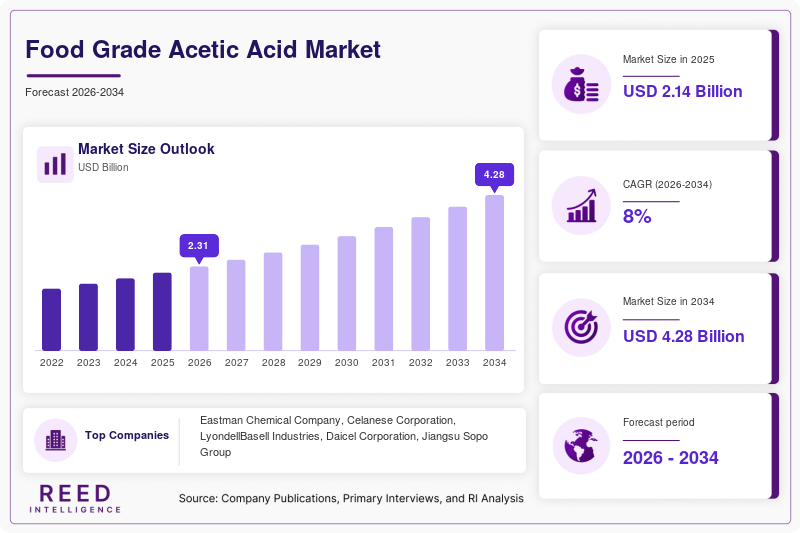
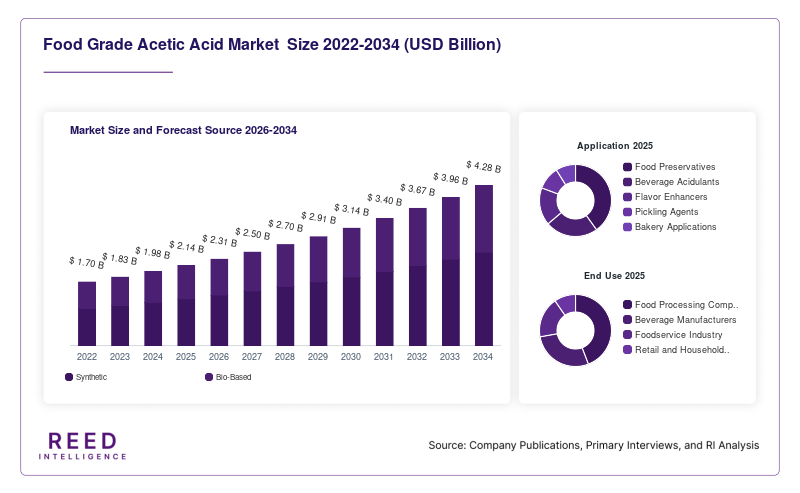
The global Food Grade Acetic Acid Market size was valued at USD 2.14 billion in 2026 and is projected to reach USD 3.96 billion by 2034, expanding at a CAGR of 8.0% during the forecast period from 2026 to 2034. Food grade acetic acid is widely used across food preservation, flavor enhancement, pickling applications, and beverage formulation due to its antimicrobial properties and acidic profile. The market continues to witness steady expansion as processed food consumption increases across developed and emerging economies. Growing demand for packaged convenience food products, along with rising awareness regarding food safety standards, has encouraged manufacturers to adopt food grade acetic acid in large-scale food processing operations.
One of the major global factors supporting market growth is the rapid expansion of the processed food and ready-to-eat meal industry. Urbanization, changing dietary patterns, and higher disposable income levels have increased demand for sauces, dressings, marinades, and preserved food items that require stable acidulants and preservatives. Food manufacturers are increasingly using food grade acetic acid to improve shelf life while maintaining product quality and regulatory compliance. In addition, growth in vinegar-based condiments and fermented food products has strengthened product demand in retail and foodservice channels.
Key Highlights
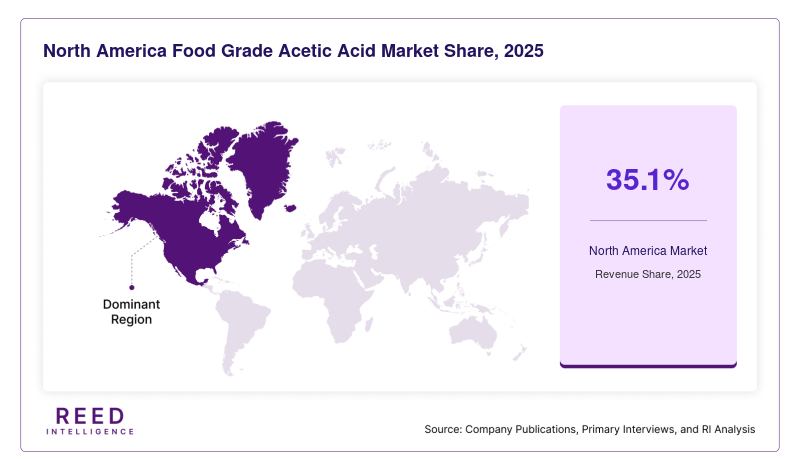
- North America dominated the market with a 35.1% share in 2025, while Asia Pacific is expected to grow at the fastest CAGR of 10.8% during 2026–2034.
- By source, synthetic acetic acid accounted for the largest share of 62.4%, while bio-based acetic acid is projected to grow at a CAGR of 11.5%.
- By application, food preservatives led with a 39.8% share, whereas beverage acidulants are expected to expand at a CAGR of 10.9%.
- The United States remained the dominant country, with market values of USD 480 million in 2024 and USD 525 million in 2025.
Market Trends
Rising Demand for Clean-Label and Natural Food Ingredients
The growing consumer preference for clean-label food products is influencing purchasing patterns across the global food industry. Consumers are increasingly reviewing ingredient labels and selecting products that contain recognizable and minimally processed additives. This trend has encouraged food manufacturers to increase the use of naturally derived food grade acetic acid in sauces, pickles, condiments, bakery products, and fermented foods. Bio-based acetic acid produced through fermentation methods is gaining stronger commercial acceptance because it aligns with clean-label positioning and sustainability objectives. Retail brands are also promoting preservative systems based on naturally sourced acids to improve product appeal among health-conscious consumers.
The trend is particularly visible in North America and Europe, where regulatory standards and consumer awareness regarding food ingredients continue to evolve. Foodservice operators and premium packaged food brands are reformulating products to reduce artificial additives while maintaining shelf stability. As a result, manufacturers of food grade acetic acid are expanding production capacities for naturally sourced variants. Increasing innovation in fermentation technology and raw material sourcing is expected to support broader commercial adoption over the forecast period.
Expansion of Processed and Convenience Food Production
The rapid expansion of the processed food industry is creating strong demand for food grade acetic acid across multiple food applications. Urban lifestyles, increasing workforce participation, and rising consumption of packaged foods have accelerated the need for effective preservatives and acidulants. Food grade acetic acid is extensively used in processed meats, canned vegetables, ready meals, dressings, sauces, and snack products due to its ability to improve shelf life and flavor consistency. Food processing companies are integrating acetic acid solutions into large-scale manufacturing systems to maintain microbial stability and meet international food safety regulations.
Emerging economies in Asia Pacific and Latin America are witnessing rapid growth in modern retail infrastructure and cold-chain logistics, further increasing demand for packaged food products. E-commerce grocery platforms and expanding supermarket chains are also contributing to higher consumption of preserved food items. Manufacturers are responding by introducing advanced food preservation formulations that incorporate food grade acetic acid for improved storage performance and quality assurance. This trend is expected to remain a significant contributor to overall market growth through 2034.
Market Drivers
Increasing Use in Food Preservation and Shelf-Life Extension
The increasing need for effective food preservation solutions is a major factor driving the Food Grade Acetic Acid Market. Food manufacturers are focusing on extending product shelf life while ensuring food safety and maintaining taste quality. Food grade acetic acid is widely recognized for its antimicrobial and pH-regulating properties, making it suitable for preserving packaged foods, pickled vegetables, processed meats, sauces, and ready-to-eat products. Rising demand for convenience foods has increased pressure on manufacturers to use reliable preservation systems that comply with food safety standards across international markets.
In addition, changing consumer lifestyles and growing demand for long-lasting food products have accelerated the adoption of acetic acid across large-scale food processing operations. The growth of online grocery delivery services and export-oriented food production has further increased the need for stable food preservation ingredients. Food companies are investing in advanced preservation technologies that combine acetic acid with natural flavoring systems to improve product stability without compromising sensory characteristics.
Growth of Beverage and Fermented Food Industries
The expansion of beverage manufacturing and fermented food production is contributing significantly to market growth. Food grade acetic acid is commonly used in vinegar production, flavored beverages, kombucha products, and fermented condiments because it enhances acidity, flavor balance, and microbial control. Rising consumer interest in probiotic beverages and fermented food products has created favorable opportunities for acetic acid suppliers. Beverage manufacturers are increasingly developing premium vinegar-based drinks and flavored wellness products that require consistent food-grade acidity solutions.
The demand for fermented food products is also increasing due to changing dietary habits and growing awareness regarding digestive health. Manufacturers are expanding product portfolios that include pickled foods, fermented sauces, and functional beverages containing acetic acid as a key ingredient. Rapid expansion of the foodservice sector and rising popularity of international cuisines are further strengthening demand. As global food production continues to diversify, food grade acetic acid is expected to remain an important ingredient in flavor enhancement and product stabilization.
Market Restraint
Volatility in Raw Material Prices and Regulatory Compliance Challenges
Fluctuations in raw material prices and strict food safety regulations continue to restrain market growth to a certain extent. Food grade acetic acid production depends on feedstocks such as methanol, ethanol, and agricultural raw materials, all of which are influenced by changing energy costs, supply chain disruptions, and agricultural output variability. Price instability affects manufacturing margins and increases procurement challenges for small and medium-scale producers. In periods of high raw material inflation, food manufacturers may reduce operational spending or seek alternative preservation ingredients with lower cost structures.
Regulatory compliance requirements also create operational complexities for market participants. Food-grade chemical products must meet strict quality standards regarding purity, contamination levels, and manufacturing practices. Regulatory agencies in North America, Europe, and Asia Pacific continue to strengthen labeling and food safety requirements, increasing the need for advanced testing and certification systems. Companies exporting food ingredients across multiple regions often face additional documentation and compliance costs. For example, manufacturers supplying acetic acid to premium organic food brands are required to maintain traceability standards and production transparency, which can increase operational expenses and delay product approvals.
Market Opportunities
Expansion of Bio-Based Acetic Acid Production Technologies
The increasing focus on sustainable manufacturing practices is creating strong opportunities for bio-based food grade acetic acid production. Manufacturers are investing in fermentation-based technologies that use renewable agricultural feedstocks instead of petroleum-derived raw materials. Growing environmental awareness and rising preference for naturally sourced food ingredients are encouraging food companies to partner with suppliers offering low-emission production methods. Bio-based acetic acid is gaining traction among premium food brands seeking clean-label positioning and environmentally responsible sourcing strategies.
Advancements in industrial biotechnology and fermentation efficiency are expected to improve production scalability and reduce manufacturing costs over the forecast period. Governments and regulatory authorities are also supporting sustainable food ingredient manufacturing through environmental policies and industrial modernization programs. As food companies continue to prioritize carbon reduction and sustainable sourcing objectives, demand for bio-based food grade acetic acid is expected to expand significantly across developed and emerging markets.
Growing Demand from Emerging Economies and Foodservice Channels
Emerging economies are presenting substantial growth opportunities for food grade acetic acid manufacturers due to rapid urbanization and changing food consumption patterns. Countries across Asia Pacific, Latin America, and the Middle East are witnessing rising demand for processed foods, restaurant meals, packaged condiments, and ready-to-cook products. Expanding middle-class populations and increasing household spending on convenience foods are encouraging food manufacturers to scale production capacities and improve food preservation systems.
The rapid expansion of quick-service restaurants, catering businesses, and international food chains is also increasing commercial demand for food-grade acidulants and preservatives. Foodservice companies require large volumes of sauces, dressings, marinades, and pickled products that rely on acetic acid for flavor stability and shelf-life management. In addition, growing investment in modern retail infrastructure and refrigerated logistics networks is supporting broader market penetration for packaged food products in emerging regions. These developments are expected to create long-term growth opportunities for suppliers and distributors operating in the global Food Grade Acetic Acid Market.
Segmental Analysis
By Source
Synthetic acetic acid accounted for the largest market share of 62.4% in 2024 due to its cost efficiency, large-scale availability, and extensive use across industrial food manufacturing applications. The segment remains dominant because synthetic production methods provide consistent quality and stable supply for large-volume food processors. Manufacturers of packaged foods, sauces, dressings, and pickled products prefer synthetic acetic acid because it supports high-output manufacturing systems and standardized preservation performance. In addition, synthetic variants are widely used in commercial vinegar production and beverage processing operations where pricing competitiveness and reliable sourcing remain important purchasing considerations.
Bio-based acetic acid is projected to register the fastest CAGR of 11.5% during the forecast period due to increasing demand for natural and sustainable food ingredients. Consumers are increasingly preferring clean-label food products containing naturally derived additives and preservatives. Food manufacturers are responding by adopting fermentation-based acetic acid solutions sourced from renewable raw materials. The segment is also benefiting from advancements in biotechnology and fermentation efficiency that improve production scalability and product consistency. Growing environmental awareness and sustainability commitments among global food brands are expected to further strengthen demand for bio-based food grade acetic acid.
By Application
Food preservatives represented the dominant application segment with a 39.8% market share in 2024 due to the widespread use of acetic acid in packaged food preservation. Food grade acetic acid is extensively used to control microbial growth, maintain acidity levels, and improve shelf life in products such as sauces, canned foods, processed meats, and pickled vegetables. Increasing global demand for convenience foods and ready-to-eat meals has strengthened the adoption of effective preservation systems. Large-scale food manufacturers continue to rely on acetic acid because it offers cost-effective preservation performance while supporting regulatory compliance and food safety standards.
Beverage acidulants are expected to expand at the fastest CAGR of 10.9% during the forecast period due to rising consumption of flavored beverages, vinegar-based drinks, and fermented wellness products. Beverage manufacturers are increasingly using food grade acetic acid to improve flavor stability and acidity balance in functional beverages and specialty drinks. Consumer interest in digestive health and probiotic products is also supporting segment growth. In addition, premium beverage brands are launching innovative vinegar-infused drinks and fermented formulations that require high-purity food grade acetic acid for product consistency and quality assurance.
By End Use
Food processing companies accounted for the largest share of 58.3% in 2024 due to extensive industrial use of food grade acetic acid in packaged food manufacturing. Processed food producers utilize acetic acid in condiments, bakery products, canned foods, meat processing, and ready meals to enhance preservation and flavor characteristics. The growth of modern retail distribution and international food trade has increased the need for stable preservation ingredients that support long shelf life and transportation efficiency. Large-scale food processors continue to invest in advanced preservation technologies that integrate food grade acetic acid into automated manufacturing operations.
The foodservice segment is projected to witness the fastest CAGR of 10.4% through 2034 due to rapid expansion of restaurants, catering businesses, and quick-service food chains worldwide. Foodservice operators require consistent supplies of sauces, marinades, dressings, and preserved ingredients that depend on acetic acid for flavor enhancement and product stability. Growth in tourism, urban dining culture, and online food delivery platforms is increasing commercial food production volumes. In addition, international restaurant chains are expanding operations across emerging economies, creating stronger demand for food-grade acidulants and preservation solutions.
Regional Analysis
North America
North America accounted for 35.1% of the global Food Grade Acetic Acid Market share in 2025 and is expected to maintain steady growth at a CAGR of 7.4% during the forecast period. The region benefits from a highly developed food processing industry and strong demand for packaged food products. Rising consumption of condiments, preserved foods, and ready-to-eat meals continues to support product demand. Food manufacturers in the United States and Canada are increasingly adopting advanced preservation technologies to comply with food safety regulations and maintain product quality standards.
The United States remained the dominant country in the regional market due to its extensive processed food manufacturing sector and strong retail distribution network. One unique growth factor supporting the market is the rising demand for vinegar-based health beverages and fermented food products among health-conscious consumers. Major food brands are investing in clean-label product development and natural ingredient sourcing, increasing demand for premium food grade acetic acid solutions.
Europe
Europe represented 27.6% of the global market share in 2025 and is projected to expand at a CAGR of 7.1% through 2034. Demand for food grade acetic acid in the region is supported by strong consumption of sauces, dressings, pickled products, and bakery items. European food manufacturers are focusing on sustainable production methods and regulatory compliance to maintain product competitiveness. Growing consumer awareness regarding food safety and ingredient transparency is also contributing to market expansion.
Germany emerged as the dominant country in the European market due to its large food processing industry and advanced manufacturing infrastructure. A unique factor driving growth in the country is the increasing use of naturally fermented ingredients in premium packaged foods. German food companies are investing in organic and clean-label product lines that require high-purity food grade acetic acid for preservation and flavor enhancement applications.
Asia Pacific
Asia Pacific held 23.8% of the global Food Grade Acetic Acid Market share in 2025 and is anticipated to record the fastest CAGR of 10.8% during the forecast period. Rapid urbanization, population growth, and changing dietary habits are increasing demand for processed and packaged foods across the region. Expanding supermarket chains, rising disposable income levels, and growing adoption of convenience foods are supporting market development. Regional manufacturers are increasing production capacities to meet rising demand from food and beverage industries.
China dominated the Asia Pacific market due to its extensive food manufacturing base and large consumer population. One unique growth factor contributing to regional expansion is the rapid growth of online grocery retail and food delivery services. The increasing availability of packaged sauces, condiments, preserved vegetables, and ready meals through digital retail platforms has significantly boosted demand for food preservation ingredients, including food grade acetic acid.
Middle East & Africa
The Middle East & Africa region accounted for 7.1% of the global market share in 2025 and is expected to grow at a CAGR of 8.2% through 2034. Demand for food grade acetic acid is increasing due to expanding foodservice industries and rising consumption of packaged food products in urban areas. Countries in the Gulf region are investing in food manufacturing and cold-chain infrastructure to strengthen food security and reduce import dependency. Increasing tourism activity is also supporting demand for preserved and processed food products.
Saudi Arabia remained the dominant country within the regional market due to strong investment in food processing facilities and retail expansion. A unique factor supporting growth is the increasing adoption of international foodservice brands and restaurant chains. These businesses require large-scale supplies of sauces, marinades, and preserved food ingredients that rely on food grade acetic acid for flavor consistency and shelf-life management.
Latin America
Latin America captured 6.4% of the global market share in 2025 and is projected to expand at a CAGR of 8.5% during the forecast period. Rising urbanization and increasing consumption of convenience foods are driving regional demand for food preservation ingredients. The region is witnessing growth in packaged snacks, canned vegetables, processed meat products, and beverage manufacturing. Food companies are modernizing production facilities and expanding export activities, contributing to greater adoption of food grade acetic acid.
Brazil dominated the Latin American market due to its strong agricultural sector and expanding processed food industry. One unique growth factor supporting the market is the growing export demand for preserved food products and sauces. Brazilian manufacturers are increasing production volumes and improving product quality standards to meet international food export requirements, creating additional demand for food grade acetic acid across industrial food processing operations.
Competitive Landscape
The Food Grade Acetic Acid Market is moderately consolidated, with leading companies focusing on production expansion, sustainable manufacturing, and product quality improvement to strengthen market positioning. Major players are investing in fermentation technology, supply chain optimization, and strategic partnerships with food processing companies. Competition is largely influenced by pricing efficiency, product purity standards, and the ability to meet regulatory compliance requirements across multiple regions.
Eastman Chemical Company remains one of the leading participants in the market due to its extensive production capabilities and broad global distribution network. The company has continued expanding its specialty food ingredient portfolio to address rising demand for high-purity acetic acid solutions. Celanese Corporation, Jiangsu Sopo, LyondellBasell Industries, and Daicel Corporation also maintain significant market shares through strong industrial manufacturing infrastructure and long-term supply agreements with food manufacturers.
Key Players
- Eastman Chemical Company
- Celanese Corporation
- LyondellBasell Industries
- Daicel Corporation
- Jiangsu Sopo Group
- Svensk Etanolkemi AB
- BP plc
- HELM AG
- Gujarat Narmada Valley Fertilizers & Chemicals Limited
- Tokyo Chemical Industry Co., Ltd.
- Merck KGaA
- Thermo Fisher Scientific Inc.
- Shandong Hualu Hengsheng Chemical Co., Ltd.
- Wacker Chemie AG
- Anhui Huayi Chemical Industry Co., Ltd.
Recent Developments
- In February 2026, Celanese Corporation announced the expansion of its acetic acid production capacity to support rising demand from global food and beverage manufacturers.
- In September 2025, Eastman Chemical Company introduced a new sustainable food-grade acetic acid portfolio developed using lower-emission manufacturing technologies.
- In June 2025, Daicel Corporation partnered with regional food processing companies in Asia Pacific to strengthen distribution capabilities for food-grade preservation ingredients.
- In November 2025, Jiangsu Sopo Group invested in advanced fermentation technologies to increase bio-based acetic acid production efficiency for clean-label food applications.
Food Grade Acetic Acid Market Segments
Source
- Synthetic
- Bio-Based
Application
- Food Preservatives
- Beverage Acidulants
- Flavor Enhancers
- Pickling Agents
- Bakery Applications
End Use
- Food Processing Companies
- Beverage Manufacturers
- Foodservice Industry
- Retail and Household Applications
By Region
- North America
- Europe
- APAC
- Middle East and Africa
- LATAM