Food Grade Butyric Acid Market Size, Share & Demand Report By Source (Synthetic Butyric Acid, Bio-Based Butyric Acid), By Form (Liquid Butyric Acid, Encapsulated Powder Formulations), By Application (Food Additives and Flavoring, Dietary Supplements, Dairy Products), By End Use (Food and Beverage Industry, Nutraceutical Industry, Pharmaceutical Industry), By Distribution Channel (Direct Sales, Online Retail, Specialty Ingredient Suppliers), By Region & Segment Forecasts, 2026–2034
USD 3950
Market Overview
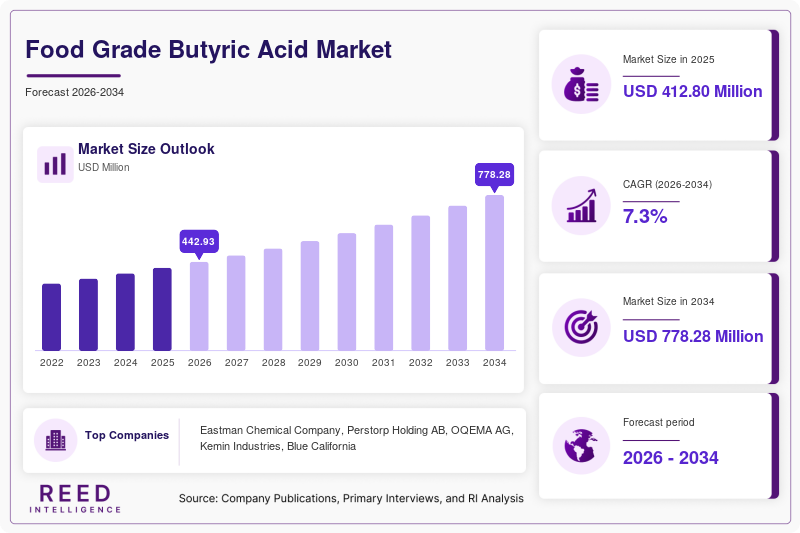
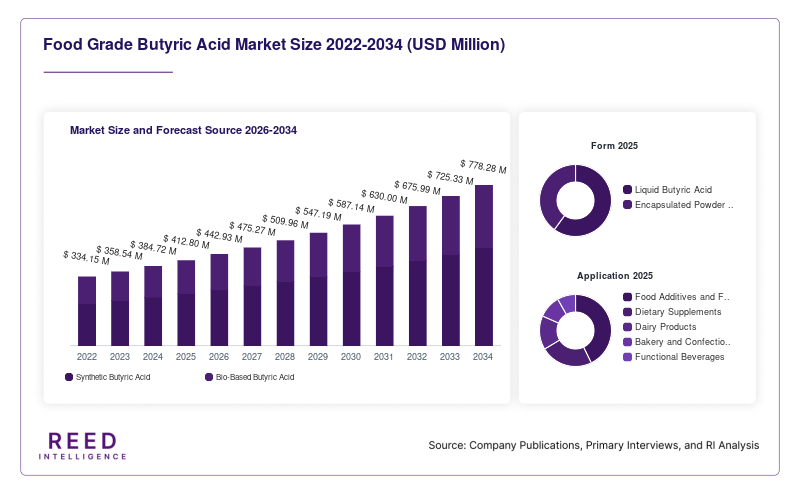
The global Food Grade Butyric Acid Market size was valued at USD 412.8 million in 2026 and is projected to reach USD 728.6 million by 2034, expanding at a CAGR of 7.3% during the forecast period (2026–2034). The market growth has been supported by increasing global demand for functional food ingredients and flavor-enhancing additives across processed food, bakery, dairy, and nutraceutical applications. Growing consumer interest in digestive wellness and clean-label food products has accelerated the use of food grade butyric acid in multiple food manufacturing segments.
Food grade butyric acid is widely utilized as a flavoring agent, preservative ingredient, and nutritional additive in the food and beverage industry. The compound is known for its ability to enhance flavor profiles and support gut health formulations in dietary supplements and functional foods. Rising awareness regarding microbiome health and digestive support has contributed to expanding adoption across global food processing industries.
Key Highlights
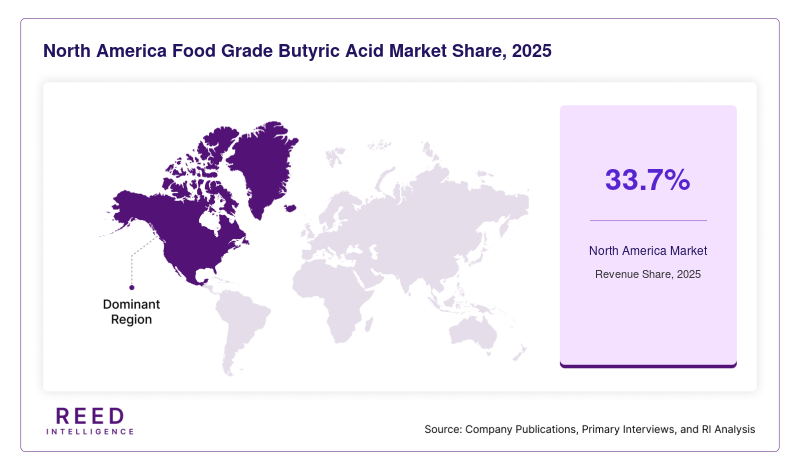
- North America accounted for 33.7% of the global Food Grade Butyric Acid Market share in 2025, while Asia Pacific is projected to register the fastest CAGR of 8.5% during the forecast period.
- By source, synthetic butyric acid dominated with a 61.4% market share in 2025, whereas bio-based butyric acid is anticipated to grow at a CAGR of 8.9% through 2034.
- By application, food additives and flavoring held the largest market share of 44.6% in 2025, while dietary supplements are expected to expand at a CAGR of 9.1%.
- By form, liquid food grade butyric acid captured 58.3% of the market in 2025, whereas encapsulated powder formulations are forecast to grow at a CAGR of 8.8%.
- The United States remained the dominant country market, valued at USD 96.4 million in 2024 and USD 102.7 million in 2025.
Market Trends
Rising Adoption of Functional Digestive Health Ingredients
Digestive wellness has become a major trend shaping the Food Grade Butyric Acid Market. Consumers are increasingly purchasing food products and supplements formulated to support gut microbiome balance and intestinal health. Food manufacturers are incorporating butyric acid into functional beverages, nutritional capsules, and fortified dairy products to meet rising demand for digestive support solutions. This trend is expected to strengthen product innovation activities across the nutraceutical and functional food industries.
Increasing Preference for Bio-Based Food Ingredients
The growing demand for sustainable and naturally sourced food ingredients is influencing market development. Manufacturers are shifting toward fermentation-derived butyric acid production methods to reduce reliance on petrochemical-based raw materials. Bio-based formulations are gaining popularity among clean-label food manufacturers and wellness-focused consumers. This trend is expected to encourage investment in environmentally sustainable production technologies.
Market Drivers
Expansion of Processed and Convenience Food Industry
The rapid growth of processed food manufacturing has significantly supported the Food Grade Butyric Acid Market. Food producers increasingly utilize flavor-enhancing additives to improve taste consistency and product stability in packaged foods. Butyric acid is widely used in bakery products, cheese formulations, confectionery, and savory snacks because it enhances aroma and flavor complexity. Expanding urban lifestyles and increasing convenience food consumption are expected to sustain demand growth.
Growing Demand for Nutritional Supplement Formulations
The increasing popularity of health supplements has accelerated the use of food grade butyric acid in nutraceutical applications. Consumers are actively seeking products that support digestive health, immune function, and overall wellness. Supplement manufacturers are introducing encapsulated butyric acid formulations designed for targeted intestinal release and enhanced absorption. Rising preventive healthcare awareness is expected to strengthen long-term market expansion.
Market Restraint
Strong Odor and Handling Challenges
The strong odor associated with butyric acid remains a major challenge for manufacturers and food formulators. Specialized encapsulation and stabilization technologies are often required to improve handling, storage, and consumer acceptance. These additional processing requirements can increase production costs and limit product adoption in certain food applications.
Market Opportunities
Development of Encapsulated Butyric Acid Products
Encapsulation technology is creating new opportunities in the Food Grade Butyric Acid Market. Encapsulated formulations improve odor control, product stability, and targeted nutrient delivery. Manufacturers investing in advanced microencapsulation technologies are expected to expand product adoption across dietary supplements and functional food applications.
Increasing Demand from Sports Nutrition Industry
The expansion of the sports nutrition industry is generating growth opportunities for food grade butyric acid manufacturers. Nutritional product developers are exploring gut-health-focused ingredients to support athletic recovery and digestive efficiency. The growing popularity of performance nutrition supplements is expected to increase demand for innovative functional ingredients.
Segmental Analysis
By Source
Synthetic Butyric Acid Dominated the Market
Synthetic butyric acid accounted for 61.4% of the Food Grade Butyric Acid Market share in 2025. The segment maintained dominance because synthetic production methods support cost-effective large-scale manufacturing and stable supply availability. Food processors widely preferred synthetic formulations for mainstream food additive applications due to pricing advantages and established industrial infrastructure.
Bio-Based Butyric Acid to Witness Fastest Growth
Bio-based butyric acid is projected to expand at a CAGR of 8.9% during the forecast period. Increasing consumer demand for natural and environmentally sustainable food ingredients will support segment growth. Manufacturers are expected to invest in fermentation technologies and renewable feedstocks to strengthen production efficiency and regulatory compliance.
By Application
Food Additives and Flavoring Held the Largest Share
Food additives and flavoring represented 44.6% of the global Food Grade Butyric Acid Market share in 2025. The segment dominated because butyric acid is extensively utilized in cheese flavors, butter formulations, confectionery products, and savory processed foods. Manufacturers relied on the ingredient to improve flavor authenticity and product consistency.
Dietary Supplements Expected to Grow Rapidly
Dietary supplements are anticipated to register a CAGR of 9.1% during the forecast period. Increasing consumer focus on gut microbiome health and intestinal wellness will support segment growth. Supplement manufacturers are expected to launch advanced butyrate formulations with controlled-release delivery technologies.
By Form
Liquid Butyric Acid Led the Market
Liquid food grade butyric acid accounted for 58.3% of the market share in 2025. The segment benefited from its widespread use in industrial food processing and flavor manufacturing operations. Liquid formulations remained preferred due to ease of blending and compatibility with large-scale production systems.
Encapsulated Powder Formulations to Register Strong Growth
Encapsulated powder formulations are projected to grow at a CAGR of 8.8% through 2034. The segment is expected to benefit from improved odor masking, storage stability, and enhanced handling efficiency. Growing utilization in nutritional supplements and functional beverages will support market expansion.
By End Use
Food and Beverage Industry Dominated the Market
The food and beverage industry held 63.2% of the Food Grade Butyric Acid Market share in 2025. The segment maintained dominance because manufacturers increasingly incorporated butyric acid into processed foods, dairy products, and savory snack applications. Expanding convenience food consumption supported segment growth globally.
Nutraceutical Industry to Expand Significantly
The nutraceutical industry segment is expected to grow at a CAGR of 8.7% during the forecast period. Increasing investment in microbiome-focused wellness products and digestive health supplements will drive segment demand. Manufacturers are expected to develop innovative formulations targeting preventive healthcare applications.
Regional Analysis
North America
North America accounted for 33.7% of the global Food Grade Butyric Acid Market share in 2025 and is projected to grow at a CAGR of 7.0% during the forecast period. The regional market benefited from increasing demand for functional foods and premium dietary supplements. The United States dominated the regional market due to strong consumer awareness regarding digestive wellness and rising demand for fortified nutritional products. Expanding investment in bio-based ingredient manufacturing also supported regional market growth.
Europe
Europe held 28.6% of the global Food Grade Butyric Acid Market share in 2025 and is anticipated to expand at a CAGR of 6.9% through 2034. The regional market was supported by growing demand for clean-label food additives and specialty dairy ingredients. Germany emerged as the leading country market due to the strong presence of food processing companies and increasing adoption of sustainable ingredient technologies. Rising demand for natural food preservation solutions is expected to support regional market expansion.
Asia Pacific
Asia Pacific represented 24.1% of the global Food Grade Butyric Acid Market share in 2025 and is forecast to register the fastest CAGR of 8.5% during the forecast period. China dominated the regional market due to increasing processed food production and expanding nutraceutical manufacturing activities. Rapid urbanization and rising middle-class consumption of packaged food products are expected to strengthen regional demand for specialty food ingredients.
Middle East & Africa
The Middle East & Africa accounted for 7.2% of the global Food Grade Butyric Acid Market share in 2025 and is projected to grow at a CAGR of 7.1% between 2026 and 2034. Saudi Arabia led the regional market owing to increasing investments in food processing infrastructure and nutritional product manufacturing. Growing demand for shelf-stable packaged food products is expected to contribute to regional market development.
Latin America
Latin America captured 6.4% of the global Food Grade Butyric Acid Market share in 2025 and is expected to grow at a CAGR of 6.8% during the forecast period. Brazil dominated the regional market due to rising demand for flavored dairy products and expanding bakery product manufacturing. Increasing consumer spending on functional food products is anticipated to support market growth in the region.
Competitive Landscape
The Food Grade Butyric Acid Market remains moderately fragmented with the presence of specialty chemical manufacturers, food ingredient suppliers, and nutraceutical ingredient companies. Market participants are focusing on bio-based production technologies, encapsulation innovations, strategic partnerships, and product diversification to strengthen their competitive position.
Eastman Chemical Company emerged as a leading market participant due to its extensive specialty chemicals portfolio and global supply capabilities. The company recently expanded its food-grade ingredient production operations to address increasing demand for sustainable and high-purity butyric acid products.
Perstorp Holding AB focused on bio-based acid production technologies for food and feed applications.
OQEMA AG strengthened its food ingredient distribution network across Europe and Asia.
Kemin Industries expanded its encapsulated nutritional ingredient portfolio targeting digestive wellness products.
Blue California invested in clean-label ingredient innovation for functional food applications.
Key Players List
- Eastman Chemical Company
- Perstorp Holding AB
- OQEMA AG
- Kemin Industries
- Blue California
- Tokyo Chemical Industry Co., Ltd.
- Merck KGaA
- Thermo Fisher Scientific Inc.
- Nanjing Chemlin Chemical Industry Co., Ltd.
- Palital Feed Additives B.V.
- Vigon International LLC
- Oxea GmbH
- Muby Chemicals
- BASF SE
- Penta Manufacturing Company
Recent Developments
- In 2025, Eastman Chemical Company expanded its specialty ingredient production capacity for food-grade applications.
- In 2024, Perstorp Holding AB introduced new bio-based butyric acid formulations for clean-label food manufacturing.
- In 2025, Kemin Industries launched advanced encapsulated butyrate solutions targeting digestive wellness supplements.
- In 2024, Blue California strengthened its fermentation-derived ingredient portfolio for functional food applications.
- In 2025, OQEMA AG expanded regional distribution partnerships for specialty food additives across Asia Pacific.
Food Grade Butyric Acid Market Segments
Source
- Synthetic Butyric Acid
- Bio-Based Butyric Acid
Form
- Liquid Butyric Acid
- Encapsulated Powder Formulations
Application
- Food Additives and Flavoring
- Dietary Supplements
- Dairy Products
- Bakery and Confectionery
- Functional Beverages
End Use
- Food and Beverage Industry
- Nutraceutical Industry
- Pharmaceutical Industry
- Specialty Ingredient Manufacturers
Distribution Channel
- Direct Sales
- Online Retail
- Specialty Ingredient Suppliers
- Food Ingredient Distributors
- Industrial Supply Networks
By Region
- North America
- Europe
- APAC
- Middle East and Africa
- LATAM