Food Grade Calcium Carbonate Market Size, Share & Demand Report By Source Type (Ground Calcium Carbonate (GCC), Precipitated Calcium Carbonate (PCC)), By Application (Food & Beverages, Dietary Supplements, Pharmaceuticals), By Form (Powdered Calcium Carbonate, Granular Calcium Carbonate), By Distribution Channel (Direct Industrial Sales, Specialty Ingredient Distributors) & Regional Forecasts, 2026–2034
USD 3950
Market Overview
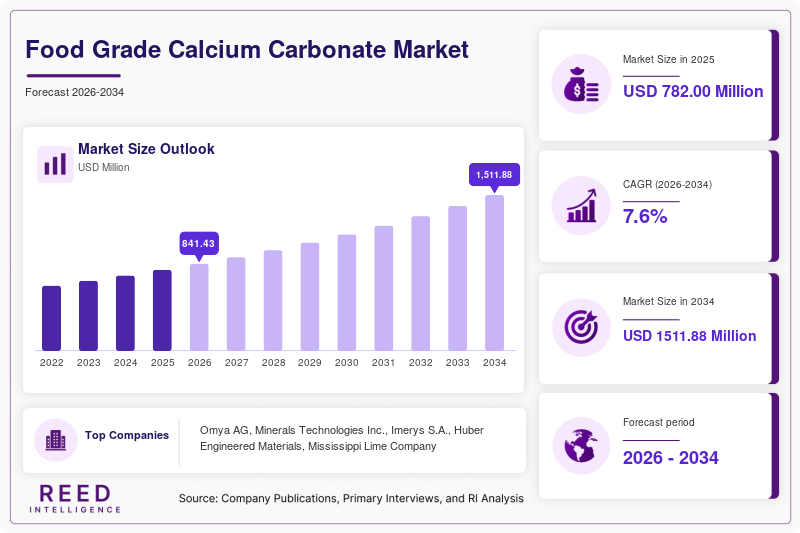
The Food Grade Calcium Carbonate Market Size was valued at approximately USD 782 million in 2026 and is projected to reach USD 1.41 billion by 2034, expanding at a CAGR of 7.6% during 2026–2034. The market is witnessing significant growth due to rising demand for nutritional fortification ingredients across food, beverage, dietary supplement, and pharmaceutical industries. Food grade calcium carbonate is widely used as a calcium enrichment agent, acidity regulator, anti-caking agent, and stabilizer in various food processing applications. Its growing importance in functional foods and health-oriented products continues to strengthen market demand worldwide.
One of the major global factors supporting the growth of the Food Grade Calcium Carbonate Market is the increasing consumer awareness regarding calcium deficiency and bone health management. Consumers are increasingly adopting fortified food products and nutritional supplements to maintain overall wellness and support preventive healthcare practices. Governments and health organizations are also encouraging nutritional fortification programs to address mineral deficiencies among aging populations and children, thereby accelerating market expansion.
Key Highlights
- Asia Pacific dominated the Food Grade Calcium Carbonate Market with a market share of 37.6% in 2025.
- North America is expected to register the fastest growth with a projected CAGR of 8.2% during 2026–2034.
- By source type, ground calcium carbonate (GCC) held the dominant share of 58.4% in 2025.
- By source type, precipitated calcium carbonate (PCC) is projected to grow at a 8.7% CAGR during the forecast period.
- By application, the food and beverage segment accounted for the largest market share in 2025.
- By application, the dietary supplements segment is forecast to expand at a 8.9% CAGR through 2034.
- China remained the dominant country with market values of approximately USD 108 million in 2024 and USD 118 million in 2025.
Market Trends
Rising Demand for Fortified Functional Foods
The increasing popularity of functional and fortified food products is a major trend shaping the Food Grade Calcium Carbonate Market. Consumers are actively seeking foods enriched with vitamins and minerals to support bone strength, immunity, and overall health. Calcium-fortified beverages, cereals, dairy alternatives, bakery products, and nutritional snacks are witnessing strong demand across global markets.
Food manufacturers are increasingly using food grade calcium carbonate because it offers high calcium concentration, cost efficiency, and compatibility with various food formulations. This trend is expected to continue as preventive healthcare and wellness-focused eating habits gain wider consumer acceptance.
Expansion of Clean-Label and Natural Ingredient Formulations
Clean-label food production is becoming increasingly important across the global food industry. Consumers are demanding ingredient transparency and minimally processed nutritional additives, encouraging manufacturers to use naturally derived mineral ingredients.
Food grade calcium carbonate sourced from purified natural limestone and mineral deposits is gaining popularity in clean-label formulations. Manufacturers are also investing in advanced purification technologies to improve product safety and food-grade compliance standards.
Market Drivers
Increasing Awareness Regarding Bone Health and Nutrition
Growing awareness regarding osteoporosis, calcium deficiency, and age-related bone disorders is a major driver supporting the growth of the Food Grade Calcium Carbonate Market. Consumers across all age groups are increasingly adopting calcium-rich diets and nutritional supplements to support skeletal health and long-term wellness.
Healthcare professionals and nutrition organizations continue promoting calcium intake through fortified foods and dietary supplements. Rising elderly populations in developed and emerging economies are further contributing to market demand.
Growth of Dietary Supplement Industry
The rapid expansion of the global dietary supplement industry is significantly contributing to the development of the Food Grade Calcium Carbonate Market. Calcium carbonate is widely used in tablets, capsules, powdered supplements, and chewable formulations because of its high elemental calcium content and affordability.
The increasing preference for preventive healthcare products and personalized nutrition solutions is driving greater consumption of calcium-based dietary supplements across global markets.
Market Restraint
Availability of Alternative Calcium Ingredients
One of the major restraints affecting the Food Grade Calcium Carbonate Market is the availability of alternative calcium ingredients such as calcium citrate, calcium phosphate, and calcium lactate. Some alternative ingredients offer higher absorption rates and better compatibility in specialized formulations, creating competitive pressure for calcium carbonate manufacturers in premium nutritional applications.
Market Opportunities
Increasing Demand for Plant-Based Fortified Foods
The rapid growth of plant-based food products is creating substantial opportunities for the Food Grade Calcium Carbonate Market. Manufacturers of dairy alternatives, vegan beverages, and plant-based nutritional products are increasingly incorporating calcium fortification ingredients to improve nutritional value.
Food grade calcium carbonate is expected to witness rising demand in plant-based milk, vegan yogurt, and fortified snack products during the forecast period.
Expansion of Nutritional Programs in Emerging Economies
Governments and public health agencies across emerging economies are increasingly implementing nutritional fortification programs to address mineral deficiencies among children and low-income populations. Calcium fortification initiatives in staple foods and nutritional supplements are expected to create favorable opportunities for market expansion.
The increasing accessibility of fortified foods through retail and healthcare distribution channels is supporting long-term market growth.
Segmental Analysis
By Source Type
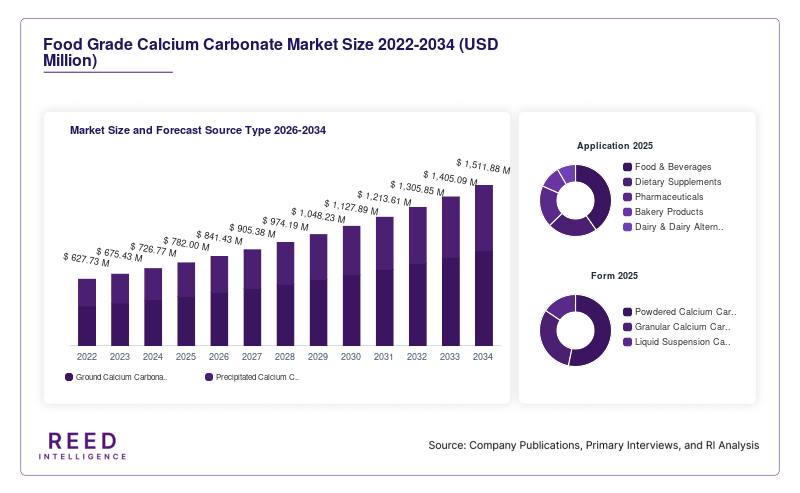
Ground calcium carbonate (GCC) dominated the Food Grade Calcium Carbonate Market with a market share of 58.4% in 2025. GCC products gained strong adoption because they offer cost-effective calcium fortification and are widely used in food processing and dietary supplement manufacturing.
Precipitated calcium carbonate (PCC) is projected to witness the fastest CAGR of 8.7% during 2026–2034. Increasing use in premium food formulations and nutraceutical products is expected to support segment growth. PCC provides improved purity, controlled particle size, and better formulation consistency.
By Application
The food and beverage segment accounted for the largest share of 46.3% in 2025 within the Food Grade Calcium Carbonate Market. Extensive use in bakery products, beverages, confectionery, dairy products, and nutritional snacks significantly contributed to segment dominance.
The dietary supplements segment is expected to expand at a 8.9% CAGR through 2034 due to increasing consumer adoption of preventive healthcare products and calcium-enriched nutritional supplements.
By Form
Powdered food grade calcium carbonate held the dominant market share of 63.7% in 2025 because of its broad compatibility with food processing and supplement manufacturing operations.
Granular food grade calcium carbonate is anticipated to register the fastest CAGR of 8.1% during the forecast period due to increasing demand for controlled-release nutritional formulations and specialized food processing applications.
By Distribution Channel
Direct industrial sales represented the dominant segment with a market share of 54.2% in 2025 in the Food Grade Calcium Carbonate Market. Large food manufacturers and nutraceutical companies increasingly procure raw materials directly from suppliers to ensure consistent product quality and supply chain efficiency.
Online ingredient distribution channels are projected to grow at a 8.4% CAGR during 2026–2034 as digital procurement systems gain popularity among small and medium-sized food processing businesses.
Regional Analysis
North America
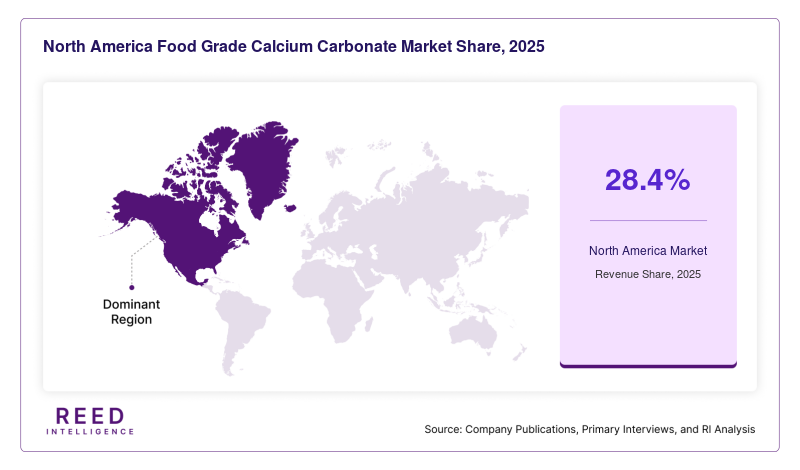
North America accounted for approximately 28.4% of the Food Grade Calcium Carbonate Market in 2025 and is projected to grow at a 8.2% CAGR during 2026–2034. The United States dominated the regional market due to strong dietary supplement consumption and rising demand for fortified food products.
The region benefits from advanced food processing industries and growing consumer preference for preventive healthcare nutrition. Demand for clean-label calcium fortification ingredients continues to support regional expansion.
Europe
Europe held a market share of 26.8% in 2025 and is expected to expand at a 7.1% CAGR through 2034. Germany remained the dominant country because of its established nutraceutical industry and growing consumption of fortified dairy and bakery products.
European consumers are increasingly adopting health-focused food products containing functional mineral ingredients. Strict food safety regulations are also encouraging the use of highly purified food-grade calcium additives.
Asia Pacific
Asia Pacific represented 37.6% of the global Food Grade Calcium Carbonate Market in 2025 and is anticipated to register a 7.9% CAGR during 2026–2034. China dominated the regional market due to large-scale food manufacturing operations and rising awareness regarding nutritional supplementation.
The region continues to benefit from increasing urbanization, expanding middle-class populations, and growing demand for fortified food and beverage products. Rising healthcare awareness is also supporting increased dietary supplement consumption.
Middle East & Africa
The Middle East & Africa accounted for 4.1% of the Food Grade Calcium Carbonate Market in 2025 and is projected to grow at a 6.8% CAGR during the forecast period. Saudi Arabia remained the dominant country because of increasing healthcare investments and rising demand for nutritional food products.
Growing awareness regarding dietary health and expanding food processing industries are contributing to regional market growth.
Latin America
Latin America held approximately 3.1% market share in 2025 and is expected to expand at a 6.9% CAGR through 2034. Brazil dominated the regional market due to increasing demand for fortified dairy products and nutritional supplements.
The growing expansion of retail food distribution networks and increasing consumer focus on health-oriented products continue to support market development across the region.
Competitive Landscape
The Food Grade Calcium Carbonate Market remains moderately competitive, with companies focusing on product purity, micronization technologies, and food-grade certification standards.
Omya AG emerged as a leading market participant due to its extensive portfolio of mineral-based food ingredients and strong global distribution capabilities. The company recently expanded its production capacity for high-purity food grade calcium carbonate products designed for nutraceutical and fortified food applications.
Minerals Technologies Inc. continues to focus on advanced precipitated calcium carbonate technologies for food and pharmaceutical applications. Imerys S.A. remains active in specialty mineral ingredients and food processing solutions. Huber Engineered Materials is investing in fine-particle calcium technologies for nutritional formulations. Mississippi Lime Company continues to expand food-grade mineral production operations.
Key Players List
- Omya AG
- Minerals Technologies Inc.
- Imerys S.A.
- Huber Engineered Materials
- Mississippi Lime Company
- Calcinor S.A.
- GCCP Resources Limited
- Maruo Calcium Co., Ltd.9
- Longcliffe Quarries Ltd.
- Schaefer Kalk GmbH & Co. KG
- Gulshan Polyols Ltd.
- Shiraishi Calcium Kaisha, Ltd.
- Lhoist Group
- Fimatec Ltd.
- Nordkalk Corporation
Recent Developments
- In 2025, several manufacturers introduced ultra-fine precipitated calcium carbonate products designed for premium nutraceutical and beverage applications.
- Omya AG expanded food-grade mineral production capacity to support rising demand for fortified food ingredients.
- Multiple food manufacturers increased adoption of calcium-fortified plant-based dairy alternatives and nutritional beverages.
- Ingredient suppliers invested in advanced micronization technologies to improve calcium carbonate dispersion and formulation stability.
- Companies increasingly developed clean-label calcium fortification solutions targeting health-focused and functional food product segments.
Food Grade Calcium Carbonate Market Segments
Source Type
- Ground Calcium Carbonate (GCC)
- Precipitated Calcium Carbonate (PCC)
Application
- Food & Beverages
- Dietary Supplements
- Pharmaceuticals
- Bakery Products
- Dairy & Dairy Alternatives
Form
- Powdered Calcium Carbonate
- Granular Calcium Carbonate
- Liquid Suspension Calcium Carbonate
Distribution Channel
- Direct Industrial Sales
- Specialty Ingredient Distributors
- Online Ingredient Platforms
By Region
- North America
- Europe
- APAC
- Middle East and Africa
- LATAM