Food Grade Calcium Phosphate Market Size, Share & Demand Report By Type (Tricalcium Phosphate, Dicalcium Phosphate, Monocalcium Phosphate, Other Calcium Phosphate Types), By Application (Bakery and Confectionery, Dairy Products, Dietary Supplements, Beverages, Infant Nutrition), By Distribution Channel (Specialty Ingredient Distributors, Online Ingredient Distribution, Retail Ingredient Suppliers), By Region & Segment Forecasts, 2026–2034
USD 3950
Market Overview
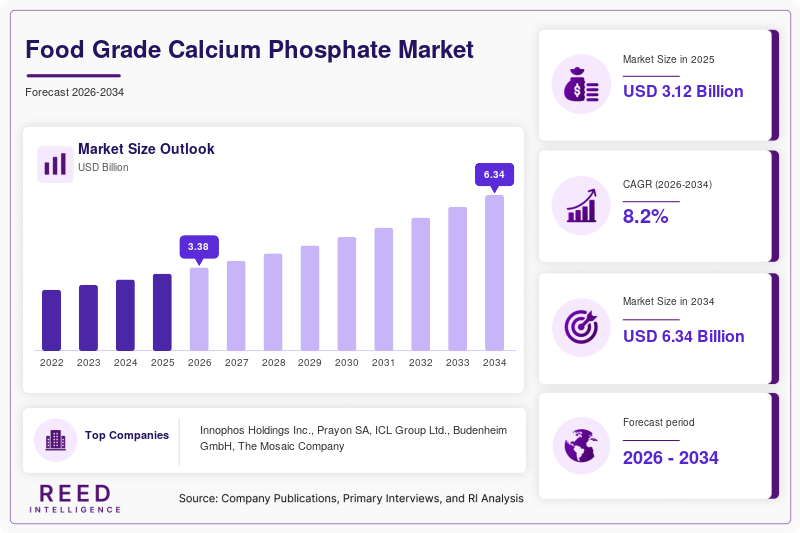
The global Food Grade Calcium Phosphate Market size was valued at USD 3.12 billion in 2026 and is projected to reach USD 5.84 billion by 2034, expanding at a CAGR of 8.2% during the forecast period from 2026 to 2034. The market is experiencing stable growth due to the increasing use of mineral-fortified ingredients in processed food, dairy products, bakery applications, and nutritional supplements. Food grade calcium phosphate is widely utilized as a firming agent, anti-caking ingredient, leavening agent, acidity regulator, and mineral fortifier across the food and beverage industry. Rising consumer awareness regarding bone health, calcium deficiency, and nutritional enrichment has further strengthened product demand across developed and emerging economies.
The growing demand for fortified food products among aging populations and health-conscious consumers has become a major global factor supporting market expansion. Manufacturers are increasingly integrating food grade calcium phosphate into ready-to-eat meals, cereals, dairy formulations, sports nutrition products, and infant nutrition applications. Expansion of the processed food sector, especially in Asia Pacific and Latin America, is also contributing to long-term market growth. In addition, advancements in food processing technologies and clean-label ingredient innovation are encouraging companies to improve product functionality and purity standards.
Key Highlights
- North America dominated the market with a 34.2% share in 2025.
- Asia Pacific is expected to grow at the fastest CAGR of 10.8% during 2026–2034.
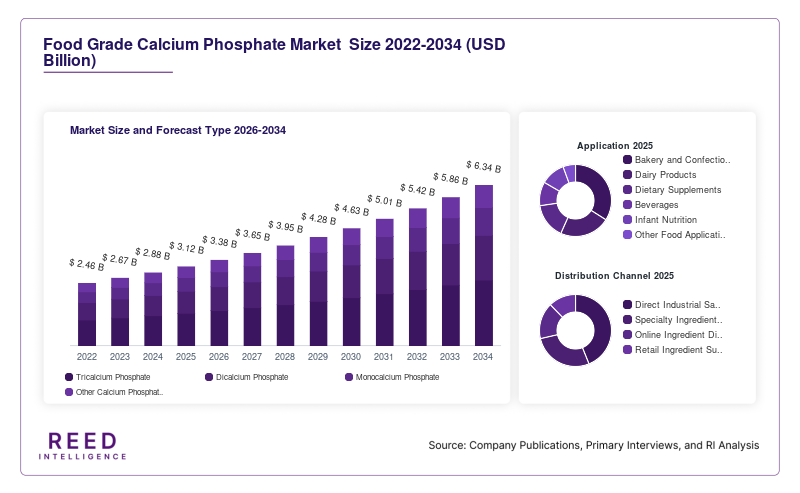
- By type, tricalcium phosphate accounted for the largest share of 39.6%.
- while dicalcium phosphate is projected to grow at a CAGR of 9.4%.
- By application, bakery and confectionery led with a 36.8% share.
- whereas dietary supplements are expected to expand at a CAGR of 10.6%.
- By distribution channel, direct industrial sales held the largest share of 44.1%.
- while online ingredient distribution is anticipated to grow at a CAGR of 11.3%.
- The United States remained the dominant country, with market values of USD 620 million in 2024 and USD 680 million in 2025.
Market Trends
Rising Demand for Functional and Fortified Foods
The increasing consumer preference for functional and fortified foods is shaping the growth trajectory of the Food Grade Calcium Phosphate Market. Food manufacturers are introducing nutrient-enriched products that provide additional health benefits beyond basic nutrition. Calcium phosphate is gaining strong adoption because it delivers calcium and phosphorus while maintaining product stability and texture. Consumers are actively purchasing fortified cereals, dairy beverages, protein bars, meal replacement drinks, and bakery products that support bone health and wellness goals. The trend is especially visible among elderly consumers, athletes, and working professionals seeking balanced nutritional intake. Regulatory support for food fortification programs in several countries has also accelerated product adoption. Manufacturers are developing customized formulations with improved solubility and flavor compatibility to support broader usage across processed food categories.
Expansion of Clean-Label and Premium Ingredient Applications
The growing preference for clean-label food ingredients is creating new opportunities for the Food Grade Calcium Phosphate Market. Consumers increasingly review ingredient labels and favor products with safe, recognizable, and multifunctional ingredients. Food grade calcium phosphate is widely accepted in premium formulations because of its mineral enrichment properties and broad compatibility with processed food systems. Companies are investing in high-purity phosphate ingredients with reduced contaminants and enhanced traceability to align with evolving food safety standards. Demand is also increasing in organic-style bakery products, nutritional beverages, and plant-based food categories. In addition, manufacturers are focusing on sustainable sourcing practices and environmentally responsible production technologies to improve brand positioning and consumer trust in global food markets.
Market Drivers
Increasing Consumption of Nutritional Supplements and Health Products
The rapid expansion of the global nutritional supplement industry is driving significant demand for food grade calcium phosphate ingredients. Consumers are becoming more aware of calcium deficiency, osteoporosis prevention, and the importance of mineral intake in maintaining long-term health. This has increased the use of calcium phosphate in tablets, powdered nutrition blends, fortified beverages, and chewable dietary supplements. Healthcare professionals and wellness brands continue to promote mineral supplementation among aging populations and women’s health segments, further supporting demand. Sports nutrition manufacturers are also using calcium phosphate in protein-based formulations and recovery products. Growing e-commerce accessibility for dietary supplements across emerging economies has additionally strengthened sales volume and improved market penetration for fortified nutritional ingredients.
Growth of Processed Food and Bakery Manufacturing Industries
The expanding processed food sector remains a major driver for the Food Grade Calcium Phosphate Market. Food grade calcium phosphate is commonly used as a leavening agent, stabilizer, anti-caking ingredient, and emulsification aid in bakery and packaged food applications. Rapid urbanization, changing lifestyles, and higher disposable income levels are increasing the consumption of convenience foods worldwide. Bakery manufacturers are especially increasing their use of phosphate ingredients in cakes, pastries, biscuits, and bread formulations to improve texture and shelf stability. Large-scale food production facilities are also prioritizing multifunctional ingredients that can improve efficiency while maintaining product quality. Emerging markets in Asia Pacific and Latin America are witnessing strong investments in food processing infrastructure, further supporting ingredient demand across industrial manufacturing operations.
Market Restraint
Regulatory Pressure and Raw Material Price Volatility
The Food Grade Calcium Phosphate Market faces challenges associated with fluctuating raw material prices and evolving food safety regulations. Production of food grade phosphate ingredients depends on the availability and pricing of phosphate rock and related mineral resources, which are vulnerable to supply chain disruptions and geopolitical factors. Rising energy and transportation costs can also increase manufacturing expenses and reduce operating margins for producers. In addition, regulatory authorities across North America and Europe are implementing strict quality standards regarding purity, heavy metal content, and food additive usage. Compliance with these regulations often requires continuous testing, documentation, and facility upgrades, increasing operational costs for manufacturers. Smaller producers may face difficulties maintaining profitability while meeting international food safety standards. These challenges can slow market expansion in cost-sensitive regions and create pricing pressure across the competitive landscape.
Market Opportunities
Growing Penetration of Plant-Based and Alternative Protein Foods
The expansion of plant-based food products is creating favorable opportunities for the Food Grade Calcium Phosphate Market. Manufacturers of dairy alternatives, vegan snacks, and plant-based beverages are incorporating calcium phosphate ingredients to improve mineral content and nutritional value. Many consumers switching to plant-based diets seek alternative calcium sources to replace traditional dairy intake. Food companies are therefore fortifying almond milk, soy beverages, oat-based products, and vegan nutritional blends with calcium phosphate compounds. The ingredient also improves product stability and texture in plant-based applications. As vegan and flexitarian lifestyles continue to gain popularity worldwide, food manufacturers are expected to increase investment in fortified alternative protein formulations, creating long-term demand opportunities for mineral ingredients across multiple food categories.
Expansion of Food Processing Capacity in Emerging Economies
Rapid industrialization of food manufacturing sectors in emerging economies presents strong growth opportunities for the Food Grade Calcium Phosphate Market. Countries across Southeast Asia, the Middle East, Africa, and Latin America are witnessing increasing investment in packaged food production and nutritional product manufacturing. Rising urban populations and growing middle-class spending are encouraging multinational food companies to expand local production facilities. Governments are also supporting domestic food processing industries through investment incentives and food fortification initiatives aimed at improving public nutrition. This environment is increasing demand for functional food ingredients such as calcium phosphate. Local manufacturers are adopting advanced production technologies and partnering with global ingredient suppliers to improve product quality and competitiveness in regional and international markets.
Segmental Analysis
By Type
Tricalcium phosphate accounted for the largest share of 39.6% in the Food Grade Calcium Phosphate Market in 2024 due to its extensive application across bakery products, dairy formulations, nutritional supplements, and powdered food products. The ingredient is widely preferred because it offers strong anti-caking performance while also acting as a calcium fortification agent. Food manufacturers commonly use tricalcium phosphate in breakfast cereals, flavored drink powders, processed cheese, and confectionery applications to improve texture stability and mineral enrichment. Its compatibility with multiple food processing systems has contributed to broad commercial adoption. In addition, regulatory approvals across major economies have strengthened its utilization in industrial-scale food manufacturing. Increasing consumer demand for nutrient-enriched products and convenience foods continues to support the dominance of this subsegment within the broader market.
Dicalcium phosphate is expected to register the fastest CAGR of 9.4% during the forecast period due to its growing use in dietary supplements, fortified beverages, and specialty nutrition applications. The ingredient is increasingly preferred in nutritional formulations because of its high bioavailability and balanced calcium-phosphorus composition. Rising awareness regarding bone health and preventive nutrition has accelerated its incorporation into tablets, capsules, protein powders, and sports nutrition products. Manufacturers are also focusing on pharmaceutical-grade and high-purity variants suitable for premium wellness products. The expanding elderly population and rising healthcare expenditure across developing economies are contributing to sustained demand growth. In addition, advancements in ingredient processing technologies are enabling producers to improve product functionality and expand application areas across modern food systems.
By Application
Bakery and confectionery applications held the largest share of 36.8% in the Food Grade Calcium Phosphate Market in 2024 because of the ingredient’s multifunctional role in processed food production. Calcium phosphate compounds are extensively used as leavening agents, stabilizers, acidity regulators, and anti-caking ingredients in cakes, pastries, bread, biscuits, and confectionery products. The rapid expansion of the global bakery sector and increasing consumer preference for packaged snack products have strengthened demand for phosphate-based food additives. Large food manufacturers prefer these ingredients because they improve texture consistency, shelf life, and production efficiency. Rising consumption of convenience foods among urban populations and growing investment in industrial bakery facilities are also contributing to segment dominance. In developed economies, premium bakery products with mineral fortification features are further supporting market expansion.
Dietary supplements are projected to witness the fastest CAGR of 10.6% during the forecast period due to increasing consumer focus on preventive healthcare and balanced nutrition. Calcium phosphate ingredients are widely incorporated into calcium tablets, chewable supplements, powdered nutritional blends, and sports nutrition formulations. Growing concerns regarding osteoporosis, calcium deficiency, and aging-related bone disorders are encouraging consumers to adopt mineral supplementation products. Manufacturers are introducing flavored and easy-to-consume supplement formats to improve customer engagement and product accessibility. The rise of online retail platforms and direct-to-consumer health brands has further accelerated supplement market penetration globally. Emerging economies are also experiencing increased healthcare awareness and disposable income growth, creating strong demand for fortified wellness products containing food grade calcium phosphate ingredients.
By Distribution Channel
Direct industrial sales accounted for the largest share of 44.1% in the Food Grade Calcium Phosphate Market in 2024 because major food and beverage manufacturers prefer long-term supply agreements with ingredient producers. Large-scale bakery, dairy, beverage, and nutritional supplement companies require consistent quality standards and reliable bulk ingredient availability for industrial production processes. Direct procurement channels enable manufacturers to negotiate pricing, ensure supply chain stability, and maintain regulatory compliance across multiple product categories. Ingredient suppliers are increasingly offering customized phosphate formulations tailored to specific production requirements and regional food regulations. Strong partnerships between global ingredient producers and multinational food companies have further strengthened this distribution model. Industrial buyers also benefit from technical support services, product testing assistance, and integrated logistics solutions provided through direct sales networks.
Online ingredient distribution is expected to expand at the fastest CAGR of 11.3% during the forecast period due to the increasing digitalization of ingredient sourcing and procurement systems. Small and medium-sized food manufacturers are increasingly using online business platforms to access specialty ingredients, compare pricing, and streamline purchasing activities. Digital marketplaces provide broader product visibility, transparent specifications, and improved supplier accessibility for emerging food businesses. Ingredient manufacturers are also investing in e-commerce platforms and digital sales channels to improve customer reach and operational efficiency. The growing popularity of specialty nutrition startups, artisanal food producers, and regional supplement brands is supporting online ingredient procurement trends. Faster delivery systems, digital inventory management, and improved cross-border trade capabilities are expected to accelerate growth in this distribution subsegment.
Regional Analysis
North America
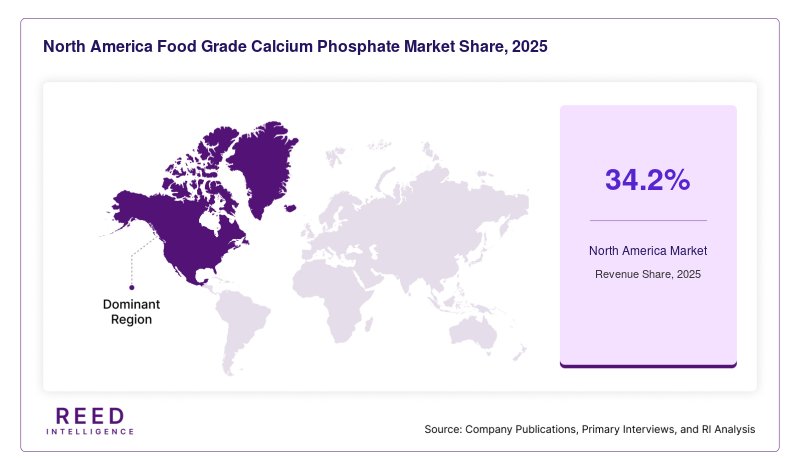
North America accounted for 34.2% of the global Food Grade Calcium Phosphate Market share in 2025 and maintained its position as the leading regional market. The region is projected to expand at a CAGR of 7.6% during the forecast period due to strong demand for fortified food products and advanced dietary supplement consumption. High awareness regarding nutritional deficiencies and preventive healthcare continues to support product usage across bakery, dairy, and nutritional applications. The presence of large food processing companies and established distribution networks also contributes to market stability.
The United States remained the dominant country in North America due to strong consumer spending on health-focused food products and nutritional supplements. The country benefits from advanced food manufacturing infrastructure and consistent innovation in fortified food categories. Increasing demand for sports nutrition, protein beverages, and functional bakery products has accelerated ingredient adoption. Major food manufacturers are also focusing on clean-label phosphate formulations with enhanced purity standards to meet changing consumer preferences and regulatory expectations.
Europe
Europe represented 27.4% of the global Food Grade Calcium Phosphate Market share in 2025 and is anticipated to grow at a CAGR of 7.9% between 2026 and 2034. Demand for fortified bakery products, dairy applications, and nutritional supplements remains strong across the region. European consumers continue to prioritize balanced diets and preventive wellness practices, increasing demand for mineral-enriched food products. Food manufacturers are investing in advanced ingredient technologies and sustainable production systems to align with regional environmental and food safety standards.
Germany emerged as the dominant country within the European market due to its large processed food industry and strong nutritional supplement manufacturing sector. The country benefits from high consumer awareness regarding calcium intake and healthy aging. Demand for functional beverages, infant nutrition products, and fortified cereals has increased steadily in recent years. German manufacturers are also focusing on sustainable ingredient sourcing and efficient production practices to maintain competitiveness within the broader European food ingredients industry.
Asia Pacific
Asia Pacific held 23.1% of the global Food Grade Calcium Phosphate Market share in 2025 and is expected to witness the fastest CAGR of 10.8% during the forecast period. Rapid urbanization, changing dietary habits, and rising disposable incomes are significantly increasing the demand for processed and fortified food products throughout the region. Expanding food processing industries in China, India, Japan, and Southeast Asia are accelerating ingredient consumption across bakery, dairy, and packaged food applications. Government-led nutrition improvement programs are also contributing to stronger market demand.
China dominated the Asia Pacific market due to its large-scale food manufacturing capacity and rapidly growing nutritional supplement sector. The country is witnessing increased consumption of fortified beverages, infant nutrition products, and functional dairy applications among urban consumers. Rising investments in modern food processing infrastructure and local ingredient manufacturing are improving domestic production capabilities. Chinese companies are also expanding exports of phosphate-based food ingredients to international markets, supporting regional market expansion.
Middle East & Africa
The Middle East & Africa accounted for 7.8% of the global Food Grade Calcium Phosphate Market share in 2025 and is projected to grow at a CAGR of 8.4% through 2034. The region is benefiting from increasing investments in food manufacturing and packaging industries. Rising awareness regarding nutrition and mineral deficiencies is encouraging food fortification initiatives in several countries. Demand for packaged bakery products, dairy alternatives, and nutritional beverages is also increasing due to urban population growth and changing consumer lifestyles.
Saudi Arabia remained the dominant country in the regional market because of expanding food processing activities and strong government support for food security initiatives. The country is investing heavily in local food manufacturing facilities and import substitution strategies. Growing demand for nutritional supplements and fortified packaged foods among younger consumers has accelerated the adoption of food grade calcium phosphate ingredients. International food brands are also increasing their regional presence through partnerships with local manufacturers and distributors.
Latin America
Latin America captured 7.5% of the global Food Grade Calcium Phosphate Market share in 2025 and is forecast to grow at a CAGR of 8.1% during the assessment period. Increasing consumption of packaged foods and convenience products is supporting market development across the region. Food manufacturers are integrating calcium phosphate ingredients into bakery products, dairy applications, and fortified beverages to meet changing nutritional preferences. Expansion of retail distribution networks and rising health awareness are also contributing to stable market growth.
Brazil emerged as the leading country in Latin America due to its large food processing industry and growing demand for fortified nutrition products. The country has experienced increasing consumption of functional beverages, processed dairy products, and nutritional supplements among middle-income consumers. Local manufacturers are investing in production modernization and ingredient innovation to improve product quality and export competitiveness. Government support for nutrition awareness programs has additionally strengthened demand for mineral-fortified food products.
Competitive Landscape
The Food Grade Calcium Phosphate Market is characterized by moderate competition, with global and regional manufacturers focusing on product quality, purity standards, and application-specific innovation. Companies are investing in research and development activities to improve ingredient functionality and expand usage across nutritional supplements, bakery products, dairy applications, and functional beverages. Strategic partnerships with food manufacturers and distribution companies remain important for strengthening market presence and improving customer reach.
Innophos Holdings Inc. remained one of the leading companies in the market due to its diversified phosphate ingredient portfolio and strong presence across North America and Europe. The company recently expanded its specialty nutrition ingredient production capabilities to support increasing demand from dietary supplement manufacturers. Other major participants such as Prayon SA, ICL Group Ltd., and Budenheim GmbH are focusing on clean-label ingredient development and sustainable manufacturing processes. Companies are also pursuing capacity expansion initiatives and regional partnerships to improve supply chain efficiency and support growing demand in emerging markets.
Key Players
- Innophos Holdings Inc.
- Prayon SA
- ICL Group Ltd.
- Budenheim GmbH
- The Mosaic Company
- Merck KGaA
- Nippon Chemical Industrial Co., Ltd.
- AG Chemi Group
- Gadot Biochemical Industries Ltd.
- Fosfa a.s.
- Chemische Fabrik Budenheim KG
- Hens Company
- Hindustan Phosphates Pvt. Ltd.
- Guizhou Zerophos Chemical Co., Ltd.
- Aditya Birla Chemicals
Recent Developments
- Innophos Holdings Inc. expanded its specialty phosphate production facility in North America in 2025 to support growing demand from nutritional supplement manufacturers.
- Prayon SA introduced a new high-purity food grade calcium phosphate ingredient line designed for clean-label bakery and dairy applications in 2024.
- ICL Group Ltd. partnered with regional food manufacturers in Asia Pacific during 2025 to strengthen phosphate ingredient distribution and improve local supply chain efficiency.
- Budenheim GmbH launched an advanced mineral fortification solution for functional beverages and plant-based nutrition products in 2024.
- The Mosaic Company invested in phosphate processing optimization technologies to improve operational efficiency and reduce production costs in 2025.
Food Grade Calcium Phosphate Market Segments
Type
- Tricalcium Phosphate
- Dicalcium Phosphate
- Monocalcium Phosphate
- Other Calcium Phosphate Types
Application
- Bakery and Confectionery
- Dairy Products
- Dietary Supplements
- Beverages
- Infant Nutrition
- Other Food Applications
Distribution Channel
- Direct Industrial Sales
- Specialty Ingredient Distributors
- Online Ingredient Distribution
- Retail Ingredient Suppliers
By Region
- North America
- Europe
- APAC
- Middle East and Africa
- LATAM