Food Grade Magnesium Carbonate Market Size, Share & Demand Report By Type (Light Magnesium Carbonate, Heavy Magnesium Carbonate), By Application (Food Additives, Dietary Supplements, Others), By End-Use (Food & Beverage Industry, Pharmaceutical & Nutraceutical, Others) By Region & Segment Forecasts, 2026–2034
USD 3950
Market Overview
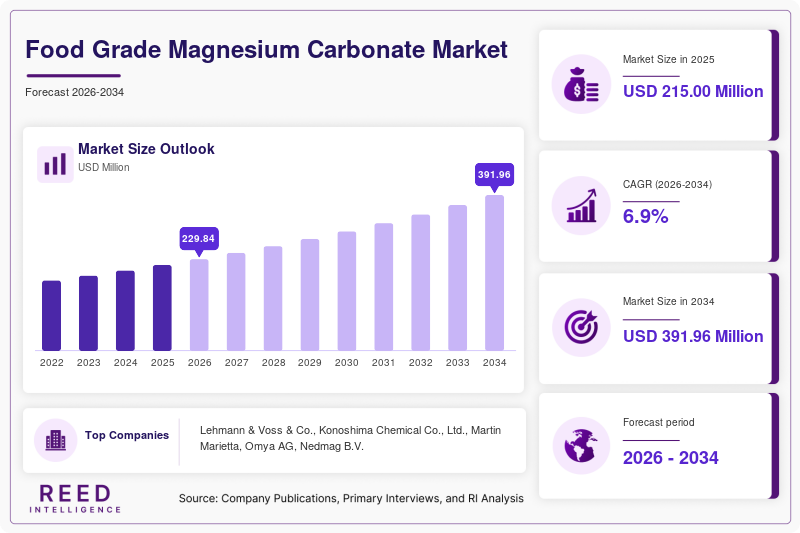
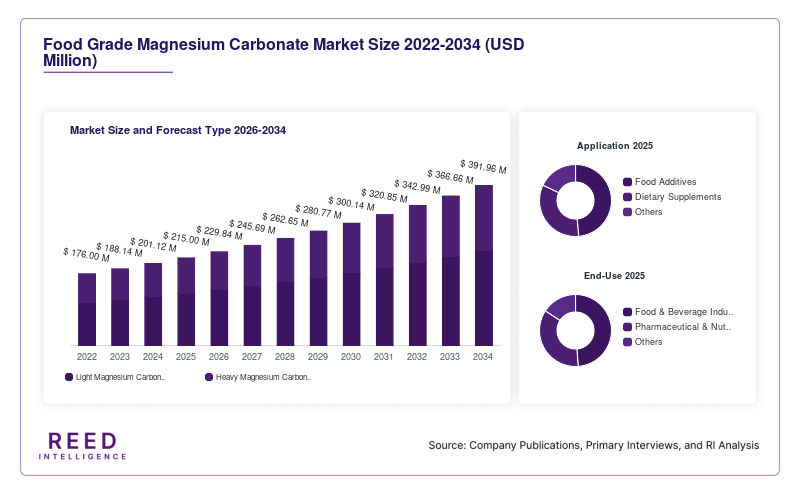
The Food Grade Magnesium Carbonate Market size was valued at approximately USD 215 million in 2026 and is projected to reach USD 368 million by 2034, expanding at a CAGR of 6.9% during the forecast period (2026–2034). This steady growth reflects rising demand for functional food additives, particularly in processed and packaged food industries where magnesium carbonate is widely used as an anti-caking agent, acidity regulator, and magnesium supplement.
One of the primary global factors supporting market expansion is the increasing consumer awareness regarding nutritional fortification and mineral supplementation. Food-grade magnesium carbonate plays a key role in enhancing magnesium intake in daily diets, which is essential for bone health, nerve function, and metabolic processes. This has driven its incorporation across bakery, dairy, beverage, and dietary supplement applications, particularly in regions experiencing rising health consciousness and urbanization.
Key Highlights
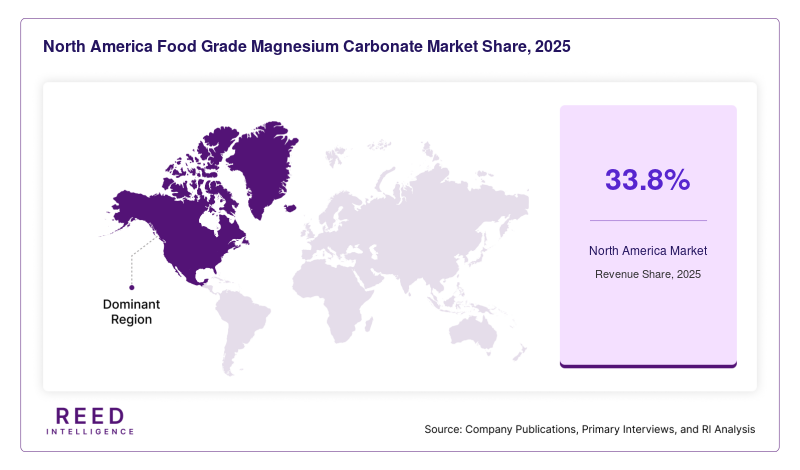
- North America dominated the market with a 33.8% share in 2025.
- Asia Pacific is expected to grow at the fastest CAGR of 8.1% during 2026–2034.
- By type, light magnesium carbonate accounted for the largest share of 56.4%, while heavy magnesium carbonate is projected to grow at a CAGR of 7.5%.
- By application, food additives led with a 47.2% share, whereas dietary supplements are expected to expand at a CAGR of 8.4%.
- The United States remained the dominant country, with market values of USD 62 million in 2024 and USD 66 million in 2025.
Market Trends
Rising Demand for Clean-Label and Functional Ingredients
The market is witnessing a noticeable shift toward clean-label and functional ingredients, driven by evolving consumer preferences for transparency and health-oriented products. Food-grade magnesium carbonate aligns well with this trend as it is perceived as a naturally derived mineral compound with multiple functional benefits. Manufacturers are increasingly incorporating it into formulations that require minimal artificial additives, particularly in bakery products, powdered beverages, and nutritional mixes. The clean-label movement has also prompted companies to highlight the presence of mineral fortification on product labels, further boosting demand. Additionally, regulatory bodies across developed markets are supporting the use of safe mineral additives, encouraging manufacturers to adopt magnesium carbonate as a compliant and versatile ingredient.
Expansion of Nutraceutical and Dietary Supplement Applications
Another prominent trend shaping the market is the rapid expansion of the nutraceutical and dietary supplement sector. Magnesium deficiency remains a common concern globally, leading to increased consumption of magnesium-based supplements. Food-grade magnesium carbonate is widely used in tablets, capsules, and powdered supplements due to its high magnesium content and stability. The growth of fitness culture, preventive healthcare, and aging populations has further accelerated demand for such products. Manufacturers are also developing innovative supplement formats, including chewable tablets and fortified beverages, which rely on magnesium carbonate for formulation stability. This trend is expected to sustain long-term market growth as consumers continue to prioritize health and wellness.
Market Drivers
Growing Processed Food Industry and Demand for Anti-Caking Agents
The expanding processed food industry is a key driver of the Food Grade Magnesium Carbonate Market. As urbanization increases and consumer lifestyles become more fast-paced, the demand for packaged and convenience foods continues to rise. Magnesium carbonate is widely used as an anti-caking agent in powdered products such as spices, baking mixes, and dairy powders, ensuring product consistency and extended shelf life. Its ability to absorb moisture and prevent clumping makes it essential in maintaining product quality during storage and transportation. Food manufacturers are increasingly relying on such additives to improve operational efficiency and reduce product wastage, thereby supporting market growth.
Increasing Focus on Mineral Fortification in Food Products
The rising emphasis on nutritional fortification is another significant driver. Governments and health organizations are encouraging the inclusion of essential minerals in food products to address nutrient deficiencies among populations. Magnesium plays a vital role in various bodily functions, and its deficiency can lead to health complications. Food-grade magnesium carbonate serves as an effective fortifying agent due to its compatibility with multiple food matrices and cost-effectiveness. This has led to its widespread adoption in cereals, beverages, and dairy products. The trend is particularly strong in emerging economies, where improving public health through fortified foods is a key priority.
Market Restraint
Regulatory and Quality Compliance Challenges
One of the primary restraints impacting the market is the stringent regulatory framework governing food-grade additives. Manufacturers must adhere to strict quality standards, purity requirements, and labeling regulations, which vary across regions. Compliance with these standards often involves significant investment in quality control systems, testing procedures, and certification processes. Smaller manufacturers may face challenges in meeting these requirements, limiting their market participation. Additionally, any deviation from established safety standards can result in product recalls and reputational damage. For instance, inconsistencies in mineral purity levels can affect product performance and consumer trust, creating barriers to market growth. These regulatory complexities can slow down product approvals and hinder innovation, especially for companies aiming to expand into new markets.
Market Opportunities
Growth Potential in Emerging Economies
Emerging economies present significant growth opportunities for the Food Grade Magnesium Carbonate Market. Rapid urbanization, increasing disposable incomes, and evolving dietary patterns are driving demand for processed and fortified foods in regions such as Asia Pacific and Latin America. Governments in these regions are also implementing nutrition programs that encourage the use of fortified ingredients, creating a favorable environment for market expansion. Local manufacturers are partnering with global players to improve production capabilities and meet rising demand. This trend is expected to unlock new revenue streams and enhance market penetration across developing regions.
Innovation in Food Formulations and Product Applications
Innovation in food formulations offers another promising opportunity for market players. Manufacturers are exploring new applications of magnesium carbonate in functional foods, plant-based products, and specialty beverages. Its versatility allows it to be used in gluten-free baking, protein powders, and fortified snacks, catering to niche consumer segments. Advances in food processing technologies are also enabling the development of customized ingredient solutions with improved solubility and stability. These innovations are helping companies differentiate their offerings and meet evolving consumer demands. As the food industry continues to innovate, the role of multifunctional additives like magnesium carbonate is expected to expand significantly.
Segmental Analysis
By Type
Light magnesium carbonate dominated the market, accounting for a 56.4% share in 2024. Its widespread use in food applications is attributed to its fine particle size, high surface area, and excellent moisture absorption properties. These characteristics make it highly effective as an anti-caking agent in powdered food products such as spices, flour, and dairy powders. Manufacturers prefer light magnesium carbonate due to its ease of handling and compatibility with various food formulations. Additionally, its cost-effectiveness and availability further support its dominance in the market. The increasing demand for processed and packaged foods continues to drive the adoption of this subsegment.
Heavy magnesium carbonate is expected to be the fastest-growing subsegment, with a CAGR of 7.5% during the forecast period. Its higher density and stability make it suitable for specific applications such as dietary supplements and fortified foods. The growing demand for magnesium-enriched products is a key factor driving this segment’s growth. Manufacturers are increasingly utilizing heavy magnesium carbonate in tablet formulations due to its compressibility and consistency. As the nutraceutical industry expands, the demand for this subsegment is expected to increase significantly.
By Application
Food additives emerged as the dominant application segment, holding a 47.2% share in 2024. Magnesium carbonate is extensively used as an anti-caking agent, acidity regulator, and stabilizer in various food products. Its ability to improve product texture and shelf life makes it a preferred choice among food manufacturers. The growth of the processed food industry and increasing demand for convenience foods have further strengthened this segment. Additionally, regulatory approvals for its use in food applications have encouraged widespread adoption across different regions.
Dietary supplements represent the fastest-growing application segment, with a CAGR of 8.4%. The rising awareness of magnesium deficiency and its health implications has led to increased consumption of magnesium-based supplements. Magnesium carbonate is widely used in supplement formulations due to its high magnesium content and stability. The growing trend of preventive healthcare and fitness has also contributed to the expansion of this segment. Manufacturers are focusing on developing innovative supplement formats, further boosting demand.
By End-Use
The food and beverage industry dominated the market, accounting for a significant share in 2024. Magnesium carbonate is widely used in bakery, dairy, and beverage products to enhance quality and stability. The increasing demand for processed and fortified foods has driven the adoption of this ingredient across the industry. Manufacturers are incorporating it into various formulations to improve product performance and meet consumer expectations. The growth of the global food industry continues to support this segment.
The pharmaceutical and nutraceutical sector is the fastest-growing end-use segment, with a CAGR of 8.2%. The increasing focus on health and wellness has led to rising demand for dietary supplements and fortified products. Magnesium carbonate plays a crucial role in supplement formulations, providing essential nutrients and improving product stability. The expansion of the nutraceutical industry and growing consumer awareness are key factors driving this segment’s growth.
Regional Analysis
North America
North America accounted for a significant share of the Food Grade Magnesium Carbonate Market, holding approximately 33.8% in 2025. The region is expected to grow at a CAGR of 5.8% during the forecast period. The presence of a well-established food processing industry, coupled with high consumer awareness regarding nutritional products, supports market growth. Demand for dietary supplements and fortified foods remains strong, driving the adoption of magnesium carbonate across multiple applications.
The United States dominates the regional market due to its advanced food manufacturing sector and strong regulatory framework ensuring product quality. A unique growth factor in this region is the increasing demand for sports nutrition products, where magnesium carbonate is used to enhance mineral content and improve product stability.
Europe
Europe held a market share of around 27.5% in 2025 and is projected to grow at a CAGR of 6.2%. The region’s focus on clean-label products and stringent food safety regulations has encouraged the use of high-quality food additives. Magnesium carbonate is widely used in bakery and confectionery products, supporting steady demand across the region.
Germany leads the European market, driven by its strong food processing industry and emphasis on quality standards. A unique growth factor is the rising popularity of organic and natural food products, which has increased demand for mineral-based additives that align with clean-label trends.
Asia Pacific
Asia Pacific is the fastest-growing region, with a projected CAGR of 8.1% from 2026 to 2034, and held a 22.4% share in 2025. Rapid urbanization and changing dietary habits are driving demand for processed and fortified foods. The region’s expanding middle-class population is also contributing to increased consumption of nutritional products.
China dominates the regional market due to its large-scale food manufacturing sector and growing demand for dietary supplements. A unique growth factor is government initiatives promoting food fortification to address nutritional deficiencies, which has significantly boosted the use of magnesium carbonate.
Middle East & Africa
The Middle East & Africa region accounted for approximately 8.3% of the market share in 2025 and is expected to grow at a CAGR of 6.5%. Increasing investments in the food processing sector and rising demand for packaged foods are supporting market expansion. The region is gradually adopting fortified food products to improve public health.
Saudi Arabia leads the market in this region, driven by its growing food industry and increasing consumer awareness. A unique growth factor is the expansion of retail and distribution networks, which has improved access to processed and fortified food products.
Latin America
Latin America held a market share of around 8.0% in 2025 and is projected to grow at a CAGR of 6.7%. The region is experiencing steady growth in the food and beverage industry, supported by rising urbanization and changing consumer preferences. Demand for convenience foods and nutritional products is increasing.
Brazil dominates the regional market due to its large population and expanding food processing sector. A unique growth factor is the increasing adoption of fortified food products in government nutrition programs, which has driven demand for magnesium carbonate.
Competitive Landscape
The Food Grade Magnesium Carbonate Market is moderately fragmented, with several global and regional players competing based on product quality, pricing, and distribution networks. Leading companies are focusing on expanding their production capacities and investing in research and development to enhance product performance. Strategic partnerships and mergers are also common, enabling companies to strengthen their market presence and expand into new regions.
A leading player in the market is Lehmann & Voss & Co., known for its extensive product portfolio and strong distribution network. The company has recently expanded its production capabilities to meet growing demand from the food and nutraceutical sectors. Other key players are also investing in sustainable production practices and innovative formulations to gain a competitive edge. The market continues to evolve with increasing emphasis on quality standards and regulatory compliance.
Key Players
- Lehmann & Voss & Co.
- Konoshima Chemical Co., Ltd.
- Martin Marietta
- Omya AG
- Nedmag B.V.
- Kyowa Chemical Industry Co., Ltd.
- Celtic Chemicals Ltd.
- Israel Chemicals Ltd.
- Tateho Chemical Industries Co., Ltd.
- SCORA S.A.S.
- Premier Magnesia, LLC
- Baymag Inc.
- Ube Industries Ltd.
- Grecian Magnesite S.A.
- RHI Magnesita
Recent Developments
- A major manufacturer expanded its magnesium carbonate production facility in Asia Pacific to meet rising regional demand for food-grade additives.
- A leading company introduced a new high-purity magnesium carbonate grade designed specifically for dietary supplement applications.
- Strategic collaboration between a global supplier and a regional distributor enhanced product availability in emerging markets.
Food Grade Magnesium Carbonate Market Segments
Type
- Light Magnesium Carbonate
- Heavy Magnesium Carbonate
Application
- Food Additives
- Dietary Supplements
- Others
End-Use
- Food & Beverage Industry
- Pharmaceutical & Nutraceutical
- Others
By Region
- North America
- Europe
- APAC
- Middle East and Africa
- LATAM