Food Grade Vitamin B Market Size, Share Demand Report By Type (Vitamin B1, Vitamin B2, Vitamin B3, Vitamin B5, Vitamin B6, Vitamin B7, Vitamin B9, Vitamin B12, Vitamin B Complex), By Application (Dietary Supplements, Functional Foods, Functional Beverages, Pharmaceuticals), By End-Use (Food and Beverage Industry, Pharmaceutical Industry, Nutraceutical Industry), By Region & Segment Forecasts, 2026–2034
USD 3950
Market Overview
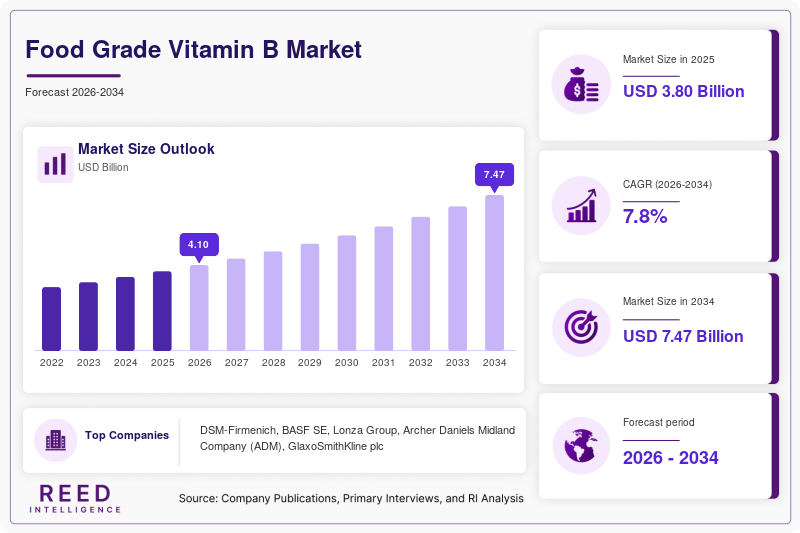
The global Food Grade Vitamin B Market size was valued at approximately USD 3.8 billion in 2026 and is projected to reach USD 6.9 billion by 2034, expanding at a CAGR of 7.8% during the forecast period (2026–2034). The market continues to witness steady expansion due to the increasing use of vitamin B complexes in functional foods, dietary supplements, and fortified beverages. Rising consumer awareness regarding preventive healthcare and micronutrient deficiencies has contributed significantly to the adoption of food-grade vitamins across both developed and emerging economies.
A key global factor supporting market growth is the increasing prevalence of lifestyle-related health conditions such as fatigue, anemia, and metabolic disorders, which has led to a higher intake of vitamin-enriched products. Manufacturers are also focusing on bioavailability and clean-label formulations, which has further strengthened product acceptance among health-conscious consumers.
Key Highlights
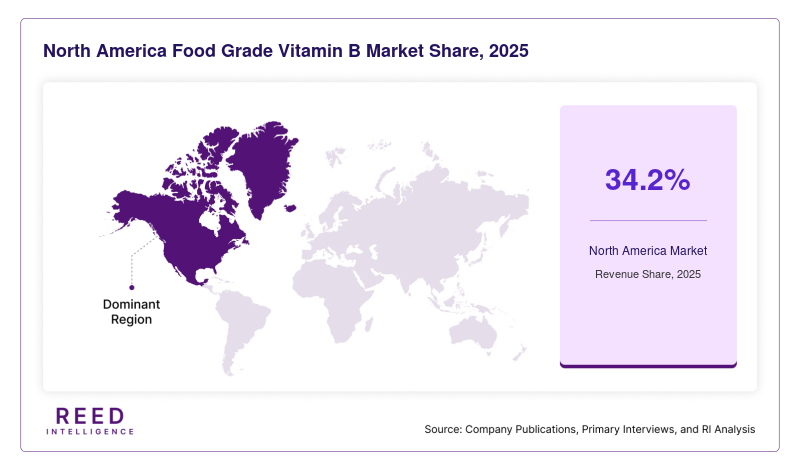
- North America dominated the market with a share of 34.2% in 2025.
- Asia Pacific is projected to register the fastest CAGR of 9.3%.
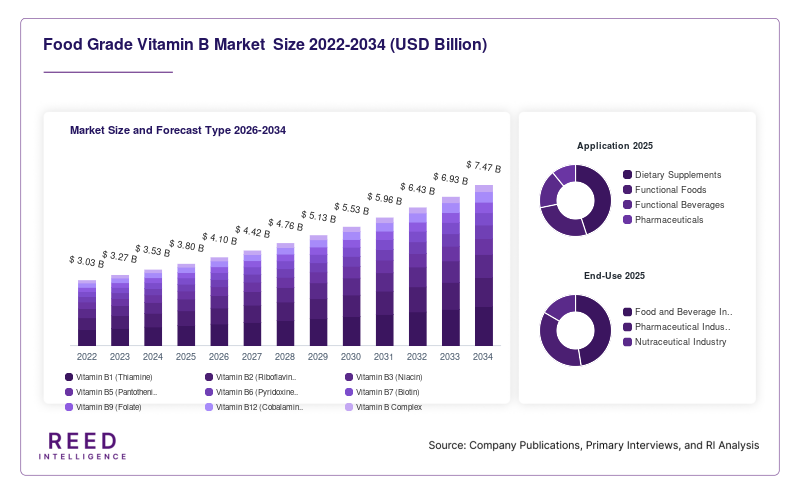
- The vitamin B12 subsegment led the type segment with a 28.6% share, while vitamin B complex blends are expected to grow at a CAGR of 8.7%. In application, dietary supplements accounted for the largest share at 41.5%, whereas functional beverages are the fastest-growing at 9.1% CAGR.
- The United States remained the dominant country, with market values of USD 1.05 billion in 2024 and USD 1.12 billion in 2025.
Market Trends
Rising Demand for Functional and Fortified Foods
The increasing demand for functional foods has become a defining trend in the Food Grade Vitamin B Market. Consumers are shifting toward products that offer additional health benefits beyond basic nutrition, particularly those that support energy metabolism and cognitive health. Vitamin B complexes are widely incorporated into cereals, dairy alternatives, and ready-to-drink beverages. This shift is supported by growing urbanization and busy lifestyles, where convenient nutrition plays a central role.
Manufacturers are also reformulating products to include multiple vitamin B variants such as B6, B9, and B12 to cater to specific health needs. Clean-label and plant-based formulations are further gaining traction, especially among younger consumers. This trend is encouraging innovation in delivery formats, including gummies, powders, and liquid supplements, which enhances market penetration across different consumer segments.
Expansion of Personalized Nutrition Solutions
Personalized nutrition is emerging as a significant trend influencing the Food Grade Vitamin B Market. Advances in health diagnostics and wearable technologies have enabled consumers to tailor nutrient intake based on individual deficiencies and lifestyle needs. Vitamin B supplements are increasingly being customized to support specific conditions such as stress management, energy enhancement, and prenatal care.
Companies are leveraging digital platforms and subscription-based models to deliver personalized vitamin packs. This trend is particularly strong in developed markets where consumers are willing to invest in targeted health solutions. Additionally, the integration of artificial intelligence in nutrition planning is helping brands differentiate their offerings, which contributes to long-term market growth and consumer engagement.
Market Drivers
Increasing Awareness of Nutritional Deficiencies
The growing awareness of micronutrient deficiencies is a major driver of the Food Grade Vitamin B Market. Vitamin B deficiencies, particularly B12 and folate, are common across various age groups and can lead to fatigue, neurological issues, and anemia. Governments and health organizations are promoting fortified foods and dietary supplementation programs to address these deficiencies.
This awareness has translated into higher consumption of fortified food products and supplements. Educational campaigns and labeling regulations have also improved consumer understanding of nutritional content. As a result, food manufacturers are increasingly incorporating vitamin B ingredients into their product portfolios to meet regulatory standards and consumer expectations. This has created a sustained demand across both developed and emerging economies.
Growth of the Dietary Supplements Industry
The rapid expansion of the dietary supplements industry is another key driver supporting the Food Grade Vitamin B Market. Consumers are increasingly adopting preventive healthcare practices, which has led to a surge in supplement consumption. Vitamin B complexes are widely used in multivitamin formulations due to their role in energy production and metabolic functions.
E-commerce platforms and direct-to-consumer models have further accelerated market growth by improving accessibility and product variety. The availability of different dosage forms, including capsules, tablets, and liquid drops, has enhanced consumer convenience. Additionally, the growing aging population, particularly in developed regions, is driving demand for supplements that support cognitive health and overall well-being.
Market Restraint
Regulatory Challenges and Quality Compliance
Stringent regulatory frameworks and quality compliance requirements pose a restraint to the Food Grade Vitamin B Market. Regulatory authorities impose strict guidelines on ingredient sourcing, labeling, and safety standards, which can increase production costs and delay product approvals. These regulations vary across regions, creating complexity for manufacturers operating in multiple markets.
For instance, variations in permissible dosage levels and health claims can limit product standardization. Smaller manufacturers may face challenges in meeting these compliance requirements due to limited resources. Additionally, concerns regarding synthetic versus natural vitamin sources have led to increased scrutiny, which affects product positioning and consumer trust. These factors collectively impact market expansion, particularly in emerging regions where regulatory frameworks are still evolving.
Market Opportunities
Emerging Demand in Developing Economies
Developing economies present significant growth opportunities for the Food Grade Vitamin B Market. Rising disposable incomes, improving healthcare infrastructure, and increasing awareness of nutrition are driving demand for fortified foods and supplements. Countries in Asia Pacific and Latin America are witnessing a shift toward preventive healthcare, which supports the adoption of vitamin-enriched products.
Government initiatives aimed at reducing malnutrition are also encouraging the use of vitamin B fortification in staple foods such as flour and rice. This creates a large-scale demand for food-grade vitamins. Additionally, local manufacturers are entering the market with cost-effective solutions, which enhances product accessibility and market penetration.
Innovation in Delivery Formats and Applications
Innovation in product formats and applications offers substantial opportunities in the Food Grade Vitamin B Market. Companies are developing new delivery systems such as effervescent tablets, chewable gummies, and fortified snacks to cater to diverse consumer preferences. These formats improve convenience and appeal, particularly among younger demographics.
The integration of vitamin B into non-traditional products such as energy drinks and plant-based foods is also gaining momentum. This diversification allows manufacturers to tap into new consumer segments and expand their product portfolios. Furthermore, advancements in encapsulation technologies are improving the stability and bioavailability of vitamins, which enhances product effectiveness and consumer satisfaction.
Segmental Analysis
By Type
The vitamin B12 subsegment dominated the Food Grade Vitamin B Market with a 28.6% share in 2024. This dominance is attributed to its critical role in nerve function and red blood cell formation. Vitamin B12 is widely used in fortified foods and dietary supplements, particularly for addressing deficiencies among vegetarians and the elderly population. The increasing prevalence of B12 deficiency has further strengthened its demand.
The vitamin B complex blends subsegment is expected to register the fastest CAGR of 8.7%. These blends combine multiple vitamin B variants, offering comprehensive health benefits. The growth is driven by rising consumer preference for multifunctional supplements that support energy metabolism and overall well-being.
By Application
Dietary supplements accounted for the largest share of 41.5% in 2024. This segment benefits from the growing trend of preventive healthcare and the increasing consumption of multivitamins. Vitamin B supplements are widely used to support energy levels, cognitive function, and immune health. The availability of diverse product formats has further boosted segment growth.
Functional beverages are the fastest-growing application segment, with a CAGR of 9.1%. These beverages incorporate vitamin B to enhance energy and performance, making them popular among younger consumers and fitness enthusiasts. The rising demand for convenient nutrition solutions is a key factor driving this growth.
By End-Use
The food and beverage industry dominated the market with a 46.3% share in 2024. Manufacturers are increasingly incorporating vitamin B into products such as cereals, dairy alternatives, and snacks to enhance nutritional value. This trend is supported by regulatory requirements and consumer demand for fortified foods.
The pharmaceutical segment is expected to grow at the fastest CAGR of 8.9%. The use of vitamin B in therapeutic applications, particularly for treating deficiencies and neurological conditions, is driving this growth. Advances in formulation technologies are also contributing to segment expansion.
Regional Analysis
North America
North America accounted for 34.2% of the global Food Grade Vitamin B Market share in 2025 and is expected to grow at a CAGR of 6.9% during the forecast period. The region benefits from a well-established dietary supplements industry and high consumer awareness regarding nutritional health. Strong distribution networks and the presence of leading manufacturers further support market growth.
The United States dominates the regional market due to its large consumer base and high adoption of fortified foods. A unique growth factor in this region is the increasing demand for clean-label and organic vitamin products, which has encouraged manufacturers to develop naturally sourced vitamin B formulations.
Europe
Europe held a significant share of 27.6% in 2025 and is projected to grow at a CAGR of 7.1%. The region’s growth is driven by strict food safety regulations and a strong focus on nutritional labeling. Consumers in Europe are highly conscious of ingredient quality, which supports demand for premium vitamin products.
Germany leads the European market due to its advanced food processing industry and strong demand for functional foods. A unique growth factor is the increasing adoption of plant-based diets, which has created a higher demand for vitamin B12 supplements derived from alternative sources.
Asia Pacific
Asia Pacific is expected to register the fastest CAGR of 9.3% during the forecast period, with a market share of 22.4% in 2025. Rapid urbanization, population growth, and rising disposable incomes are key factors driving market expansion. The region is also witnessing increased awareness of nutritional deficiencies.
China dominates the Asia Pacific market due to its large population and expanding food processing sector. A unique growth factor is government-led fortification programs aimed at reducing malnutrition, which significantly boosts demand for vitamin B ingredients.
Middle East & Africa
The Middle East & Africa region accounted for 8.1% of the market share in 2025 and is projected to grow at a CAGR of 7.5%. Increasing health awareness and improving healthcare infrastructure are contributing to market growth. The demand for dietary supplements is rising steadily in urban areas.
South Africa is a key market within the region, supported by growing consumer interest in wellness products. A unique growth factor is the rising prevalence of vitamin deficiencies, which has led to increased consumption of fortified foods and supplements.
Latin America
Latin America held a market share of 7.7% in 2025 and is expected to grow at a CAGR of 7.8%. The region is experiencing gradual growth due to improving economic conditions and increasing awareness of nutrition. The demand for functional foods is gaining momentum.
Brazil dominates the Latin American market due to its large population and expanding food industry. A unique growth factor is the increasing penetration of international supplement brands, which has enhanced product availability and consumer awareness.
Competitive Landscape
The Food Grade Vitamin B Market is characterized by the presence of several established players focusing on product innovation and strategic partnerships. Leading companies are investing in research and development to enhance product quality and expand their application scope. The market is moderately consolidated, with a few key players holding a significant share.
DSM-Firmenich is a leading player in the market, known for its extensive portfolio of vitamin ingredients. The company recently expanded its production capacity to meet growing global demand. Other players are focusing on sustainability and clean-label solutions to align with evolving consumer preferences. Strategic collaborations and acquisitions are also common, enabling companies to strengthen their market position and geographic presence.
Key Players
- DSM-Firmenich
- BASF SE
- Lonza Group
- ADM
- GlaxoSmithKline plc
- Nestlé Health Science
- Amway Corporation
- Herbalife Nutrition Ltd.
- Nature’s Bounty Co.
- Pfizer Inc.
- Sanofi S.A.
- Now Foods
- Garden of Life
- Vitabiotics Ltd.
- Blackmores Limited
Recent Developments
- DSM-Firmenich expanded its vitamin B production facility in 2025 to support rising global demand for fortified food ingredients.
- BASF SE introduced a new line of high-purity vitamin B12 formulations aimed at improving bioavailability in dietary supplements.
- Lonza Group launched a customized vitamin B complex solution designed for personalized nutrition applications in 2024.
Food Grade Vitamin B Market Segments
Type
- Vitamin B1 (Thiamine)
- Vitamin B2 (Riboflavin)
- Vitamin B3 (Niacin)
- Vitamin B5 (Pantothenic Acid)
- Vitamin B6 (Pyridoxine)
- Vitamin B7 (Biotin)
- Vitamin B9 (Folate)
- Vitamin B12 (Cobalamin)
- Vitamin B Complex
Application
- Dietary Supplements
- Functional Foods
- Functional Beverages
- Pharmaceuticals
End-Use
- Food and Beverage Industry
- Pharmaceutical Industry
- Nutraceutical Industry
By Region
- North America
- Europe
- APAC
- Middle East and Africa
- LATAM