Food Processing Blades Market Size, Share & Demand Report By Type (Rotary Blades, Straight Blades, Circular Blades, Precision Slicing Blades), By Application (Meat Processing, Vegetable & Fruit Processing, Bakery Processing, Dairy Processing), By End-Use (Industrial Food Processing, Commercial Kitchens, Small Food Enterprises), By Region & Segment Forecasts, 2026–2034
USD 3950
Market Overview
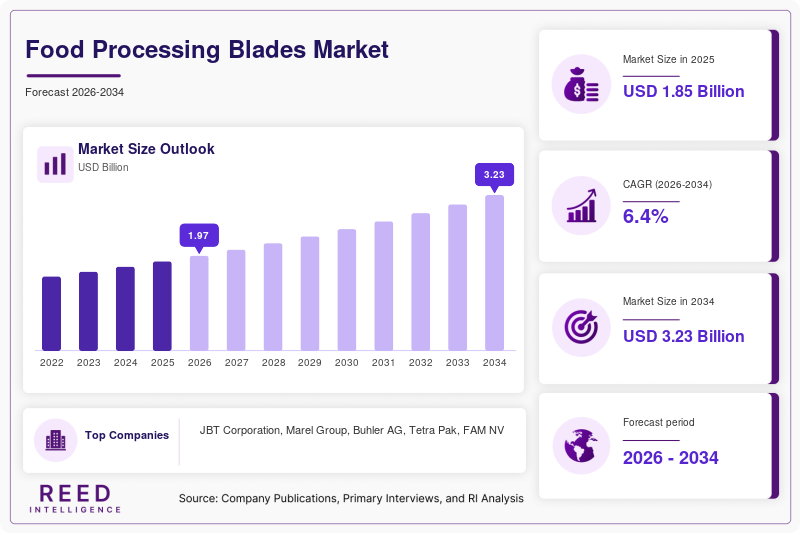
The Food Processing Blades Market was valued at approximately USD 1.85 billion in 2026 and is projected to reach USD 3.05 billion by 2034, expanding at a CAGR of 6.4% during 2026–2034. The market size reflects steady demand from industrial food processing units, commercial kitchens, and emerging automated food production lines. Blades are essential components used in slicing, dicing, grinding, and cutting operations, making them critical for operational efficiency, product consistency, and food safety compliance.
A major global factor supporting market growth is the rapid expansion of the processed food industry, driven by urbanization and changing dietary habits. Consumers increasingly prefer ready-to-eat and convenience foods, which has pushed manufacturers to invest in advanced processing equipment. This trend has increased the demand for high-performance blades with longer life cycles, corrosion resistance, and precision cutting capabilities.
Key Highlights
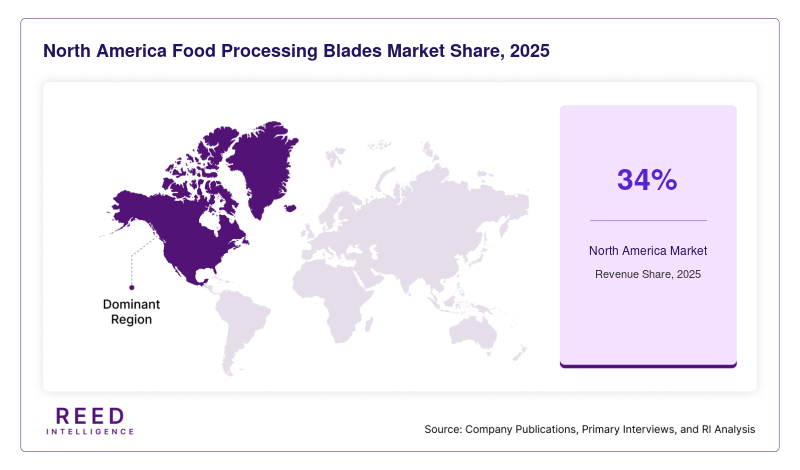
- North America dominated with 34% market share.
- Asia Pacific is the fastest-growing region with a CAGR of 7.8%
- Rotary blades led the type segment, while precision slicing blades are the fastest-growing with a CAGR of 7.2%
- Meat processing dominated applications, while bakery processing is the fastest-growing with a CAGR of 7.5%
- The United States recorded USD 520 million (2024) and USD 545 million (2025) market values
Market Trends
Increasing Adoption of Automation in Food Processing
The integration of automation across food processing facilities is reshaping the Food Processing Blades Market. Automated machinery requires blades that can operate at high speeds while maintaining precision and consistency. This has led to the development of advanced blade designs tailored for robotic systems and automated cutting lines. Manufacturers are investing in blades that reduce downtime and enhance throughput, particularly in large-scale production environments. The demand for automated slicing and dicing solutions in meat, dairy, and vegetable processing is increasing steadily. This trend is also encouraging the use of predictive maintenance technologies, where sensors monitor blade wear and performance, reducing operational disruptions.
Growing Preference for Hygienic and Corrosion-Resistant Materials
Food safety regulations are becoming more stringent globally, prompting manufacturers to adopt blades made from hygienic and corrosion-resistant materials. Stainless steel and ceramic blades are gaining traction due to their resistance to contamination and ease of cleaning. This trend is especially relevant in industries such as dairy and seafood processing, where hygiene standards are critical. Manufacturers are also focusing on antimicrobial coatings and non-stick surfaces to enhance product safety. The shift toward sustainable materials and eco-friendly manufacturing processes is further influencing blade production, aligning with broader environmental goals in the food industry.
Market Drivers
Expansion of Processed and Packaged Food Industry
The rapid growth of the processed and packaged food industry is a primary driver of the Food Processing Blades Market. Increasing urbanization, rising disposable incomes, and changing consumer lifestyles have significantly boosted demand for ready-to-eat and convenience foods. Food manufacturers are scaling up production capacities to meet this demand, which directly increases the need for efficient and durable processing blades. High-volume production environments require blades that can maintain sharpness over extended periods, reducing replacement frequency and operational costs. This has encouraged innovation in blade materials and designs, supporting market growth.
Rising Demand for Precision and Efficiency in Food Processing
Food processing companies are increasingly focused on achieving uniform product quality and minimizing waste. Precision cutting is essential in ensuring consistent portion sizes and improving product presentation. Advanced blades designed for specific applications, such as meat slicing or vegetable dicing, help manufacturers achieve higher efficiency and accuracy. This demand for precision is particularly strong in export-oriented markets, where quality standards are strict. Additionally, the adoption of high-speed processing equipment has created a need for blades that can withstand intense operational conditions, further driving market expansion.
Market Restraint
High Maintenance and Replacement Costs
One of the key challenges in the Food Processing Blades Market is the high cost associated with maintenance and replacement. Industrial blades are subject to continuous wear and tear due to exposure to hard materials, high-speed operations, and varying temperatures. Frequent sharpening and replacement are necessary to maintain performance, which increases operational costs for food processing companies. Small and medium-sized enterprises often find it difficult to invest in premium blades with advanced materials due to budget constraints.
Additionally, improper maintenance can lead to reduced efficiency and potential contamination risks, impacting product quality. For example, dull blades can cause uneven cuts in meat processing, leading to product wastage and lower profitability. The need for skilled labor to maintain and replace blades further adds to the cost burden. These factors can limit the adoption of advanced blade technologies, particularly in developing regions where cost sensitivity is high. As a result, manufacturers must balance performance enhancements with affordability to sustain market growth.
Market Opportunities
Growth in Emerging Markets
Emerging economies present significant growth opportunities for the Food Processing Blades Market. Rapid industrialization, increasing investments in food processing infrastructure, and rising consumer demand for packaged foods are driving market expansion in regions such as Asia Pacific and Latin America. Governments in these regions are promoting food processing industries through favorable policies and incentives, encouraging the establishment of new processing facilities. This creates a strong demand for efficient and cost-effective blades. Local manufacturers are also entering the market, offering competitively priced products, which further boosts adoption.
Innovation in Smart and Long-Life Blades
Technological innovation offers substantial opportunities for market players. The development of smart blades equipped with sensors to monitor wear and performance is gaining attention. These blades can provide real-time data, enabling predictive maintenance and reducing downtime. Additionally, advancements in materials science are leading to the creation of long-life blades with enhanced durability and resistance to corrosion. Such innovations can significantly reduce maintenance costs and improve operational efficiency. Companies investing in research and development are likely to gain a competitive edge by offering differentiated products that meet evolving industry requirements.
Segmental Analysis
By Type
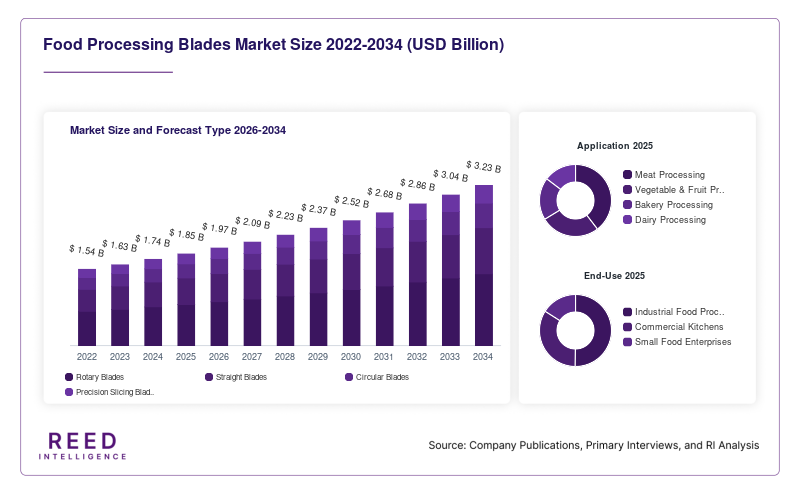
Rotary blades dominated the Food Processing Blades Market in 2024, accounting for approximately 42% of the market share. These blades are widely used in slicing and cutting applications across various food processing industries. Their ability to deliver consistent performance and handle high-volume operations makes them a preferred choice among manufacturers. Rotary blades are commonly used in meat, vegetable, and bakery processing, where precision and speed are critical. Their design allows for efficient cutting with minimal waste, improving overall productivity. Additionally, advancements in materials and coatings have enhanced their durability and resistance to wear, further supporting their dominance.
Precision slicing blades are the fastest-growing subsegment, with a projected CAGR of 7.2% during the forecast period. These blades are designed for applications requiring high accuracy and uniformity, such as deli meats and cheese slicing. The increasing demand for aesthetically appealing and uniformly cut food products is driving their adoption. Food manufacturers are investing in advanced slicing technologies to meet consumer expectations and reduce product wastage. Innovations in blade geometry and materials are improving performance, making precision slicing blades an attractive option for modern processing facilities.
By Application
Meat processing accounted for the largest share of approximately 38% in 2024. The segment’s dominance is attributed to the high demand for processed meat products globally. Blades used in this segment must withstand tough cutting conditions and maintain sharpness over extended periods. The growing consumption of packaged and processed meat products is driving demand for efficient cutting solutions. Manufacturers are focusing on developing blades with enhanced durability and resistance to corrosion to meet industry requirements.
Bakery processing is the fastest-growing application segment, with a CAGR of 7.5%. The rising demand for baked goods, including bread, pastries, and cakes, is driving this growth. Blades used in bakery processing must ensure precise cutting without damaging the product’s texture. Innovations in blade design are improving performance in slicing soft and delicate products. The expansion of bakery chains and increasing consumer preference for convenience foods are further supporting the growth of this segment.
By End-Use
Industrial food processing dominated the market in 2024, accounting for around 55% of the total share. Large-scale processing facilities require high-performance blades to handle continuous operations and maintain efficiency. These facilities prioritize durability, precision, and compliance with food safety standards. The adoption of automated processing systems in industrial settings is further driving demand for advanced blades.
Commercial kitchens are the fastest-growing end-use segment, with a CAGR of 6.9%. The growth of the food service industry, including restaurants and catering services, is driving demand for high-quality blades. Commercial kitchens require versatile blades that can handle various cutting tasks efficiently. The increasing popularity of cloud kitchens and quick-service restaurants is also contributing to the growth of this segment. Manufacturers are focusing on developing user-friendly and cost-effective blades to meet the needs of this market.
Regional Analysis
North America
North America accounted for approximately 34% of the global market share in 2025 and is expected to grow at a CAGR of 5.8% during the forecast period. The region benefits from a well-established food processing industry and high adoption of advanced technologies. The presence of large-scale food manufacturers and strict food safety regulations drive demand for high-quality blades. Investments in automation and smart processing equipment further support market growth.
The United States dominates the regional market due to its extensive food processing infrastructure. A key growth factor is the increasing adoption of automated processing systems in meat and poultry industries. Companies are investing in precision cutting technologies to improve efficiency and reduce labor costs, which drives demand for advanced blades.
Europe
Europe held around 27% market share in 2025 and is projected to grow at a CAGR of 5.5%. The region’s growth is driven by strong regulatory frameworks focusing on food safety and hygiene. Countries such as Germany, France, and the UK are key contributors, with well-developed food processing sectors. The demand for high-performance blades is supported by the need for compliance with stringent quality standards.
Germany leads the European market due to its advanced manufacturing capabilities. A unique growth factor is the region’s focus on sustainable and eco-friendly production practices. Manufacturers are increasingly adopting recyclable materials and energy-efficient processes, influencing the design and production of food processing blades.
Asia Pacific
Asia Pacific is the fastest-growing region, with a CAGR of 7.8% and a 25% market share in 2025. Rapid urbanization, population growth, and increasing demand for processed foods are key drivers. Countries such as China, India, and Japan are investing heavily in food processing infrastructure, creating strong demand for blades.
China dominates the region due to its large-scale food production industry. A significant growth factor is the expansion of small and medium-sized food processing enterprises. These businesses are adopting modern equipment to improve efficiency, driving demand for affordable and durable blades.
Middle East & Africa
The Middle East & Africa region accounted for 8% of the market share in 2025 and is expected to grow at a CAGR of 6.2%. Growth is supported by increasing investments in food processing facilities and rising demand for packaged foods. The region is gradually adopting advanced technologies to improve food production efficiency.
Saudi Arabia is a key market within the region. A unique growth factor is government initiatives aimed at boosting food security and reducing reliance on imports. Investments in local food processing industries are increasing, which drives demand for processing equipment and blades.
Latin America
Latin America held approximately 6% market share in 2025 and is projected to grow at a CAGR of 6.5%. The region’s growth is driven by expanding agricultural output and increasing demand for processed food products. Countries such as Brazil and Mexico are key contributors.
Brazil dominates the regional market due to its strong meat processing industry. A major growth factor is the country’s focus on export-oriented food production. The need to meet international quality standards drives demand for high-performance blades that ensure precision and consistency.
Competitive Landscape
The Food Processing Blades Market is moderately fragmented, with several global and regional players competing based on product quality, innovation, and pricing. Leading companies focus on research and development to introduce advanced blade materials and designs that enhance performance and durability. Strategic partnerships, mergers, and acquisitions are common strategies adopted to expand market presence.
A key leader in the market is JBT Corporation, known for its extensive product portfolio and strong global presence. The company has recently invested in advanced manufacturing technologies to improve blade precision and durability. Other major players are also focusing on expanding their product offerings and strengthening distribution networks. The competitive environment encourages continuous innovation, ensuring the availability of high-performance blades tailored to specific industry needs.
Key Players List
- JBT Corporation
- Marel Group
- Buhler AG
- Tetra Pak
- FAM NV
- Minerva Omega Group
- Friedr. Dick GmbH
- Nemco Food Equipment
- Urschel Laboratories
- Bettcher Industries
- Torrey Hills Technologies
- Fernite Machine Knives
- York Saw and Knife Co.
- Hyde Industrial Blade Solutions
- TGW Global
Recent Developments
- In 2025, JBT Corporation introduced a new line of high-durability stainless steel blades designed for automated processing systems.
- In 2024, Marel Group launched precision slicing blades with enhanced wear resistance for meat processing applications.
- In 2025, Buhler AG expanded its production capacity to meet growing demand for food processing components, including blades.
Food Processing Blades Market Segments
Type
- Rotary Blades
- Straight Blades
- Circular Blades
- Precision Slicing Blades
Application
- Meat Processing
- Vegetable & Fruit Processing
- Bakery Processing
- Dairy Processing
End-Use
- Industrial Food Processing
- Commercial Kitchens
- Small Food Enterprises
By Region
- North America
- Europe
- APAC
- Middle East and Africa
- LATAM