Foot Patch Market Size, Share & Demand Report By Product Type (Detox Foot Patches, Herbal Foot Patches, Aromatherapy Foot Patches), By Application (Detoxification, Sleep Improvement, Pain Relief, Stress Reduction), By Distribution Channel (Online Retail, Pharmacies & Drug Stores, Supermarkets & Hypermarkets, Specialty Wellness Stores, Direct-to-Consumer), By End-Use (Individual Consumers, Wellness Centers & Spas), By Region & Segment Forecasts, 2026–2034
USD 3950
Market Overview
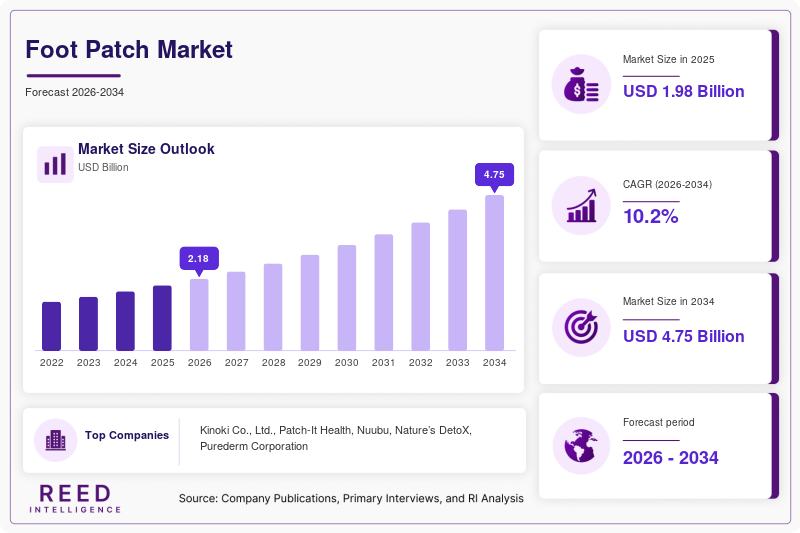
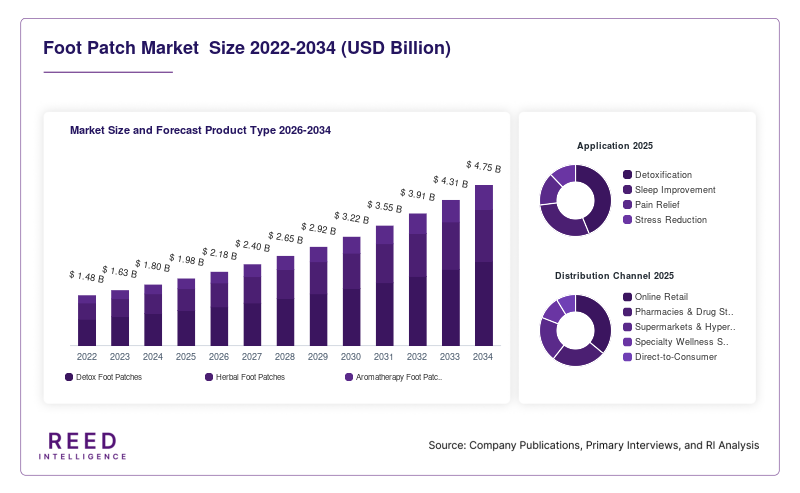
The global Foot Patch Market size was estimated at USD 2.18 billion in 2026 and is projected to reach USD 4.76 billion by 2034, expanding at a CAGR of 10.2% from 2026 to 2034. The market has experienced steady expansion due to the rising consumer inclination toward non-invasive wellness solutions and preventive healthcare practices. A key global factor supporting this growth has been the increasing awareness of personal detoxification and self-care routines, particularly among urban populations seeking convenient and natural remedies.
The shift toward alternative therapies and herbal wellness products has contributed significantly to the adoption of foot patches across both developed and emerging markets. Additionally, the growing e-commerce ecosystem has enhanced accessibility, enabling manufacturers to reach a wider consumer base.
Key Highlights:
- North America dominated the market with a 34.6% share in 2025, while Asia Pacific is expected to grow at the fastest CAGR of 11.8% (2026–2034).
- By type, detox foot patches led with a 62.3% share in 2025, whereas herbal-infused patches are projected to grow at a CAGR of 11.5%.
- By distribution channel, online retail was the leading segment with a 48.9% share, while direct-to-consumer (DTC) sales are anticipated to expand at 12.1% CAGR.
- The United States remained the dominant country, with market values of USD 610 million in 2024 and USD 665 million in 2025.
Market Trends
Rising Popularity of Herbal and Natural Ingredients
Consumers are increasingly favoring foot patches made with natural ingredients such as bamboo vinegar, ginger extract, and lavender oil. This trend reflects a broader shift toward clean-label wellness products, influencing manufacturers to reformulate products with organic and chemical-free components.
Integration with Wellness and Lifestyle Branding
Foot patches are increasingly being marketed as part of holistic wellness routines, including sleep improvement and stress management. Brands are aligning products with lifestyle benefits rather than solely focusing on detoxification, thereby expanding their consumer appeal.
Market Drivers
Increasing Demand for Non-Invasive Wellness Solutions
The demand for simple, non-invasive health products has significantly contributed to the growth of the Foot Patch Market. Consumers are increasingly adopting products that require minimal effort while offering perceived health benefits, making foot patches a convenient choice.
Expansion of E-Commerce and Direct Sales Channels
The rapid expansion of online retail platforms has improved product visibility and accessibility. Digital marketing strategies and influencer endorsements have further accelerated product adoption across various demographics.
Market Restraint
Limited Scientific Validation of Detox Claims
One of the primary challenges facing the Foot Patch Market is the lack of strong scientific evidence supporting detoxification claims. This skepticism among healthcare professionals and informed consumers may limit widespread adoption in certain regions.
Market Opportunities
Growing Demand in Emerging Economies
Emerging markets in Asia, Latin America, and Africa present significant growth opportunities due to rising disposable incomes and increasing awareness of personal wellness products.
Product Innovation and Customization
Manufacturers are focusing on product differentiation through customization, such as patches targeting specific concerns like fatigue relief or sleep enhancement. This innovation is expected to attract niche consumer segments.
Segmental Analysis
By Type
The detox foot patches segment dominated the Foot Patch Market with a 62.3% share in 2025, primarily due to widespread consumer perception of detoxification benefits. Meanwhile, herbal-infused foot patches are expected to grow at a CAGR of 11.5%, driven by increasing demand for natural and plant-based formulations.
By Material
Bamboo vinegar-based patches held the largest share of 45.7% in 2025, owing to their traditional usage and perceived effectiveness. The charcoal-based patches segment is projected to grow at a CAGR of 10.9%, supported by its association with toxin absorption properties.
By Application
The detoxification segment led the market with a 51.6% share in 2025. However, sleep improvement applications are anticipated to grow at a CAGR of 11.2%, driven by increasing consumer focus on stress relief and relaxation.
By Distribution Channel
Online retail dominated with a 48.9% share in 2025, reflecting the growing preference for digital shopping. The direct-to-consumer (DTC) segment is expected to expand at a CAGR of 12.1%, supported by brand-owned platforms and subscription models.
By End-Use
The individual consumers segment accounted for a 74.5% share in 2025, as foot patches are primarily purchased for personal use. Meanwhile, wellness centers and spas are expected to grow at a CAGR of 10.4%, driven by the integration of foot patches into holistic treatment offerings.
Regional Analysis
North America
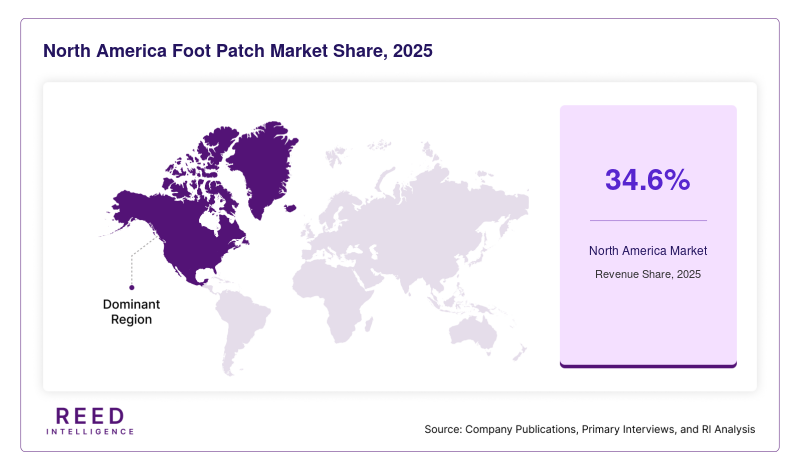
North America accounted for 34.6% of the global Foot Patch Market share in 2025 and is expected to grow at a CAGR of 9.1% during the forecast period. The United States dominated the region due to high consumer awareness of wellness products and strong online retail infrastructure. The growth is supported by the increasing adoption of alternative health solutions.
Europe
Europe held a 27.3% share in 2025 and will expand at a CAGR of 8.7% from 2026 to 2034. Germany led the regional market, driven by a strong preference for herbal and natural health products. Regulatory emphasis on product quality has also influenced market development.
Asia Pacific
Asia Pacific captured 22.8% of the market share in 2025 and is projected to grow at the fastest CAGR of 11.8%. China emerged as the dominant country due to its traditional medicine heritage and large consumer base. Increasing urbanization has further fueled demand.
Middle East & Africa
The Middle East & Africa region accounted for 7.1% of the market share in 2025 and is expected to grow at a CAGR of 9.6%. The United Arab Emirates led the market, supported by rising disposable income and expanding retail networks.
Latin America
Latin America held a 8.2% share in 2025 and will grow at a CAGR of 9.3%. Brazil dominated the region, driven by increasing interest in personal care and wellness products among younger populations.
Competitive Landscape
The Foot Patch Market is moderately fragmented, with several regional and international players competing through product innovation and branding strategies. Leading companies focus on expanding their product portfolios and strengthening online presence. Kinoki Co., Ltd. is recognized as a market leader due to its strong brand recognition and wide product distribution.
The company recently introduced an advanced herbal formulation targeting improved sleep quality, enhancing its competitive positioning. Other key players such as Patch-It Health, Nuubu, Nature’s DetoX, and Purederm Corporation emphasize natural ingredients and eco-friendly packaging to attract health-conscious consumers. Strategic partnerships with e-commerce platforms and wellness influencers are commonly adopted to increase visibility. Additionally, companies are investing in research and development to improve product efficacy and address skepticism around detox claims, thereby strengthening consumer trust and market penetration.
Key Players List
- Kinoki Co., Ltd.
- Patch-It Health
- Nuubu
- Nature’s DetoX
- Purederm Corporation
- Herbal Concepts Inc.
- Detox Foot Pads Ltd.
- Green Life Wellness
- MediPatch Solutions
- BioBalance Products
- ZenPatch Co.
- Natural Health Innovations
- Vitality Wellness Group
- EcoPatch International
- Harmony Health Products
Recent Developments
- In 2025, Kinoki Co., Ltd. launched a new product line featuring enhanced herbal formulations targeting sleep improvement.
- In 2024, Nuubu expanded its distribution network across Asia Pacific through strategic e-commerce partnerships.
- In 2025, Purederm Corporation introduced eco-friendly packaging solutions to align with sustainability trends.
- In 2024, Patch-It Health invested in digital marketing campaigns to strengthen its online presence.
- In 2025, Nature’s DetoX developed customized foot patches designed for specific wellness needs such as fatigue relief.
Foot Patch Market Segments
Product Type
- Detox Foot Patches
- Herbal Foot Patches
- Aromatherapy Foot Patches
Application
- Detoxification
- Sleep Improvement
- Pain Relief
- Stress Reduction
Distribution Channel
- Online Retail
- Pharmacies & Drug Stores
- Supermarkets & Hypermarkets
- Specialty Wellness Stores
- Direct-to-Consumer
By Region
- North America
- Europe
- APAC
- Middle East and Africa
- LATAM