Foot Ulcer Sensor Market Size, Share & Demand Report By Sensor Type (Temperature Sensors, Pressure Sensors, Moisture Sensors), By Product Type (Smart Insoles, Sensor-Enabled Socks, Smart Footwear), By Application (Diabetic Foot Ulcer Prevention, Pressure Ulcer Monitoring), By End Use (Hospitals, Clinics, Home Healthcare), By Region & Segment Forecasts, 2025–2033
USD 3950
Market Overview
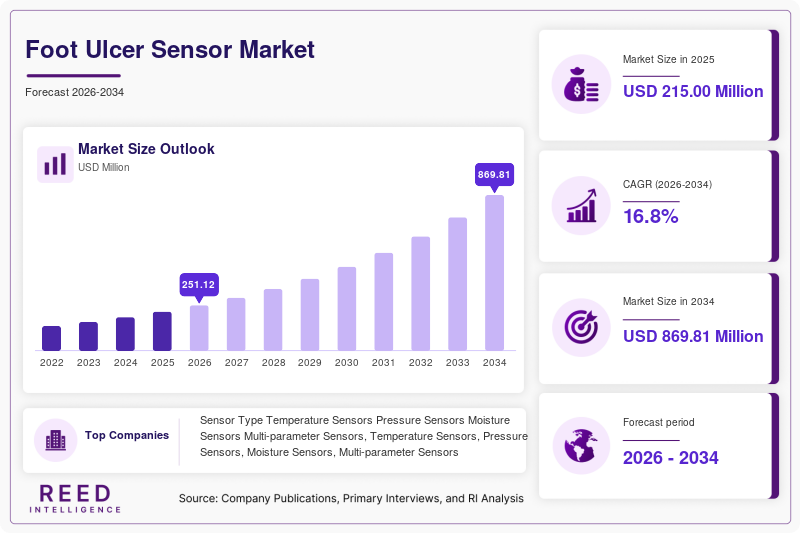
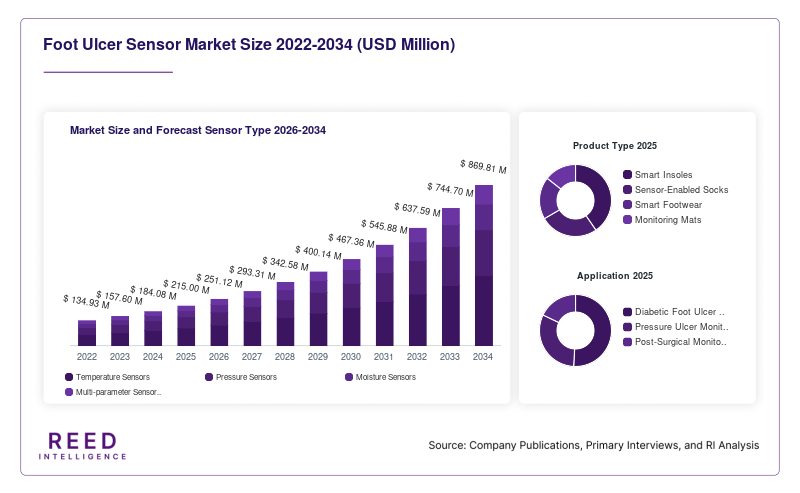
The Foot Ulcer Sensor Market size was valued at USD 215 million in 2024 and is projected to reach USD 865 million by 2033, expanding at a CAGR of 16.8% from 2025 to 2033. The market growth reflects the increasing need for early detection technologies that help prevent complications related to diabetic foot ulcers and pressure injuries. Foot ulcer sensors are medical monitoring devices that track pressure, temperature, or moisture changes in the foot to detect early signs of ulcer development. These technologies are widely integrated into wearable systems, smart insoles, and remote patient monitoring platforms to improve preventive care.
A key global factor supporting the growth of the Foot Ulcer Sensor Market is the rapid expansion of digital healthcare and remote monitoring systems. Healthcare providers increasingly adopt connected monitoring technologies to manage chronic conditions outside clinical settings. Foot ulcer sensors enable real-time monitoring of pressure and temperature variations in the foot, allowing clinicians to intervene early and reduce hospitalization risk. The integration of these sensors with mobile applications and telehealth systems further enhances patient compliance and clinical outcomes.
Key Highlights
- North America held approximately 38.5% of the global market share in 2025, while Asia Pacific is projected to register the fastest CAGR of 19.7% through 2033.
- Temperature sensors dominated the product segment with 42.3% share in 2024, while smart insole systems are expected to grow at a CAGR of 20.6%.
- Hospitals represented the leading end-use segment with 46.1% share in 2024, whereas home healthcare monitoring will expand at a CAGR of 21.2%.
- The United States accounted for a market value of USD 72 million in 2024 and is estimated to reach USD 81 million in 2025.
Market Trends
Integration of Wearable Health Monitoring Technologies
One of the major trends shaping the Foot Ulcer Sensor Market is the integration of wearable sensor technologies into footwear and medical monitoring devices. Manufacturers are increasingly developing smart insoles, socks, and footwear embedded with pressure and temperature sensors capable of continuously monitoring foot conditions. These wearable devices transmit real-time data to mobile applications or clinical dashboards, enabling early identification of abnormal pressure points or temperature changes that may indicate ulcer formation. The growing acceptance of wearable healthcare technologies among patients with chronic diseases has accelerated the adoption of such solutions. In addition, the shift toward home-based healthcare monitoring is supporting the demand for convenient and non-invasive sensor devices.
Adoption of AI-Enabled Predictive Monitoring Platforms
Another emerging trend in the Foot Ulcer Sensor Market is the incorporation of artificial intelligence and predictive analytics in monitoring platforms. Advanced sensor systems now integrate algorithms capable of analyzing foot pressure distribution, gait patterns, and thermal variations over time. These systems can generate predictive alerts that warn patients and healthcare providers before tissue damage occurs. The combination of sensor data and AI-based analytics improves clinical decision-making and enables proactive care management. This technological convergence is expected to transform preventive diabetic foot care by shifting the focus from treatment to early intervention.
Market Drivers
Rising Prevalence of Diabetes and Foot Ulcer Complications
The increasing global burden of diabetes represents a major driver for the Foot Ulcer Sensor Market. Diabetic patients are highly susceptible to foot ulcers due to nerve damage and poor circulation, which can lead to serious complications if not detected early. Traditional monitoring approaches often rely on visual inspection or periodic clinical examinations, which may not identify early warning signs. Foot ulcer sensors provide continuous monitoring of pressure, temperature, and moisture levels, allowing healthcare professionals to detect risk factors at an early stage. As healthcare systems emphasize preventive care and complication management, the demand for such monitoring technologies continues to increase.
Expansion of Remote Patient Monitoring Programs
Another significant driver supporting the Foot Ulcer Sensor Market growth is the expansion of remote patient monitoring initiatives. Healthcare providers are increasingly deploying digital monitoring technologies to track chronic conditions outside hospitals. Foot ulcer sensors allow clinicians to monitor patient foot health remotely and intervene before ulcers develop. Remote monitoring reduces hospital visits and lowers treatment costs associated with advanced ulcer complications. As telehealth infrastructure expands globally, the adoption of sensor-based monitoring devices for chronic disease management is expected to increase.
Market Restraint
High Device Costs and Limited Accessibility
One of the primary restraints affecting the Foot Ulcer Sensor Market is the relatively high cost of advanced monitoring systems. Foot ulcer sensors often incorporate sophisticated electronics, wireless communication modules, and data analytics software. These technological components increase the overall cost of devices, which may limit accessibility for patients in low- and middle-income regions. Healthcare providers and insurance systems may also hesitate to adopt these technologies if reimbursement policies are unclear.
Additionally, the implementation of sensor-based monitoring solutions often requires supporting digital infrastructure such as mobile applications, cloud platforms, and data management systems. In healthcare settings where digital infrastructure is still developing, integrating these technologies may be challenging. Patients may also require training to use wearable monitoring devices effectively, which can affect adoption rates.
Cost considerations and infrastructure limitations can therefore restrict market penetration in emerging healthcare systems. Although technological advancements are gradually reducing manufacturing costs, affordability remains a critical factor influencing adoption. As a result, market participants are focusing on developing cost-efficient sensor systems that maintain accuracy while improving accessibility for a broader patient population.
Market Opportunities
Growth of Preventive Healthcare Technologies
Preventive healthcare is becoming a central focus for healthcare systems worldwide, creating opportunities for the Foot Ulcer Sensor Market. Healthcare providers are increasingly prioritizing technologies that help identify disease risks before complications arise. Foot ulcer sensors support this approach by enabling early detection of pressure or temperature abnormalities that could lead to ulcer formation. The adoption of preventive monitoring solutions is expected to grow in outpatient and home-based healthcare settings. As healthcare providers emphasize early intervention strategies, the demand for advanced monitoring devices will likely increase.
Expansion of Smart Footwear and Digital Health Ecosystems
The growing adoption of smart footwear and connected health ecosystems presents another opportunity for the Foot Ulcer Sensor Market. Technology companies and medical device manufacturers are collaborating to integrate sensor technology into everyday footwear products. These solutions combine medical monitoring with consumer wearable technology, expanding the potential user base beyond clinical environments. Smart footwear platforms that track foot health metrics can be integrated with digital health applications and wearable fitness devices. This integration allows continuous monitoring and personalized health insights, creating new growth avenues for manufacturers and technology providers.
Segmental Analysis
By Sensor Type
Temperature sensors represented the dominant subsegment in the Foot Ulcer Sensor Market, accounting for approximately 42.3% of the market share in 2024. These sensors monitor temperature variations in the foot that may indicate inflammation or tissue stress before ulcers develop. Temperature-based monitoring systems are widely used in clinical settings due to their reliability and ability to detect early warning signs of foot complications. Healthcare professionals frequently rely on temperature monitoring because localized increases in temperature often precede ulcer formation.
The pressure sensors subsegment is expected to experience the fastest growth with a CAGR of 19.8% during the forecast period. Pressure sensors measure load distribution across different areas of the foot, helping identify high-risk pressure points. The increasing use of pressure mapping technologies in smart insoles and wearable footwear solutions will support this growth. As healthcare providers focus on improving gait analysis and pressure management for patients with mobility challenges, pressure-based monitoring systems will become increasingly important.
By Product Type
The smart insole systems segment held the largest share of the Foot Ulcer Sensor Market in 2024, accounting for approximately 36.7% of the total market share. Smart insoles integrate multiple sensors within footwear to continuously monitor pressure distribution, temperature variations, and walking patterns. These systems provide real-time feedback through mobile applications and clinical dashboards, allowing healthcare providers to track patient foot health remotely. Their ability to combine multiple monitoring parameters in a single device has contributed to their widespread adoption.
The sensor-enabled socks segment will register the fastest growth with a CAGR of 20.6% through 2033. These wearable devices incorporate flexible sensors within textile materials, enabling comfortable and continuous monitoring. Sensor-enabled socks are designed for long-term daily use and provide detailed insights into foot temperature and pressure patterns. Their lightweight design and compatibility with digital health platforms are expected to encourage broader adoption among patients seeking convenient monitoring solutions.
By Application
The diabetic foot ulcer prevention segment accounted for the largest portion of the Foot Ulcer Sensor Market, holding approximately 54.2% of the market share in 2024. Diabetes remains one of the leading causes of foot ulcer complications globally. Foot ulcer sensors are increasingly used in preventive care programs designed to monitor early signs of tissue damage. These technologies allow healthcare providers to identify potential risks before ulcers develop, reducing the need for advanced medical treatment.
The pressure ulcer monitoring segment will record the fastest CAGR of 18.7% during the forecast period. Pressure ulcers commonly occur in patients with limited mobility who remain in the same position for extended periods. Sensor-based monitoring systems can detect prolonged pressure on specific areas of the foot, enabling caregivers to intervene quickly. As healthcare providers emphasize improved patient monitoring in long-term care facilities, the demand for pressure ulcer monitoring solutions will increase.
By End-Use
The hospitals segment dominated the Foot Ulcer Sensor Market in 2024 with approximately 46.1% market share. Hospitals frequently adopt advanced monitoring technologies to enhance diagnostic accuracy and patient care quality. Foot ulcer sensors are used in hospital settings to monitor high-risk patients, particularly those with diabetes or mobility impairments. Clinical environments also provide access to advanced data analysis systems that support effective monitoring.
The home healthcare segment is projected to expand at the fastest CAGR of 21.2% from 2025 to 2033. Increasing demand for remote monitoring technologies is encouraging the adoption of wearable sensor devices in home-based care settings. Patients can use these devices to track foot health metrics while clinicians monitor data remotely. The shift toward patient-centric care models will support the growth of home-based monitoring solutions.
Regional Analysis
North America
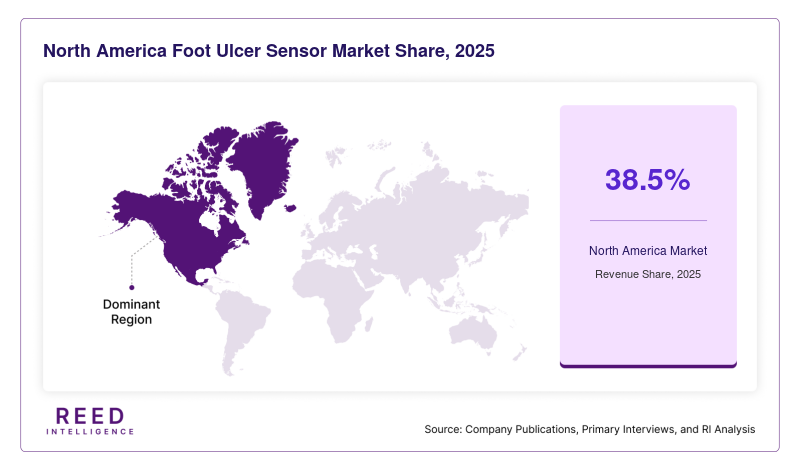
North America accounted for approximately 38.5% of the Foot Ulcer Sensor Market share in 2025, reflecting the region’s established healthcare infrastructure and early adoption of medical monitoring technologies. The regional market will expand at a CAGR of 15.4% from 2025 to 2033. Growth in North America will be influenced by strong investments in medical technology innovation and the widespread use of wearable healthcare devices. Healthcare providers across the region have increasingly incorporated digital monitoring tools into chronic disease management programs, creating favorable conditions for the adoption of foot ulcer sensors.
The United States represented the dominant country within the regional market. One major factor supporting market expansion in the country is the strong presence of medical device manufacturers and research institutions specializing in wearable healthcare technologies. These organizations continue to develop advanced sensor platforms that enhance monitoring accuracy and patient convenience. In addition, the country’s growing emphasis on value-based healthcare models has encouraged the adoption of technologies that reduce long-term treatment costs associated with ulcer complications.
Europe
Europe represented approximately 27.2% of the Foot Ulcer Sensor Market share in 2025 and will expand at a CAGR of 14.8% through 2033. The regional market has been supported by increasing investments in healthcare technology innovation and the rising adoption of digital health solutions. Several European healthcare systems have implemented initiatives aimed at improving chronic disease monitoring through connected medical devices.
Germany emerged as the dominant country in the European market. A key factor supporting growth in Germany is the country’s strong medical device manufacturing sector combined with supportive regulatory frameworks for digital health technologies. Healthcare providers in Germany have actively adopted innovative monitoring tools designed to improve patient outcomes and reduce hospitalization rates associated with diabetic complications.
Asia Pacific
Asia Pacific accounted for approximately 21.4% of the Foot Ulcer Sensor Market share in 2025 and will register the fastest growth rate with a CAGR of 19.7% between 2025 and 2033. Rapid healthcare infrastructure development and increasing awareness regarding chronic disease management are supporting the expansion of the regional market. Governments across the region are also promoting digital health initiatives that encourage the adoption of remote monitoring technologies.
China represented the leading country in the Asia Pacific market. A key growth factor in China is the rapid expansion of the country’s medical technology industry and increasing investments in digital healthcare solutions. Domestic technology companies are actively developing wearable monitoring devices designed for chronic disease management. These innovations, combined with expanding healthcare services, are expected to strengthen market growth in the region.
Middle East & Africa
The Middle East & Africa accounted for approximately 7.1% of the Foot Ulcer Sensor Market share in 2025 and will grow at a CAGR of 13.9% through 2033. Market expansion in the region is influenced by gradual improvements in healthcare infrastructure and increasing adoption of modern medical technologies. Healthcare providers are focusing on enhancing diagnostic capabilities and preventive care services to improve patient outcomes.
Saudi Arabia emerged as the dominant country in the regional market. A distinct growth factor in the country is the government’s ongoing investment in healthcare modernization initiatives. These programs aim to introduce advanced medical technologies into hospitals and specialized treatment centers. As healthcare institutions adopt modern monitoring devices, demand for foot ulcer sensors is expected to increase.
Latin America
Latin America held approximately 5.8% of the Foot Ulcer Sensor Market share in 2025 and will expand at a CAGR of 14.2% during the forecast period. Market growth in the region will be driven by increasing awareness of chronic disease management and the gradual adoption of modern medical technologies in healthcare facilities.
Brazil represented the dominant country in Latin America. One major growth factor supporting the market in Brazil is the expansion of specialized diabetes care programs within hospitals and healthcare institutions. These programs emphasize early detection and preventive monitoring of diabetic complications. As healthcare providers increasingly incorporate digital monitoring solutions into treatment protocols, the adoption of foot ulcer sensor technologies will likely increase.
Competitive Landscape
The Foot Ulcer Sensor Market features a combination of medical device manufacturers, wearable technology developers, and digital health companies. Market participants focus on technological innovation, strategic collaborations, and product development to expand their market presence.
One of the leading players in the market is Podimetrics, which specializes in temperature-monitoring solutions designed to detect early signs of diabetic foot complications. The company has developed a smart mat system that monitors foot temperature and transmits data to healthcare providers for preventive intervention. Recent developments include improvements in remote monitoring capabilities and integration with clinical care platforms.
Other companies operating in the market are expanding their product portfolios through partnerships with healthcare institutions and technology providers. These strategies enable companies to strengthen their distribution networks and enhance product capabilities. As competition intensifies, manufacturers are focusing on improving sensor accuracy, device comfort, and digital health integration.
Key Players
- Podimetrics
- Sensoria Health
- Orpyx Medical Technologies
- Tekscan Inc.
- Moticon GmbH
- XSENSOR Technology Corporation
- Digitsole
- SurroSense Rx
- Siren Care Inc.
- Plantiga Technologies
Recent Developments
- 2024: Podimetrics expanded its remote patient monitoring platform with enhanced temperature-tracking capabilities for early ulcer detection.
- 2024: Sensoria Health introduced an updated smart insole system integrated with advanced mobile health applications.
- 2023: Orpyx Medical Technologies launched a new pressure-sensing insole designed to improve gait monitoring and pressure management.
- 2023: Siren Care developed sensor-embedded medical socks capable of continuous temperature monitoring for diabetic patients.
- 2023: Tekscan Inc. enhanced its pressure mapping technology for clinical foot health monitoring applications.
Foot Ulcer Sensor Market Segments
Sensor Type
- Temperature Sensors
- Pressure Sensors
- Moisture Sensors
- Multi-parameter Sensors
Product Type
- Smart Insoles
- Sensor-Enabled Socks
- Smart Footwear
- Monitoring Mats
Application
- Diabetic Foot Ulcer Prevention
- Pressure Ulcer Monitoring
- Post-Surgical Monitoring
End Use
- Hospitals
- Clinics
- Home Healthcare
- Rehabilitation Centers
By Region
- North America
- Europe
- APAC
- Middle East and Africa
- LATAM