Forward Osmosis Market Size, Share & Demand Report By Technology (Membrane-Based Systems, Hybrid Systems), By Application (Desalination, Wastewater Reuse, Food & Beverage Processing, Others), By End-Use Industry (Municipal, Industrial, Pharmaceutical, Food & Beverage), By Membrane Type (Cellulose Triacetate, Thin-Film Composite), By Region & Segment Forecasts, 2025–2034
USD 3950
Market Overview
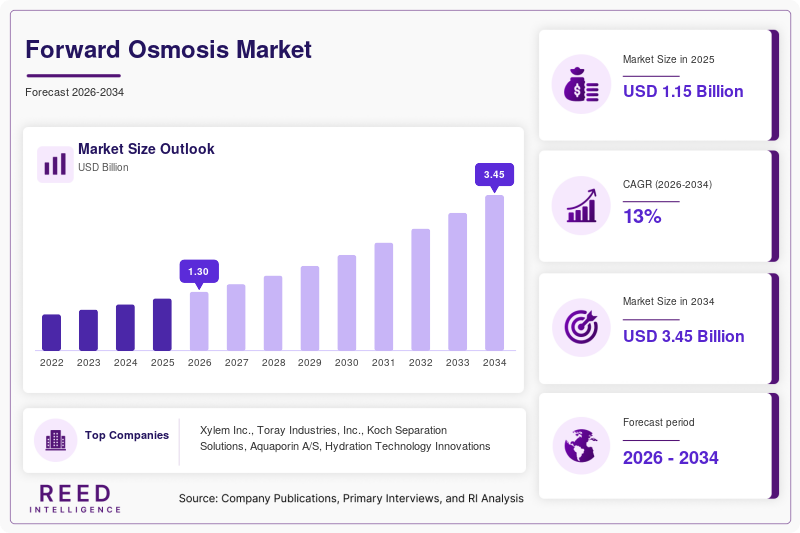
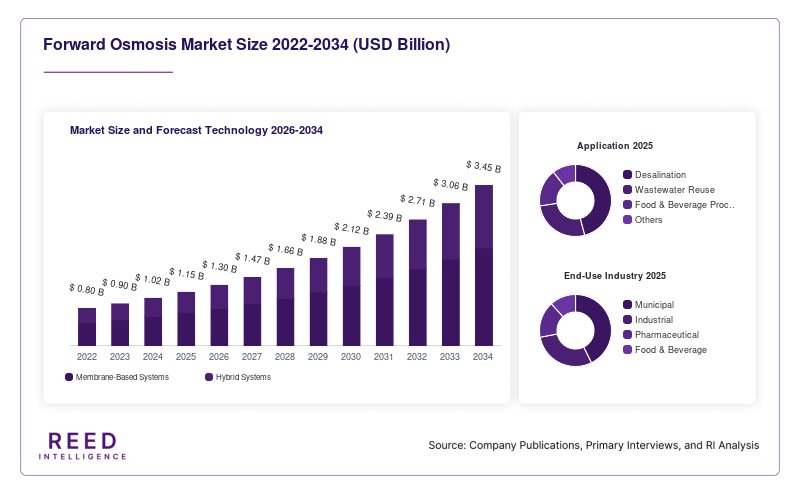
The Forward Osmosis Market size was estimated at USD 1.15 billion in 2025 and is projected to reach approximately USD 3.45 billion by 2034, expanding at a CAGR of 13.0% during the forecast period (2025–2034). The market growth is primarily supported by the increasing global demand for energy-efficient water treatment technologies. As industries and municipalities face rising pressure to reduce operational costs and carbon footprints, forward osmosis (FO) systems have gained traction due to their lower energy consumption compared to conventional reverse osmosis processes.
Forward osmosis leverages natural osmotic pressure gradients to separate water from dissolved contaminants, making it suitable for desalination, wastewater treatment, and food concentration processes. The technology’s ability to operate under low hydraulic pressure and minimize membrane fouling has further strengthened its adoption across diverse end-use sectors.
Key Highlights
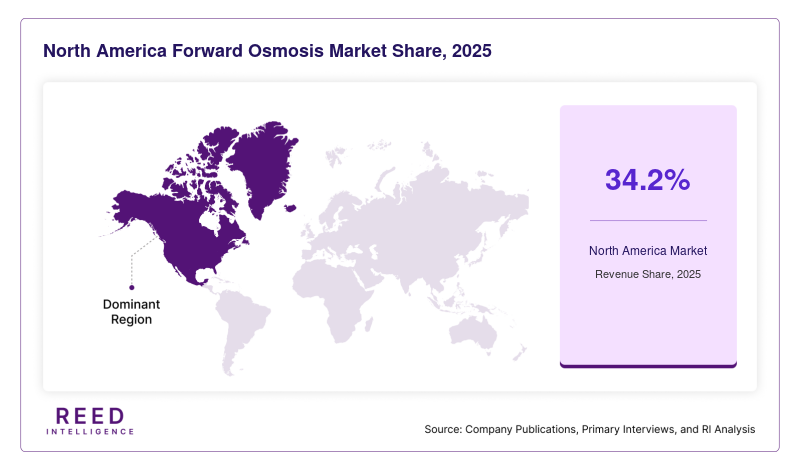
- North America dominated the market with a 34.2% share in 2025, while Asia Pacific is projected to grow at the fastest CAGR of 15.2%
- Membrane-based systems led the technology segment with a 48.6% share, while hybrid FO systems are expected to grow at a CAGR of 14.8%
- Desalination accounted for the largest application share at 41.3%, while wastewater reuse is projected to expand at a CAGR of 15.6%
- The U.S. market was valued at USD 365 million in 2025 and is estimated to reach USD 395 million in 2026
Market Trends
Integration of Hybrid Water Treatment Systems
A growing trend in the Forward Osmosis Market is the integration of FO with complementary technologies such as reverse osmosis, membrane distillation, and nanofiltration. These hybrid systems enhance overall efficiency by combining the strengths of multiple processes. Industries are increasingly adopting such integrated solutions to optimize water recovery rates and reduce operational costs. This trend is particularly prominent in industrial wastewater treatment, where complex contaminants require multi-stage purification.
Rising Adoption in Food and Beverage Processing
Forward osmosis is gaining traction in the food and beverage industry for concentration and preservation processes. Unlike thermal methods, FO preserves product quality by operating at lower temperatures and avoiding phase changes. Applications such as juice concentration, dairy processing, and liquid food preservation are benefiting from this technology. As consumer demand for minimally processed and high-quality food products rises, manufacturers are increasingly adopting forward osmosis solutions to maintain nutritional value and flavor integrity.
Market Drivers
Increasing Demand for Energy-Efficient Water Treatment Solutions
The growing emphasis on reducing energy consumption in water treatment processes is a major driver for the Forward Osmosis Market. Traditional desalination and filtration methods require significant energy inputs, making them costly and environmentally challenging. Forward osmosis systems operate with lower energy requirements, making them attractive for both industrial and municipal applications. This efficiency advantage is driving adoption, especially in regions facing energy constraints.
Expanding Industrial Wastewater Treatment Requirements
Industrial sectors such as power generation, chemicals, and pharmaceuticals are generating increasing volumes of wastewater. Stringent environmental regulations are compelling industries to adopt advanced treatment technologies. Forward osmosis offers an effective solution for treating high-salinity and complex wastewater streams. Its ability to handle challenging feedwater compositions while maintaining performance has made it a preferred choice for industrial applications, thereby supporting market growth.
Market Restraint
High Initial Capital Investment and Membrane Costs
Despite its advantages, the Forward Osmosis Market faces challenges related to high initial investment and membrane costs. Advanced FO membranes require specialized materials and manufacturing processes, leading to higher upfront expenses compared to conventional technologies. Additionally, the need for draw solution regeneration systems adds to the overall cost of implementation.
These cost barriers can limit adoption, particularly among small and medium-sized enterprises. While long-term operational savings are significant, the initial capital requirement often delays investment decisions. Furthermore, the lack of standardized systems and limited large-scale commercial deployments has contributed to uncertainty among potential adopters. Addressing these cost challenges through technological advancements and economies of scale will be critical for broader market penetration.
Market Opportunities
Growing Demand for Water Reuse and Recycling
The increasing focus on sustainable water management presents a significant opportunity for the Forward Osmosis Market. Governments and industries are prioritizing water reuse to address resource scarcity and environmental concerns. Forward osmosis systems are well-suited for recycling wastewater into usable water, offering high recovery rates and reduced environmental impact. This trend is expected to drive demand across municipal and industrial sectors.
Emerging Applications in Pharmaceutical and Biotechnology Industries
The pharmaceutical and biotechnology sectors are exploring forward osmosis for applications such as concentration of sensitive compounds and purification of process streams. The technology’s ability to operate under mild conditions makes it ideal for handling delicate biological materials. As these industries continue to expand, the adoption of FO systems is expected to increase, creating new growth avenues for market players.
Segmental Analysis
By Technology
Membrane-based forward osmosis systems dominated the market with a 48.6% share in 2025. These systems were widely adopted due to their efficiency in separating contaminants and suitability for various applications. Their ability to operate under low pressure and deliver consistent performance has made them the preferred choice across industries.
Hybrid forward osmosis systems will grow at the fastest CAGR of 14.8% during the forecast period. These systems will gain traction due to their ability to integrate with other technologies, enhancing overall efficiency. The increasing demand for multi-stage water treatment solutions will drive the adoption of hybrid systems.
By Application
Desalination accounted for the largest share of 41.3% in 2025. The increasing need for freshwater in water-scarce regions has driven the adoption of forward osmosis for desalination processes. Its energy efficiency compared to conventional methods has further supported its dominance.
Wastewater reuse is expected to grow at the fastest CAGR of 15.6%. The rising focus on sustainable water management and stricter environmental regulations will drive demand for wastewater recycling solutions, boosting this segment.
By End-Use Industry
The municipal sector held the dominant share of 36.7% in 2025. Municipalities have increasingly adopted forward osmosis systems for water treatment and reuse applications, driven by growing urbanization and water demand.
The pharmaceutical industry will grow at a CAGR of 14.9% during the forecast period. The need for high-purity water and efficient processing solutions will drive adoption in this sector.
By Membrane Type
Cellulose triacetate membranes dominated the market with a 44.2% share in 2025. These membranes were preferred due to their stability and cost-effectiveness in various applications.
Thin-film composite membranes will grow at the fastest CAGR of 15.3%. Their superior performance and higher permeability will drive adoption in advanced applications.
Regional Analysis
North America
North America accounted for 34.2% of the Forward Osmosis Market share in 2025 and will expand at a CAGR of 12.4% during the forecast period.
The United States dominated the regional market due to strong investments in advanced water treatment technologies. The presence of established industrial infrastructure and increasing focus on sustainable water management have supported adoption. Additionally, government initiatives promoting water reuse have further strengthened the market in this region.
Europe
Europe held a 26.1% share of the Forward Osmosis Market in 2025 and will grow at a CAGR of 11.8% through 2034.
Germany emerged as the leading country in this region, driven by its emphasis on environmental sustainability and industrial efficiency. The country’s stringent regulations on wastewater discharge have encouraged industries to adopt advanced treatment technologies, including forward osmosis systems.
Asia Pacific
Asia Pacific captured 22.8% of the Forward Osmosis Market in 2025 and will register the fastest CAGR of 15.2% over the forecast period.
China dominated the regional market due to rapid industrialization and increasing water scarcity. The government’s focus on improving water infrastructure and promoting advanced treatment technologies has accelerated the adoption of forward osmosis systems.
Middle East & Africa
The Middle East & Africa region held a 9.4% share of the Forward Osmosis Market in 2025 and will grow at a CAGR of 13.6% during the forecast period.
Saudi Arabia led the market in this region due to its reliance on desalination technologies. The country’s efforts to diversify water sources and improve energy efficiency have contributed to the adoption of forward osmosis systems.
Latin America
Latin America accounted for 7.5% of the Forward Osmosis Market share in 2025 and will expand at a CAGR of 12.9% through 2034.
Brazil dominated the regional market, supported by increasing investments in water infrastructure and industrial development. The growing need for efficient wastewater treatment solutions has driven the adoption of forward osmosis technology in the country.
Competitive Landscape
The Forward Osmosis Market is characterized by the presence of several established and emerging players focusing on innovation and strategic collaborations. The market leader, Xylem Inc., has strengthened its position through continuous investment in advanced membrane technologies and expansion into emerging markets. The company recently introduced an enhanced forward osmosis solution aimed at improving energy efficiency in industrial applications.
Other key players are focusing on product development and partnerships to expand their market presence. Companies are also investing in research and development to improve membrane performance and reduce costs. The competitive environment remains dynamic, with increasing emphasis on technological advancements and sustainability.
Key Players
- Xylem Inc.
- Toray Industries, Inc.
- Koch Separation Solutions
- Aquaporin A/S
- Hydration Technology Innovations
- Toyobo Co., Ltd.
- LG Chem
- Veolia Water Technologies
- Suez Water Technologies & Solutions
- DuPont Water Solutions
- Pentair plc
- Alfa Laval AB
- Evoqua Water Technologies
- Porifera Inc.
- Oasys Water
Recent Developments
- 2024: Xylem Inc. launched an advanced forward osmosis membrane designed for industrial wastewater applications.
- 2024: Aquaporin A/S expanded its production capacity to meet rising global demand.
- 2023: Toray Industries introduced a new high-performance FO membrane with improved durability.
- 2023: Veolia Water Technologies partnered with industrial firms to deploy hybrid FO systems.
- 2023: DuPont Water Solutions enhanced its membrane portfolio with advanced FO capabilities.
Forward Osmosis Market Segments
Technology
- Membrane-Based Systems
- Hybrid Systems
Application
- Desalination
- Wastewater Reuse
- Food & Beverage Processing
- Others
End-Use Industry
- Municipal
- Industrial
- Pharmaceutical
- Food & Beverage
Membrane Type
- Cellulose Triacetate
- Thin-Film Composite
By Region
- North America
- Europe
- APAC
- Middle East and Africa
- LATAM