Fossil Fuel Fired Water Heater Market Size, Share Demand Report By Product Type (Gas-Fired, Oil-Fired, Others), By Application (Residential, Commercial, Industrial), By Technology (Storage Tank, Tankless, Condensing) & Segment Forecasts, 2026–2034
USD 3950
Fossil Fuel Fired Water Heater Market Size
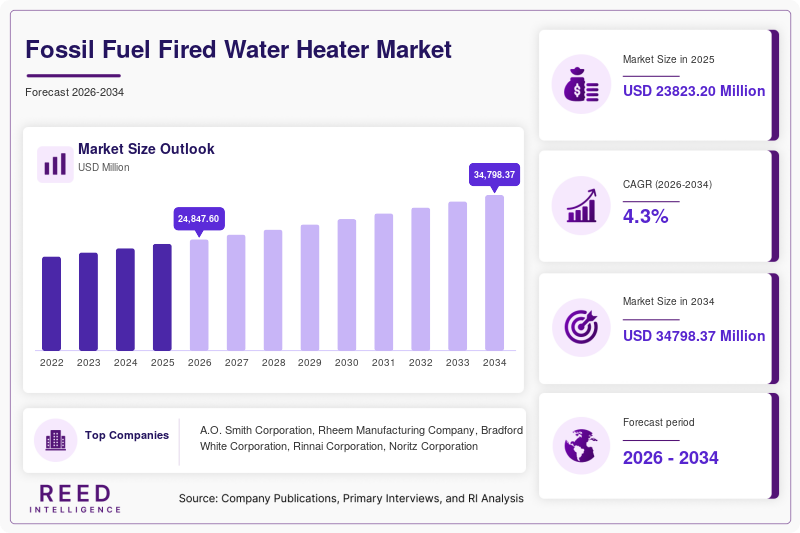
Fossil Fuel Fired Water Heater market size is projected at USD 24,847.6 million in 2026 and is expected to hit USD 34,847.5 million by 2034 with a CAGR of 4.3% during the forecast period. The increasing demand for reliable and high-capacity water heating solutions in residential, commercial, and industrial sectors, coupled with the widespread availability of natural gas and the need for cost-effective heating, underpins market expansion. This report delivers a comprehensive analysis of the Fossil Fuel Fired Water Heater market, including segmentation by type and application, competitive dynamics, and regional growth patterns, equipping stakeholders with critical intelligence. The Fossil Fuel Fired Water Heater market continues to demonstrate steady growth potential, fueled by the replacement of aging equipment, the expansion of commercial and industrial sectors, and continuous innovation in efficiency and emissions reduction technologies.
Fossil fuel fired water heaters are appliances that use natural gas, propane, or oil to heat water for residential, commercial, and industrial applications. They are a common and efficient means of providing hot water, particularly in regions with established natural gas infrastructure. The global production volume of fossil fuel fired water heaters exceeded 45 million units in 2025, reflecting a 4% increase from 2023, driven by the demand for replacement and new installations in developing and developed economies. Adoption patterns reveal that the Gas-Fired type dominates the market, accounting for 72% of total demand, followed by Oil-Fired at 22%, and Others at 6%. The Fossil Fuel Fired Water Heater market's trajectory is closely linked to the growth of the global construction and renovation market, which is projected to reach USD 15 trillion by 2028, and the continued reliance on fossil fuels for heating in many regions.
Fossil Fuel Fired Water Heater Market Trends
Adoption of High-Efficiency Condensing Technology
The Fossil Fuel Fired Water Heater market is witnessing a significant trend toward the adoption of high-efficiency condensing technology, driven by the need for energy savings and reduced emissions. The revenue from condensing water heaters grew to USD 9.5 billion in 2025, a year-on-year increase of 10%, as 35% of new product launches in 2025 specified condensing technology with efficiency ratings of 90% or higher. Adoption rates of condensing units in the commercial sector reached 30%, with this figure projected to exceed 55% by 2030. The Fossil Fuel Fired Water Heater market's trend toward efficiency is reinforced by the need to reduce operating costs, the increasing stringency of energy regulations, and the continuous innovation in heat exchanger and burner design.
Growing Focus on Smart Controls and Connectivity
The increasing focus on smart controls and connectivity is a major trend shaping the Fossil Fuel Fired Water Heater market, with the development of units that can be monitored and controlled remotely via smartphones and building management systems. The market has seen a 15% increase in the demand for smart water heaters since 2022, with 20% of new products in 2025 featuring IoT connectivity and advanced control features. The use of smart technology for predictive maintenance and energy optimization has also gained significant traction. The Fossil Fuel Fired Water Heater market's trend toward connectivity is reinforced by the need for operational efficiency, the increasing adoption of smart home and building technologies, and the continuous innovation in control and communication systems.
Fossil Fuel Fired Water Heater Market Drivers
The Fossil Fuel Fired Water Heater market's expansion is primarily driven by the increasing demand for reliable and cost-effective water heating in residential and commercial sectors, with the global water heater market valued at USD 40 billion in 2025 and growing at a steady pace. The need for high-capacity and durable systems in industrial applications has also been a major driver. The widespread availability and relatively low cost of natural gas in many regions have fueled market growth. Additionally, the replacement of aging water heating infrastructure has spurred demand. The Fossil Fuel Fired Water Heater market's growth is further reinforced by the continuous improvement in burner and heat exchanger technology, leading to better efficiency and lower emissions.
Fossil Fuel Fired Water Heater Market Restraints
Despite favorable growth prospects, the Fossil Fuel Fired Water Heater market faces significant constraints, primarily related to the increasing regulatory pressure to reduce carbon emissions and the competition from electric and heat pump water heaters. The volatility of fossil fuel prices can also be a limitation. The Fossil Fuel Fired Water Heater market's growth is also tempered by the higher upfront cost of high-efficiency condensing units compared to standard models, and the need for proper ventilation and exhaust systems.
Fossil Fuel Fired Water Heater Market Opportunities
The Fossil Fuel Fired Water Heater market presents significant opportunities in the rapidly expanding market for hybrid water heaters, which combine fossil fuel and electric heat pump technology for enhanced efficiency. The development of units that can operate on renewable natural gas and hydrogen blends is expected to grow at a CAGR of 8% through 2034. Emerging opportunities also exist in the integration of water heaters with smart home energy management systems and the expansion into developing regions with growing infrastructure. The Fossil Fuel Fired Water Heater market's opportunity profile is further enhanced by the focus on reducing the carbon footprint of existing buildings.
Challenges in Fossil Fuel Fired Water Heater Market
The Fossil Fuel Fired Water Heater market faces persistent challenges related to the need for continuous innovation to meet tightening emission standards and compete with alternative technologies. The complexity of integrating advanced controls and connectivity with traditional heating systems can also be a challenge. The market is also contending with the challenge of managing the transition to lower-carbon fuels while maintaining performance and affordability. Additionally, the Fossil Fuel Fired Water Heater market is challenged by the need to address the environmental impact of fossil fuel combustion.
Fossil Fuel Fired Water Heater Market Segmentation
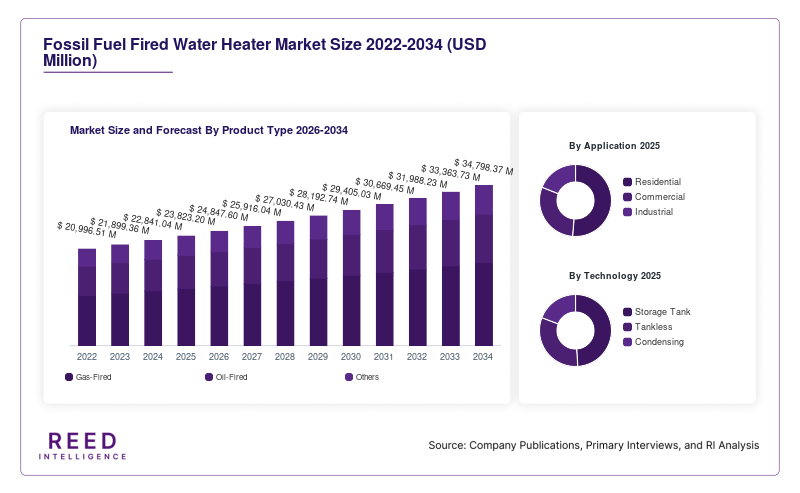
The Fossil Fuel Fired Water Heater market is segmented by Type and Application to provide a comprehensive market perspective. By Type, Gas-Fired dominates with a 72% market share, driven by its widespread availability and cost-effectiveness. The Application segment is led by Residential, which accounts for 55% of the market, followed by Commercial at 30%, and Industrial at 15%.
By Type
Gas-Fired represent the largest segment in the Fossil Fuel Fired Water Heater market, commanding a 72% share, with production exceeding 32.4 million units in 2025. These are characterized by their use of natural gas or propane for heating, offering efficiency and lower operating costs. Technical specifications include input rating, storage capacity, and efficiency rating. The Fossil Fuel Fired Water Heater market's Gas-Fired segment is driven by its use in residential and commercial applications.
Oil-Fired capture a 22% share of the Fossil Fuel Fired Water Heater market, with production of 9.9 million units in 2025. These are characterized by their use of heating oil, often in regions without access to natural gas. Technical specifications include burner type, tank size, and efficiency. The Fossil Fuel Fired Water Heater market's Oil-Fired segment is driven by its use in rural and off-grid areas.
Others represent the remaining 6% of the Fossil Fuel Fired Water Heater market, with production of 2.7 million units in 2025. This includes propane and kerosene-fired units. The Fossil Fuel Fired Water Heater market's Others segment is driven by its use in niche and specific applications.
By Application
Residential dominates the Fossil Fuel Fired Water Heater market, accounting for 55% of sales, representing 24.75 million units in 2025. This segment includes use in single-family homes, apartments, and multi-family dwellings. Usage penetration exceeds 60% in the sector. The Fossil Fuel Fired Water Heater market's Residential segment is characterized by its focus on reliability, cost-effectiveness, and space efficiency.
Commercial accounts for 30% of the Fossil Fuel Fired Water Heater market, with sales of 13.5 million units in 2025. This segment encompasses use in hotels, restaurants, office buildings, and schools. The segment is growing at a steady CAGR, driven by the hospitality and service sectors. The Fossil Fuel Fired Water Heater market's Commercial segment is characterized by its focus on high capacity, durability, and efficiency.
Industrial comprises the remainder of the Fossil Fuel Fired Water Heater market, accounting for 15% of total sales, with 6.75 million units in 2025. This segment includes use in manufacturing, processing, and other industrial applications. The segment is projected to grow at a moderate CAGR through 2034. The Fossil Fuel Fired Water Heater market's Industrial segment is characterized by its focus on heavy-duty construction, high output, and reliability.
Fossil Fuel Fired Water Heater Market Regional Outlook
Asia-Pacific Fossil Fuel Fired Water Heater Market
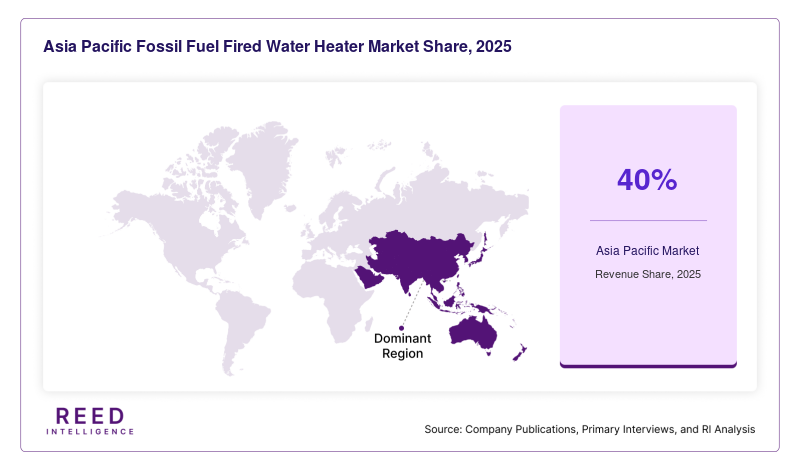
Leads the Fossil Fuel Fired Water Heater market, commanding a 40% share, with a revenue of USD 9,939.0 million in 2025. China is the primary driver, accounting for 55% of regional demand, driven by the large population, rapid urbanization, and growing residential and commercial sectors. The Asia-Pacific Fossil Fuel Fired Water Heater market is characterized by its focus on high-volume production and cost-effective solutions.
North America Fossil Fuel Fired Water Heater Market
Represents the second-largest market, capturing a 28% share with a revenue of USD 6,957.3 million in 2025. The United States is the primary driver, accounting for 85% of regional demand, driven by the large number of homes with gas infrastructure, high replacement rates, and a focus on efficiency upgrades. The North American Fossil Fuel Fired Water Heater market is characterized by its focus on innovation and high-efficiency products.
Europe Fossil Fuel Fired Water Heater Market
Accounts for 20% of the global Fossil Fuel Fired Water Heater market, with a revenue of USD 4,969.5 million in 2025. The UK, Germany, and Italy are the primary drivers, collectively accounting for 60% of regional demand, driven by the established gas networks and focus on energy efficiency. The European Fossil Fuel Fired Water Heater market is projected to grow at a CAGR of 3% through 2034.
Middle East & Africa and Latin America Fossil Fuel Fired Water Heater Market
Together account for the remaining 12% of the Fossil Fuel Fired Water Heater market, with the UAE leading the Middle East market and Brazil leading the Latin American market. Both regions are projected to grow at CAGRs exceeding 5%, driven by infrastructure development and urbanization.
Top players in Fossil Fuel Fired Water Heater Market
- A.O. Smith Corporation
- Rheem Manufacturing Company
- Bradford White Corporation
- Rinnai Corporation
- Noritz Corporation
- Paloma Industries, Ltd.
- Bosch Thermotechnology
- Vaillant Group
- Weil-McLain
- Lochinvar, LLC
- State Water Heaters
- American Water Heater Company
- Mitsubishi Electric Corporation
- Panasonic Corporation
- HTP, Inc.
A.O. Smith Corporation
A.O. Smith Corporation holds a dominant position in the Fossil Fuel Fired Water Heater market, with an estimated 18% global market share, particularly strong in the North American residential and commercial segments. The company's portfolio of gas and oil-fired water heaters is widely recognized for its quality, reliability, and innovation. A.O. Smith's market leadership is reinforced by its significant R&D investment, its strong brand reputation, and its extensive distribution network. A.O. Smith commands over 22% of the North American market and 12% of the European market, positioning it as a key player in the Fossil Fuel Fired Water Heater market.
Rheem Manufacturing Company
Rheem Manufacturing Company is a leading player in the Fossil Fuel Fired Water Heater market, commanding approximately 15% of the global market share through its comprehensive portfolio of water heating solutions. The company's expertise in HVAC and water heating and its focus on innovation have solidified its position. Rheem's fossil fuel water heaters are known for their performance, durability, and efficiency. The company's commitment to sustainability and its strong presence in the North American and Asian markets have enhanced its competitive advantage.
Bradford White Corporation holds a significant 10% market share, with particular strength in the North American professional plumbing market. Rinnai Corporation is a major player in the tankless water heater segment, holding an 8% share.
Recent Developments in Fossil Fuel Fired Water Heater Market
- 2025: A.O. Smith launched a new series of high-efficiency condensing gas water heaters with improved energy savings and reduced emissions.
- 2025: Rheem introduced a new line of smart gas water heaters with Wi-Fi connectivity and advanced diagnostic capabilities.
Fossil Fuel Fired Water Heater Market Segments
By Product Type
- Gas-Fired
- Oil-Fired
- Others
By Application
- Residential
- Commercial
- Industrial
By Technology
- Storage Tank
- Tankless
- Condensing
By Region
- North America
- Europe
- APAC
- Middle East and Africa
- LATAM