Foundation Repair Services Market Size, Share & Trends Analysis Report By Repair Type (Settlement Repair, Wall Repair, Chimney Repair, Floor Slab Repair, Other Repair Type), By Application (Buildings, Roads, Pavements & Tunnels, Railways, Dams, Other Applications), By End User (Residential, Commercial) and By Region (North America, Europe, Asia-Pacific, Middle East and Africa, Latin America) Forecasts, 2026–2034
USD 3950
Foundation Repair Services Market Size
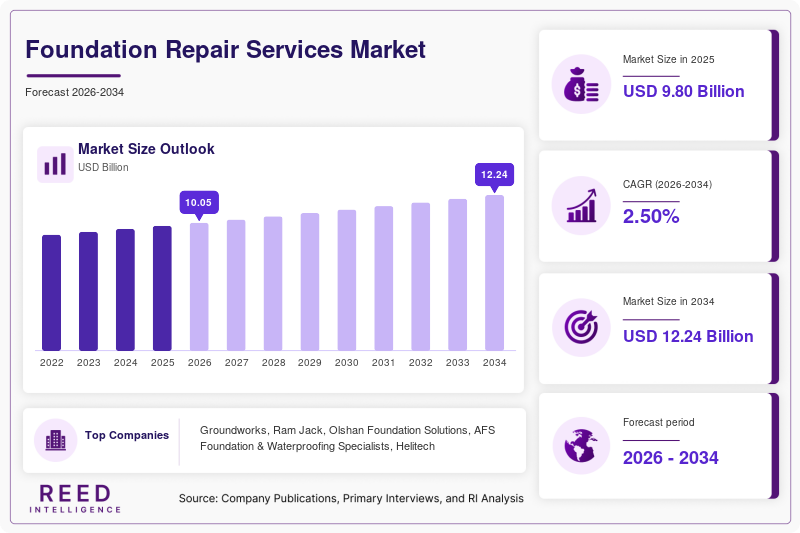
The foundation repair services market was valued at USD 9.80 billion in 2025 and is estimated to reach USD 10.05 billion in 2026. The market is projected to reach USD 12.30 billion by 2034, registering a CAGR of 2.50% during 2026–2034.
Foundation repair services address structural settlement, wall movement, slab displacement, cracking, water-related deterioration and other conditions affecting the stability of buildings and infrastructure. The underlying demand is linked to the physical deterioration of foundations rather than discretionary construction spending. The U.S. Department of Housing and Urban Development identifies poor soil conditions, water migration, flooding, seismic activity, inadequate design and construction deficiencies among the principal causes of foundation failures.
Moisture is another recurring source of foundation-related work. The U.S. Environmental Protection Agency notes that foundations are exposed to rainwater, groundwater, snowmelt, plumbing leaks and high water tables, while persistent moisture can make foundation problems difficult and expensive to correct.
Foundation Repair Services Market Drivers
Soil Movement and Foundation Settlement Create Persistent Demand for Structural Repair
Foundation settlement remains a central source of repair activity because soil conditions can change the load-bearing behavior of the ground beneath a structure. HUD identifies expansive soils, poorly compacted fill, organic soils and other problematic site conditions as causes of foundation movement.
The market mechanism is direct: soil movement can create differential settlement, wall cracking, floor displacement and structural movement, requiring stabilization or underpinning. Repair providers can address these conditions through methods including piers, underpinning and slab stabilization. Technaviо identifies stabilization, lifting, leveling, underpinning and waterproofing as core service categories.
Demand is strongest in areas where soil conditions and groundwater behavior create recurring structural movement. However, diagnosis is important because visible cracking does not necessarily indicate the same underlying failure mechanism, which can delay purchasing decisions.
Water Intrusion Converts Drainage and Moisture Problems Into Repair Requirements
Water exposure creates a second demand pathway. EPA guidance identifies rain, snowmelt, groundwater, plumbing leaks, condensation and high water tables as sources of foundation moisture. Persistent water intrusion can also create conditions associated with mold and building deterioration.
The commercial mechanism begins with drainage or moisture exposure and can progress to cracking, wall displacement, deterioration or basement water problems. This creates demand for waterproofing, crack repair, drainage correction and, in more severe cases, structural stabilization.
The effect is particularly relevant to basements, crawl spaces and below-grade structures because these components have greater contact with surrounding soil. Preventive drainage improvements can reduce the need for extensive structural work, creating a counterbalance to repair demand.
Subsidence and Ground Instability Expand the Need for Specialized Foundation Solutions
Land subsidence can gradually lower the ground surface and affect structures built above unstable or compacting soils. USGS identifies groundwater withdrawal, drainage of organic soils, mining, hydrocompaction, natural compaction and sinkholes among the causes of subsidence.
Where subsidence affects developed areas, property owners may require foundation stabilization, underpinning or structural monitoring. The mechanism is particularly important for structures where differential movement creates cracks, uneven floors or loss of structural support.
The opportunity is strongest for contractors with specialized engineering and stabilization capabilities. However, regional exposure varies considerably, so subsidence does not translate uniformly into repair demand across geographies.
Foundation Repair Services Market Restraints
High Repair Costs Encourage Property Owners to Delay Non-Critical Work
Foundation repair can involve structural engineering, excavation, specialized equipment, materials and skilled labor. HUD notes that settlement remediation can be expensive and recommends careful investigation of the underlying cause before selecting a repair approach.
The economic mechanism is therefore different from ordinary maintenance spending. Property owners may prioritize repairs that address active structural movement or water intrusion while postponing cosmetic cracks or problems perceived as stable.
Financing programs, inspection services and minimally invasive repair techniques can reduce the barrier. However, large structural interventions can still require significant upfront expenditure, limiting adoption among budget-constrained homeowners and smaller commercial property owners.
Skilled Labor and Site-Specific Diagnosis Limit Service Scalability
Foundation repair is not a standardized installation service because the appropriate solution depends on soil conditions, foundation design, movement patterns and water exposure. Technavio describes soil testing, engineering assessment, underpinning, piering and mudjacking as part of the technical foundation-repair process.
This creates a labor and capacity constraint. Contractors need trained technicians and, for complex projects, structural or geotechnical expertise. Expansion into new geographic markets therefore requires more than adding sales capacity.
Technology-enabled inspections and standardized repair systems can improve productivity, but local site conditions continue to require professional assessment.
Foundation Repair Services Market Opportunities
Minimally Invasive Stabilization Methods Can Reduce Disruption During Repairs
Helical piers, push piers and polyurethane-based lifting systems provide alternatives to more disruptive excavation-intensive approaches. Industry research identifies increasing adoption of helical piers and polyurethane foam injection because these methods can reduce installation time and site disruption.
The commercial opportunity is strongest for occupied residential properties and operating commercial facilities where extended excavation or closure creates additional costs. Faster installation can improve contractor productivity while reducing disruption for property owners.
However, these methods are not universal substitutes. Soil composition, foundation condition, structural loads and engineering requirements determine whether a particular stabilization method is appropriate.
Digital Inspection and Monitoring Can Move the Market Toward Preventive Maintenance
Foundation contractors are increasingly incorporating digital inspection, remote assessment and monitoring concepts into service delivery. Industry sources identify drone inspection, IoT monitoring and AI-assisted diagnostics as emerging applications.
The market mechanism is a shift from one-time repair toward condition monitoring. Sensors or digital inspection records can help contractors identify movement trends and provide property owners with evidence supporting earlier intervention.
This could increase recurring inspection and maintenance revenue, although the commercial value depends on whether monitoring produces actionable information and whether customers are willing to pay for preventive services.
Waterproofing and Foundation Repair Integration Expands the Addressable Service Package
Foundation problems frequently involve both structural and moisture-related conditions. EPA guidance emphasizes the importance of drainage and moisture control in preventing foundation problems.
This creates an opportunity for contractors to bundle waterproofing, drainage, crawl-space services, crack repair and structural stabilization. Such integrated offerings can increase the value of individual customer engagements and reduce the need for property owners to coordinate multiple contractors.
The main limitation is the need for broader technical capabilities and installation expertise across several service categories.
Foundation Repair Services Market Repair Type Analysis
By Repair Type
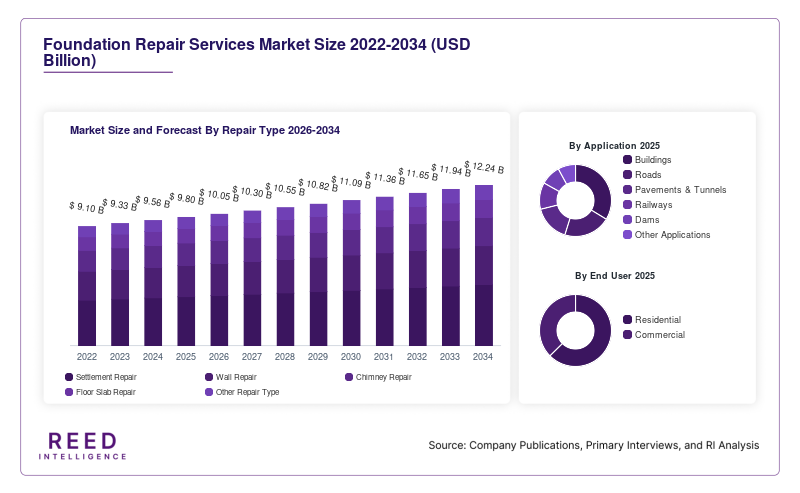
Settlement Repair accounts for approximately 44% of the market in 2025. Foundation settlement can result from expansive soils, poorly compacted fill, organic soils, water movement and other ground-related conditions. HUD identifies soil and water-related movement among the principal causes of foundation displacement.
Settlement repair therefore covers a recurring class of structural problems requiring underpinning, piering, lifting, leveling or soil stabilization. Its large share reflects the breadth of properties exposed to ground movement.
Wall Repair accounts for approximately 27% of the market in 2025 and is projected to grow at approximately 2.90% CAGR through 2034. Wall movement can be associated with settlement, hydrostatic pressure and lateral soil forces, creating demand for wall anchors, reinforcement and stabilization.
Floor Slab Repair accounts for approximately 13% of the 2025 market and is projected to grow at approximately 2.40% CAGR.
Chimney Repair accounts for approximately 7% and is projected to grow at approximately 1.80% CAGR, while Other Repair Type accounts for approximately 9% and is projected to grow at approximately 2.00% CAGR.
Foundation Repair Services Market Application Analysis
By Application
Buildings account for approximately 48% of the market in 2025. Residential and commercial buildings generate demand for foundation stabilization, wall repair, waterproofing, slab lifting and settlement correction.
Foundation failures can compromise structural integrity, create water intrusion and produce visible movement. HUD identifies cracking, settlement, lateral movement and water intrusion as consequences associated with foundation displacement.
The recurring nature of building maintenance also supports service demand because owners have incentives to protect property value and maintain usable space.
Roads, Pavements & Tunnels account for approximately 22% of the 2025 market and are projected to grow at approximately 2.60% CAGR.
Railways account for approximately 12% and are projected to grow at approximately 2.50% CAGR, while Dams account for approximately 8% and are projected to grow at approximately 2.20% CAGR.
Other Applications account for approximately 10% and are projected to grow at approximately 2.10% CAGR.
Foundation Repair Services Market End User Analysis
By End User
Residential applications account for approximately 58% of the market in 2025. Residential properties are exposed to settlement, moisture intrusion, expansive soils, drainage problems and age-related deterioration. The breadth of the housing stock creates a larger number of potential repair points than specialized infrastructure applications.
Homeowners also increasingly encounter foundation problems through property inspections, real-estate transactions and preventive maintenance assessments. EPA guidance emphasizes that foundation moisture problems can be difficult and expensive to correct when improperly addressed.
Commercial applications account for approximately 42% of the market in 2025 and are projected to grow at approximately 3.10% CAGR through 2034. Commercial properties can generate higher-value projects because larger buildings and facilities may require engineering assessments, stabilization, waterproofing and structural rehabilitation.
Foundation Repair Services Market Regional Analysis
North America Holds the Largest Regional Share Through Extensive Property Exposure and Established Foundation-Repair Infrastructure
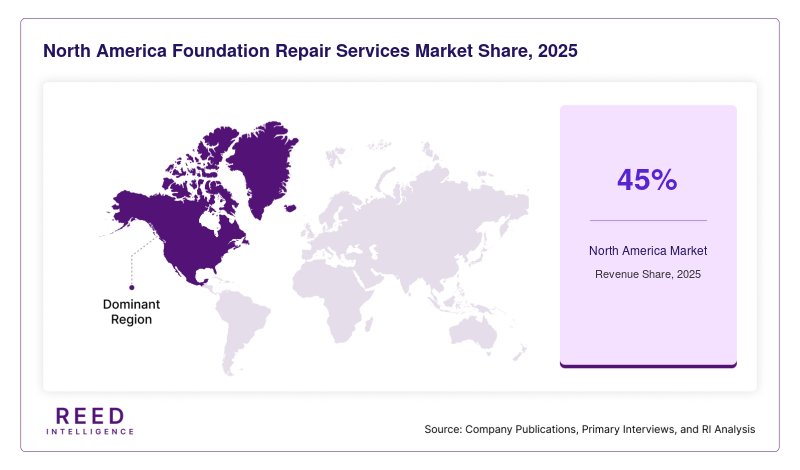
North America accounts for approximately 45% of the market in 2025. The region's demand base includes residential buildings, commercial properties and infrastructure exposed to settlement, moisture, expansive soils and subsidence.
The U.S. has documented exposure to land subsidence across more than 17,000 square miles in 45 states, while USGS identifies groundwater withdrawal and soil compaction among major causes.
The region also has an established contractor ecosystem spanning structural repair, waterproofing, basement systems and concrete lifting. This supports specialized service delivery.
North America is projected to grow at approximately 2.20% CAGR through 2034. The moderate pace reflects an established repair base rather than rapid penetration into a new service category.
Europe Maintains Demand Through Aging Buildings and Moisture-Related Structural Maintenance
Europe accounts for approximately 18% of the market in 2025. Foundation repair demand is supported by older building stock, variable soil conditions, moisture exposure and renovation requirements.
Below-grade structures and older masonry buildings can require waterproofing, crack stabilization and structural reinforcement. EPA's technical guidance on foundation moisture illustrates how water exposure can create persistent building-maintenance requirements.
Europe is projected to grow at approximately 2.30% CAGR through 2034. Demand is likely to remain maintenance-led, with heritage properties and renovation projects creating specialized requirements.
Asia-Pacific Is the Fastest-Growing Region as Urban Development Expands the Installed Property Base
Asia-Pacific accounts for approximately 25% of the market in 2025 and is projected to register approximately 3.30% CAGR through 2034. Urban expansion, large construction activity and a growing installed base of residential and commercial structures create a broader future repair base.
Ground conditions vary substantially across countries, making soil assessment and foundation engineering important components of repair projects. The region also contains major urban areas where groundwater management and subsidence can affect structures.
The primary constraint is uneven service-market maturity. Specialist foundation contractors and advanced diagnostic technologies are more developed in some markets than others.
Middle East and Africa Represent Developing Markets With Demand Concentrated Around Structural and Water-Related Repairs
Middle East and Africa account for approximately 7% of the market in 2025 and are projected to grow at approximately 2.40% CAGR through 2034.
Demand is linked to commercial construction, residential development, infrastructure maintenance and water-management requirements. In arid markets, soil moisture variation and groundwater conditions can create localized foundation challenges, while infrastructure expansion increases the installed asset base requiring long-term maintenance.
Adoption varies by country because specialist contractor availability, engineering capacity and maintenance budgets differ substantially.
Latin America Maintains a Smaller Market With Opportunities in Urban Property Rehabilitation
Latin America accounts for approximately 5% of the market in 2025 and is projected to grow at approximately 2.60% CAGR through 2034.
Urban density, aging structures, variable soil conditions and localized subsidence create requirements for foundation stabilization and structural rehabilitation. USGS research demonstrates that groundwater-related subsidence can damage buildings and infrastructure where aquifer systems experience significant compaction.
The market remains constrained by financing availability, fragmented contractor networks and uneven adoption of specialized foundation technologies.
Foundation Repair Services Market Competitive Landscape
The foundation repair services industry remains fragmented, with competition organized largely around geographic service coverage, technical expertise, repair methodology, brand reputation and the ability to provide integrated waterproofing and structural solutions. Technavio characterizes the market structure as fragmented and identifies regional and specialized contractors alongside larger service providers.
Groundworks has pursued a consolidation strategy by bringing regional foundation and concrete-repair capabilities into a broader network. Its acquisition of Leveled Concrete in 2025 added concrete-leveling capabilities and polyurethane foam injection expertise to its service portfolio.
Thrasher Foundation Repair also expanded its network through the 2025 integration of Midwest Foundation Repair, combining regional operations and foundation-repair capabilities under the Thrasher brand.
Key Market Players
- Groundworks
- Ram Jack
- Olshan Foundation Solutions
- AFS Foundation & Waterproofing Specialists
- Helitech
- Baker's Waterproofing & Foundation Repair
- JES Foundation Repair
- TerraFirma Foundation Systems
- Thrasher Foundation Repair
- Arizona Foundation Solutions
Foundation Repair Services Market Recent Developments
- September 2025 – Groundworks acquired Leveled Concrete, a Houston-based concrete-leveling company. The acquisition added polyurethane foam injection and concrete-leveling capabilities to Groundworks' broader foundation and structural maintenance portfolio, increasing its ability to address slab and concrete repair requirements alongside foundation services.
- June 2025 – Midwest Foundation Repair announced its rebranding under Thrasher Foundation Repair. The integration consolidated regional foundation-repair operations and was accompanied by supply-chain coordination for structural steel piers and basement waterproofing technologies.
Foundation Repair Services Market Segments
By Repair Type
- Settlement Repair
- Wall Repair
- Chimney Repair
- Floor Slab Repair
- Other Repair Type
By Application
- Buildings
- Roads
- Pavements & Tunnels
- Railways
- Dams
- Other Applications
By End User
- Residential
- Commercial
By Region
- North America
- Europe
- APAC
- Middle East and Africa
- LATAM