Franchise Market Size, Share & Trends Analysis Report By Franchise Type (Business Format Franchise, Product Distribution Franchise, Manufacturing Franchise, Master Franchise), By Industry (Food & Beverages, Retail, Personal Services, Commercial & Residential Services, Education & Training), By Ownership Model (Single-Unit Franchise, Multi-Unit Franchise, Area Development Franchise, Multi-Brand Franchise) Forecasts, 2026–2034
USD 3950
Franchise Market Size
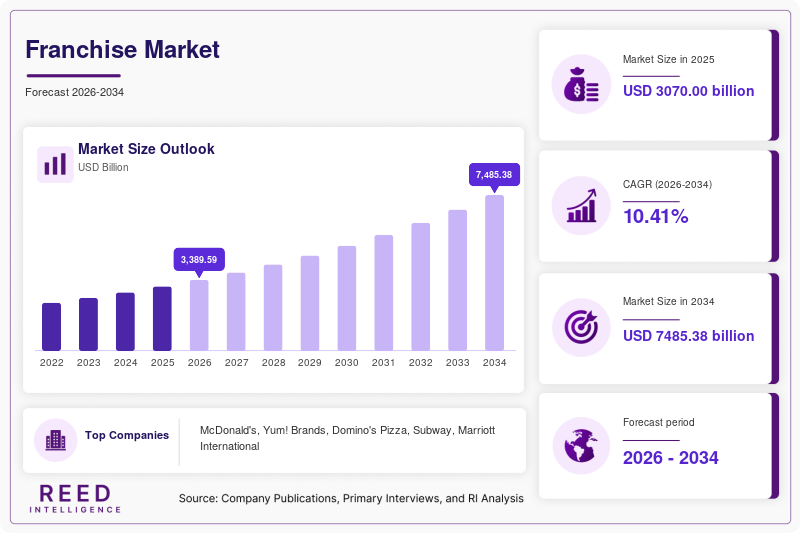
The global franchise market size was valued at USD 3,070.00 billion in 2025 and is projected to grow from USD 3,389.57 billion in 2026 to USD 7,485.38 billion by 2034, registering a CAGR of 10.41% during the forecast period from 2026 to 2034.
The commercial structure of franchising is broadening beyond traditional restaurants and retail into home services, personal services, education, healthcare, senior care, fitness, business services and experiential concepts. The International Franchise Association's 2026 outlook forecasts U.S. franchise establishments to increase from 832,521 to 845,000 and franchise employment to approach 8.9 million, while child services and commercial and residential services are identified among the fastest-growing franchise industries.
The franchise market is expanding through a combination of geographic replication, multi-unit ownership, master-franchise arrangements, service-sector adoption and technology-enabled franchise management. The model transfers part of the capital and operating responsibility to franchisees while allowing franchisors to monetize brands, systems, intellectual property, training, supply chains and operating standards across multiple locations.
Food and beverage remains a major application because standardized menus, procurement, store formats and operating procedures make concepts relatively scalable. Yum! Brands, for example, operates a system of more than 63,000 restaurants across 155+ countries and territories, with its businesses primarily operated by franchisees. McDonald's reported 45,356 restaurants at the end of 2025, approximately 95% of which were franchised.
Franchise Market Drivers
Expansion of Multi-Unit and Asset-Light Business Models
Franchising gives brands a mechanism to add locations without funding every outlet entirely from corporate balance sheets. This structure becomes particularly valuable when brands have standardized operating processes, recognizable intellectual property and repeatable customer demand. Large franchise systems demonstrate how the model can support rapid network expansion. Yum! states that its franchise partners operate primarily across its global restaurant network and that new locations are opened at a high frequency across markets.
The mechanism extends beyond restaurants. Service businesses can use mobile or home-based formats that require less fixed infrastructure. IFA's 2026 analysis notes that low-investment mobile and home-based models are contributing to the expansion of commercial and residential services.
As more franchisees become multi-unit operators, franchisors can transfer proven operating systems to larger local networks. This increases unit density, purchasing scale and regional brand visibility while creating demand for franchise management, training, supply-chain and technology services.
Growth of Service-Based Franchising
The franchise model is moving into industries where demand is recurring and localized. Home repair, cleaning, pest control, moving and storage, childcare, senior care, beauty, fitness and other personal services can use franchise structures because customers generally purchase services within defined geographic areas.
IFA's 2026 Economic Outlook specifically identifies child services and commercial and residential services among the fastest-growing franchise industries. Its commercial and residential services analysis projects more than USD 143.3 billion in U.S. output for 2026 and notes that more than 11% of new franchise concepts in 2025 were in home services.
The commercial mechanism is different from traditional retail: the franchisee provides local labor and customer relationships while the franchisor supplies branding, training, marketing systems, technology and standardized operating procedures. This structure supports geographic expansion without requiring every service location to operate from a large physical storefront.
International Expansion Through Master Franchise Structures
International franchising is becoming more accessible to brands outside the largest global chains. IFA reports that international franchising has expanded across industries and that roughly 80% of surveyed franchisor members either already conduct international franchising, plan to begin it or intend to accelerate it.
Master-franchise agreements reduce the operational burden associated with entering unfamiliar markets because a regional partner can take responsibility for development, recruitment and local operations. Recent Subway agreements illustrate this mechanism: the company signed master-franchise agreements for Taiwan in March 2026 and Panama earlier that month, with the Panama agreement including a 10-year development plan and modernization of existing restaurants.
This structure creates a scalable route into APAC, LATAM, Europe and emerging markets where local real-estate knowledge, labor practices and consumer preferences can otherwise slow expansion.
Franchise Market Restraints
Labor Costs and Franchisee-Level Operating Pressure
Franchise expansion does not eliminate operating costs. Franchisees remain exposed to labor availability, wages, rent, utilities, supply costs and local demand. IFA's 2025 Franchisor Survey found that 37% of respondents identified the availability, quality and cost of labor as their top business challenge, while 70% reported that franchisees had unfilled job vacancies.
The effect is important because weak franchisee economics can delay new-unit development even when the franchisor's brand is strong. Franchisors increasingly need to improve labor productivity, digital ordering, scheduling and operational efficiency to preserve unit-level economics.
Regulatory and Compliance Complexity
Franchising requires contractual, disclosure, intellectual-property, employment, competition and consumer-protection compliance that varies by jurisdiction. In the U.S., the FTC Franchise Rule requires franchisors to provide prospective franchisees with a disclosure document containing 23 specified categories of information.
India illustrates a different regulatory structure. Invest India states that there is no single umbrella franchising law in India, but multiple laws can apply, including contract, intellectual-property and competition legislation.
For international systems, these differences increase legal costs and can lengthen franchise approval and development cycles.
Franchise Market Opportunities
AI-Enabled Franchise Management and Local Marketing
AI is becoming an operating tool for distributed franchise networks rather than only a marketing experiment. The structural problem is that franchisors need centralized brand consistency while franchisees need locally relevant customer acquisition and reporting.
In April 2026, Reshift Media launched Franify, an AI-powered platform designed to coordinate digital advertising, social media, local budgeting, lead generation and analytics across franchise networks. In August 2026, the platform received industry recognition for its franchise-specific AI and automation capabilities.
This creates an opportunity for software providers and franchisors to automate repetitive local marketing, lead management, reporting and content localization while maintaining centralized brand controls. AI-based tools can also lower the administrative burden on franchisees, which is particularly relevant for multi-location operators.
Expansion of Home-Based and Essential Services
Home services offer a different expansion mechanism from store-based franchising. A mobile workforce can serve customers within a defined territory without the capital requirement associated with a large retail location.
IFA's 2026 research identifies commercial and residential services as the highest-growth franchised industry in the U.S., with demand supported by repair, maintenance, cleaning, moving, storage and pest-control services. The segment also recorded a 3.7% CAGR in franchised units from 2021 to 2024, according to FRANdata research cited by IFA.
This creates room for new concepts with relatively low fixed infrastructure, recurring service demand and technology-supported scheduling and customer management.
Segmental Analysis
By Franchise Type
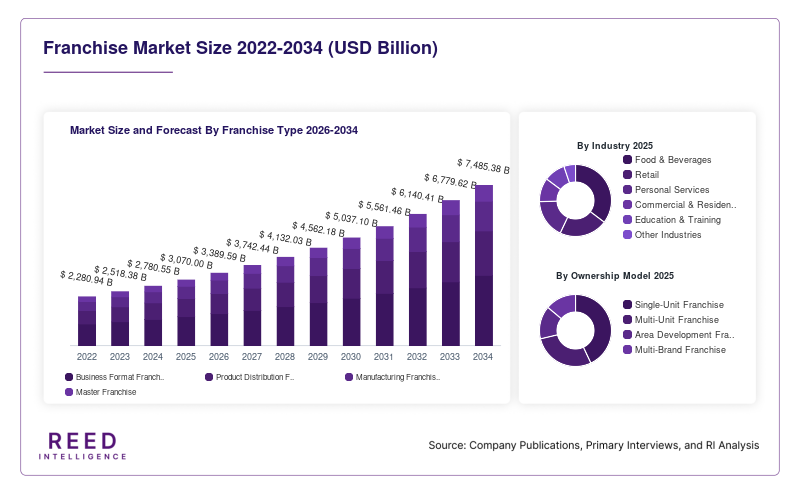
Business Format Franchise represents approximately 64% of the global franchise market in 2025, making it the dominant franchise structure. It combines the brand name with a complete operating system covering products or services, training, marketing, processes, technology and quality standards. Restaurants, hotels, fitness businesses, education providers and service companies commonly use this structure because standardized operations can be replicated across locations.
Product Distribution Franchise represents approximately 17%, with franchisees primarily distributing branded products while receiving less operational control from the franchisor than under a full business-format structure.
Master Franchise represents approximately 10% but is the fastest-growing franchise type, with an estimated CAGR of 13.2%. The model gives a regional partner responsibility for developing a brand within a defined territory, creating a mechanism for faster international expansion. Subway's 2026 Taiwan and Panama agreements demonstrate the continued use of master-franchise structures for international development.
By Industry
Food & Beverages represents approximately 31% of the global market in 2025, supported by standardized menus, procurement systems, recognizable brands and repeat customer traffic. Yum! Brands operates more than 63,000 restaurants across 155+ countries and territories, illustrating the scalability of franchise-based restaurant systems.
Retail accounts for approximately 21%, supported by convenience stores, specialty retail, automotive-related retail and consumer services.
Commercial & Residential Services accounts for approximately 16% and is the fastest-growing industry segment, with a CAGR of about 12.7%. Demand is supported by repair, maintenance, cleaning, pest control, moving and other recurring local services. IFA's 2026 industry analysis identifies this segment as the fastest-growing franchised industry in the U.S.
Education & Training represents approximately 8%, while Other Industries account for approximately 6%, covering sectors such as travel, business services and specialized professional services.
By Ownership Model
Single-Unit Franchise accounts for approximately 43% of the market in 2025, reflecting the large number of entrepreneurs operating individual locations.
Multi-Unit Franchise represents approximately 34%. Large franchise systems increasingly depend on operators capable of managing multiple locations because these franchisees can deploy capital, management systems and operational expertise across larger territories.
Multi-Brand Franchise accounts for approximately 10% and is the fastest-growing ownership model, with a CAGR of approximately 12.4%. Multi-brand operators can spread management infrastructure and real-estate capabilities across complementary concepts, although franchisor approval and brand-specific operating standards remain important constraints.
Regional Analysis
North America Franchise Market
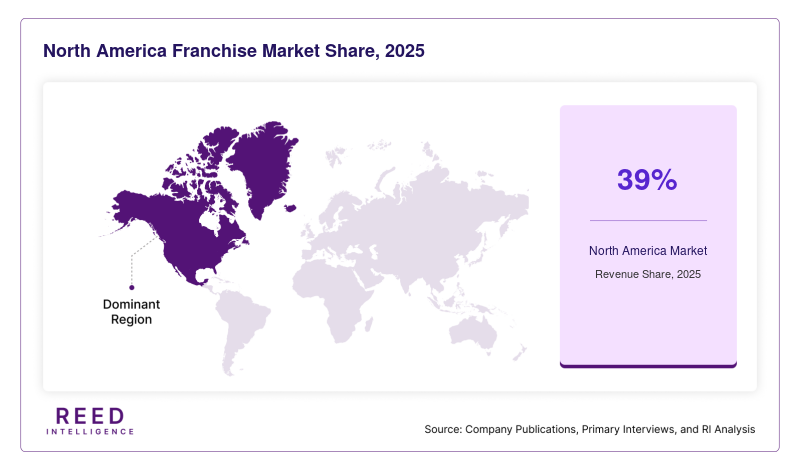
North America represents approximately 39% of the global franchise market in 2025, supported by the maturity of the U.S. franchise ecosystem, established franchise financing, extensive franchise advisory infrastructure and a large base of multi-unit operators.
The U.S. provides the strongest publicly documented benchmark for the industry. IFA's 2026 Economic Outlook projects 845,000 franchise establishments and nearly 8.9 million franchise jobs in the country, with franchise output expected to reach USD 921.4 billion.
The region's franchise mix is increasingly extending into services. Child services and commercial and residential services are among the fastest-growing categories, while the Southeast and Southwest are identified as important areas for franchise expansion.
Technology adoption is another structural factor. Franchise systems are deploying AI for local marketing, customer analytics, lead management, reporting and operational efficiency. This matters because the North American market has a large installed base that increasingly competes on unit-level productivity rather than simply adding locations.
North America is projected to grow at approximately 9.3% CAGR. The principal constraint is maturity: established systems must maintain franchisee profitability and same-unit performance while controlling labor and occupancy costs.
Europe Franchise Market
Europe represents approximately 25% of the global franchise market in 2025, supported by established consumer brands, dense urban markets and significant cross-border franchise activity.
European franchising is highly diverse because market structures, employment laws, consumer rules and franchise-specific regulations differ between countries. This encourages franchisors to work with regional or master franchise partners that understand local operating conditions.
International expansion is also becoming more accessible to mid-sized franchisors. IFA reports that international franchising is no longer limited to the largest brands and now appears across the full range of franchise industries.
Retail, food service, hospitality, education and personal services remain important applications. Marriott provides a strong hospitality example: its 2025 annual report shows 7,644 franchised/licensed/other properties at year-end, representing more than 1.18 million rooms. The company also signed nearly 1,200 development deals representing approximately 163,000 rooms during 2025.
Europe is expected to register approximately 9.6% CAGR, with growth increasingly dependent on cross-border development and service concepts rather than only mature restaurant networks.
APAC Franchise Market
APAC represents approximately 19% of the global franchise market in 2025 and is the fastest-growing region, with an estimated CAGR of 13.1%. The region combines large consumer populations with rapidly developing urban markets and significant room for international franchise concepts.
Master franchising is particularly relevant because local partners can manage real estate, staffing, regulatory requirements and consumer adaptation. Subway's March 2026 agreement with Yellowstone Investment Corp. in Taiwan gives the master franchisee responsibility for managing and developing the brand across the country.
The region also supports substantial franchise activity across food service, convenience retail, hotels, education, fitness and consumer services. Yum! operates its major franchise brands across more than 155 countries and territories, illustrating how large franchise systems use localized operators to scale globally.
India, China, Japan, Australia, South Korea and Southeast Asian markets present different development stages, from mature franchise ecosystems to markets where international brands are still expanding their local partner networks.
APAC's main constraint is regulatory and consumer-market diversity. Franchise agreements, intellectual-property protections, foreign investment rules, labor structures and consumer preferences can vary substantially between countries.
Middle East and Africa Franchise Market
Middle East and Africa represents approximately 9% of the global franchise market in 2025 and is projected to grow at approximately 11.9% CAGR. International restaurant, hospitality, retail, education and service brands are using franchise and master-franchise structures to enter markets where local operating knowledge is important.
The model is particularly suited to Gulf markets because local partners can contribute real-estate relationships, development capabilities and knowledge of consumer preferences. Hospitality provides another important channel because international hotel brands can expand their networks through franchised and licensed properties without owning every physical asset.
Subway's international development structure includes dedicated development contacts for the Middle East and Africa, while the company announced new master-franchise agreements in Qatar in December 2025.
Africa offers longer-term expansion potential across food service, education, healthcare, logistics, retail and consumer services. However, currency volatility, financing availability, infrastructure gaps and differences in regulatory enforcement can affect franchise development schedules.
LATAM Franchise Market
LATAM represents approximately 8% of the global franchise market in 2025 and is projected to grow at approximately 11.5% CAGR. Franchise structures are well suited to the region because local operators can combine international brands with knowledge of domestic consumers, real estate and labor markets.
Food and beverage remains an important application, but service categories are gaining relevance as consumers seek standardized local services in areas such as education, beauty, fitness, home maintenance and professional services.
Subway's March 2026 Panama agreement with Grupo Vierci demonstrates the use of master-franchise development in the region. The 10-year agreement includes a plan to expand the existing footprint by more than 30% and modernize restaurants with kiosks, mobile ordering and loyalty technology.
Brazil, Mexico, Argentina, Colombia, Chile and Central American markets provide different combinations of population scale, consumer demand and franchise maturity. The main constraint is macroeconomic volatility, particularly currency movements and financing costs, which can affect franchisee investment decisions and imported supply-chain costs.
Competitive Landscape
The franchise market is structurally fragmented because franchise concepts operate across hundreds of industries and geographic markets. Large multinational franchisors compete with national chains, regional concepts and emerging service brands. Competitive positioning depends on brand recognition, franchisee economics, operating simplicity, supply-chain strength, technology, training, territory availability and the ability to support local execution.
Restaurant franchisors demonstrate the scale of the model. McDonald's had 45,356 restaurants at the end of 2025, approximately 95% franchised, while Yum! reported a predominantly franchise-operated network exceeding 63,000 restaurants across 155+ countries and territories.
Hospitality is another major competitive arena. Marriott reported 7,644 franchised/licensed/other properties and 1.18 million rooms at the end of 2025. Hilton added nearly 100,000 rooms to its global portfolio during 2025 and reached its 9,000th hotel, demonstrating continued use of asset-light expansion across international markets.
Key Market Players
- McDonald's
- Yum! Brands
- Domino's Pizza
- Subway
- Marriott International
- Hilton
- 7-Eleven
- Anytime Fitness
- Dunkin'
- RE/MAX
- The UPS Store
- Great Clips
Recent Market Developments
August 2026 – AI Franchise Marketing Platform Received Industry Recognition. Franify, an AI-powered platform developed by Reshift Media for franchise organizations, received a Gold Stevie Award for Technical Innovation in August 2026. The platform combines national and local marketing workflows, AI-assisted content localization, advertising, analytics and local budget controls. The development reflects increasing investment in technology designed specifically for distributed franchise systems.
March 2026 – Subway Signed Master Franchise Agreement in Taiwan: Subway appointed Yellowstone Investment Corp. as master franchisee for Taiwan in March 2026. Yellowstone is responsible for managing and developing Subway's restaurants across the market, giving the brand a local partner for nationwide expansion.
Franchise Market Segments
By Franchise Type
- Business Format Franchise
- Product Distribution Franchise
- Manufacturing Franchise
- Master Franchise
By Industry
- Food & Beverages
- Retail
- Personal Services
- Commercial & Residential Services
- Education & Training
- Other Industries
By Ownership Model
- Single-Unit Franchise
- Multi-Unit Franchise
- Area Development Franchise
- Multi-Brand Franchise
By Region
- North America
- Europe
- APAC
- Middle East and Africa
- LATAM