Freezer Label Market Size, Share & Demand Report By Material (Plastic, Paper, Others), By Adhesive Type (Permanent, Removable), By Application (Food Packaging, Pharmaceuticals, Logistics, Others), By End-Use Industry (Food & Beverage, Healthcare, Retail, Others), By Printing Technology (Flexographic, Digital, Offset, Others), By Region & Segment Forecasts, 2026–2034
USD 3950
Market Overview
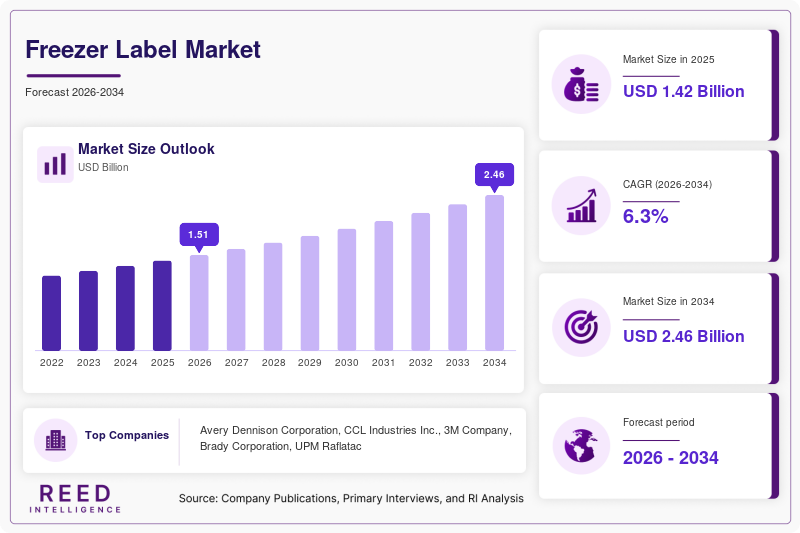
The global Freezer Label Market size was valued at USD 1.42 billion in 2026 and is projected to reach USD 2.31 billion by 2034, registering a CAGR of 6.3% during 2026–2034. The market is witnessing steady expansion as cold-chain packaging becomes more essential across food processing, pharmaceutical logistics, laboratory storage, and industrial chemical transportation. Freezer labels are specifically engineered to maintain adhesion, readability, and durability in low-temperature environments where conventional labels often fail due to moisture, frost, and condensation. Their importance has increased as businesses prioritize accurate product identification, compliance labeling, and efficient warehouse tracking systems.
The rapid development of refrigerated supply chains worldwide has strongly supported the growth of the Freezer Label Market. Increasing demand for frozen meals, packaged seafood, dairy products, vaccines, and temperature-sensitive healthcare products has encouraged manufacturers to invest in reliable label solutions. Innovations in pressure-sensitive adhesives, synthetic films, and printable coatings are also helping suppliers offer products suitable for deep-freeze and ultra-low temperature applications.
Key Highlights
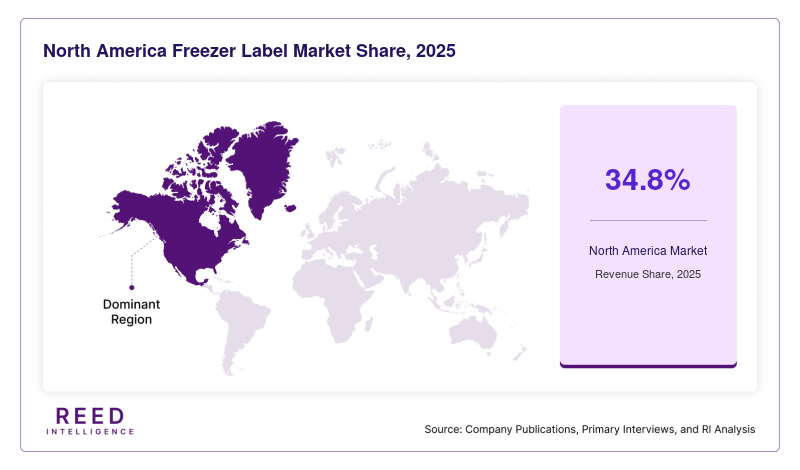
- North America held the dominant regional share of 34.8% in 2025, while Asia Pacific is expected to register the fastest CAGR of 7.5% through 2034.
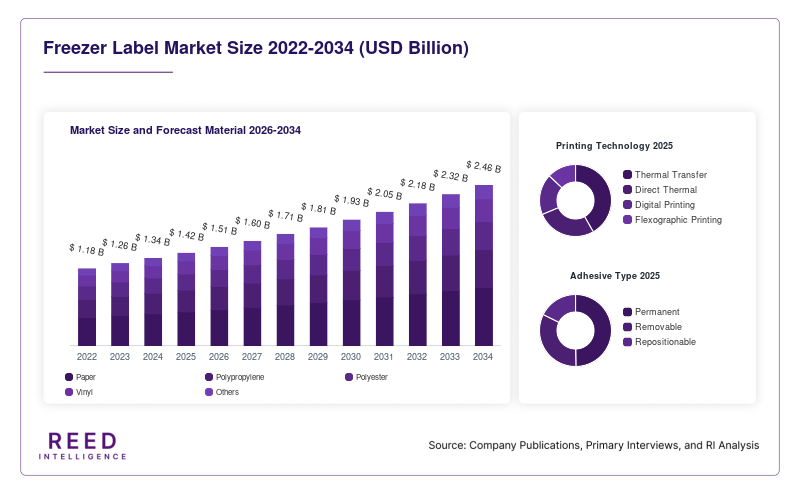
- By material, Polypropylene accounted for the largest share of 38.6%, while Polyester is forecast to grow at 7.2% CAGR.
- By printing technology, Thermal Transfer Labels led with 41.3% share, while Digital Printable Labels are expected to witness 7.8% CAGR.
- By application, Food Packaging remained dominant with 46.9% share, while Pharmaceutical Cold Storage is projected to grow fastest at 8.1% CAGR.
- The United States was the dominant country and was valued at USD 312 million in 2024 and USD 329 million in 2025.
Market Trends
Rise of Smart Identification and Traceability Labels
The use of freezer labels integrated with QR codes, serialized barcodes, and RFID-compatible surfaces is increasing across logistics and retail sectors. Cold storage operators are adopting these solutions to improve product traceability, inventory visibility, and warehouse automation. Food producers are also using scannable labels to meet regulatory standards related to product origin, expiration tracking, and recall management.
Shift Toward Sustainable Label Materials
Environmental concerns are influencing purchasing decisions across the packaging industry. As a result, freezer label manufacturers are developing recyclable face stocks, linerless labels, and water-based adhesive technologies that reduce waste generation. Retail brands and frozen food companies are increasingly preferring eco-conscious labeling formats that align with sustainability targets without compromising freezer performance.
Market Drivers
Growing Demand for Frozen and Convenience Foods
Changing consumer lifestyles, urbanization, and rising preference for ready-to-cook products are increasing global demand for frozen foods. Supermarkets and e-commerce grocery platforms are expanding frozen product portfolios, which directly supports the need for durable freezer labels. These labels help maintain branding visibility, nutritional information, barcode scanning, and storage instructions during transportation and shelf display.
Expansion of Temperature-Controlled Healthcare Logistics
The pharmaceutical sector is another major contributor to the Freezer Label Market. Vaccines, biologics, diagnostic reagents, and laboratory specimens often require storage under refrigerated or frozen conditions. Freezer labels ensure accurate identification, reduce handling errors, and remain legible despite repeated movement between storage environments. Rising healthcare investments and global biologics trade continue to create long-term demand.
Market Restraint
Volatility in Raw Material and Adhesive Costs
Manufacturers of freezer labels depend heavily on petrochemical-based films, specialty coatings, and adhesive compounds. Price fluctuations in raw materials can impact production costs and reduce profit margins. Smaller producers may face challenges in maintaining competitive pricing, particularly when customers seek cost-efficient bulk contracts.
Market Opportunities
Growth of Cryogenic and Ultra-Low Temperature Applications
Research laboratories, gene therapy centers, and biotech companies increasingly require labels that can perform in environments below -80°C. This has created a niche growth area for advanced freezer labels designed for cryogenic vials, specimen tubes, and specialty containers. Suppliers entering this segment can benefit from higher-value product demand.
Expansion of Private Label Frozen Retail Brands
Retail chains around the world are rapidly growing their private-label frozen food offerings. These products require customized freezer labels with attractive designs, strong adhesion, and multilingual product information. Label converters capable of fast-turnaround printing and flexible order volumes are expected to benefit significantly.
Segmental Analysis
By Material
Polypropylene Dominated the Market
Polypropylene labels accounted for 38.6% share in 2025. This material remained highly preferred because it offers moisture resistance, cost efficiency, and reliable print quality. It is widely used in frozen food trays, retail pouches, jars, and plastic containers where label clarity and durability are essential.
Polyester Will Grow at the Fastest Rate
Polyester labels are projected to grow at a 7.2% CAGR through 2034. Their higher strength, chemical resistance, and dimensional stability make them suitable for medical packaging, industrial products, and laboratory storage. Increasing demand for premium long-life labels will support segment growth.
By Printing Technology
Thermal Transfer Held the Largest Share
Thermal transfer labels represented 41.3% of the market in 2025. They remained widely used because they provide sharp barcode printing, long-lasting image quality, and compatibility with industrial-scale printers used in warehouses and manufacturing units.
Digital Printable Labels to Expand Rapidly
Digital printable labels are expected to grow at 7.8% CAGR through 2034. Their ability to support short production runs, quick artwork changes, multilingual printing, and customized branding will drive demand among retailers and emerging brands.
By Adhesive Type
Permanent Adhesives Led the Market
Permanent adhesive labels held 63.4% share in 2025 as they provided strong bonding on plastic, glass, and corrugated surfaces. These labels are widely used where long-term attachment is necessary during storage and transportation.
Removable Adhesives Showing Strong Potential
Removable adhesive labels are projected to grow at 6.9% CAGR during the forecast period. Laboratories, reusable containers, and temporary inventory systems are likely to support demand for labels that can be removed cleanly without residue.
By Application
Food Packaging Dominated Demand
Food packaging accounted for 46.9% market share in 2025. Frozen vegetables, meats, ready meals, desserts, and seafood all require durable labels that remain readable in moisture-heavy freezer environments.
Pharmaceutical Cold Storage to Grow Fastest
Pharmaceutical cold storage is expected to register 8.1% CAGR through 2034. Increasing biologics trade, vaccine distribution, and diagnostic sample transport will support the need for precise and compliant labeling solutions.
Regional Analysis
North America
North America accounted for 34.8% of the global market share in 2025 and is projected to grow at a 5.9% CAGR through 2034. The region benefits from a highly developed cold storage network, strong packaged food consumption, and advanced retail distribution systems. Demand for freezer labels remained high across frozen meals, meat packaging, and pharmaceutical transport. The United States led regional demand due to extensive adoption of automated labeling and barcode inventory systems.
Europe
Europe represented 27.1% share in 2025 and is expected to expand at a 5.8% CAGR over the forecast period. Demand was supported by frozen bakery products, dairy exports, seafood packaging, and pharmaceutical storage requirements. Regulatory emphasis on labeling compliance and sustainability also encouraged innovation. Germany dominated the regional market because of its strong manufacturing base and packaging technology ecosystem.
Asia Pacific
Asia Pacific held 24.3% share in 2025 and is likely to witness the fastest 7.5% CAGR through 2034. Rapid urbanization, supermarket expansion, and changing food consumption patterns are driving the adoption of frozen packaged products. Export-oriented seafood and processed food industries are also contributing to regional growth. China remained the dominant country due to large-scale food processing output and expanding cold-chain infrastructure.
Middle East & Africa
Middle East & Africa captured 7.2% share in 2025 and is anticipated to grow at 6.1% CAGR through 2034. Rising food imports, tourism-related hospitality demand, and healthcare infrastructure development are increasing the use of freezer labels. Demand is particularly visible in modern warehousing facilities. Saudi Arabia led the region because of investments in logistics modernization and food security initiatives.
Latin America
Latin America accounted for 6.6% market share in 2025 and is expected to grow at 6.0% CAGR during the forecast period. Growth is linked to increasing exports of meat, poultry, and frozen fruits as well as retail modernization. Improved refrigeration capacity is also supporting demand. Brazil dominated the regional market owing to its strong processed food industry and export-oriented supply chains.
Competitive Landscape
The Freezer Label Market remains moderately competitive, with both multinational corporations and specialized regional converters operating across the value chain. Competition is largely based on adhesive performance, print quality, customization capability, delivery timelines, and sustainability credentials. Companies are increasingly launching labels that perform under condensation, freezing cycles, and deep-freeze storage conditions.
Avery Dennison Corporation remained a leading participant due to its broad pressure-sensitive materials portfolio and strong global converter network. The company recently expanded cold-chain compatible label solutions with improved recyclable components. CCL Industries Inc. maintains a strong presence in packaged foods and healthcare applications. 3M Company is known for advanced adhesive technologies. Brady Corporation focuses on industrial and laboratory labels, while UPM Raflatac continues to strengthen sustainable labelstock offerings.
Key Players List
- Avery Dennison Corporation
- CCL Industries Inc.
- 3M Company
- Brady Corporation
- UPM Raflatac
- LINTEC Corporation
- Multi-Color Corporation
- SATO Holdings Corporation
- Zebra Technologies
- Henkel AG
- Coveris
- Fuji Seal International
- Mactac
- Resource Label Group
- TSC Auto ID
Recent Developments
- Label manufacturers introduced freezer-grade adhesives with improved condensation resistance.
- Several companies launched recyclable synthetic label materials for frozen packaging.
- Digital print converters expanded customized short-run freezer label production.
- Cryogenic storage facilities increased procurement of ultra-low temperature labels.
- Automated warehouses adopted barcode freezer labels for faster scanning efficiency.
Freezer Label Market Segments
Material
- Paper
- Polypropylene
- Polyester
- Vinyl
- Others
Printing Technology
- Thermal Transfer
- Direct Thermal
- Digital Printing
- Flexographic Printing
Adhesive Type
- Permanent
- Removable
- Repositionable
Application
- Food Packaging
- Pharmaceutical Storage
- Laboratory Samples
- Chemicals
- Retail Frozen Goods
End User
- Manufacturers
- Retailers
- Logistics Providers
- Healthcare Institutions
By Region
- North America
- Europe
- APAC
- Middle East and Africa
- LATAM