Fresh Apricot Market Size, Share & Demand Report By Product Type (Conventional Fresh Apricots, Organic Fresh Apricots), By Distribution Channel (Supermarkets & Hypermarkets, Online Grocery Platforms, Specialty Fruit Stores), By End User (Households, Food Processing Companies, Hospitality Sector) By Region & Segment Forecasts, 2026–2034
USD 3950
Market Overview
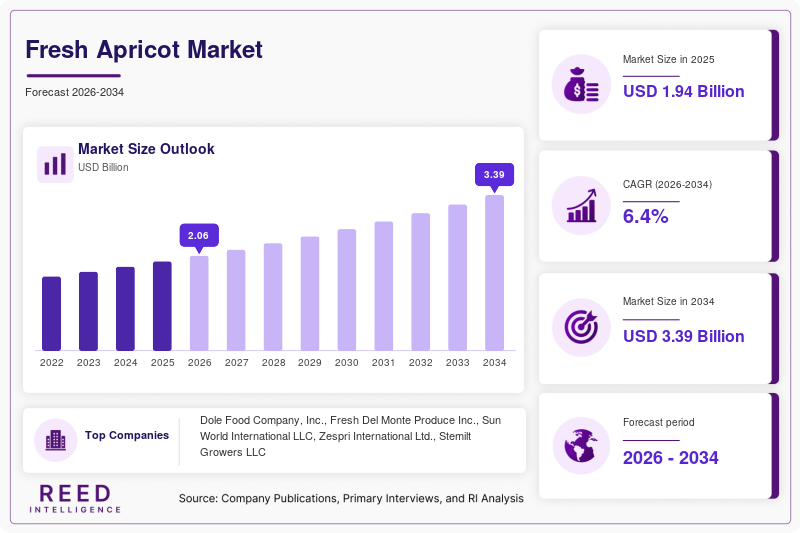
The Fresh Apricot Market size was valued at USD 1.94 billion in 2026 and is projected to reach USD 3.18 billion by 2034, expanding at a CAGR of 6.4% during the forecast period from 2026 to 2034. The global Fresh Apricot Market growth has been supported by rising consumer demand for nutrient-rich fresh fruits and increasing awareness regarding healthy dietary habits across developed and emerging economies.
Fresh apricots are widely consumed due to their high vitamin, mineral, antioxidant, and dietary fiber content. The fruit is increasingly incorporated into balanced diets, functional food products, smoothies, desserts, and retail fresh produce categories. Growing interest in natural and minimally processed food products has strengthened the market outlook for fresh apricots globally.
Key Highlights
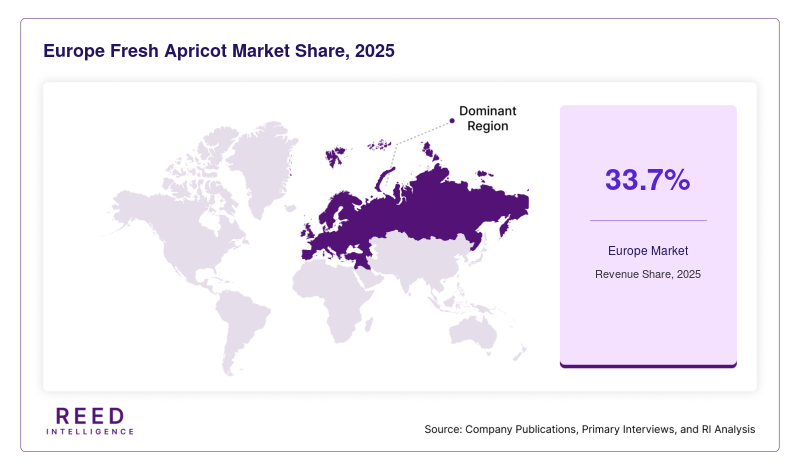
- Europe accounted for 33.7% of the global Fresh Apricot Market share in 2025, while Asia Pacific is projected to register the fastest CAGR of 7.2% during the forecast period.
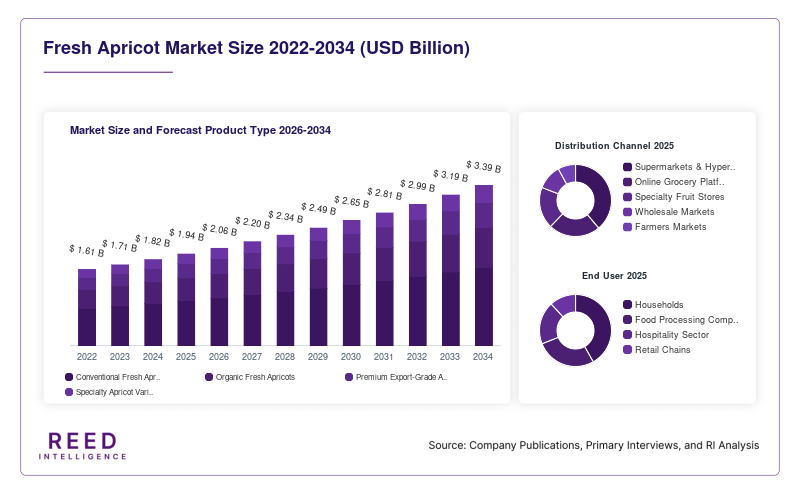
- By product type, conventional fresh apricots held the leading market share of 72.4% in 2025, whereas organic fresh apricots are expected to expand at a CAGR of 8.1% through 2034.
- By distribution channel, supermarkets and hypermarkets accounted for 41.8% of the Fresh Apricot Market share in 2025, while online retail is projected to grow at a CAGR of 8.4%.
- By application, direct household consumption represented 48.3% of the market share in 2025, whereas foodservice applications are anticipated to witness a CAGR of 7.5% during the study period.
- By end user, residential consumers accounted for 52.7% of the market share in 2025, while commercial food processors are expected to grow at a CAGR of 7.0%.
- The Turkey Fresh Apricot Market was valued at USD 214.5 million in 2024 and increased to USD 227.8 million in 2025 due to rising export demand and improved apricot cultivation output.
Market Trends
Rising Demand for Organic Fresh Apricots
One of the major trends shaping the Fresh Apricot Market is the increasing demand for organic fresh apricots. Consumers are becoming more conscious regarding food safety, pesticide usage, and sustainable farming practices, which has accelerated the adoption of organically cultivated fruit products.
Retailers and fruit producers are expanding their organic product portfolios to cater to premium consumer segments seeking healthier and environmentally responsible food options.
Expansion of Premium Fruit Packaging Solutions
Another key trend influencing the Fresh Apricot Market is the growing use of premium and sustainable fruit packaging solutions. Companies are adopting biodegradable trays, recyclable packaging materials, and modified atmosphere packaging technologies to extend product shelf life and improve product presentation.
Premium packaging is also helping exporters and retailers reduce transportation damage and enhance consumer purchasing experience.
Market Drivers
Increasing Consumer Preference for Healthy Snacking
The growing consumer preference for healthy snacking has emerged as a major driver for the Fresh Apricot Market. Consumers increasingly prefer fresh fruits over processed snacks due to their nutritional benefits and natural ingredients.
Fresh apricots are widely consumed as convenient healthy snacks because they contain vitamins A and C, antioxidants, and dietary fiber. The expansion of wellness-focused dietary trends is expected to continue supporting market growth.
Growth of Organized Fresh Produce Retail
The rapid expansion of organized fresh produce retail networks has significantly contributed to Fresh Apricot Market growth. Supermarkets, specialty grocery chains, and online grocery platforms are improving the accessibility and visibility of fresh fruit products.
Enhanced cold chain logistics and retail infrastructure development are enabling retailers to maintain fruit quality and expand product distribution across urban and semi-urban markets.
Market Restraint
Seasonal Production and Supply Chain Vulnerability
Seasonal production dependency remains a major restraint for the Fresh Apricot Market. Apricot cultivation is highly sensitive to weather conditions, frost damage, and water availability, which can create fluctuations in supply and pricing.
Short harvest periods and perishability challenges may also increase logistics costs and inventory losses for producers and distributors.
Market Opportunities
Expansion of Export-Oriented Fruit Trade
The increasing expansion of export-oriented fruit trade presents a significant opportunity for the Fresh Apricot Market. Producers are focusing on quality certification, improved storage systems, and international retail partnerships to expand export volumes.
Growing demand for imported seasonal fruits across Asia Pacific and the Middle East is expected to create favorable opportunities for exporters.
Increasing Demand from Functional Food Manufacturers
Functional food manufacturers are generating new opportunities for the Fresh Apricot Market by incorporating fresh apricots into health-oriented product formulations. Smoothies, yogurt products, breakfast bowls, and natural desserts increasingly feature fresh apricot ingredients.
The growing popularity of nutrient-rich food products is expected to strengthen commercial demand for premium-quality fresh apricots.
Segmental Analysis
By Product Type
Based on product type, the Fresh Apricot Market is segmented into conventional fresh apricots and organic fresh apricots.
Conventional fresh apricots dominated the market with a 72.4% share in 2025 due to their wider availability, lower production costs, and established distribution networks.
Organic fresh apricots are expected to witness the fastest CAGR of 8.1% during the forecast period. Rising consumer demand for chemical-free fruit products is expected to support segment growth.
By Distribution Channel
Based on distribution channel, the Fresh Apricot Market is segmented into supermarkets & hypermarkets, specialty stores, online retail, and local fruit markets.
Supermarkets and hypermarkets accounted for the highest market share of 41.8% in 2025 because consumers preferred organized retail environments offering quality assurance and product variety.
Online retail is anticipated to expand at a CAGR of 8.4% through 2034. Increasing digital grocery adoption and doorstep delivery convenience are expected to drive segment growth.
By Application
Based on application, the Fresh Apricot Market is segmented into direct household consumption, foodservice applications, bakery & confectionery, and beverage preparation.
Direct household consumption held the leading market share of 48.3% in 2025 due to increasing consumer preference for fresh fruit consumption in daily diets.
Foodservice applications are expected to grow at a CAGR of 7.5% during the study period. Restaurants and cafes are increasingly incorporating fresh apricots into premium culinary offerings and healthy menu formulations.
By End User
Based on end user, the Fresh Apricot Market is categorized into residential consumers, commercial food processors, hospitality businesses, and retail chains.
Residential consumers accounted for the dominant market share of 52.7% in 2025 because households increasingly purchased fresh fruits as part of balanced nutritional diets.
Commercial food processors are projected to witness a CAGR of 7.0% through 2034. Rising demand for fruit-based functional foods and premium desserts is expected to support segment growth.
By Packaging Type
Based on packaging type, the Fresh Apricot Market is segmented into cartons, trays & clamshells, bags & pouches, and bulk packaging.
Cartons accounted for the dominant market share of 36.9% in 2025 due to their suitability for transportation and export-oriented supply chains.
Trays and clamshells are expected to witness a CAGR of 7.3% during the forecast period. Increasing retail preference for visually appealing and damage-resistant fruit packaging is anticipated to strengthen demand.
Regional Analysis
Europe
Europe accounted for 33.7% of the Fresh Apricot Market share in 2025 and is projected to expand at a CAGR of 6.1% during the forecast period. The region maintained strong demand due to high fruit consumption rates and established fresh produce retail networks.
Turkey represented the dominant country within the regional market because of its extensive apricot cultivation capacity and strong export-oriented production infrastructure.
North America
North America held 24.6% of the global Fresh Apricot Market share in 2025 and is expected to grow at a CAGR of 6.3% through 2034. Rising health awareness and increasing preference for fresh fruit snacks supported regional market growth.
The United States dominated the regional market due to expanding premium grocery retail channels and increasing consumer demand for organic fruit products.
Asia Pacific
Asia Pacific accounted for 27.1% of the Fresh Apricot Market share in 2025 and is anticipated to register the fastest CAGR of 7.2% during the study period. Urbanization and rising disposable income contributed significantly to regional market expansion.
China emerged as the dominant country within the region because of increasing fresh fruit consumption and expanding domestic retail distribution infrastructure.
Middle East & Africa
The Middle East & Africa represented 8.2% of the Fresh Apricot Market share in 2025 and is projected to grow at a CAGR of 6.8% during the forecast period. Increasing fruit import activities and expanding hospitality sectors supported regional market demand.
Saudi Arabia dominated the regional market due to rising demand for premium imported fruits and growth in organized retail channels.
Latin America
Latin America accounted for 6.4% of the Fresh Apricot Market share in 2025 and is expected to witness a CAGR of 6.5% through 2034. Agricultural diversification and increasing fruit consumption supported regional market growth.
Chile represented the leading country within Latin America because of expanding fruit export operations and investments in cold storage infrastructure.
Competitive Landscape
The Fresh Apricot Market remains moderately fragmented, with producers and distributors focusing on product quality, export expansion, sustainable farming practices, and cold chain infrastructure development. Companies are increasingly investing in organic cultivation, premium packaging, and direct retail partnerships to strengthen market presence.
Dole plc maintained a leading position in the market due to its extensive global fresh produce distribution network and diversified fruit product portfolio. The company recently expanded premium fruit packaging solutions for export-oriented apricot distribution.
Fresh Del Monte Produce Inc. continued strengthening its global fresh fruit logistics capabilities to improve product availability across retail channels. Stemilt Growers focused on sustainable fruit farming and premium apricot cultivation practices. Sun World International expanded proprietary fruit variety development programs, while Zespri Group increased investments in digital fresh produce supply chain management systems.
Key Players List
- Dole plc
- Fresh Del Monte Produce Inc.
- Stemilt Growers
- Sun World International
- Zespri Group
- Driscoll’s Inc.
- Frieda’s LLC
- Oppy (The Oppenheimer Group)
- AGRANA Beteiligungs-AG
- Greenyard NV
- Nature’s Touch Frozen Foods
- Sage Fruit Company
- Prima Frutta Packing Inc.
- Fruit Growers Supply Company
- Royal Ridge Fruits
Recent Developments
- In February 2026, Dole plc expanded premium fresh apricot packaging solutions for export distribution across European retail channels.
- In September 2025, Fresh Del Monte Produce Inc. strengthened cold chain logistics infrastructure to improve fresh fruit shelf life and transportation efficiency.
- In November 2025, Stemilt Growers introduced sustainable irrigation programs for apricot farming operations in North America.
- In April 2026, Sun World International expanded proprietary apricot variety development initiatives targeting premium fruit markets.
- In July 2025, Greenyard NV increased investments in digital produce tracking technologies for fresh fruit supply chain optimization.
Fresh Apricot Market Segments
Product Type
- Conventional Fresh Apricots
- Organic Fresh Apricots
- Premium Export-Grade Apricots
- Specialty Apricot Varieties
Distribution Channel
- Supermarkets & Hypermarkets
- Online Grocery Platforms
- Specialty Fruit Stores
- Wholesale Markets
- Farmers Markets
End User
- Households
- Food Processing Companies
- Hospitality Sector
- Retail Chains
Region
- North America
- Europe
- Asia Pacific
- Middle East & Africa
- Latin America
By Region
- North America
- Europe
- APAC
- Middle East and Africa
- LATAM