Friction Modifiers Organic Inorganic Market Size, Share & Demand Report By Type (Organic Friction Modifiers, Inorganic Friction Modifiers), By Application (Automotive, Industrial Machinery, Marine, Aerospace), By End-Use (Transportation, Manufacturing, Energy, Others), By Region & Segment Forecasts, 2025–2034
USD 3950
Market Overview
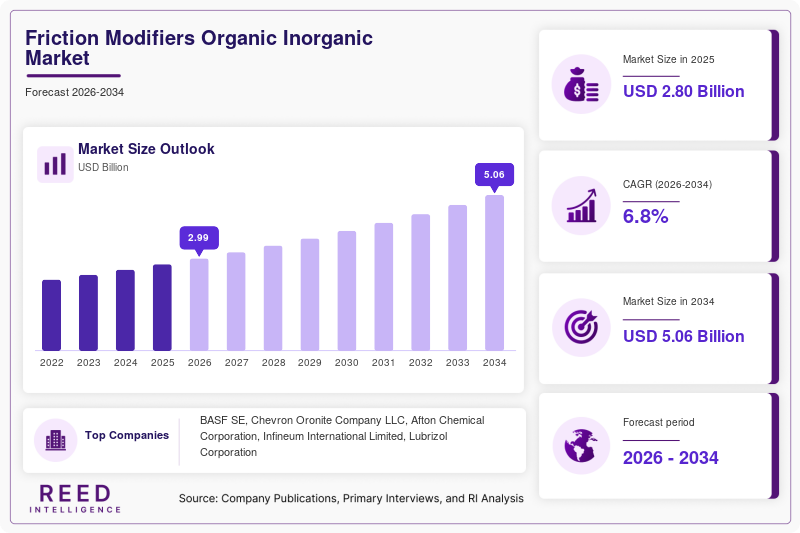
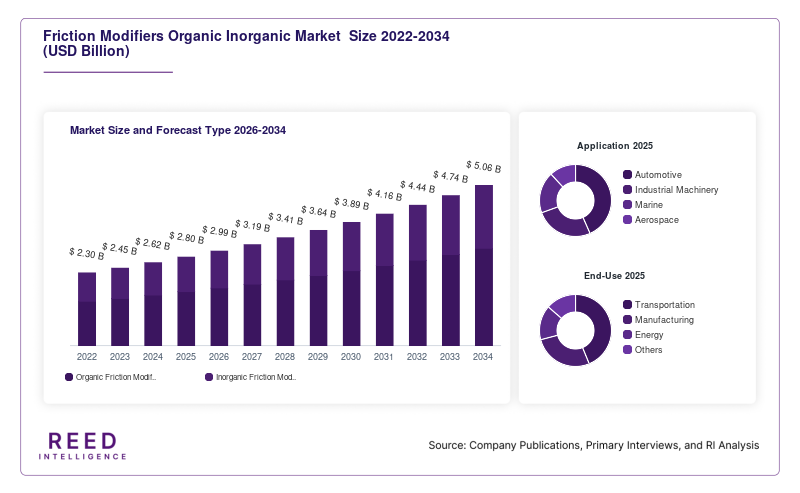
The Friction Modifiers Organic Inorganic Market size is estimated at USD 2.8 billion and is projected to reach approximately USD 3.0 billion in 2026. Looking ahead, the market is expected to grow to around USD 5.1 billion by 2034, registering a compound annual growth rate (CAGR) of 6.8% during the forecast period from 2025 to 2034.
Friction modifiers, both organic and inorganic, are essential additives used to reduce wear and improve efficiency in mechanical systems. Organic friction modifiers, such as fatty acids and esters, are widely used due to their biodegradability and compatibility with base oils. Inorganic friction modifiers, including molybdenum disulfide and graphite, offer high thermal stability and performance under extreme conditions. The growing demand for fuel-efficient vehicles and reduced emissions is accelerating the adoption of these additives.
Key Highlights
- Market projected to grow from USD 2.8B (2025) to USD 5.1B (2034), reflecting ~1.8× growth driven by lubricant demand across automotive and industrial sectors.
- Expected CAGR of 6.8% (2025–2034), supported by rising use of synthetic lubricants (~55% share) and advanced additive technologies.
- Strong demand from automotive and industrial sectors, with automotive contributing ~48% share and industrial applications growing at ~7.0% CAGR.
- Increasing focus on eco-friendly additives, with organic friction modifiers holding >60% share and bio-based variants growing at ~7% CAGR.
- Rising adoption in EVs and renewable energy, with these segments expanding at >7% CAGR and contributing to increasing share in next-generation lubrication demand.
Market Trends
Shift Toward Bio-Based and Sustainable Friction Modifiers
A significant trend in the Friction Modifiers Organic Inorganic Market is the growing preference for bio-based and environmentally friendly additives. Manufacturers are increasingly focusing on organic friction modifiers derived from renewable sources such as vegetable oils and fatty acids. This shift is driven by stringent environmental regulations and the need to reduce the ecological footprint of lubricants. Bio-based friction modifiers offer improved biodegradability and lower toxicity, making them suitable for applications in sensitive environments. In addition, advancements in formulation technologies are enabling these products to match or exceed the performance of conventional additives.
Integration of Nanotechnology in Friction Modifier Development
Another emerging trend is the incorporation of nanotechnology in friction modifier formulations. Nanoparticles such as graphene, nano-molybdenum, and metal oxides are being used to enhance lubrication performance. These materials provide superior anti-wear and friction-reducing properties due to their high surface area and unique structural characteristics. The use of nanotechnology is particularly beneficial in high-load and high-temperature applications. As research and development efforts continue, the commercialization of nano-based friction modifiers is expected to increase, offering improved efficiency and longer equipment life.
Market Drivers
Rising Demand for Fuel Efficiency and Emission Reduction
The increasing emphasis on fuel efficiency and emission reduction is a primary driver of the Friction Modifiers Organic Inorganic Market. Governments worldwide are implementing stringent emission standards, compelling automotive manufacturers to enhance engine performance and reduce friction losses. Friction modifiers play a critical role in achieving these objectives by minimizing energy losses and improving fuel economy. The growing adoption of hybrid and electric vehicles further supports the demand for specialized lubricants. As a result, lubricant manufacturers are investing in advanced additive technologies to meet evolving regulatory and performance requirements.
Growth of Industrial Machinery and Automation
The expansion of industrial automation and advanced manufacturing is another key driver. Industries such as mining, construction, and manufacturing rely heavily on machinery that requires efficient lubrication to ensure smooth operation and reduce wear. Friction modifiers enhance the performance of industrial lubricants by improving load-bearing capacity and reducing maintenance requirements. The increasing adoption of automated systems and robotics is further driving demand for high-performance lubricants. This trend is expected to continue as industries focus on improving productivity and operational efficiency.
Market Restraint
High Cost and Compatibility Challenges of Advanced Additives
One of the major restraints in the Friction Modifiers Organic Inorganic Market is the high cost associated with advanced additive formulations, particularly those involving nanotechnology or specialized inorganic compounds. These products often require complex manufacturing processes and high-quality raw materials, leading to increased costs. Additionally, compatibility issues with existing lubricant formulations can limit their adoption. For instance, certain inorganic friction modifiers may cause sedimentation or instability in specific base oils, affecting performance. These challenges can discourage small and medium-sized manufacturers from adopting advanced solutions, thereby limiting market growth. Overcoming these issues requires continuous research and development to improve formulation stability and cost efficiency.
Market Opportunities
Expansion in Electric Vehicle Lubrication Systems
The rapid growth of electric vehicles presents a significant opportunity for the Friction Modifiers Organic Inorganic Market. Unlike traditional internal combustion engines, EVs require specialized lubricants for components such as gearboxes, bearings, and thermal management systems. Friction modifiers can enhance efficiency and reduce energy losses in these systems. As EV adoption increases globally, the demand for tailored lubricant solutions is expected to rise. This creates opportunities for manufacturers to develop innovative products specifically designed for EV applications.
Increasing Demand in Renewable Energy Applications
Another promising opportunity lies in the renewable energy sector, particularly in wind and solar power systems. Wind turbines, for example, operate under extreme conditions and require high-performance lubricants to ensure reliability and longevity. Friction modifiers can improve the efficiency and durability of these systems by reducing wear and friction. As investments in renewable energy continue to grow, the demand for advanced lubrication solutions is expected to increase, providing new growth avenues for market participants.
Segmental Analysis
By Type
The organic friction modifiers segment dominated the market in 2024, accounting for approximately 62% of the total share. These modifiers are widely used due to their compatibility with various base oils and their environmentally friendly properties. Organic additives such as fatty acids and esters provide effective friction reduction and are commonly used in automotive and industrial lubricants. Their biodegradability and low toxicity make them suitable for applications where environmental impact is a concern. The increasing demand for sustainable lubrication solutions is further supporting the growth of this segment.
The inorganic friction modifiers segment is expected to be the fastest-growing, with a CAGR of 7.2% during the forecast period. This growth is driven by their superior performance in extreme conditions, such as high temperatures and heavy loads. Materials like molybdenum disulfide and graphite offer excellent anti-wear properties and durability. The rising demand for high-performance lubricants in industrial and aerospace applications is a key growth factor. Additionally, advancements in nanotechnology are enhancing the effectiveness of inorganic friction modifiers.
By Application
The automotive segment held the largest share in 2024, accounting for around 48% of the market. Friction modifiers are extensively used in engine oils, transmission fluids, and gear oils to improve efficiency and reduce wear. The growing focus on fuel efficiency and emission reduction is driving the adoption of advanced lubricants in this sector. The increasing production of vehicles, particularly in emerging economies, is further supporting market growth.
The industrial machinery segment is projected to be the fastest-growing, with a CAGR of 7.0%. This growth is driven by the increasing adoption of automation and advanced manufacturing technologies. Friction modifiers enhance the performance of industrial lubricants by reducing friction and extending equipment life. The need for efficient and reliable machinery in sectors such as mining, construction, and manufacturing is a key growth factor.
By End-Use
The transportation sector dominated the market in 2024, accounting for approximately 55% of the total share. This includes automotive, aviation, and marine applications. Friction modifiers play a crucial role in improving fuel efficiency and reducing maintenance costs in these sectors. The increasing demand for high-performance vehicles and the adoption of advanced technologies are supporting the growth of this segment.
The energy sector is expected to be the fastest-growing, with a CAGR of 7.3%. This growth is driven by the increasing use of friction modifiers in renewable energy systems such as wind turbines. These systems require high-performance lubricants to operate efficiently under extreme conditions. The global shift toward renewable energy is a major growth factor for this segment.
Regional Analysis
North America
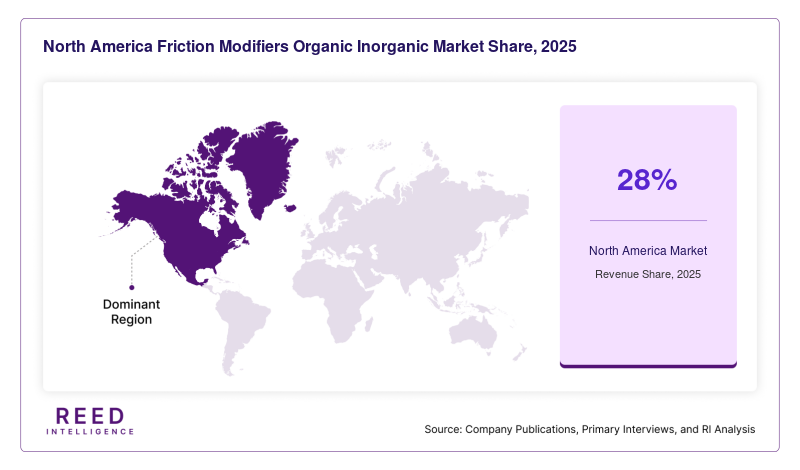
North America accounted for approximately 28% of the global Friction Modifiers Organic Inorganic Market share in 2025 and is expected to grow at a CAGR of 6.2% during the forecast period. The region benefits from a well-established automotive and industrial base, along with strong research and development capabilities. The presence of major lubricant manufacturers and additive suppliers supports market growth. Increasing regulatory pressure to reduce emissions is also driving the adoption of advanced friction modifiers.
The United States dominates the North American market due to its large automotive industry and technological advancements. A key growth factor is the increasing adoption of electric vehicles, which requires specialized lubrication solutions. The focus on sustainability and energy efficiency is further encouraging the use of eco-friendly friction modifiers.
Europe
Europe held around 24% of the market share in 2025 and is projected to grow at a CAGR of 6.5%. The region is characterized by stringent environmental regulations and a strong focus on sustainability. These factors are driving the demand for bio-based and low-emission lubricants. The presence of leading automotive manufacturers also contributes to market growth.
Germany is the dominant country in Europe, driven by its robust automotive industry. A unique growth factor is the emphasis on high-performance engineering and innovation. The demand for premium lubricants in high-end vehicles is supporting the adoption of advanced friction modifiers.
Asia Pacific
Asia Pacific led the market with a share of 34% in 2025 and is expected to register the highest CAGR of 7.5%. Rapid industrialization, urbanization, and growing automotive production are key factors driving market growth. The region also benefits from increasing investments in manufacturing and infrastructure development.
China is the leading country in the region due to its large industrial base and automotive production capacity. A major growth factor is the expansion of electric vehicle manufacturing, supported by government incentives. This is creating significant demand for specialized friction modifiers.
Middle East & Africa
The Middle East & Africa region accounted for about 7% of the market share in 2025 and is projected to grow at a CAGR of 5.8%. The market is driven by the oil and gas industry, which requires efficient lubrication solutions for equipment and machinery. Increasing industrial activities are also contributing to growth.
Saudi Arabia is a key market in the region, supported by its strong oil and gas sector. A unique growth factor is the increasing investment in industrial diversification, which is driving demand for advanced lubricants and additives.
Latin America
Latin America held approximately 7% of the market share in 2025 and is expected to grow at a CAGR of 5.9%. The region is experiencing gradual growth in automotive and industrial sectors, which is supporting the demand for friction modifiers. Economic recovery in key countries is also contributing to market expansion.
Brazil dominates the Latin American market due to its large automotive industry. A significant growth factor is the increasing focus on bio-based lubricants, driven by the availability of renewable raw materials such as vegetable oils.
Competitive Landscape
The Friction Modifiers Organic Inorganic Market is moderately fragmented, with several global and regional players competing based on product innovation, quality, and pricing. Key companies are focusing on research and development to introduce advanced formulations that meet evolving industry requirements. Strategic partnerships, mergers, and acquisitions are common strategies to expand market presence.
One of the leading players in the market is a major chemical company known for its extensive product portfolio and strong global presence. This company has recently introduced a new range of nano-based friction modifiers designed to enhance performance in electric vehicle applications. Other prominent players are also investing in sustainable and bio-based solutions to align with environmental regulations.
Key Players
- BASF SE
- Chevron Oronite Company LLC
- Afton Chemical Corporation
- Infineum International Limited
- Lubrizol Corporation
- Croda International Plc
- Evonik Industries AG
- Clariant AG
- LANXESS AG
- TotalEnergies Additives
- Vanderbilt Chemicals LLC
- BRB International BV
- ADEKA Corporation
- Mitsui Chemicals Inc.
- Rhein Chemie (Lanxess)
Recent Developments
- A leading additive manufacturer launched a new line of bio-based friction modifiers aimed at reducing environmental impact while maintaining high performance.
- A major chemical company expanded its production capacity for inorganic friction modifiers to meet growing demand from industrial applications.
- An industry player introduced nano-enhanced friction modifiers designed for electric vehicle lubrication systems, improving efficiency and durability.
Friction Modifiers Organic Inorganic Market Segments
Type
- Organic Friction Modifiers
- Inorganic Friction Modifiers
Application
- Automotive
- Industrial Machinery
- Marine
- Aerospace
End-Use
- Transportation
- Manufacturing
- Energy
- Others
By Region
- North America
- Europe
- APAC
- Middle East and Africa
- LATAM