Friction Pendulum Bearing Market Size, Share & Demand Report By Type (Single Concave Friction Pendulum Bearings, Double Concave Bearings, Triple Pendulum Bearings), By Application (Bridges, Buildings, Industrial Structures, Others), By End-Use (Infrastructure, Commercial, Industrial), By Distribution Channel (Direct Sales, Distributors), By Region & Segment Forecasts, 2025–2034
USD 3950
Market Overview
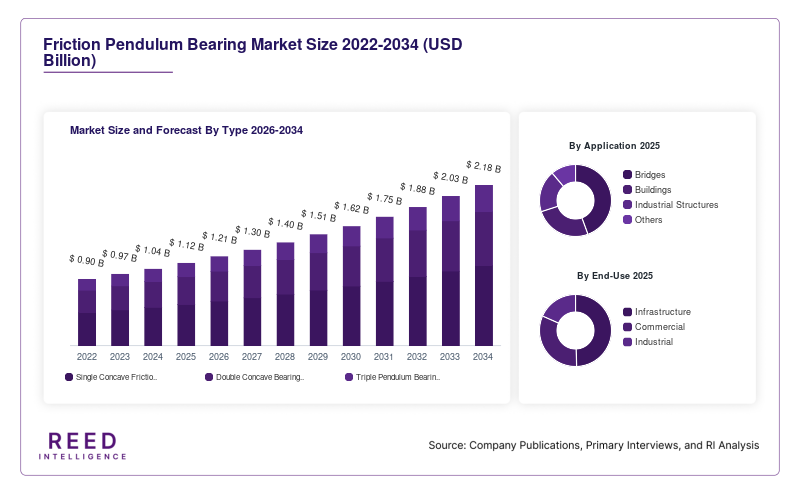
The global Friction Pendulum Bearing Market size was valued at USD 1.12 billion in 2025 and is projected to reach USD 2.18 billion by 2034, expanding at a CAGR of 7.7% during the forecast period (2025–2034). The market is witnessing stable growth driven by increasing demand for seismic protection systems in infrastructure projects. Friction pendulum bearings are widely used in bridges, buildings, and industrial structures to reduce seismic impact by isolating structural movement during earthquakes.
A key global factor supporting the growth of the Friction Pendulum Bearing Market is the rising emphasis on disaster-resilient infrastructure. Governments and regulatory bodies are increasingly mandating seismic protection standards in earthquake-prone regions. This has led to higher adoption of advanced base isolation technologies, including friction pendulum systems, to enhance structural safety and longevity.
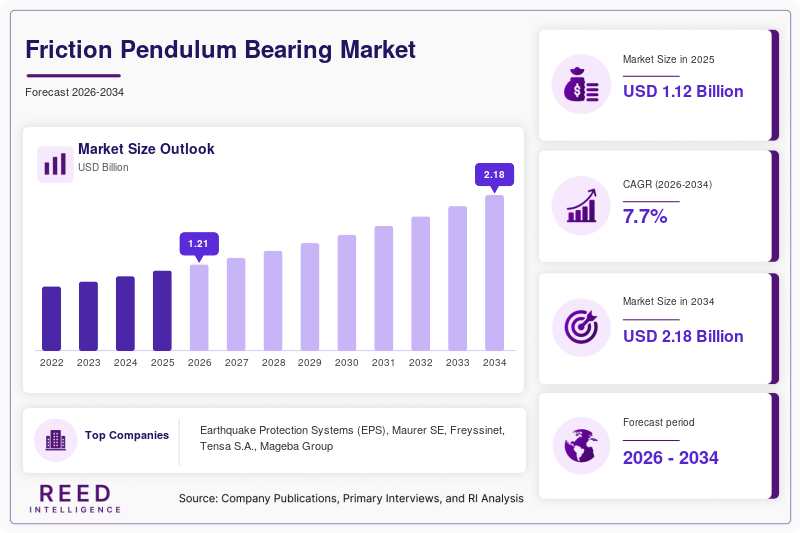
Key Highlights:
- Asia Pacific dominated the market with a 39.6% share in 2025, while Latin America is expected to grow at the fastest CAGR of 8.2% through 2034.
- By type, single concave friction pendulum bearings held the largest share (46.8%), while triple pendulum bearings are projected to grow at a CAGR of 8.5%.
- By application, bridges accounted for the leading share (42.3%), while commercial buildings are expected to grow at a CAGR of 8.1%.
- China remained the dominant country with USD 298 million in 2025, projected to reach USD 322 million in 2026.
Market Trends
Increasing Adoption of Advanced Seismic Isolation Systems
The Friction Pendulum Bearing Market is experiencing growing adoption of advanced seismic isolation technologies. Engineers and construction firms are integrating friction pendulum systems into infrastructure projects to improve earthquake resistance. These systems provide controlled movement and energy dissipation, making them suitable for high-risk seismic zones.
Integration of Smart Monitoring Technologies
There is a rising trend toward integrating sensors and monitoring systems with friction pendulum bearings. These smart systems enable real-time tracking of structural performance and maintenance needs. The adoption of digital monitoring solutions is enhancing reliability and lifecycle management of infrastructure assets.
Market Drivers
Increasing Infrastructure Development in Seismic Zones
The expansion of infrastructure projects in earthquake-prone regions is a major driver of the Friction Pendulum Bearing Market. Governments are investing in resilient infrastructure to minimize damage during seismic events. The use of friction pendulum bearings is becoming essential in such projects.
Stringent Building Codes and Safety Regulations
Regulatory frameworks mandating seismic safety standards are driving the adoption of advanced isolation systems. Construction companies are required to comply with these standards, increasing the demand for friction pendulum bearings in new and retrofitting projects.
Market Restraint
High Initial Installation Costs
A significant restraint in the Friction Pendulum Bearing Market is the high initial cost associated with installation. These systems require specialized design and engineering, which can increase project expenses.
Additionally, the complexity of installation and maintenance may limit adoption in cost-sensitive markets. While the long-term benefits are substantial, upfront investment remains a challenge for some end-users.
Market Opportunities
Retrofitting of Existing Infrastructure
The growing need to upgrade aging infrastructure presents a major opportunity for the Friction Pendulum Bearing Market. Retrofitting existing buildings and bridges with seismic isolation systems can enhance safety and extend structural lifespan.
Expansion in Emerging Economies
Emerging economies are investing in infrastructure development, creating opportunities for market growth. Increasing awareness of seismic safety and adoption of modern construction technologies are driving demand for friction pendulum bearings in these regions.
Segmental Analysis
By Type
Single concave friction pendulum bearings dominated the Friction Pendulum Bearing Market in 2025, accounting for 46.8% of the total share. Their cost-effectiveness and ease of installation make them widely used in various applications.
Triple pendulum bearings are expected to grow at the fastest CAGR of 8.5% during the forecast period. These systems offer enhanced performance and flexibility, making them suitable for complex structures.
By Application
Bridges held the largest share of 42.3% in 2025, driven by the need for seismic protection in transportation infrastructure. Friction pendulum bearings are widely used to reduce structural damage during earthquakes.
Commercial buildings are projected to grow at a CAGR of 8.1%, supported by increasing construction activities. The demand for resilient building designs is driving growth.
By End-Use
Infrastructure projects accounted for 51.6% of the market in 2025, supported by government investments in public infrastructure.
Industrial facilities are expected to grow at a CAGR of 7.8%, driven by the need for safety and operational continuity.
By Distribution Channel
Direct sales accounted for 54.2% of the market share in 2025, as large projects require direct procurement from manufacturers.
Distributor channels are expected to grow at a CAGR of 7.6%, supported by expanding supply networks.
Regional Analysis
North America
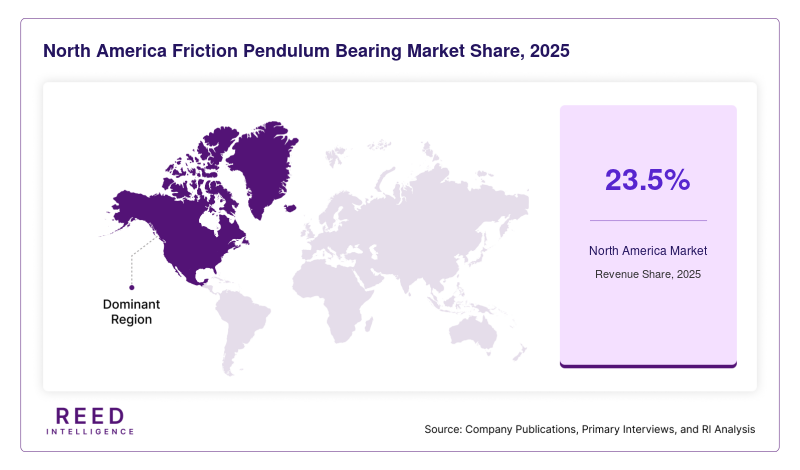
North America accounted for 23.5% of the Friction Pendulum Bearing Market share in 2025 and is expected to grow at a CAGR of 7.5% during the forecast period. The region’s growth is supported by strict building regulations and advanced infrastructure development.
The United States dominated the regional market due to its focus on seismic safety and retrofitting projects. The adoption of advanced isolation technologies is driving demand.
Europe
Europe held a market share of 21.8% in 2025 and is projected to grow at a CAGR of 7.2% through 2034. The region’s emphasis on sustainable and resilient infrastructure is supporting market growth.
Italy emerged as the leading country due to its seismic activity and strong regulatory framework. The use of friction pendulum bearings in infrastructure projects is increasing.
Asia Pacific
Asia Pacific led the Friction Pendulum Bearing Market with a 39.6% share in 2025 and is expected to grow at a CAGR of 7.9%. Rapid urbanization and infrastructure development are key factors driving growth.
China remained the dominant country, supported by large-scale construction projects. The adoption of seismic protection technologies is increasing in the region.
Middle East & Africa
The Middle East & Africa accounted for 7.1% of the market in 2025 and is expected to grow at a CAGR of 7.4%. Infrastructure development and urban expansion are supporting demand.
Turkey led the regional market due to its seismic activity and focus on resilient construction. The adoption of advanced isolation systems is contributing to growth.
Latin America
Latin America held a market share of 8.0% in 2025 and is projected to grow at a CAGR of 8.2%. Increasing investments in infrastructure are driving market expansion.
Chile dominated the regional market, supported by its seismic risk and infrastructure projects. The demand for seismic protection systems is growing.
Competitive Landscape
The Friction Pendulum Bearing Market is moderately consolidated, with key players focusing on technological advancements and project-based contracts. Companies are investing in research and development to enhance product performance and durability.
Earthquake Protection Systems (EPS) is a leading player in the market, known for its innovative friction pendulum technologies. The company recently introduced advanced triple pendulum systems designed for improved seismic performance.
Other major players are focusing on expanding their global presence and strengthening partnerships with construction firms. Strategic collaborations and product innovations are key strategies adopted by market participants.
Key Players List
- Earthquake Protection Systems (EPS)
- Maurer SE
- Freyssinet
- Tensa S.A.
- Mageba Group
- Kawakin Core-Tech Co., Ltd.
- Bridgestone Corporation
- Oiles Corporation
- Granor Rubber & Engineering
- Canam Group Inc.
- Ekspan Ltd.
- DYWIDAG-Systems International
- VSL International Ltd.
- Zaoqiang Dacheng Rubber Co., Ltd.
- Hengshui Zhengtong Rubber Co., Ltd.
Recent Developments
- Earthquake Protection Systems launched advanced triple pendulum bearing systems for large infrastructure projects.
- Maurer SE expanded its seismic isolation product portfolio.
- Mageba Group secured contracts for bridge infrastructure projects.
- Bridgestone Corporation developed improved rubber-based bearing technologies.
- Freyssinet introduced new solutions for structural safety and durability.
Friction Pendulum Bearing Market Segments
By Type
- Single Concave Friction Pendulum Bearings
- Double Concave Bearings
- Triple Pendulum Bearings
By Application
- Bridges
- Buildings
- Industrial Structures
- Others
By End-Use
- Infrastructure
- Commercial
- Industrial
By Distribution Channel
- Direct Sales
- Distributors
By Region
- North America
- Europe
- APAC
- Middle East and Africa
- LATAM