Friction Washer Market Size, Share & Demand Report By Type (External Tooth Washers, Internal Tooth Washers, Wave Washers, Spring Washers), By Material (Stainless Steel, Carbon Steel, Brass, Composite Materials), By Application (Automotive, Aerospace, Construction, Renewable Energy), By End-Use Industry (Industrial Machinery, Electronics, Energy & Power, Marine), By Region & Segment Forecasts, 2026–2034
USD 3950
Market Overview
The global Friction Washer Market size was valued at approximately USD 1.42 billion in 2026 and is projected to reach USD 2.38 billion by 2034, expanding at a CAGR of 6.7% from 2026 to 2034. Friction washers, widely used in mechanical assemblies to prevent loosening due to vibration and dynamic loads, have become integral components across industries such as automotive, aerospace, industrial machinery, and construction equipment.
A major global factor supporting the growth of the Friction Washer Market is the increasing demand for durable fastening solutions in high-performance industrial applications. As industries continue to emphasize safety, efficiency, and long-term reliability, friction washers are gaining traction due to their ability to maintain joint integrity under extreme conditions, including high pressure and temperature.
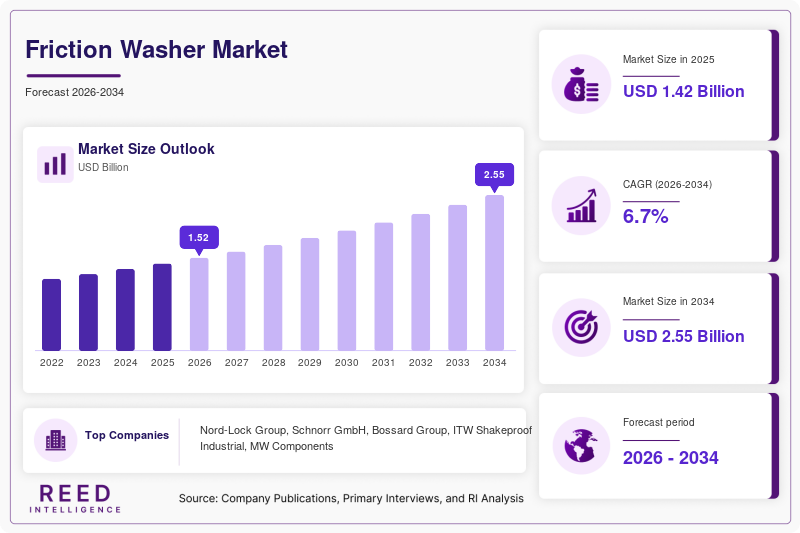
Key Highlights:
- Asia Pacific dominated the market with 38.6% share, while it is expected to be the fastest-growing region with a CAGR of 7.5%.
- By type, external tooth washers led with 34.2% share, while wave washers are projected to grow fastest at a CAGR of 7.9%.
- By material, stainless steel washers dominated with 41.8% share, while composite materials are expected to grow fastest at 8.3% CAGR.
- The United States remained the dominant country, with market values of USD 310 million in 2024 and USD 327 million in 2025.
Market Trends
Increasing Adoption in Electric Vehicles
The rise of electric vehicles (EVs) is significantly influencing the Friction Washer Market. EV systems require components that can withstand constant vibration and thermal variations without compromising performance. Friction washers are increasingly used in battery packs, motor assemblies, and drivetrain systems due to their ability to maintain secure fastening. As EV production scales globally, manufacturers are focusing on lightweight and corrosion-resistant washers to enhance vehicle efficiency and durability.
Shift Toward Advanced Materials
Another prominent trend shaping the Friction Washer Market is the growing shift toward advanced materials such as engineered polymers and composite alloys. Traditional metal washers are being complemented by materials that offer improved wear resistance, reduced weight, and better corrosion protection. These innovations are particularly relevant in aerospace and marine industries, where environmental exposure is severe. Additionally, manufacturers are investing in coatings and surface treatments to extend product lifespan and reduce maintenance costs.
Market Drivers
Growth of Industrial Automation
The rapid expansion of industrial automation is a key driver of the Friction Washer Market. Automated machinery operates under continuous motion and vibration, requiring fastening components that ensure stability and safety. Friction washers provide reliable resistance against loosening, making them essential in robotics, conveyor systems, and automated production lines. As industries adopt smart manufacturing technologies, demand for precision-engineered fastening solutions continues to rise.
Rising Infrastructure Development
Global infrastructure development, particularly in emerging economies, is boosting the demand for construction equipment and heavy machinery. Friction washers are widely used in these applications to secure structural joints and maintain mechanical integrity under heavy loads. Government investments in transportation, energy, and urban development projects are further accelerating market growth. The need for durable and cost-effective fastening solutions in large-scale projects continues to support the expansion of the Friction Washer Market.
Market Restraint
Availability of Alternative Fastening Technologies
One of the major challenges facing the Friction Washer Market is the increasing availability of alternative fastening technologies such as adhesive bonding, thread-locking compounds, and advanced locking nuts. These alternatives offer advantages in specific applications, including reduced assembly time and improved aesthetic outcomes. In certain industries, particularly electronics and lightweight assemblies, manufacturers are opting for non-mechanical fastening methods.
Additionally, the performance limitations of friction washers in extremely high-stress environments can restrict their adoption. While they are effective in many applications, certain heavy-duty operations may require more specialized solutions. The presence of low-cost substitutes in price-sensitive markets also impacts overall demand.
Market Opportunities
Expansion in Renewable Energy Sector
The growing adoption of renewable energy systems presents a significant opportunity for the Friction Washer Market. Wind turbines and solar panel installations require robust fastening systems to withstand environmental stress and continuous operation. Friction washers are increasingly being used to secure structural and mechanical components in these systems. As governments invest in clean energy infrastructure, demand for reliable fastening solutions is expected to rise.
Customization and Precision Engineering
Another emerging opportunity lies in the development of customized friction washers tailored to specific industrial applications. Manufacturers are focusing on precision engineering to meet unique requirements such as load capacity, corrosion resistance, and thermal stability. The ability to offer application-specific solutions enhances product value and opens new market segments. This trend is particularly relevant in aerospace and medical equipment industries, where performance standards are stringent.
Segmental Analysis
By Type
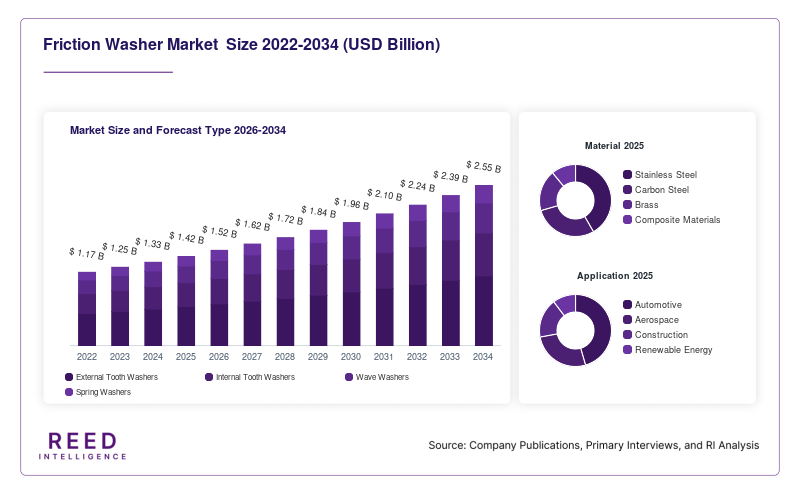
External tooth washers dominated the Friction Washer Market with a 34.2% share in 2025. Their ability to provide strong locking action and prevent loosening made them widely used across industrial and automotive applications.
Wave washers are expected to be the fastest-growing subsegment, with a projected CAGR of 7.9%. Their compact design and ability to absorb shock and vibration make them suitable for space-constrained applications.
By Material
Stainless steel washers accounted for the largest share of 41.8% in 2025, owing to their corrosion resistance and durability. They are widely used in harsh environments such as marine and chemical industries.
Composite materials are projected to grow at the fastest rate, with a CAGR of 8.3%, driven by their lightweight properties and improved performance characteristics.
By Application
Automotive applications dominated the market with a 29.6% share in 2025, supported by high demand for reliable fastening components in vehicles.
The renewable energy segment is expected to grow fastest, with a CAGR of 8.1%, driven by increasing installations of wind and solar systems.
By End-Use Industry
Industrial machinery held the largest share of 33.5% in 2025, reflecting widespread use in manufacturing equipment.
The aerospace sector is anticipated to grow fastest at a CAGR of 7.6%, due to rising demand for lightweight and high-performance components.
Regional Analysis
North America
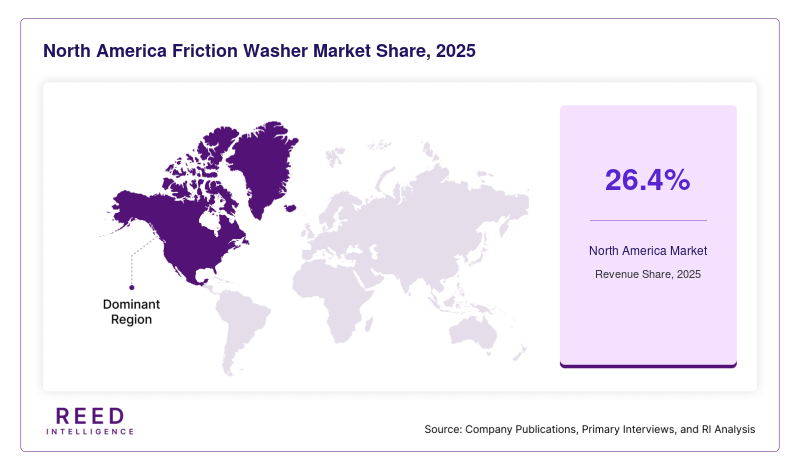
North America accounted for 26.4% of the Friction Washer Market share in 2025 and is expected to grow at a CAGR of 6.2% during 2026–2034. The region’s mature industrial base and strong presence of automotive and aerospace manufacturers contributed to its significant share.
The United States dominated the regional market due to its advanced manufacturing ecosystem and high demand for precision components. The country’s focus on technological innovation and adoption of automated systems has driven the need for high-performance friction washers.
Europe
Europe held 22.1% market share in 2025 and is projected to expand at a CAGR of 6.0% over the forecast period. The region’s emphasis on engineering excellence and stringent quality standards supported steady demand.
Germany emerged as the dominant country, driven by its robust automotive and machinery industries. The country’s commitment to high-quality manufacturing and export-oriented production has sustained demand for reliable fastening components.
Asia Pacific
Asia Pacific captured the largest share of 38.6% in 2025 and is anticipated to grow at a CAGR of 7.5%, making it the fastest-growing region. Rapid industrialization and infrastructure development were key contributors to this growth.
China dominated the region due to its large-scale manufacturing sector and expanding construction activities. The country’s role as a global manufacturing hub has driven consistent demand for friction washers across multiple industries.
Middle East & Africa
The Middle East & Africa accounted for 6.5% of the market share in 2025 and is expected to grow at a CAGR of 5.8%. The region’s growth was supported by investments in oil & gas and infrastructure projects.
Saudi Arabia led the market, driven by large-scale industrial and energy projects. The country’s focus on economic diversification has increased demand for industrial components, including friction washers.
Latin America
Latin America held 6.4% share in 2025 and is projected to grow at a CAGR of 5.9%. Economic development and industrial expansion supported market growth in the region.
Brazil dominated due to its strong manufacturing and construction sectors. The country’s ongoing infrastructure projects and industrial activities have contributed to steady demand for fastening solutions.
Competitive Landscape
The Friction Washer Market is moderately fragmented, with several global and regional players competing on product quality, pricing, and innovation. Leading companies focus on expanding their product portfolios and enhancing manufacturing capabilities.
One prominent market leader is Nord-Lock Group, known for its advanced wedge-locking solutions. The company recently introduced new washer designs aimed at improving performance in high-vibration environments.
Other key players are actively investing in research and development to develop innovative materials and coatings. Strategic partnerships and acquisitions are also common as companies seek to strengthen their market presence and expand into emerging regions.
Key Players List
- Nord-Lock Group
- Schnorr GmbH
- Bossard Group
- ITW Shakeproof Industrial
- MW Components
- Growermetal S.p.A.
- Rotor Clip Company
- Boker’s Inc.
- American Ring & Tool Company
- Disc-Lock International
- Fastenal Company
- MISUMI Group Inc.
- Arconic Corporation
- Stanley Black & Decker
- Precision Brand Products
Recent Developments
- 2025: Nord-Lock Group launched a new line of corrosion-resistant friction washers for marine applications.
- 2024: Bossard Group expanded its manufacturing facility in Asia to meet rising regional demand.
- 2025: MW Components introduced custom-engineered washers for aerospace applications.
- 2024: Schnorr GmbH developed advanced coating technology to enhance washer durability.
- 2025: Fastenal Company strengthened its distribution network across emerging markets.
Friction Washer Market Segments
Type
- External Tooth Washers
- Internal Tooth Washers
- Wave Washers
- Spring Washers
Material
- Stainless Steel
- Carbon Steel
- Brass
- Composite Materials
Application
- Automotive
- Aerospace
- Construction
- Renewable Energy
End-Use Industry
- Industrial Machinery
- Electronics
- Energy & Power
- Marine
By Region
- North America
- Europe
- APAC
- Middle East and Africa
- LATAM