Fried Onion Machine Market Size, Share & Demand Report By Machine Type (Manual Machines, Semi-Automatic Machines, Automatic Fried Onion Machines), By Capacity (Low-Capacity Machines, Medium-Capacity Machines), By Application (Commercial Food Processing, Packaged Snack Production), By End-Use (Food Manufacturing Companies, Quick-Service Restaurants, Commercial Kitchens, Catering Service Providers), By Region & Segment Forecasts, 2026–2034
USD 3950
Market Overview
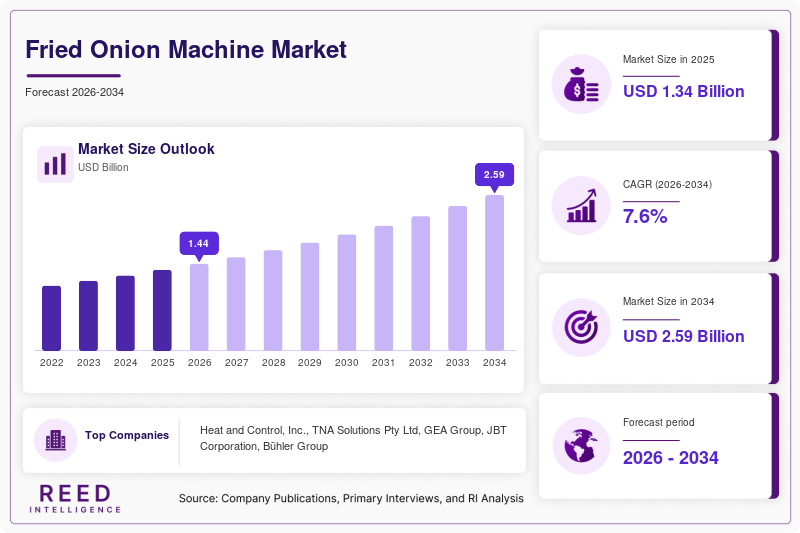
The Fried Onion Machine Market size was valued at USD 1.34 billion in 2026 and is projected to reach USD 2.41 billion by 2034, expanding at a CAGR of 7.6% during the forecast period of 2026–2034. The global Fried Onion Machine Market growth was supported by the increasing global demand for processed food products and the rapid expansion of commercial food processing facilities. Food manufacturers increasingly adopted automated frying and slicing equipment to improve production efficiency, maintain product consistency, and reduce labor dependency. The growing consumption of ready-to-eat snacks, frozen foods, and packaged fried onion products further accelerated demand for advanced fried onion processing machinery across industrial food manufacturing operations.
The rising adoption of automation in food processing significantly contributed to the expansion of the Fried Onion Machine Market. Manufacturers increasingly invested in fully automatic frying systems, temperature-controlled processing technologies, and oil filtration systems to improve operational productivity and reduce food wastage. In addition, the increasing focus on hygienic food production standards and energy-efficient machinery encouraged food processing companies to modernize existing production facilities.
Key Highlights
- Asia Pacific dominated the Fried Onion Machine Market with 41.2% share in 2025, while Middle East & Africa is projected to register the fastest CAGR of 8.4% during 2026–2034.
- By machine type, automatic fried onion machines accounted for the largest market share of 52.7% in 2025, while fully automated continuous frying systems are anticipated to witness the fastest CAGR of 8.9% during the forecast period.
- By capacity, medium-capacity machines remained the leading segment with 44.5% share in 2025, while high-capacity industrial machines are expected to grow at a CAGR of 8.7%.
- By application, commercial food processing held the dominant share of 48.6% in 2025, whereas packaged snack production is forecast to grow at a CAGR of 8.5% through 2034.
- By end-use, food manufacturing companies held the dominant share of 46.3% in 2025, while quick-service restaurants are forecast to grow at a CAGR of 8.2% during the forecast period.
- India Fried Onion Machine Market was valued at USD 138 million in 2024 and reached USD 149 million in 2025.
Market Trends
Increasing Adoption of Fully Automated Food Processing Systems
One of the major trends shaping the Fried Onion Machine Market is the increasing adoption of fully automated food processing systems across industrial manufacturing facilities. Food producers are increasingly investing in automated slicing, frying, and oil filtration technologies to improve operational efficiency and reduce manual intervention. These systems help maintain product consistency, optimize frying temperatures, and reduce production downtime.
Manufacturers are also integrating programmable logic controllers and digital monitoring systems into fried onion processing machinery. The growing preference for automated food production lines is expected to support market expansion during the forecast period.
Rising Demand for Energy-Efficient Frying Technologies
Another notable trend in the Fried Onion Machine Market is the rising demand for energy-efficient frying equipment. Food manufacturers are increasingly focusing on reducing operational costs and minimizing energy consumption during large-scale frying operations. Advanced heating systems, heat recovery technologies, and automated oil management solutions are gaining popularity across commercial processing facilities.
The growing emphasis on sustainable food manufacturing practices is also encouraging adoption of low-energy industrial frying systems. This trend is expected to increase investments in next-generation food processing equipment globally.
Market Drivers
Growing Demand for Processed and Convenience Foods
The increasing consumption of processed and convenience foods worldwide is a major driver of the Fried Onion Machine Market. Rapid urbanization, changing consumer lifestyles, and rising preference for ready-to-cook food products continue to increase demand for fried onion ingredients across restaurants and packaged food manufacturing companies.
Food processing companies are expanding production capacities to meet rising consumer demand for snacks, frozen foods, seasoning products, and instant meal preparations. This expansion continues to support machinery installation activities globally.
Expansion of Commercial Food Processing Infrastructure
The continuous expansion of commercial food processing infrastructure is another important factor driving the Fried Onion Machine Market. Governments and private food manufacturers are increasingly investing in automated food production facilities to improve operational productivity and food safety compliance.
Large-scale processing plants increasingly require advanced frying systems capable of handling high-volume production with consistent product quality. Rising investments in food manufacturing modernization are expected to support long-term market growth.
Market Restraint
High Initial Investment and Maintenance Costs
One major restraint affecting the Fried Onion Machine Market is the high initial investment associated with industrial food processing equipment. Advanced automated frying systems often require significant capital expenditure for installation, customization, and facility integration. Small-scale food manufacturers may face financial limitations in adopting fully automated machinery.
In addition, regular equipment maintenance, oil management, and component replacement increase long-term operational expenses, which may restrict adoption among budget-sensitive businesses.
Market Opportunities
Expansion of Packaged Snack Manufacturing in Emerging Economies
Rapid expansion of packaged snack manufacturing facilities across emerging economies is creating strong opportunities for the Fried Onion Machine Market. Increasing disposable incomes and rising demand for convenience foods are encouraging food companies to increase production capacities in Asia Pacific, Latin America, and Africa.
The growing popularity of fried onion toppings, seasoning mixes, and packaged snack products is expected to support machinery demand during the forecast period.
Development of Smart Food Processing Equipment
Manufacturers are increasingly focusing on smart food processing equipment integrated with IoT-enabled monitoring systems and automated production analytics. These technologies improve machine efficiency, reduce production errors, and optimize energy consumption during frying operations.
The integration of predictive maintenance systems and remote operational monitoring capabili
Segmental Analysis
By Machine Type
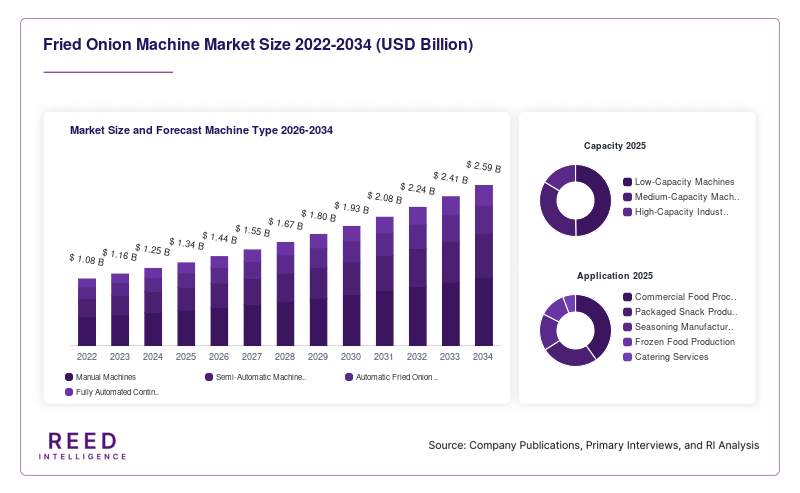
Based on machine type, the Fried Onion Machine Market is segmented into manual machines, semi-automatic machines, automatic fried onion machines, and fully automated continuous frying systems.
Automatic fried onion machines dominated the market with 52.7% share in 2025 due to increasing adoption across medium- and large-scale food processing facilities. Manufacturers preferred these systems because they improve operational efficiency, maintain frying consistency, and reduce labor dependency.
Fully automated continuous frying systems are projected to witness the fastest CAGR of 8.9% during the forecast period. Increasing demand for uninterrupted large-scale food production and advanced oil filtration technologies will support segment growth. The growing integration of digital monitoring systems is expected to accelerate adoption.
By Capacity
Based on capacity, the market is categorized into low-capacity machines, medium-capacity machines, and high-capacity industrial machines.
Medium-capacity machines accounted for the largest market share of 44.5% in 2025 due to widespread utilization among regional food manufacturers and commercial kitchens. These machines offered balanced production efficiency and moderate installation costs, supporting strong market demand.
High-capacity industrial machines are anticipated to grow at the fastest CAGR of 8.7% during 2026–2034. Increasing expansion of industrial snack production and large-scale food manufacturing facilities will support segment growth. Rising demand for bulk production capabilities is expected to increase adoption globally.
By Application
Based on application, the market includes commercial food processing, packaged snack production, seasoning manufacturing, frozen food production, and catering services.
Commercial food processing held the dominant market share of 48.6% in 2025 due to increasing industrial production of fried onions for food ingredient applications. Food manufacturers increasingly utilized advanced frying systems to improve production speed and maintain consistent product quality.
Packaged snack production is expected to register the fastest CAGR of 8.5% during the forecast period. Rising demand for flavored snacks, ready-to-eat foods, and onion-based seasoning products will support segment growth. Expanding snack manufacturing capacities across emerging economies are expected to increase machinery demand.
By End-Use
Based on end-use, the market is segmented into food manufacturing companies, quick-service restaurants, commercial kitchens, and catering service providers.
Food manufacturing companies dominated the market in 2025 with 46.3% share due to high-volume production requirements and increasing adoption of automated food processing systems. Large-scale manufacturers increasingly invested in industrial frying technologies to improve operational efficiency and reduce production costs.
Quick-service restaurants are expected to witness the fastest CAGR of 8.2% during the forecast period. Rising expansion of fast-food chains and increasing demand for standardized food preparation processes will support segment growth. The growing need for consistent food quality is expected to accelerate machinery adoption.
Regional Analysis
Asia Pacific
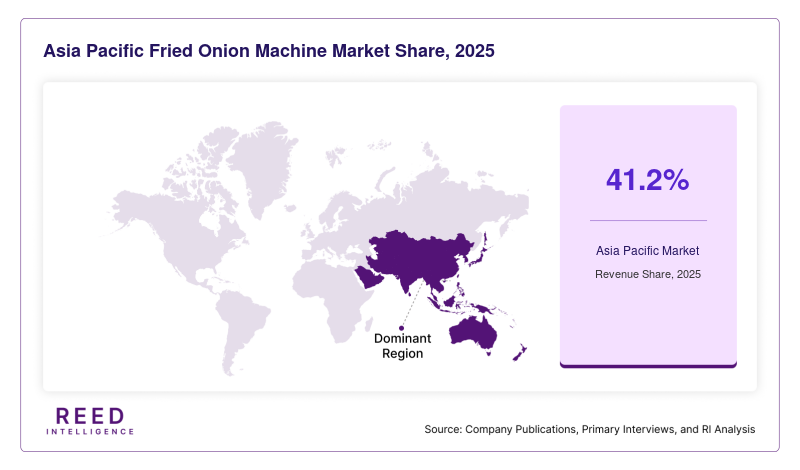
Asia Pacific accounted for 41.2% of the Fried Onion Machine Market share in 2025 and is expected to grow at a CAGR of 8.1% during 2026–2034. The region maintained strong market demand due to rapid expansion of food processing industries and increasing consumption of packaged food products. Commercial food manufacturers increasingly adopted automated frying equipment to improve production efficiency and maintain food quality standards.
India remained the dominant country in the region due to its large food processing sector and rising demand for fried onion ingredients across restaurants and packaged food companies. Increasing investments in food manufacturing infrastructure significantly supported regional market growth.
North America
North America held 24.8% of the global Fried Onion Machine Market share in 2025 and is projected to expand at a CAGR of 7.2% during the forecast period. The region experienced stable demand due to increasing automation in commercial food manufacturing and rising adoption of energy-efficient food processing systems.
The U.S. dominated the regional market owing to the expansion of packaged snack production facilities and increasing investments in industrial food automation technologies. The growing preference for high-capacity continuous frying systems contributed to market expansion.
Europe
Europe represented 18.6% of the global market share in 2025 and is anticipated to grow at a CAGR of 7.1% during 2026–2034. Increasing food safety regulations and strong adoption of automated food processing technologies supported regional growth. Food manufacturers increasingly upgraded production lines to improve energy efficiency and operational consistency.
Germany emerged as the leading country in the region due to advanced food machinery manufacturing capabilities and increasing demand for industrial food processing equipment. The growing use of automated frying technologies further strengthened regional market demand.
Middle East & Africa
The Middle East & Africa accounted for 8.1% of the Fried Onion Machine Market share in 2025 and is forecast to grow at the fastest CAGR of 8.4% through 2034. The region witnessed increasing investments in food manufacturing and hospitality infrastructure. Expanding urban populations and rising demand for processed food products contributed to increasing machinery adoption.
Saudi Arabia led the regional market due to increasing food processing investments and expansion of commercial food production facilities. Growing demand for packaged and frozen food products supported market growth.
Latin America
Latin America captured 7.3% of the global market share in 2025 and is expected to expand at a CAGR of 7.4% during the forecast period. Increasing food industry modernization and rising demand for convenience food products supported regional growth. Food manufacturers increasingly invested in automated frying systems to improve operational productivity.
Brazil remained the dominant country in Latin America owing to growing packaged food manufacturing activities and rising demand for industrial food processing equipment. Expanding quick-service restaurant networks further contributed to regional market development.
Competitive Landscape
The Fried Onion Machine Market remains moderately fragmented with the presence of food processing equipment manufacturers and industrial kitchen machinery suppliers. Market participants are focusing on automation technologies, energy-efficient equipment development, and production capacity expansion to strengthen their competitive position.
Heat and Control, Inc. remained a leading player in the market due to its extensive industrial food processing equipment portfolio and strong global distribution network. The company recently expanded its automated frying system offerings for commercial snack production facilities.
TNA Solutions Pty Ltd continued focusing on integrated food production technologies and automated frying solutions. GEA Group increased investments in energy-efficient food processing equipment development. JBT Corporation strengthened its industrial frying machinery portfolio for packaged food manufacturers. Bühler Group focused on advanced smart processing technologies and automated production systems for industrial food applications.
Key Players List
- Heat and Control, Inc.
- TNA Solutions Pty Ltd
- GEA Group
- JBT Corporation
- Bühler Group
- Kiremko B.V.
- Flo-Mech Ltd.
- FusionTech Integrated, Inc.
- Fabcon Food Systems Ltd.
- Economode Food Equipment
- Food Processing Equipment Company
- Alard Equipment Corporation
- Grace Food Processing & Packaging Machinery
- Zhengzhou Longer Machinery Co., Ltd.
- Gelgoog Food Machinery
Fried Onion Machine Market Segments
Machine Type
- Manual Machines
- Semi-Automatic Machines
- Automatic Fried Onion Machines
- Fully Automated Continuous Frying Systems
Capacity
- Low-Capacity Machines
- Medium-Capacity Machines
- High-Capacity Industrial Machines
Application
- Commercial Food Processing
- Packaged Snack Production
- Seasoning Manufacturing
- Frozen Food Production
- Catering Services
End-Use
- Food Manufacturing Companies
- Quick-Service Restaurants
- Commercial Kitchens
- Catering Service Providers
By Region
- North America
- Europe
- APAC
- Middle East and Africa
- LATAM