Friedreich's Ataxia Drug Market Size, Share Demand Report By Drug Type (Antioxidant Therapies, Gene Therapies, Iron Chelators, Other Drug Types), By Route of Administration (Oral, Injectable, Other Routes), By Therapy Type (Symptomatic Treatment, Disease-Modifying Treatment), By Distribution Channel (Hospital Pharmacies, Retail Pharmacies, Online Pharmacies), By Region & Segment Forecasts, 2026–2034
USD 3950
Market Overview
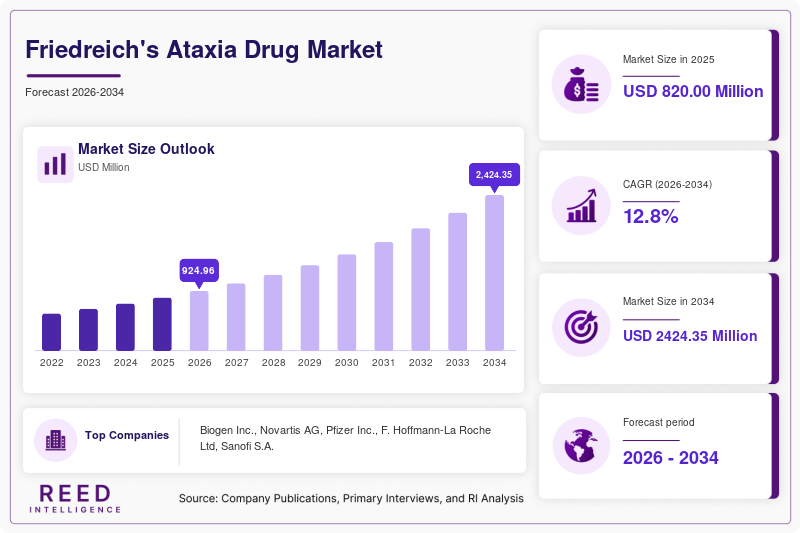
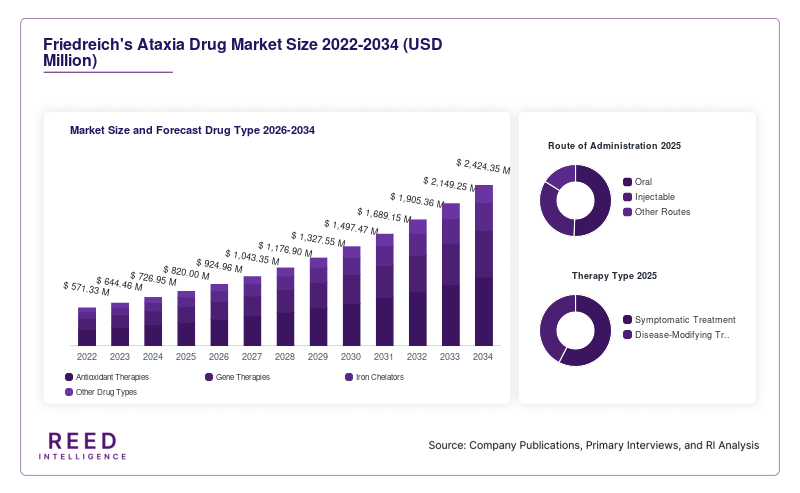
The global Friedreich's Ataxia Drug Market size was valued at approximately USD 820 million in 2026 and is projected to reach around USD 2.15 billion by 2034, expanding at a compound annual growth rate (CAGR) of 12.8% during 2026–2034. The market growth is primarily influenced by increasing awareness of rare neurodegenerative disorders and expanding access to orphan drug designations, which have accelerated research and commercialization efforts.
A major global factor supporting the growth of the Friedreich's Ataxia Drug Market is the advancement in genetic and mitochondrial-targeted therapies. Breakthroughs in gene editing technologies and precision medicine have enabled pharmaceutical companies to develop therapies that directly address the underlying genetic mutation responsible for Friedreich's Ataxia. This has significantly improved treatment outcomes and encouraged investment in clinical pipelines.
Key Highlights:
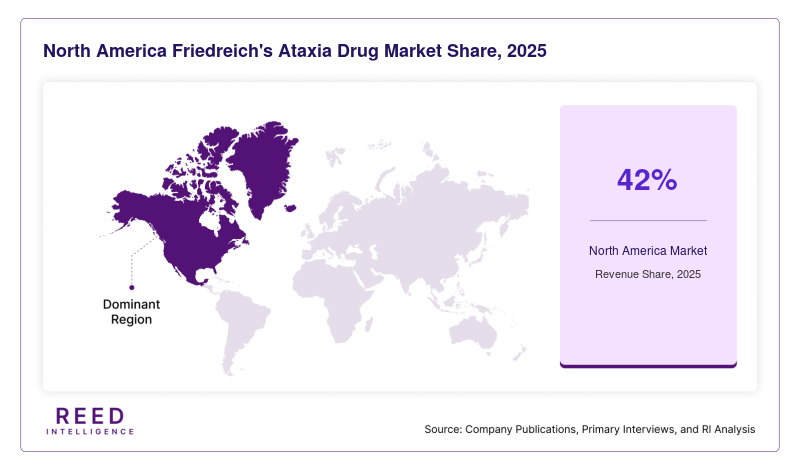
- North America dominated the market with a 42% share in 2025, while Asia Pacific is expected to register the fastest CAGR of 14.6%.
- By drug type, antioxidant therapies led with a 38% share, while gene therapies are projected to grow at a CAGR of 16.2%.
- By distribution channel, hospital pharmacies dominated with 45% share, while online pharmacies are expected to grow at 15.1% CAGR.
- The U.S. market was valued at USD 310 million in 2024 and reached approximately USD 345 million in 2025.
Market Trends
Rising Adoption of Gene and RNA-Based Therapies
The Friedreich's Ataxia Drug Market is witnessing a shift toward gene and RNA-based therapeutic approaches. These therapies target the root genetic cause of the disease, offering the potential for disease modification rather than symptom management. Pharmaceutical companies are increasingly investing in adeno-associated virus (AAV)-based gene delivery systems and RNA interference technologies. This trend is reshaping the treatment paradigm, as traditional drug therapies are gradually complemented or replaced by precision-based solutions. Clinical trials for gene therapies have shown promising results in slowing disease progression, which is encouraging further investment and partnerships in this space.
Expansion of Orphan Drug Pipeline
Another notable trend in the Friedreich's Ataxia Drug Market is the expansion of the orphan drug pipeline. Due to the rarity of the condition, regulatory agencies are offering incentives such as tax credits, reduced clinical trial costs, and extended exclusivity periods. As a result, several mid-sized and emerging biotech firms are entering the market with innovative drug candidates. This trend has led to a diversified pipeline with multiple therapeutic approaches under investigation, including mitochondrial enhancers, iron chelators, and neuroprotective agents. The growing pipeline is expected to intensify competition and accelerate the commercialization of effective treatments over the forecast period.
Market Drivers
Increasing Prevalence and Diagnosis Rates
The rising prevalence and improved diagnosis rates of Friedreich's Ataxia are key drivers of market growth. Advances in genetic testing technologies have enabled earlier and more accurate diagnosis, leading to increased patient identification. Healthcare providers are becoming more aware of rare neurological disorders, which is contributing to better screening practices. As more patients are diagnosed, the demand for effective therapeutic interventions is rising, directly supporting the expansion of the Friedreich's Ataxia Drug Market.
Favorable Regulatory and Funding Environment
The regulatory landscape for rare diseases has become increasingly supportive, significantly boosting the Friedreich's Ataxia Drug Market. Governments and regulatory agencies are offering incentives such as orphan drug designation, priority review, and accelerated approval pathways. These initiatives reduce the time and cost associated with drug development. Additionally, increased funding from public and private organizations for rare disease research is enabling pharmaceutical companies to invest in innovative therapies. This supportive environment is encouraging the development of novel drugs and facilitating their faster entry into the market.
Market Restraint
High Cost of Treatment and Limited Accessibility
One of the major challenges in the Friedreich's Ataxia Drug Market is the high cost associated with treatment, particularly for advanced therapies such as gene-based treatments. These therapies often involve complex manufacturing processes and require specialized infrastructure, leading to high pricing. As a result, affordability becomes a significant concern, especially in developing regions with limited healthcare coverage.
Additionally, limited accessibility to specialized treatment centers and a lack of reimbursement policies in certain regions further restrict market growth. Patients in low- and middle-income countries often face barriers in accessing advanced therapies, which limits the overall adoption of innovative treatments. The combination of high costs and restricted access poses a significant restraint to the widespread expansion of the Friedreich's Ataxia Drug Market.
Market Opportunities
Emerging Markets Expansion
Emerging economies present a significant growth opportunity for the Friedreich's Ataxia Drug Market. Countries in Asia Pacific, Latin America, and the Middle East are witnessing improvements in healthcare infrastructure and increased awareness of rare diseases. Governments in these regions are gradually implementing policies to support rare disease treatment, including funding programs and improved diagnostic capabilities. As pharmaceutical companies expand their presence in these markets, there is substantial potential for increased patient access and market penetration.
Development of Combination Therapies
The development of combination therapies offers a promising opportunity for the Friedreich's Ataxia Drug Market. Combining different therapeutic approaches, such as antioxidants with gene therapies, can enhance treatment efficacy and address multiple aspects of the disease simultaneously. This approach is gaining attention among researchers and pharmaceutical companies, as it may lead to improved clinical outcomes. The growing focus on combination therapies is expected to open new avenues for innovation and create additional revenue streams in the market.
Segmental Analysis
By Drug Type
Antioxidant therapies dominated the Friedreich's Ataxia Drug Market in 2025, accounting for approximately 38% of the market share. These therapies have been widely used due to their ability to reduce oxidative stress, which is a key factor in disease progression. Their established clinical use and relatively lower cost compared to advanced therapies contributed to their dominance.
Gene therapies are expected to be the fastest-growing segment, with a projected CAGR of 16.2% during 2026–2034. The increasing focus on addressing the genetic root cause of the disease is driving the adoption of gene-based treatments. Advances in gene editing technologies and ongoing clinical trials are expected to support the growth of this segment.
By Route of Administration
Oral drugs held the largest share of the Friedreich's Ataxia Drug Market in 2025, accounting for around 46% of the market. Their ease of administration and high patient compliance made them the preferred choice among patients and healthcare providers.
Injectable therapies are expected to grow at the fastest CAGR of 14.8%. The increasing development of biologics and gene therapies, which require injectable delivery, is driving the growth of this segment. Improved delivery technologies are further supporting their adoption.
By Distribution Channel
Hospital pharmacies dominated the market with a 45% share in 2025, as most treatments for Friedreich's Ataxia are administered under medical supervision. The availability of specialized healthcare professionals and infrastructure contributed to this dominance.
Online pharmacies are expected to grow at a CAGR of 15.1%, driven by increasing digitalization and patient preference for convenient access to medications. The expansion of e-commerce platforms in healthcare is supporting this growth.
By Therapy Type
Symptomatic treatment therapies held the largest share of the Friedreich's Ataxia Drug Market in 2025, accounting for 52% of the market. These therapies focus on managing symptoms and improving quality of life, making them widely adopted.
Disease-modifying therapies are expected to grow at a CAGR of 15.7%, driven by advancements in biotechnology and increasing focus on long-term treatment outcomes. The development of therapies targeting the underlying cause of the disease is supporting this segment's growth.
Regional Analysis
North America
North America accounted for approximately 42% of the Friedreich's Ataxia Drug Market share in 2025 and will continue to maintain its dominance, growing at a projected CAGR of 12.2% during 2026–2034. The region's strong healthcare infrastructure and high investment in rare disease research supported its leading position.
The United States emerged as the dominant country due to its advanced biotechnology ecosystem. The presence of major pharmaceutical companies and robust clinical trial activity contributed to the growth of the Friedreich's Ataxia Drug Market. Additionally, patient advocacy groups played a crucial role in raising awareness and supporting early diagnosis.
Europe
Europe held around 28% market share in 2025 and is expected to grow at a CAGR of 11.9% over the forecast period. The region benefited from supportive regulatory policies and increasing focus on rare diseases.
Germany led the regional market due to its strong healthcare system and research institutions. Government initiatives promoting orphan drug development and collaborations between academic institutions and pharmaceutical companies supported the growth of the Friedreich's Ataxia Drug Market.
Asia Pacific
Asia Pacific captured nearly 16% of the market share in 2025 and is projected to grow at the fastest CAGR of 14.6% during 2026–2034. The region is witnessing rapid improvements in healthcare infrastructure and growing awareness of genetic disorders.
China dominated the regional market due to increasing investment in biotechnology and expanding access to advanced diagnostic tools. The government's focus on improving healthcare accessibility and supporting innovation contributed to the growth of the Friedreich's Ataxia Drug Market.
Middle East & Africa
The Middle East & Africa region accounted for approximately 7% of the market share in 2025 and is expected to grow at a CAGR of 10.5%. Growth in this region was driven by gradual improvements in healthcare systems and increasing awareness of rare diseases.
Saudi Arabia led the regional market due to its investments in healthcare infrastructure and initiatives to enhance rare disease diagnosis. Government-led healthcare reforms played a key role in supporting the growth of the Friedreich's Ataxia Drug Market.
Latin America
Latin America held about 7% market share in 2025 and is projected to grow at a CAGR of 11.3% during the forecast period. The region is experiencing increased awareness and improving access to healthcare services.
Brazil dominated the market due to its expanding healthcare system and growing focus on rare disease management. Efforts to improve diagnostic capabilities and patient access to treatment contributed to the growth of the Friedreich's Ataxia Drug Market.
Competitive Landscape
The Friedreich's Ataxia Drug Market is moderately competitive, with several pharmaceutical and biotechnology companies focusing on developing innovative therapies. Key players are investing in research and development to strengthen their product pipelines and expand their market presence.
The market leader is Biogen Inc., which has been actively involved in developing therapies for neurological disorders. The company recently advanced its gene therapy candidate into late-stage clinical trials, reflecting its commitment to innovation in the Friedreich's Ataxia Drug Market.
Other prominent players include Novartis AG, Pfizer Inc., F. Hoffmann-La Roche Ltd, and Sanofi S.A., all of which are focusing on strategic collaborations and pipeline expansion. These companies are leveraging their global presence and research capabilities to gain a competitive edge.
Key Players List
- Biogen Inc.
- Novartis AG
- Pfizer Inc.
- F. Hoffmann-La Roche Ltd
- Sanofi S.A.
- Takeda Pharmaceutical Company Limited
- AstraZeneca plc
- Vertex Pharmaceuticals Incorporated
- Sarepta Therapeutics, Inc.
- Ionis Pharmaceuticals, Inc.
- Reata Pharmaceuticals, Inc.
- PTC Therapeutics, Inc.
- Catalyst Pharmaceuticals, Inc.
- BioMarin Pharmaceutical Inc.
- Ultragenyx Pharmaceutical Inc.
Recent Developments
- Biogen Inc. advanced its Friedreich's Ataxia gene therapy candidate into Phase III trials in 2025.
- Novartis AG expanded its rare disease portfolio with new mitochondrial-targeted therapies.
- Pfizer Inc. initiated collaborations with biotech firms to accelerate RNA-based drug development.
- Roche increased investment in neurodegenerative disease research programs.
- Sanofi S.A. announced strategic partnerships to enhance its orphan drug pipeline.
Friedreich's Ataxia Drug Market Segments
Drug Type
- Antioxidant Therapies
- Gene Therapies
- Iron Chelators
- Other Drug Types
Route of Administration
- Oral
- Injectable
- Other Routes
Therapy Type
- Symptomatic Treatment
- Disease-Modifying Treatment
Distribution Channel
- Hospital Pharmacies
- Retail Pharmacies
- Online Pharmacies
By Region
- North America
- Europe
- APAC
- Middle East and Africa
- LATAM