Frozen Novelty Market Size, Share & Trends Analysis Report By Product Type (Ice Cream Bars & Sticks, Ice Cream Cones, Ice Cream Sandwiches, Ice Pops & Water Ices, Mochi & Other Novelty Formats), By Product Positioning (Mainstream Indulgent, Premium & Loaded, Better-for-You & High-Protein, Plant-Based & Free-From), By Distribution Channel (Supermarkets & Hypermarkets, Convenience Stores & Gas Stations, Foodservice & Out-of-Home, E-commerce & Specialty Retail) and By Region (North America, Europe,
USD 3950
Frozen Novelty Market Size
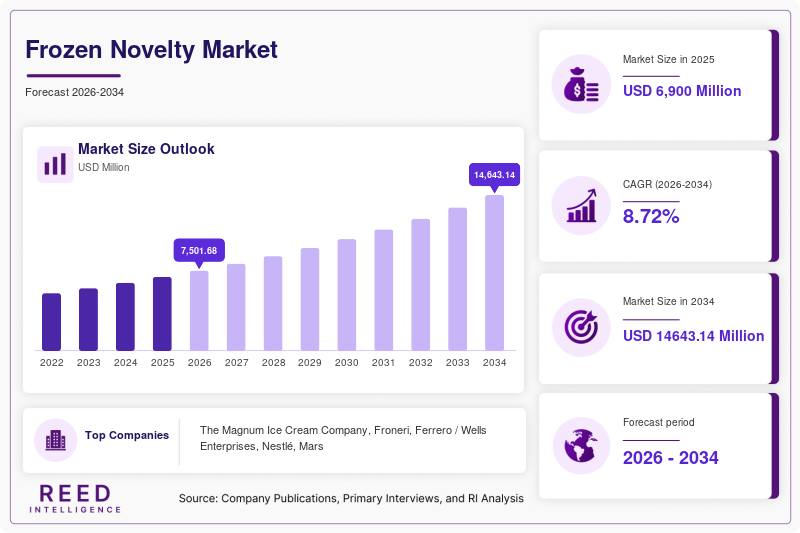
The global frozen novelty market is valued at USD 6,900 Million in 2025 and USD 7,501.68 Million in 2026. The market is projected to reach USD 14643.14 Million by 2034, registering an 8.72% CAGR during the forecast period.
The frozen novelty market comprises separately packaged single-serving frozen desserts such as ice cream sandwiches, fudge sticks, juice bars and other portable frozen treats. The International Dairy Foods Association distinguishes novelties from conventional packaged ice cream by their single-serving, individually packaged format, which can contain dairy or non-dairy ingredients.
The category has become an important part of the frozen dessert aisle because it combines portion control, convenience, portability and indulgence. Circana data reported by Dairy Foods show that U.S. frozen novelty dollar sales increased 3% year over year to approximately USD 9.2 Billion for the 52 weeks ending December 28, 2025, while the narrower frozen-novelties subcategory increased 3.7% to approximately USD 8.6 Billion. Unit growth was comparatively modest, reinforcing the importance of pricing, premiumization and mix rather than volume alone.
Within the U.S. market, product innovation is increasingly shaping competitive performance. Yasso and JonnyPops recorded strong dollar and unit growth during the same Circana period, demonstrating that better-for-you positioning, snackability and differentiated formats can outperform the broader category.
Frozen Novelty Market Drivers
Convenience and portion-controlled snacking are reinforcing individually packaged frozen desserts
The fundamental attraction of frozen novelties is convenience. Individually packaged bars, sticks, cones and sandwiches can be consumed without utensils, provide a pre-portioned serving and work across at-home, impulse and on-the-go occasions.
IDFA defines novelties around this individually packaged, single-serving format, while earlier industry research found that consumers viewed convenience and smaller portions as important reasons for novelty-format growth.
This structure also supports multiple price points. Manufacturers can offer standard bars for mass retail, premium coated sticks for indulgent occasions and mini formats for consumers seeking smaller portions.
Premiumization and differentiated textures are increasing value per serving
Frozen novelty manufacturers are increasingly using coatings, fillings, inclusions, layered centers, crunchy toppings and hybrid textures to make single-serve products more distinctive.
Magnum's 2026 Signature Pistachio and Signature Peach launches combine multiple layers, flavored centers, inclusions and coated shells. Froneri's Biscoff portfolio similarly adds biscuit pieces and a Biscoff-derived coating to an ice cream stick.
This strategy allows brands to compete on sensory experience rather than product format alone and supports premium price positioning even when physical unit volumes grow more slowly.
Consumers are responding to better-for-you formats without abandoning indulgence
Frozen novelty innovation increasingly balances indulgence with protein, lower sugar, plant-based ingredients or reduced portion size.
Protein Pints' Protein Pops provide an example of this transition, combining a conventional chocolate-coated frozen bar with 10 grams of complete protein and reduced-sugar positioning. The product debuted through Sprouts Farmers Market and subsequent grocery distribution.
At the premium end, The Magnum Ice Cream Company said Yasso continued to record double-digit growth in the first half of 2026, with the brand expanding from sticks into pints while retaining its high-protein, lower-calorie positioning.
This supports a wider market transition toward permissible indulgence, where shoppers do not necessarily eliminate treats but increasingly seek a product attribute that justifies the occasion.
Frozen Novelty Market Restraints
Ingredient, packaging and cold-chain costs create persistent margin pressure
Frozen novelties require continuous cold-chain handling from manufacturing through distribution and retail. Product complexity can also increase the cost of coatings, inclusions, premium dairy ingredients, plant-based proteins, specialty sweeteners and packaging.
The USDA has documented long-term changes in U.S. frozen-dairy production and notes that production volumes declined from 2000 to 2024, while category mix continued to shift. The data illustrate the mature nature of the underlying frozen-dessert category and the importance of managing costs and mix efficiently.
Category demand is highly seasonal and discretionary
Frozen novelties experience strong seasonal swings, especially in markets where warm-weather consumption dominates. USDA research shows that ice cream and other milk-based desserts are purchased more heavily in warmer months.
Although brands are increasingly marketing frozen treats as year-round snacks, seasonality still affects production planning, freezer utilization, promotion timing and inventory management.
Frozen Novelty Market Opportunities
Novelty formats linked to confectionery, bakery and viral food trends can create rapid product adoption
Collaborations allow frozen-dessert manufacturers to transfer brand recognition from adjacent food categories directly into the freezer.
Wells and Ferrero's Nutella Ice Cream introduced both cones and packaged ice cream, while Froneri's Biscoff portfolio transfers the recognizable biscuit flavor, texture and branding into a frozen stick format.
This creates opportunities for co-branded products involving chocolate, cookies, candy, beverages, bakery brands and culturally viral flavors.
Protein, reduced-sugar, plant-based and functional novelties can expand consumption occasions
The better-for-you segment can attract consumers who want indulgence with a nutritional benefit or dietary compatibility.
Protein Pints' Protein Pops demonstrate a format specifically designed around protein and lower sugar, while GoodPop's 2026 launches emphasize organic fruit ingredients, coconut cream and cleaner-label positioning.
These products can broaden the consumer base without abandoning the convenience advantages of the traditional stick, pop or sandwich format.
Emerging frozen-snack formats such as mochi and mini products can increase trial and frequency
Mochi, mini bars, bite-sized products and individually portioned premium formats give manufacturers ways to combine novelty, texture and portion control.
Morinaga's acquisition of My/Mochi in 2026 demonstrates the strategic importance of this segment. Morinaga identified My/Mochi's U.S. manufacturing, major-retailer distribution and premium mochi positioning as complementary to its existing frozen-confectionery capabilities.
The opportunity extends to mixed-format variety packs, mini indulgences and culturally inspired frozen snacks.
Product Type Analysis
Ice Cream Bars & Sticks remain the dominant product format because they combine portability, portion control and strong premiumization potential
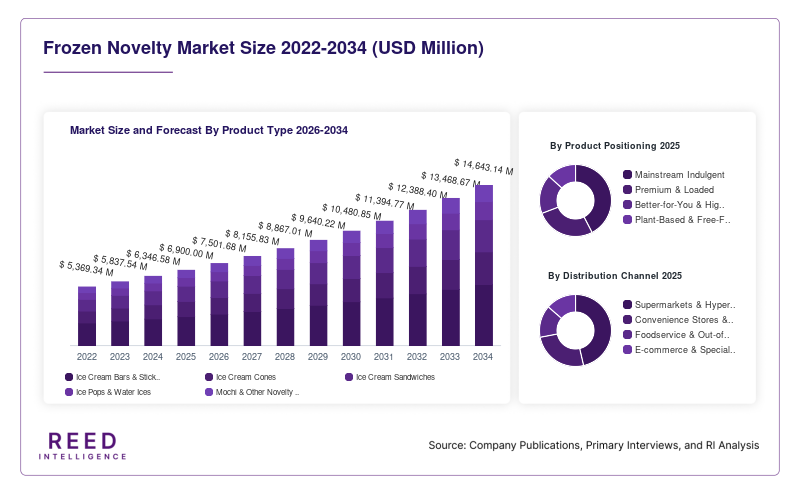
The Ice Cream Bars & Sticks segment accounts for 37% of the global market in 2026 and is projected to register an 8.20% CAGR.
Stick formats remain highly compatible with impulse consumption and support a wide range of product architectures, including chocolate coatings, layered centers, inclusions, fruit preparations and premium toppings. Industry research presented through IDFA identified stick formats as the largest novelty-format share in the U.S. in 2022, while current launches from Magnum, Froneri, Protein Pints and other brands continue to center on stick-based products.
Mochi & Other Novelty Formats are the fastest-growing major product category as texture and portion innovation accelerates
The Mochi & Other Novelty Formats segment accounts for 11% of the global market in 2026 and is projected to register an 11.80% CAGR, making it the fastest-growing major product category.
Mochi adds a chewy outer layer and distinctive eating experience to the frozen-dessert format. Morinaga's 2026 acquisition of My/Mochi reflects the strategic interest in this category, while My/Mochi had approximately USD 80 Million in U.S. sales for the 52 weeks ending January 25, 2026, according to the data cited in Morinaga's acquisition announcement.
Product Positioning Analysis
Mainstream Indulgent products remain the dominant positioning because familiarity and affordable enjoyment sustain the largest consumer base
The Mainstream Indulgent segment accounts for 45% of the global market in 2026 and is projected to register a 7.80% CAGR.
Mainstream products remain centered on familiar flavors and formats, including vanilla, chocolate, cookies and cream, strawberry and caramel. IDFA's 2026 survey confirms the continued strength of traditional flavors while also showing consumers' willingness to shift between familiar favorites.
Better-for-You & High-Protein products are the fastest-growing positioning category
The Better-for-You & High-Protein segment accounts for 15% of the global market in 2026 and is projected to register an 11.60% CAGR, making it the fastest-growing positioning category.
The segment combines familiar indulgent formats with protein, reduced sugar, lower-calorie or portion-controlled benefits. Protein Pints' 2026 Protein Pops provide a direct example, while Yasso's double-digit first-half performance shows that high-protein frozen products can extend beyond niche health positioning.
Distribution Channel Analysis
Supermarkets & Hypermarkets remain the dominant distribution channel because frozen novelties benefit from broad freezer assortment and household grocery traffic
The Supermarkets & Hypermarkets segment accounts for 42% of the global market in 2026 and is projected to register a 7.90% CAGR.
Grocery retailers provide broad freezer capacity, national branded distribution, multipacks and promotional merchandising. Wells' 2026 portfolio includes extensive multi-pack, cone, sandwich and bar offerings distributed across grocery and foodservice environments.
Convenience Stores & Gas Stations are the fastest-growing major distribution channel as impulse occasions expand
The Convenience Stores & Gas Stations segment accounts for 21% of the global market in 2026 and is projected to register a 10.70% CAGR, making it the fastest-growing major distribution channel.
Convenience locations align closely with the single-serve, portable nature of frozen novelties, particularly bars, sticks, cones and pops.
Magnum's own 2026 U.K. commercialization focuses on impulse packs alongside multipacks, while industry data continue to identify stick and portable formats as major novelty drivers.
Foodservice & Out-of-Home sales remain important for impulse and experiential consumption
The segment is projected to register an 8.10% CAGR.
Foodservice operators use cones, bars, cups, sandwiches and branded frozen desserts to create incremental dessert occasions. Wells describes its foodservice business as a major supplier of ice cream and frozen novelties across quick-service restaurants, full-service restaurants, healthcare, education and recreation.
Frozen Novelty Market Regional Analysis
North America Frozen Novelty Market
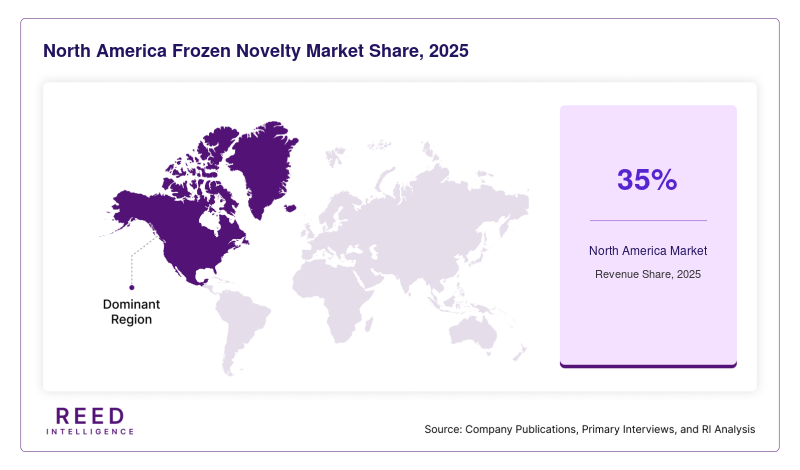
North America remains the dominant regional market because of its large frozen-dessert base, extensive retail freezer infrastructure, mature novelty category and concentration of major manufacturers and brands.
The North America region accounts for 35% of the global market in 2026 and is projected to register a 7.90% CAGR.
The U.S. is particularly important. Circana data reported by Dairy Foods place the U.S. frozen-novelties subcategory at approximately USD 8.6 Billion in 2025, while IDFA's 2026 survey shows that 97% of U.S. adults like or love ice cream.
The region also has a large innovation pipeline spanning premium sticks, protein products, mochi, sandwich formats and branded collaborations. Morinaga's acquisition of My/Mochi and Wells/Ferrero's Nutella Ice Cream launch illustrate ongoing investment in differentiated frozen-snack formats.
APAC Frozen Novelty Market
APAC is the fastest-growing regional market as urbanization, modern grocery, premium snacking, frozen-food penetration and novel flavor adoption continue expanding.
The APAC region accounts for 28% of the global market in 2026 and is projected to register a 10.80% CAGR, making it the fastest-growing regional market.
The region has strong potential for format innovation, particularly around mochi, matcha, tea, fruit, tropical flavors and locally adapted premium products. Häagen-Dazs Japan's 2026 product calendar includes Green Tea, seasonal fruit, pistachio, tropical and other regionally distinctive formats, showing the importance of localized innovation.
India is also becoming strategically important. The Magnum Ice Cream Company completed the acquisition of 61.9% of Kwality Wall's India in March 2026 and described India as one of its fastest-growing, under-penetrated ice cream markets, combining global brands with local manufacturing and distribution capabilities.
Europe Frozen Novelty Market
Europe is projected to register an 8.20% CAGR, supported by mature ice cream consumption, strong branded-manufacturer presence, premiumization and extensive convenience and impulse channels.
The region is also an important center for premium novelty innovation. Magnum's Signature Pistachio and Signature Peach launches in the U.K. combine multiple textures, premium inclusions and new flavor architectures, while Froneri's Biscoff partnership extends premium branded novelty formats.
The separation of The Magnum Ice Cream Company from Unilever in December 2025 also created a standalone global ice-cream company with a large branded portfolio and renewed focus on category-specific growth.
Middle East and Africa Frozen Novelty Market
The Middle East and Africa market is projected to register a 9.30% CAGR, supported by youthful populations, hot climates, urban retail expansion, tourism and strong demand for indulgent cold foods.
The region is particularly suitable for single-serve formats because temperature and outdoor consumption patterns support impulse purchasing.
Premium and global-brand penetration is expanding alongside locally adapted flavors and halal-compatible formulations.
LATAM Frozen Novelty Market
LATAM is projected to register an 8.70% CAGR, supported by warm climates, strong impulse-consumption patterns, expanding modern retail and increasing premiumization.
Brazil and Mexico represent significant markets for branded frozen desserts, while convenience stores, supermarkets and foodservice channels provide broad routes to market.
Frozen Novelty Market Competitive Landscape
The Magnum Ice Cream Company is one of the largest global participants in the category following its December 2025 demerger from Unilever. Its portfolio includes Magnum, Ben & Jerry's, Cornetto, Heartbrand brands and regional labels such as Yasso. During the first half of 2026, the company reported 4.7% organic sales growth, with all four leading brands growing and Yasso continuing to grow at a double-digit rate.
Froneri is a major global ice cream manufacturer operating through licensed and owned brands and private-label capabilities. Its 2026 Biscoff portfolio demonstrates a strategy of using recognized confectionery brands to create higher-value frozen formats, including indulgent sticks and other branded products.
Wells Enterprises, now part of Ferrero's broader portfolio, has a significant North American frozen-novelty presence through Blue Bunny, Blue Ribbon Classics, Bomb Pop and other brands. Ferrero's 2026 Nutella Ice Cream launch with Wells adds a globally recognized confectionery brand to the packaged frozen category.
Key Market Players
- The Magnum Ice Cream Company
- Froneri
- Ferrero / Wells Enterprises
- Nestlé
- Mars
- Morinaga & Co.
- General Mills
- Hudsonville Ice Cream
- Blue Bell Creameries
- J&J Snack Foods
- Yasso
- GoodPop
- Protein Pints
- My/Mochi Ice Cream
- Turkey Hill Dairy
Recent Developments
September 2026 – The Magnum Ice Cream Company emphasized India as a major strategic growth market and discussed using cultural occasions such as Diwali to build ice-cream consumption. CEO Peter ter Kulve described India, China and the U.S. as important markets undergoing changes in consumer behavior and highlighted opportunities to make ice cream more relevant to festive occasions.
July 2026 – GoodPop introduced three new diner-inspired frozen novelty pops. The launch added Peach 'n Cream and Berries 'n Cream products and brought back its Fudge n' Vanilla French Fry Pop in a dairy-ice-cream formulation. The products are positioned around nostalgia, recognizable flavor combinations and ingredient-conscious frozen snacking.
Frozen Novelty Market Segments
By Product Type
- Ice Cream Bars & Sticks
- Ice Cream Cones
- Ice Cream Sandwiches
- Ice Pops & Water Ices
- Mochi & Other Novelty Formats
By Product Positioning
- Mainstream Indulgent
- Premium & Loaded
- Better-for-You & High-Protein
- Plant-Based & Free-From
By Distribution Channel
- Supermarkets & Hypermarkets
- Convenience Stores & Gas Stations
- Foodservice & Out-of-Home
- E-commerce & Specialty Retail
By Region
- North America
- Europe
- APAC
- Middle East and Africa
- LATAM