Fruit Jam, Jelly And Preserves Market Size, Share & Demand Report By Product Type (Fruit Jam, Fruit Jelly, Fruit Preserves, Organic Fruit Spreads), By Distribution Channel (Supermarkets & Hypermarkets, Convenience Stores, Online Retail, Specialty Stores, Direct-to-Consumer Channels), By End Use (Household Consumption, Food Service Industry, Bakery & Confectionery, Industrial Food Processing), By Region & Segment Forecasts, 2026–2034
USD 3950
Market Overview
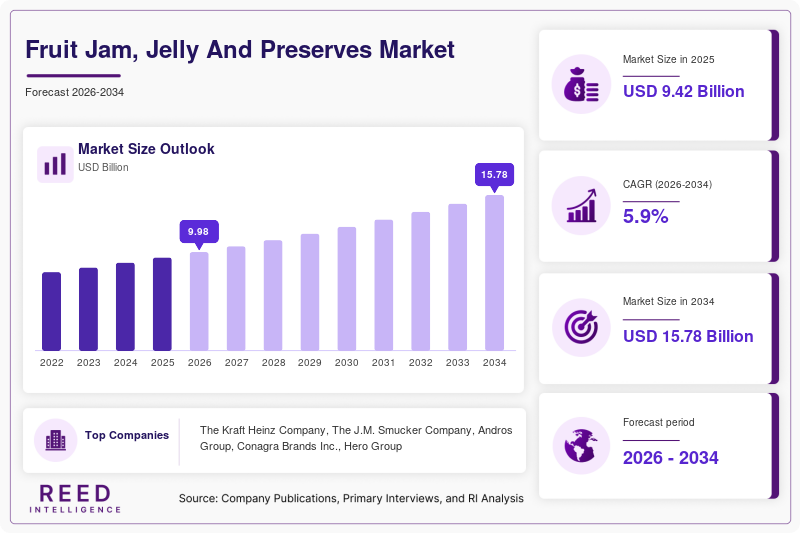
The global Fruit Jam, Jelly And Preserves Market size is valued at approximately USD 9.42 billion in 2026 and is projected to reach around USD 14.86 billion by 2034, expanding at a CAGR of 5.9% during 2026–2034. The market growth is driven by increasing demand for convenient breakfast spreads, rising consumption of processed food products, and continuous product innovation in reduced-sugar and organic fruit-based spreads. Expanding retail distribution networks and growing urbanization across emerging economies further support steady market expansion over the forecast period.
One of the primary global factors supporting market growth is the increasing consumer shift toward clean-label and natural ingredient-based food products. Health-conscious consumers are increasingly preferring fruit jams, jellies, and preserves made with real fruit content, minimal artificial additives, and natural sweeteners. This trend is encouraging manufacturers to invest in organic sourcing, sustainable production processes, and transparent labeling practices. Additionally, advancements in food preservation technologies are improving shelf life and maintaining nutritional value, which is strengthening global product acceptance.
Key Highlights
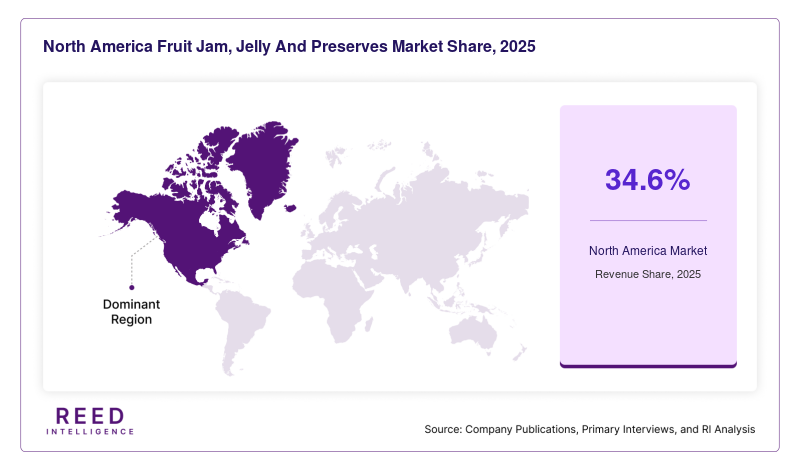
- North America dominated the market with a 34.6% share in 2025.
- Asia Pacific is expected to grow at the fastest CAGR of 10.8% during 2026–2034.
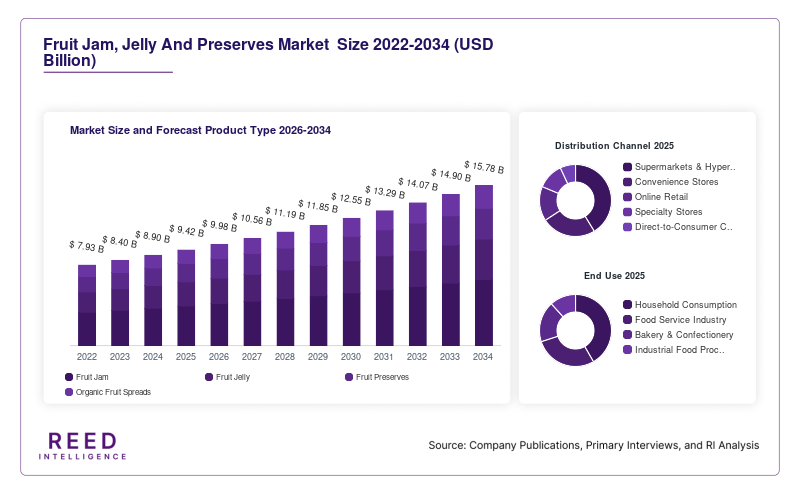
- By product type, fruit jams accounted for the largest share of 42.1%, while fruit preserves are projected to grow at a CAGR of 9.6%.
- By distribution channel, supermarkets and hypermarkets led with a 48.3% share, whereas online retail is expected to expand at a CAGR of 11.5%.
- The United States remained the dominant country, with market values of USD 1.62 billion in 2024 and USD 1.74 billion in 2025.
Market Trends
Rising Demand for Low-Sugar and Sugar-Free Fruit Spreads
The Fruit Jam, Jelly And Preserves Market is witnessing a notable shift toward low-sugar and sugar-free formulations as consumers become more conscious of calorie intake and metabolic health. Manufacturers are increasingly using alternative sweeteners such as stevia, erythritol, and monk fruit extracts to cater to diabetic and health-focused consumers. This shift is also influenced by government regulations promoting reduced sugar consumption in packaged foods. Product labeling transparency and nutritional profiling are becoming essential, especially in developed regions. As a result, brands are reformulating traditional recipes while maintaining taste consistency to retain customer loyalty.
Expansion of Premium and Artisanal Product Lines
Another significant trend shaping the market is the growing demand for premium and artisanal fruit spreads made from exotic fruits, single-origin ingredients, and small-batch production techniques. Consumers are showing interest in gourmet breakfast products that offer unique flavors such as mixed berry blends, tropical fruit combinations, and organic handmade preserves. This trend is particularly strong in urban markets, where disposable income levels are higher and culinary experimentation is more common. Premium packaging, glass jars, and sustainable materials are also enhancing product appeal and supporting brand differentiation in a competitive marketplace.
Market Drivers
Growing Consumption of Convenience-Based Breakfast Products
The increasing preference for convenient breakfast solutions is a key driver of the Fruit Jam, Jelly And Preserves Market. Busy lifestyles, especially in urban areas, have led consumers to adopt ready-to-eat spreads that can be quickly paired with bread, toast, or bakery items. Fruit jams and jellies provide an affordable and flavorful option, making them a staple in household consumption. Additionally, the rising popularity of Western-style breakfast habits in emerging economies is expanding demand. Food service outlets and quick-service restaurants are also integrating fruit spreads into their menus, further supporting market growth.
Rising Health Awareness and Functional Food Integration
Another important driver is the growing awareness of functional foods that offer nutritional benefits beyond basic sustenance. Fruit jams and preserves made from antioxidant-rich fruits such as blueberries, strawberries, and raspberries are increasingly marketed as health-supportive products. Consumers are seeking spreads enriched with vitamins, fiber, and natural fruit extracts. This has encouraged manufacturers to invest in fortification techniques and clean-label formulations. The inclusion of superfruits and organic ingredients is also enhancing product positioning in health-focused retail categories, driving consistent demand across both developed and developing regions.
Market Restraint
Fluctuating Raw Material Prices and Supply Chain Constraints
The Fruit Jam, Jelly And Preserves Market faces challenges due to fluctuating prices of raw fruits and seasonal supply limitations. Fruit production is highly dependent on climatic conditions, agricultural yield variability, and regional farming practices. Adverse weather events such as droughts or floods can significantly impact fruit availability, leading to increased production costs. Additionally, global supply chain disruptions can affect transportation and storage efficiency, further influencing pricing stability. These factors create uncertainty for manufacturers, especially those relying on imported fruit concentrates and seasonal produce, thereby affecting overall profitability and pricing strategies.
Market Opportunities
Increasing Demand for Organic and Clean-Label Products
A major opportunity in the Fruit Jam, Jelly And Preserves Market lies in the rising consumer preference for organic and clean-label products. Consumers are increasingly scrutinizing ingredient lists and seeking products free from artificial preservatives, colors, and synthetic additives. This has opened significant growth potential for organic-certified fruit spreads made with sustainably sourced fruits. Retailers are expanding organic product sections, while brands are investing in certification and traceability systems. The growing penetration of organic food culture in emerging economies is expected to further accelerate demand over the forecast period.
Growth of E-Commerce and Direct-to-Consumer Channels
The expansion of e-commerce platforms and direct-to-consumer sales channels presents another strong opportunity for market growth. Online grocery shopping has become more mainstream, allowing consumers to access a wider variety of fruit jams, jellies, and preserves. Digital platforms enable niche and artisanal brands to reach global audiences without heavy retail investments. Subscription-based models and personalized product offerings are also gaining traction. Additionally, social media marketing and influencer-driven food trends are helping brands increase visibility and customer engagement, particularly among younger demographics.
Segmental Analysis
Product Type Segment
Fruit jams held the dominant share of approximately 42.1% in 2025, driven by their widespread household use and affordability. They remain a staple breakfast product across both developed and emerging economies, supported by long shelf life and easy availability in retail channels. Their versatility in bakery and dessert applications further strengthens demand across food service industries.
Fruit preserves are emerging as the fastest-growing subsegment with a CAGR of around 9.6%, supported by rising demand for premium and minimally processed fruit products. Consumers are increasingly seeking fruit pieces with higher nutritional retention, which is boosting the popularity of preserves made with natural processing methods and reduced sugar content.
Distribution Channel Segment
Supermarkets and hypermarkets accounted for 48.3% share in 2025, driven by strong product visibility, promotional offers, and wide product assortments. These outlets remain the primary purchasing destination for packaged food products, including jams and jellies, especially in urban regions.
Online retail is the fastest-growing channel with a CAGR of approximately 11.5%, supported by increasing digital adoption and convenience shopping trends. E-commerce platforms allow access to niche brands, organic variants, and global product ranges, expanding consumer choice and market penetration.
End-Use Segment
Household consumption dominated the market with a 56.7% share in 2025, reflecting consistent use of fruit spreads in daily breakfast routines. The affordability and familiarity of jams and jellies make them a household staple across diverse income groups.
Food service applications are the fastest-growing subsegment with a CAGR of 8.8%, driven by rising café culture, bakery expansion, and hospitality sector growth. Restaurants and hotels increasingly use fruit spreads in desserts, pastries, and breakfast menus, supporting commercial demand expansion.
Regional Analysis
North America
North America accounted for nearly 34.6% of the global Fruit Jam, Jelly And Preserves Market share in 2025 and is expected to register a CAGR of 5.1% during 2026–2034. Strong consumer preference for ready-to-eat breakfast products continues to support regional demand. The market benefits from established retail infrastructure, high packaged food consumption, and growing interest in organic fruit spreads. Product innovation focused on reduced sugar and natural ingredients is further strengthening market expansion. Rising adoption of premium preserves among urban households also contributes to steady revenue growth. Foodservice demand from cafés and bakery chains remains significant across the region. Increased investment in sustainable packaging solutions is influencing purchasing behavior. Manufacturers are also introducing seasonal fruit variants to improve customer engagement. Growth in private-label fruit spread products across supermarkets is supporting competitive pricing strategies.
The United States remains the dominant country within North America due to strong consumption of breakfast spreads and advanced food processing capabilities. One major growth factor is the increasing demand for clean-label and organic food products among health-conscious consumers. Retailers are expanding shelf space for natural and preservative-free jams and jellies. Canada also shows rising demand for locally sourced fruit preserves and premium artisanal brands. Consumer interest in convenient and nutritious breakfast options continues to expand market penetration. The region benefits from strong cold-chain logistics and efficient supply networks. Online grocery shopping is further increasing accessibility to premium fruit spread products. Manufacturers are collaborating with fruit growers to ensure consistent raw material quality. Expansion of gourmet food stores and specialty retailers is also supporting premium product sales.
Europe
Europe represented approximately 28.9% of the global Fruit Jam, Jelly And Preserves Market in 2025 and is projected to grow at a CAGR of 5.3% through 2034. The region has a strong tradition of fruit preserve consumption, particularly in breakfast and bakery applications. Demand for organic and artisanal jams is increasing steadily across Western Europe. Consumers are showing preference for high-fruit-content products with natural ingredients. Growth in sustainable food production practices is also influencing purchasing decisions. Premium glass packaging and environmentally friendly labeling are becoming important competitive factors. Increasing demand from cafés, hotels, and bakeries continues to support commercial consumption. Innovation in exotic fruit combinations and gourmet flavors is expanding consumer interest. Rising awareness regarding sugar reduction is encouraging manufacturers to introduce healthier formulations.
Germany dominates the European market due to its advanced food processing sector and strong retail distribution network. A major growth factor is the increasing popularity of premium and organic breakfast products among urban consumers. France and the United Kingdom also contribute significantly to regional demand, supported by strong bakery industries and changing breakfast habits. Consumers are increasingly preferring locally sourced fruits and sustainable production methods. Regulatory support for clean-label food manufacturing is encouraging innovation across the region. Supermarkets continue to dominate sales, although online grocery channels are growing steadily. Demand for fruit spreads with functional ingredients such as chia seeds and antioxidants is rising. Seasonal fruit preserve collections are gaining popularity among premium consumers. Manufacturers are investing in eco-friendly packaging technologies to strengthen brand positioning.
Asia Pacific
Asia Pacific held around 22.4% of the Fruit Jam, Jelly And Preserves Market share in 2025 and is expected to witness the fastest CAGR of 10.8% during the forecast period. Rapid urbanization and changing food consumption patterns are major contributors to regional growth. Increasing influence of Western breakfast culture is driving demand for fruit-based spreads across developing economies. Rising disposable income levels are enabling consumers to purchase premium packaged food products. Expansion of modern retail chains and online grocery platforms is improving product accessibility. Foodservice industries including cafés and bakeries are increasingly using fruit preserves in desserts and bakery fillings. Manufacturers are introducing tropical fruit flavors tailored to regional taste preferences. Product awareness campaigns and digital marketing are also strengthening market visibility. Growing youth populations and convenience-oriented lifestyles continue to support long-term growth.
China remains the dominant country in the Asia Pacific market due to expanding urban populations and rising packaged food consumption. One major growth factor is the rapid development of café chains and bakery outlets across metropolitan cities. India is also emerging as a high-potential market because of increasing retail modernization and growing preference for quick breakfast solutions. Japan and South Korea are witnessing rising demand for premium fruit preserves with unique flavor combinations. Consumers are increasingly interested in imported and organic fruit spread products. Expansion of e-commerce grocery platforms is improving market reach in smaller cities. Local manufacturers are investing in advanced processing technologies to enhance shelf life and product quality. Rising tourism and hospitality industries are contributing to commercial demand growth. Government support for food processing industries is also encouraging market expansion.
Middle East & Africa
The Middle East & Africa region accounted for nearly 7.1% of the global Fruit Jam, Jelly And Preserves Market in 2025 and is forecast to grow at a CAGR of 6.2% through 2034. Increasing urbanization and changing dietary patterns are supporting demand for packaged breakfast products across the region. Expansion of hospitality and tourism sectors is creating new opportunities for commercial fruit spread consumption. Growing imports of premium food products are also influencing market development. Supermarkets and hypermarkets are increasing availability of international fruit jam brands. Rising awareness regarding convenience foods is driving household consumption in urban centers. Demand for halal-certified and natural ingredient products is also increasing steadily. Manufacturers are focusing on affordable packaging formats to improve accessibility. Growth in organized retail infrastructure continues to strengthen product distribution networks.
Saudi Arabia dominates the regional market due to strong demand from hotels, restaurants, and urban households. One major growth factor is the increasing preference for Western-style breakfast habits among younger consumers. The United Arab Emirates also represents a significant market because of its large expatriate population and premium retail sector. South Africa is witnessing growing demand for locally produced fruit preserves and affordable packaged spreads. Rising investment in food processing industries is improving domestic production capabilities. Consumers are increasingly seeking healthier products with reduced sugar content. Expansion of café chains and quick-service restaurants is supporting foodservice demand. Importers are introducing international gourmet preserve brands to attract premium consumers. Digital retail channels are also helping brands expand customer reach across metropolitan areas.
Latin America
Latin America captured approximately 6.6% share of the Fruit Jam, Jelly And Preserves Market in 2025 and is expected to grow at a CAGR of 6.5% during 2026–2034. The region benefits from abundant fruit production and expanding processed food industries. Increasing urbanization and rising middle-class populations are driving consumption of packaged breakfast products. Consumers are gradually shifting toward convenient and ready-to-eat food items. Retail modernization and supermarket expansion are improving product visibility across urban markets. Local fruit varieties are widely used in jams and preserves, creating strong regional flavor preferences. Manufacturers are introducing affordable packaging options to attract price-sensitive consumers. Growing tourism and hospitality sectors are contributing to commercial product demand. Increasing penetration of private-label fruit spread products is also supporting market competition.
Brazil remains the leading country in the Latin American market due to its large fruit cultivation industry and strong domestic consumption. One major growth factor is increasing investment in food processing and export-oriented production facilities. Mexico is also witnessing growing demand for fruit jams and jellies driven by expanding bakery and café industries. Consumers are increasingly interested in tropical fruit blends and organic preserves. Government support for agricultural production is helping ensure stable raw material supply. Local manufacturers are adopting modern packaging technologies to improve shelf appeal and storage efficiency. Rising internet penetration is supporting growth in online grocery sales. International brands are entering the region through strategic retail partnerships. Demand for premium and artisanal fruit preserves is gradually increasing among urban consumers.
Competitive Landscape
The Fruit Jam, Jelly And Preserves Market is moderately consolidated, with leading players focusing on product innovation, organic formulations, and expansion into emerging markets. Key companies include The Kraft Heinz Company, Smucker’s, Andros Group, Valio Ltd., and Duerr’s. Among these, The Kraft Heinz Company remains a leading player due to its strong global distribution network and diversified product portfolio. Recent developments include the launch of reduced-sugar fruit spreads targeting health-conscious consumers and expansion of organic product lines across North America and Europe.
Key Players
- The Kraft Heinz Company
- The J.M. Smucker Company
- Andros Group
- Conagra Brands Inc.
- Valio Ltd.
- Duerr’s Ltd.
- Baxters Food Group
- Hero Group
- AGRANA Beteiligungs-AG
- F. Duerr & Sons
- Crofter’s Food Ltd.
- Tiptree (Wilkin & Sons)
- Bonne Maman
- Rigoni di Asiago
- Polaner
Recent Developments
- In 2025, several manufacturers introduced low-sugar and stevia-based fruit jam formulations to address rising demand for healthier spreads.
- In 2024, key players expanded production facilities in Asia Pacific to meet growing regional demand and strengthen supply chain efficiency.
- In early 2026, premium artisanal brands launched limited-edition fruit preserve collections featuring exotic fruit blends targeting gourmet consumers.
Fruit Jam, Jelly And Preserves Market Segments
Product Type
- Fruit Jam
- Fruit Jelly
- Fruit Preserves
- Organic Fruit Spreads
Distribution Channel
- Supermarkets & Hypermarkets
- Convenience Stores
- Online Retail
- Specialty Stores
- Direct-to-Consumer Channels
End Use
- Household Consumption
- Food Service Industry
- Bakery & Confectionery
- Industrial Food Processing
By Region
- North America
- Europe
- APAC
- Middle East and Africa
- LATAM