FSynthetic Monitoring Market Size, Share & Demand Report By Component (Solutions, Services), By Deployment Mode (Cloud-Based Monitoring, On-Premise Monitoring, Hybrid Monitoring), By End User (BFSI, IT & Telecommunications, Retail & E-Commerce, Healthcare, Manufacturing, Government, Media & Entertainment, Others), By Region & Segment Forecasts, 2026–2034
USD 3950
Market Overview
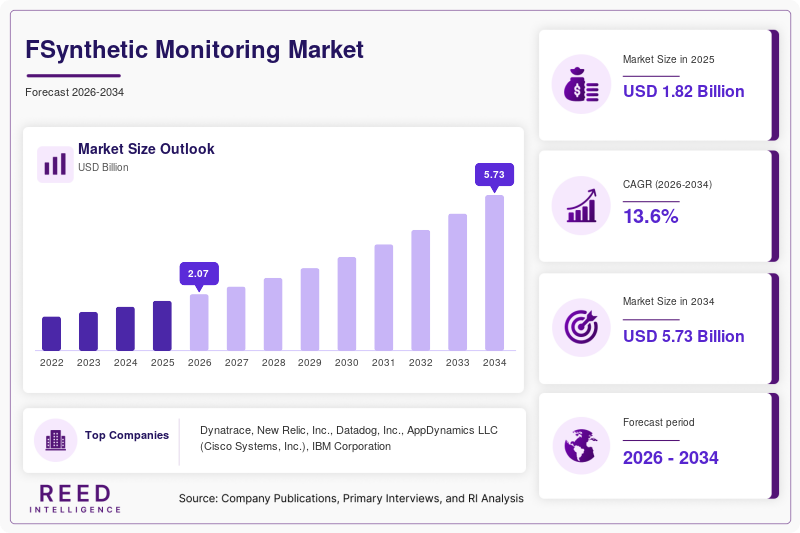
The global FSynthetic Monitoring Market size was valued at USD 1.82 billion in 2026 and is projected to reach USD 5.04 billion by 2034, expanding at a compound annual growth rate (CAGR) of 13.6% during 2026–2034. Synthetic monitoring has become a critical component of modern digital experience management strategies, enabling organizations to proactively test and monitor websites, applications, APIs, and digital services through automated scripts that simulate user interactions. As enterprises continue to accelerate digital transformation initiatives, the need for continuous visibility into application performance and user experience has increased significantly.
One of the major global factors supporting market growth is the rapid expansion of cloud-native applications and distributed digital infrastructures. Businesses operating across multiple regions require uninterrupted application availability and performance. Synthetic monitoring solutions help organizations detect performance bottlenecks before they affect real users, reducing downtime and improving customer satisfaction. The increasing adoption of DevOps, Site Reliability Engineering (SRE), and observability platforms has further strengthened demand for synthetic monitoring technologies across industries including banking, retail, healthcare, telecommunications, and manufacturing.
Key Highlights
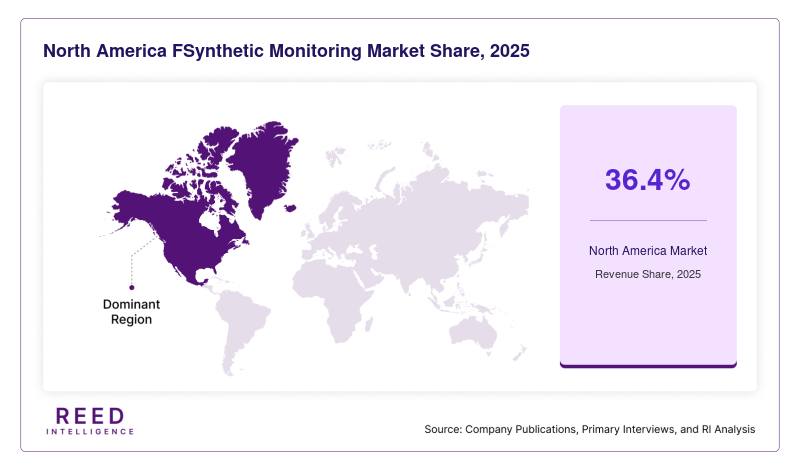
- North America dominated the market with a 36.4% share in 2025, while Asia Pacific is expected to grow at the fastest CAGR of 15.1% during 2026–2034.
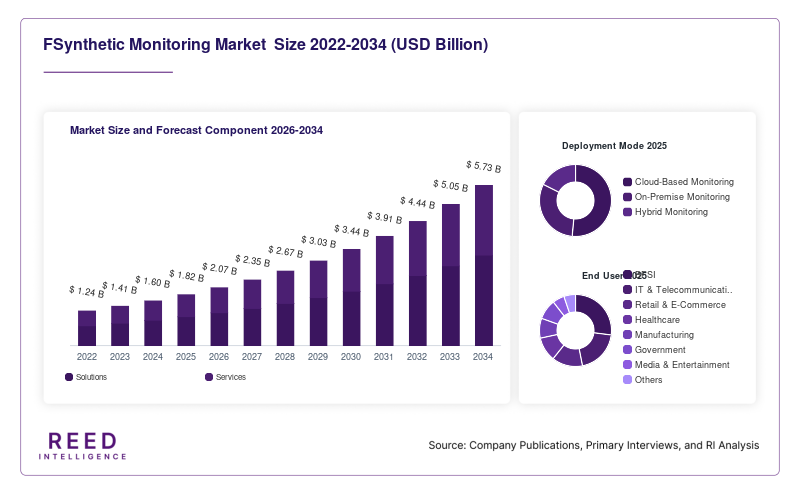
- By Component, Solutions accounted for the largest share of 67.8%, while Services are projected to grow at a CAGR of 14.8%.
- By Deployment Mode, Cloud-Based Monitoring led with a 62.5% share, whereas Hybrid Monitoring is expected to expand at a CAGR of 15.4%.
- By End User, BFSI held the largest share of 24.9%, while Healthcare is anticipated to grow at a CAGR of 16.2%.
- The United States remained the dominant country, with market values of USD 465 million in 2024 and USD 525 million in 2025.
Market Trends
Growing Integration of AI-Driven Observability Platforms
A significant trend shaping the FSynthetic Monitoring Market is the integration of synthetic monitoring capabilities with AI-driven observability platforms. Enterprises increasingly seek unified visibility across infrastructure, applications, networks, and user experiences. Synthetic monitoring tools are being enhanced with machine learning algorithms that automatically identify anomalies, predict potential service disruptions, and prioritize alerts based on business impact. This approach reduces manual troubleshooting efforts and improves operational efficiency. Organizations are adopting intelligent monitoring platforms that combine synthetic tests with real-user monitoring data, enabling more comprehensive performance insights. As digital environments become more complex, AI-powered observability solutions are expected to play a central role in enterprise monitoring strategies.
Expansion of Multi-Cloud and Hybrid Monitoring Environments
The increasing adoption of multi-cloud and hybrid IT architectures is creating new opportunities for synthetic monitoring vendors. Enterprises are deploying applications across public clouds, private clouds, and on-premise infrastructures to improve flexibility and resilience. This distributed environment requires continuous monitoring of application performance across multiple locations and service providers. Synthetic monitoring solutions are evolving to provide cross-platform visibility and automated testing capabilities that support diverse infrastructures. Businesses are investing in monitoring systems capable of validating application performance across geographies, devices, and network conditions. The growing complexity of digital ecosystems continues to drive demand for advanced synthetic monitoring technologies designed for hybrid operational environments.
Market Drivers
Rising Demand for Superior Digital Customer Experiences
The increasing emphasis on digital customer experience is a major driver for the FSynthetic Monitoring Market. Businesses across industries recognize that website performance, application responsiveness, and service availability directly influence customer retention and revenue generation. Even minor disruptions can result in lost sales, reduced customer trust, and reputational damage. Synthetic monitoring allows organizations to simulate user journeys and identify issues before customers encounter them. This proactive approach helps maintain service quality and supports continuous optimization initiatives. As digital engagement becomes a primary business channel, enterprises are expanding investments in monitoring technologies to ensure consistent and reliable customer experiences across all digital touchpoints.
Accelerating Adoption of DevOps and Continuous Delivery Practices
The widespread adoption of DevOps methodologies and continuous delivery pipelines is significantly contributing to market growth. Organizations release software updates more frequently than ever before, increasing the need for automated performance validation. Synthetic monitoring enables development and operations teams to evaluate application functionality, availability, and response times throughout the software lifecycle. Automated testing capabilities support rapid deployments while minimizing operational risks. As enterprises continue modernizing application development processes, synthetic monitoring solutions are becoming essential tools for ensuring stability and performance. The growing focus on automation, agility, and operational efficiency is expected to sustain strong market demand throughout the forecast period.
Market Restraint
Complexity of Implementation Across Diverse IT Environments
Despite strong growth prospects, the FSynthetic Monitoring Market faces challenges related to implementation complexity across diverse technology environments. Large enterprises often operate legacy systems, cloud platforms, microservices architectures, and third-party applications simultaneously. Integrating synthetic monitoring across these environments can require significant technical expertise, customization efforts, and ongoing maintenance. Organizations may encounter difficulties in developing accurate test scripts that reflect real-world user behavior. Additionally, managing large volumes of monitoring data can increase operational complexity and resource requirements. Smaller enterprises with limited IT budgets may hesitate to adopt comprehensive synthetic monitoring platforms due to perceived implementation costs and skill requirements. In some cases, poorly configured monitoring systems generate excessive alerts, creating operational inefficiencies rather than performance improvements. These factors can slow adoption rates, particularly among organizations lacking mature IT operations and observability practices.
Market Opportunities
Emerging Demand from Healthcare Digitalization Initiatives
Healthcare organizations are increasingly investing in digital platforms, telemedicine solutions, electronic health records, and patient engagement applications. This transformation creates substantial opportunities for synthetic monitoring providers. Healthcare institutions require reliable digital services to ensure uninterrupted access to critical information and patient care systems. Synthetic monitoring enables proactive identification of performance issues that could affect healthcare operations. As governments and private healthcare providers expand digital health initiatives, demand for advanced monitoring solutions is expected to increase significantly. Vendors that offer compliance-oriented monitoring capabilities, security-focused analytics, and healthcare-specific performance testing features are well positioned to benefit from this expanding market segment.
Expansion of Monitoring Requirements for API Ecosystems
Modern enterprises increasingly rely on APIs to connect applications, services, and business processes. The growing importance of API-driven architectures presents a substantial opportunity for synthetic monitoring vendors. Organizations need continuous visibility into API availability, response times, and transaction reliability to maintain seamless digital experiences. Synthetic monitoring solutions capable of testing complex API workflows and identifying performance bottlenecks are gaining traction across industries. As businesses continue adopting microservices architectures and digital integration platforms, API monitoring requirements are expected to expand rapidly. Vendors developing specialized synthetic monitoring tools for API performance management can capture significant growth opportunities throughout the forecast period.
Segmental Analysis
By Component
The Solutions segment dominated the FSynthetic Monitoring Market and accounted for approximately 67.8% of revenue in 2024. Organizations increasingly prioritize software platforms that provide automated transaction testing, performance analytics, alert management, and dashboard visualization capabilities. The segment benefits from growing demand for proactive monitoring solutions that support cloud-native applications and distributed digital infrastructures. Enterprises seek comprehensive platforms capable of monitoring websites, mobile applications, APIs, and business-critical digital services from multiple geographic locations. Continuous innovation in AI-driven analytics and automation features further strengthens the market position of solution providers. As digital experience management becomes a strategic priority, adoption of advanced monitoring software continues to rise.
The Services segment is projected to grow at the fastest CAGR of 14.8% through 2034. Increasing implementation complexity and demand for specialized expertise are driving growth across consulting, integration, managed services, and training categories. Many organizations require assistance in configuring monitoring frameworks, developing synthetic scripts, and integrating monitoring tools with existing observability platforms. Service providers also help enterprises optimize monitoring strategies and improve operational efficiency. As synthetic monitoring deployments become more sophisticated, businesses are increasingly relying on external expertise to maximize technology value. This trend is expected to sustain strong growth for service-oriented offerings throughout the forecast period.
By Deployment Mode
The Cloud-Based Monitoring segment accounted for the largest share of approximately 62.5% in 2024. Cloud deployment models offer scalability, flexibility, and lower infrastructure requirements compared with traditional on-premise alternatives. Enterprises favor cloud-based synthetic monitoring solutions because they support rapid implementation and provide access to monitoring nodes across multiple global regions. Organizations operating distributed applications benefit from centralized management capabilities and real-time performance visibility. The increasing adoption of SaaS applications, public cloud services, and digital transformation initiatives continues to support segment growth. Cloud-native monitoring platforms remain particularly attractive to organizations seeking agile and cost-effective performance management solutions.
The Hybrid Monitoring segment is expected to expand at a CAGR of 15.4% during the forecast period. Many enterprises maintain a combination of cloud and on-premise environments due to regulatory, security, and operational requirements. Hybrid monitoring solutions provide unified visibility across diverse infrastructures, helping organizations manage increasingly complex IT ecosystems. The segment is benefiting from growing adoption of multi-cloud strategies and hybrid application architectures. Enterprises require monitoring tools capable of tracking performance across interconnected environments while maintaining consistent service levels. As hybrid IT models become more prevalent, demand for integrated monitoring solutions is expected to increase substantially.
By End User
The BFSI segment held the leading market position with an estimated 24.9% share in 2024. Financial institutions depend heavily on uninterrupted digital services for customer engagement, transactions, and operational efficiency. Synthetic monitoring enables banks, insurers, and payment providers to proactively identify performance issues before they affect customers. The sector faces stringent expectations regarding service reliability and user experience, making monitoring technologies a critical investment area. Increasing adoption of mobile banking applications, digital payments, and online financial services further supports demand. Financial organizations continue expanding investments in observability and monitoring platforms to enhance operational resilience and maintain customer trust.
The Healthcare segment is anticipated to register the fastest CAGR of 16.2% through 2034. Healthcare providers increasingly rely on digital platforms for patient engagement, telemedicine, clinical workflows, and health information management. These applications require high levels of availability and performance to support effective care delivery. Synthetic monitoring helps healthcare organizations identify issues before they disrupt critical services. Growing investments in digital health infrastructure and connected healthcare ecosystems are creating favorable market conditions. As healthcare systems continue modernizing and expanding digital capabilities, demand for advanced monitoring solutions is expected to accelerate significantly.
Regional Analysis
North America
North America accounted for approximately 36.4% of the global FSynthetic Monitoring Market in 2025 and is expected to maintain a strong position throughout the forecast period. The region is projected to register a CAGR of 12.8% between 2026 and 2034. Strong adoption of cloud computing, digital transformation programs, and enterprise observability solutions continues to support market expansion. Organizations across banking, retail, healthcare, and technology sectors increasingly deploy synthetic monitoring tools to improve application reliability and customer experience management.
The United States remains the dominant country in the regional market. A major growth factor is the presence of large-scale digital enterprises operating complex cloud-native environments. These organizations invest heavily in application performance monitoring, AI-driven analytics, and automated testing platforms. Continuous innovation in software development practices and growing adoption of DevOps methodologies further contribute to market growth across the country.
Europe
Europe represented approximately 27.1% of global market revenue in 2025 and is anticipated to achieve a CAGR of 12.4% through 2034. The region benefits from widespread enterprise digitalization and increasing investments in cloud migration projects. Businesses across sectors are adopting synthetic monitoring technologies to ensure compliance, operational resilience, and consistent digital service performance. Demand is particularly strong among financial institutions and telecommunications providers seeking enhanced visibility into application availability.
Germany emerged as the leading country within the European market. A unique growth factor is the country's strong industrial digitization initiatives and adoption of Industry 4.0 technologies. Manufacturing enterprises increasingly depend on connected applications and cloud-based systems, creating demand for proactive monitoring solutions. The integration of digital technologies across industrial operations continues to generate new opportunities for synthetic monitoring vendors.
Asia Pacific
Asia Pacific held around 22.8% of the global FSynthetic Monitoring Market in 2025 and is forecast to record the fastest CAGR of 15.1% during the study period. Rapid expansion of digital services, increasing smartphone penetration, and growth in cloud infrastructure investments are driving regional demand. Enterprises are prioritizing customer experience optimization as competition intensifies across digital channels. Synthetic monitoring solutions are increasingly deployed to maintain service quality and support business continuity.
China represents the largest market within Asia Pacific. One distinctive growth factor is the rapid expansion of large-scale digital ecosystems supporting e-commerce, fintech, and online services. Organizations managing high transaction volumes require continuous monitoring capabilities to ensure application stability. The growing scale of digital commerce activities continues to create substantial demand for advanced monitoring technologies throughout the country.
Middle East & Africa
The Middle East & Africa accounted for approximately 7.2% of global revenue in 2025 and is projected to grow at a CAGR of 13.2% through 2034. Governments and enterprises are accelerating investments in digital transformation and smart infrastructure initiatives. Cloud adoption rates are increasing steadily, creating demand for monitoring tools that support reliable digital operations. Organizations across telecommunications, banking, and public services sectors are investing in synthetic monitoring to enhance application performance management.
The United Arab Emirates remains the dominant country in the region. A key growth factor is the implementation of smart city programs and government-led digital innovation initiatives. Public and private sector organizations are deploying increasingly sophisticated digital platforms that require proactive monitoring. This focus on digital excellence continues to strengthen demand for synthetic monitoring solutions across the country.
Latin America
Latin America captured approximately 6.5% of the global market in 2025 and is expected to achieve a CAGR of 12.7% during the forecast period. Increasing internet penetration, growth in digital banking services, and expansion of e-commerce platforms are contributing to market development. Organizations are investing in application monitoring technologies to improve customer engagement and minimize service disruptions. Demand is particularly notable among financial institutions seeking reliable digital service delivery.
Brazil is the leading country within the Latin American market. One unique growth factor is the rapid evolution of digital payment ecosystems and online financial services. Financial institutions require continuous visibility into application performance to ensure transaction reliability and customer satisfaction. As digital financial services continue expanding, synthetic monitoring adoption is expected to increase steadily across the country.
Competitive Landscape
The FSynthetic Monitoring Market is characterized by strong competition among established observability providers, cloud monitoring vendors, and specialized performance management companies. Market participants focus on expanding AI-driven analytics capabilities, strengthening cloud monitoring features, and enhancing integration with broader observability ecosystems. Strategic partnerships, product innovation, and acquisitions remain key competitive strategies.
Dynatrace is widely recognized as a leading participant due to its comprehensive observability platform and advanced automation capabilities. The company recently expanded synthetic monitoring functionality through enhanced AI-based root-cause analysis features designed to improve incident resolution efficiency.
Key Players
- Dynatrace
- New Relic
- Datadog
- AppDynamics
- IBM
- Splunk
- SolarWinds
- Broadcom
- Catchpoint
- SmartBear
- Elastic
- LogicMonitor
- ManageEngine
- Site24x7
- Riverbed Technology
Recent Developments
- In 2025, a leading observability platform provider expanded its AI-powered synthetic monitoring capabilities to enable faster anomaly detection and automated root-cause analysis across cloud-native environments.
- In 2025, several synthetic monitoring vendors introduced advanced API monitoring solutions designed to support growing enterprise adoption of microservices and distributed application architectures.
- In 2024, a major application performance monitoring company launched enhanced real-user and synthetic monitoring integration features to provide unified visibility into digital experience performance.
- In 2024, market participants increased investments in machine learning-based monitoring technologies aimed at improving predictive analytics, alert accuracy, and incident response efficiency.
- In 2025, strategic partnerships between cloud service providers and monitoring software vendors accelerated the deployment of synthetic monitoring solutions across multi-cloud and hybrid IT infrastructures.
FSynthetic Monitoring Market Segments
Component
- Solutions
- Services
Deployment Mode
- Cloud-Based Monitoring
- On-Premise Monitoring
- Hybrid Monitoring
End User
- BFSI
- IT & Telecommunications
- Retail & E-Commerce
- Healthcare
- Manufacturing
- Government
- Media & Entertainment
- Others
By Region
- North America
- Europe
- APAC
- Middle East and Africa
- LATAM