FTIR Portable Spectrometer Market Size, Share Demand Report By Product Type (Handheld Spectrometers, Portable Benchtop Spectrometers, Wearable Spectrometers), By Application (Chemical Analysis, Environmental Monitoring, Food Safety Testing, Forensic Analysis), By End-Use Industry (Pharmaceuticals, Environmental, Food & Beverage, Oil & Gas, Academic & Research) By Region & Segment Forecasts, 2026–2034
USD 3950
Market Overview
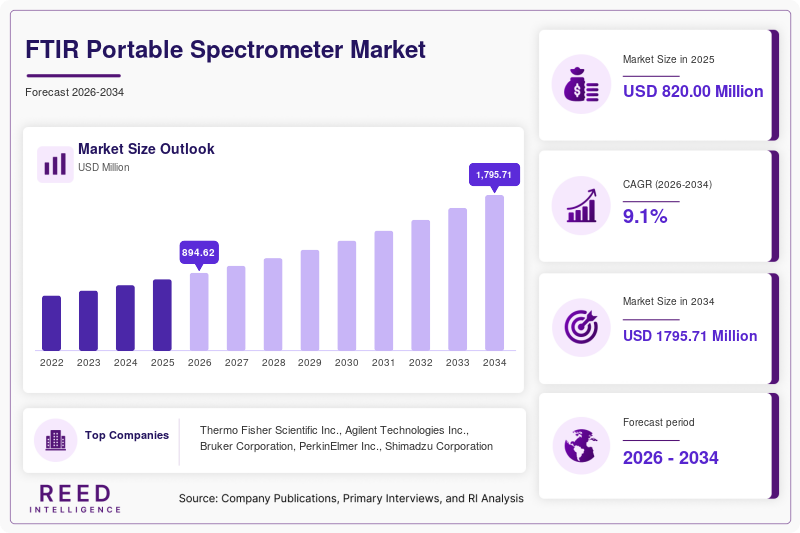
The FTIR Portable Spectrometer Market size was valued at approximately USD 820 million in 2026 and is projected to reach around USD 1640 million by 2034, expanding at a CAGR of 9.1% during the forecast period (2026–2034). The steady expansion of field-based analytical technologies across industries such as pharmaceuticals, environmental monitoring, and defense has significantly contributed to the adoption of portable Fourier Transform Infrared (FTIR) spectrometers. These devices enable rapid, non-destructive material identification, which has become essential for real-time decision-making in decentralized environments.
A key global factor supporting market growth is the increasing emphasis on on-site chemical analysis to improve operational efficiency and regulatory compliance. Industries are moving away from centralized laboratory testing toward portable solutions that reduce turnaround time and enhance productivity. The growing integration of FTIR devices with digital platforms and cloud-based data systems further supports adoption, particularly in industrial and research applications where data accuracy and accessibility are critical.
Key Highlights
- North America dominated the market with a 35.1% share in 2025.
- Asia Pacific is expected to grow at the fastest CAGR of 10.6% during 2026–2034.
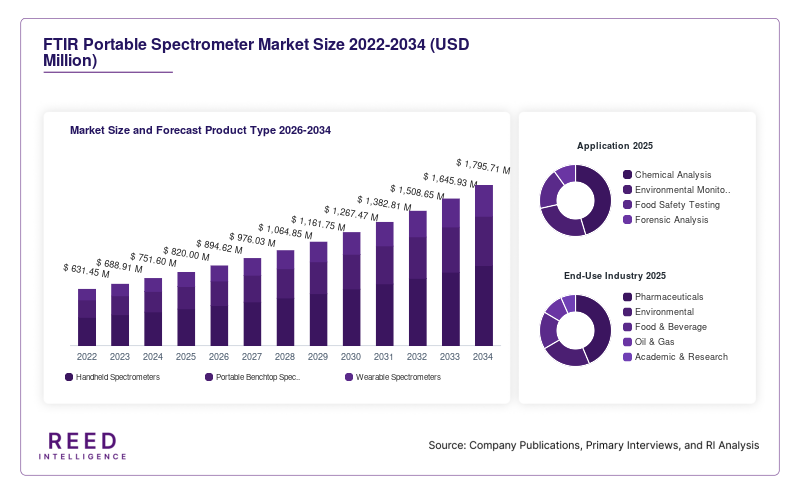
- By product type, handheld spectrometers accounted for the largest share of 42.8%.
- while wearable spectrometers are projected to grow at a CAGR of 11.3%.
- By application, chemical analysis led with a 39.6% share, whereas environmental monitoring is expected to expand at a CAGR of 10.9%.
- The United States remained the dominant country, with market values of USD 260 million in 2024 and USD 285 million in 2025.
Market Trends
Increasing integration of AI and data analytics in portable spectrometry
The FTIR Portable Spectrometer Market is experiencing a shift toward intelligent analytical systems driven by the integration of artificial intelligence and advanced data analytics. Manufacturers are embedding machine learning algorithms into spectrometers to enable automated spectral interpretation, reducing the dependency on skilled operators. This trend is particularly relevant in industries such as pharmaceuticals and forensics, where accurate identification of compounds is essential. AI-powered systems can rapidly compare spectral data with extensive libraries, improving efficiency and reliability. Additionally, cloud connectivity allows real-time data sharing and remote monitoring, enhancing collaborative workflows. This evolution is transforming portable spectrometers from simple measurement tools into comprehensive analytical platforms capable of delivering actionable insights.
Expansion of applications in environmental and safety monitoring
Another notable trend is the increasing use of portable FTIR spectrometers in environmental and occupational safety applications. Governments and regulatory bodies are implementing stricter emission norms and workplace safety standards, which require continuous monitoring of gases and hazardous substances. Portable FTIR devices provide a practical solution by enabling on-site detection of pollutants, volatile organic compounds, and toxic gases. Industries such as oil and gas, mining, and manufacturing are adopting these devices to ensure compliance and reduce environmental risks. The growing focus on sustainability and worker safety is expected to drive demand for portable spectrometry solutions that offer real-time analysis and reliable performance in diverse field conditions.
Market Drivers
Rising demand for on-site and real-time chemical analysis
The growing need for immediate chemical identification across industries is a major driver of the FTIR Portable Spectrometer Market. Traditional laboratory-based analysis often involves delays due to sample transportation and processing, which can hinder timely decision-making. Portable FTIR spectrometers address this challenge by enabling rapid, on-site analysis with high accuracy. Industries such as pharmaceuticals, food safety, and law enforcement increasingly rely on these devices for quality control, contamination detection, and forensic investigations. The ability to obtain instant results improves operational efficiency and reduces costs associated with laboratory testing. As industries continue to prioritize speed and precision, the demand for portable spectrometry solutions is expected to rise steadily.
Growth in regulatory compliance and safety requirements
Stringent regulatory frameworks across various sectors are driving the adoption of portable FTIR spectrometers. Governments worldwide are enforcing stricter guidelines related to environmental protection, workplace safety, and product quality. Compliance with these regulations requires continuous monitoring and accurate identification of chemical substances. Portable FTIR devices offer a convenient and reliable solution for meeting these requirements, particularly in field-based applications. For example, environmental agencies use these spectrometers to monitor air quality and detect pollutants, while industrial facilities utilize them to ensure safe handling of hazardous materials. The increasing focus on compliance and risk management is expected to sustain market growth over the forecast period.
Market Restraint
High initial cost and technical complexity
Despite the advantages of portable FTIR spectrometers, their high initial cost and technical complexity act as significant restraints for market growth. Advanced spectrometers equipped with high-resolution sensors, robust software, and connectivity features can be expensive, limiting their adoption among small and medium-sized enterprises. Additionally, the operation of these devices often requires specialized knowledge, which may necessitate training and increase overall implementation costs. In developing regions, budget constraints and limited technical expertise further restrict market penetration. For instance, smaller laboratories and field operators may opt for less expensive alternatives, even if they offer lower accuracy. This cost barrier can slow down adoption rates, particularly in price-sensitive markets, impacting overall industry expansion.
Market Opportunities
Emerging demand in developing economies
Developing economies present significant growth opportunities for the FTIR Portable Spectrometer Market due to increasing industrialization and infrastructure development. Countries in Asia Pacific, Latin America, and Africa are investing in sectors such as manufacturing, energy, and environmental monitoring, creating demand for portable analytical tools. As regulatory standards in these regions become more stringent, industries are adopting advanced technologies to ensure compliance. Portable FTIR spectrometers offer a cost-effective solution for on-site analysis, making them suitable for emerging markets. Additionally, government initiatives aimed at improving environmental monitoring and public safety are expected to drive adoption, providing new avenues for market expansion.
Advancements in miniaturization and device portability
Technological advancements in miniaturization are creating new opportunities for the FTIR Portable Spectrometer Market. Manufacturers are developing compact and lightweight devices without compromising performance, making them more accessible for field applications. Innovations in battery technology and wireless connectivity are further enhancing portability and usability. These advancements enable deployment in remote locations and challenging environments, such as disaster sites and industrial facilities. The increasing demand for user-friendly and portable analytical tools is encouraging manufacturers to focus on product innovation. As technology continues to evolve, the availability of affordable and efficient portable spectrometers is expected to expand, driving market growth.
Segmental Analysis
By Product Type
Handheld spectrometers emerged as the dominant subsegment, accounting for 42.8% of the market share in 2024. Their compact design, ease of use, and ability to deliver quick results make them highly suitable for field applications. Industries such as pharmaceuticals, food safety, and law enforcement prefer handheld devices due to their portability and efficiency. These spectrometers enable real-time analysis, reducing dependency on laboratory testing and improving operational productivity. The growing demand for decentralized testing solutions further strengthens the position of handheld spectrometers in the market.
Wearable spectrometers are expected to be the fastest-growing subsegment, with a CAGR of 11.3% during the forecast period. The growth is driven by advancements in miniaturization and increasing demand for continuous monitoring solutions. Wearable devices offer hands-free operation, making them ideal for industrial and hazardous environments. Their ability to provide real-time data enhances safety and efficiency in operations. As industries prioritize worker safety and operational efficiency, the adoption of wearable spectrometers is expected to increase significantly.
By Application
Chemical analysis dominated the application segment, holding a 39.6% share in 2024. Portable FTIR spectrometers are widely used for identifying chemical compounds in industries such as pharmaceuticals, petrochemicals, and food processing. Their ability to provide accurate and rapid analysis makes them essential for quality control and research applications. The increasing demand for efficient analytical tools in industrial processes further supports the dominance of this subsegment.
Environmental monitoring is projected to be the fastest-growing application, with a CAGR of 10.9%. The growth is driven by increasing regulatory requirements and rising awareness of environmental sustainability. Portable FTIR spectrometers are used to detect pollutants and monitor air quality in real time. Governments and industries are adopting these devices to ensure compliance with environmental standards and reduce ecological impact.
By End-Use Industry
The pharmaceutical industry held the largest share of 36.2% in 2024 due to its extensive use of FTIR spectrometers for drug development and quality control. Portable devices enable on-site testing, improving efficiency and reducing turnaround time. The growing focus on research and development in the pharmaceutical sector further drives demand for advanced analytical tools.
The environmental sector is expected to grow at the fastest CAGR of 10.7% during the forecast period. The increasing emphasis on sustainability and regulatory compliance is driving the adoption of portable FTIR spectrometers for monitoring environmental conditions. These devices provide accurate and real-time data, supporting effective decision-making in environmental management.
Regional Analysis
North America
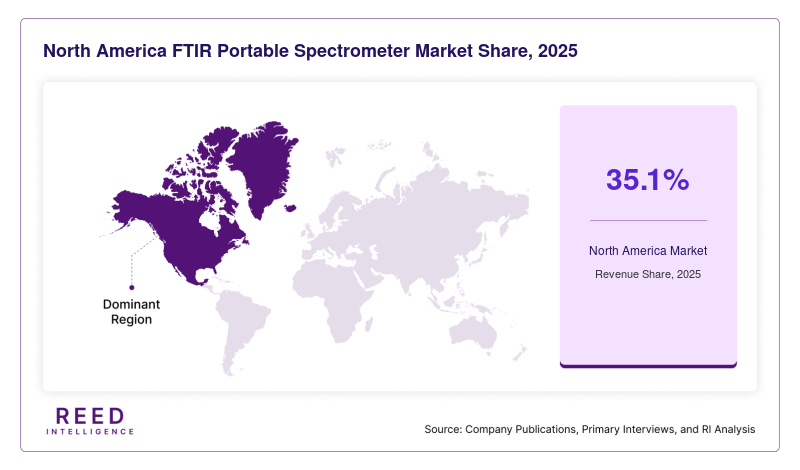
North America held a dominant share of 35.1% in 2025 and is expected to maintain steady growth with a CAGR of 8.7% during the forecast period. The region’s strong presence in advanced research, pharmaceuticals, and defense sectors drives demand for portable FTIR spectrometers. High adoption of innovative technologies and established regulatory frameworks further support market growth. Additionally, the presence of major industry players contributes to continuous product development and innovation, strengthening the regional market position.
The United States dominates the North American market due to its advanced industrial infrastructure and strong focus on research and development. A key growth factor is the increasing use of portable spectrometers in forensic and homeland security applications. Government agencies rely on these devices for rapid identification of hazardous substances, enhancing national security and public safety.
Europe
Europe accounted for a significant market share of 27.4% in 2025 and is projected to grow at a CAGR of 8.9%. The region benefits from strict environmental regulations and a strong emphasis on sustainability, driving demand for portable analytical tools. Industries such as chemical manufacturing and pharmaceuticals extensively use FTIR spectrometers for compliance and quality control purposes.
Germany is the leading country in the European market, supported by its robust industrial base and focus on technological innovation. A unique growth factor is the increasing adoption of portable spectrometers in environmental monitoring programs aimed at reducing industrial emissions and promoting sustainable practices.
Asia Pacific
Asia Pacific is expected to witness the fastest growth, with a CAGR of 10.6% during the forecast period, driven by rapid industrialization and expanding manufacturing sectors. The region’s growing focus on environmental protection and workplace safety is fueling demand for portable FTIR spectrometers. Increasing investments in research and development further contribute to market expansion.
China dominates the Asia Pacific market due to its large industrial base and increasing regulatory enforcement. A key growth factor is the rising adoption of portable spectrometers in manufacturing industries for quality assurance and process optimization, supporting efficient production and compliance.
Middle East & Africa
The Middle East & Africa region held a moderate market share of 5.8% in 2025 and is expected to grow at a CAGR of 9.3%. Growth is driven by the expanding oil and gas industry and increasing focus on environmental monitoring. Portable FTIR spectrometers are widely used for detecting gas leaks and ensuring safety in industrial operations.
Saudi Arabia leads the regional market, supported by its strong oil and gas sector. A unique growth factor is the increasing deployment of portable spectrometers in energy infrastructure projects to enhance operational safety and efficiency.
Latin America
Latin America accounted for 6.7% of the market share in 2025 and is projected to grow at a CAGR of 9.0%. The region’s growth is supported by rising industrial activities and increasing awareness of environmental regulations. Portable FTIR spectrometers are gaining traction in sectors such as mining and agriculture.
Brazil dominates the Latin American market due to its large industrial and agricultural sectors. A key growth factor is the increasing use of portable spectrometers in environmental monitoring to ensure compliance with evolving regulations and improve sustainability practices.
Competitive Landscape
The FTIR Portable Spectrometer Market is characterized by the presence of several established players focusing on innovation and product development. Key companies are investing in research and development to enhance device performance and expand application areas. The market leader, Thermo Fisher Scientific, maintains a strong position through its extensive product portfolio and global distribution network. Recent developments include the launch of advanced portable spectrometers with improved sensitivity and connectivity features.
Other major players are adopting strategies such as partnerships, mergers, and acquisitions to strengthen their market presence. Companies are also focusing on expanding their reach in emerging markets to capitalize on growth opportunities. Continuous innovation and technological advancements remain key factors driving competition in the market.
Key Players
- Thermo Fisher Scientific Inc.
- Agilent Technologies Inc.
- Bruker Corporation
- PerkinElmer Inc.
- Shimadzu Corporation
- ABB Ltd.
- Horiba Ltd.
- Jasco Inc.
- Foss Analytical A/S
- B&W Tek
- Ocean Insight
- Rigaku Corporation
- Metrohm AG
- Hitachi High-Tech Corporation
- Smiths Detection Group Ltd.
Recent Developments
- Thermo Fisher Scientific introduced a new portable FTIR spectrometer with enhanced AI-based spectral analysis capabilities in 2025.
- Agilent Technologies expanded its portable spectroscopy portfolio with a compact device designed for environmental monitoring applications.
- Bruker Corporation launched an upgraded handheld FTIR spectrometer featuring improved battery life and wireless connectivity for field operations.
FTIR Portable Spectrometer Market Segments
Product Type
- Handheld Spectrometers
- Portable Benchtop Spectrometers
- Wearable Spectrometers
Application
- Chemical Analysis
- Environmental Monitoring
- Food Safety Testing
- Forensic Analysis
End-Use Industry
- Pharmaceuticals
- Environmental
- Food & Beverage
- Oil & Gas
- Academic & Research
By Region
- North America
- Europe
- APAC
- Middle East and Africa
- LATAM