Fuel Cells For Military Unmanned Aerial Vehicle Market Size, Share & Demand Report By Type (Proton Exchange Membrane Fuel Cells, Solid Oxide Fuel Cells), By Application (Intelligence, Surveillance, and Reconnaissance, Combat Support), By End-Use (Defense Forces, Paramilitary and Homeland Security), By Region & Segment Forecasts, 2025–2034
USD 3950
Market Overview
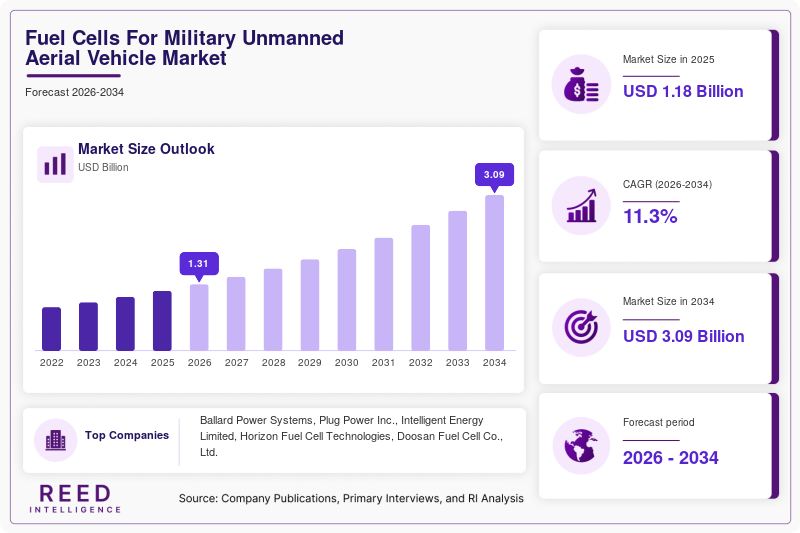
The Fuel Cells For Military Unmanned Aerial Vehicle Market size is estimated at USD 1.18 billion, with projections indicating growth to approximately USD 1.32 billion in 2026. By 2034, the market is expected to reach USD 3.42 billion, registering a compound annual growth rate (CAGR) of 11.3% from 2025 to 2034.
This growth trajectory is primarily driven by the need for longer flight durations compared to traditional battery-powered UAVs. Fuel cells offer extended operational capabilities, reduced acoustic signatures, and higher energy density, making them suitable for reconnaissance, surveillance, and intelligence missions. Additionally, the increasing use of UAVs in modern warfare and border monitoring has amplified the demand for reliable power systems.
Key Highlights
- Market projected to reach USD 3.42 billion by 2034, driven by rising UAV adoption and fuel cell integration.
- Expected to grow at a CAGR of 11.3% during 2025–2034, supported by continuous technological advancements.
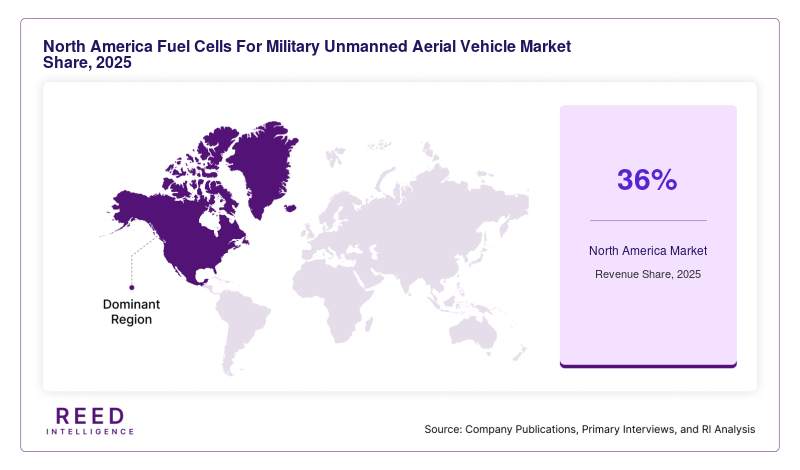
- North America dominated with a 36% share in 2025 due to strong defense investments.
- Asia Pacific is the fastest-growing region with a CAGR of 12.6%, driven by military modernization.
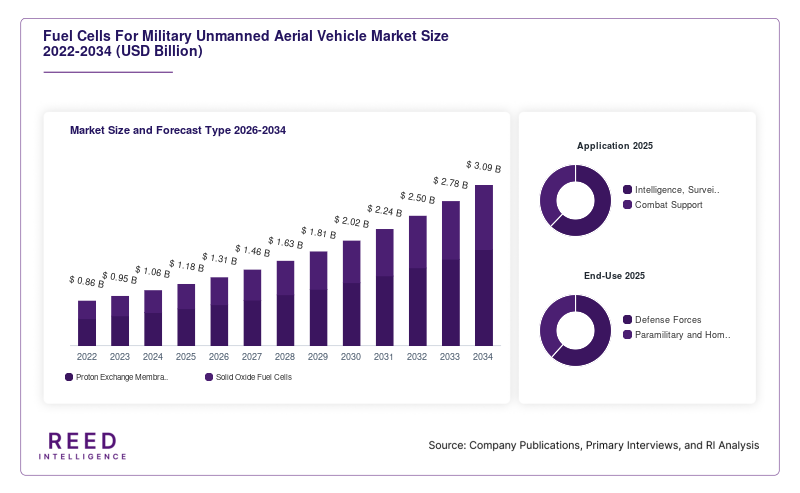
- PEM fuel cells led with a 58% share, while SOFC is the fastest-growing segment.Growth driven by demand for long-endurance UAVs, higher defense spending, and focus on clean energy.
Market Trends
Integration of Hydrogen Fuel Cell Systems with Hybrid Power Architectures
One of the notable trends in the Fuel Cells For Military Unmanned Aerial Vehicle Market is the integration of hydrogen fuel cells with hybrid power systems. Military UAV manufacturers are combining fuel cells with lithium-ion batteries to achieve optimal performance across different mission phases. This hybrid approach allows UAVs to utilize battery power during takeoff and landing, while fuel cells provide sustained energy during cruising. The result is improved operational efficiency, enhanced range, and better energy management. This trend is gaining traction as defense agencies seek flexible energy solutions capable of adapting to diverse mission requirements.
Miniaturization and Lightweight Design of Fuel Cell Components
Another important trend is the miniaturization of fuel cell systems to meet the weight constraints of military UAVs. Manufacturers are focusing on reducing the size and mass of fuel cell stacks, hydrogen storage units, and associated components without compromising performance. Lightweight designs improve payload capacity and flight endurance, which are critical factors in surveillance and reconnaissance missions. Advances in material science, including the use of composite materials and nanotechnology, are enabling the development of compact fuel cell systems. This trend is expected to accelerate as demand for small and medium-sized UAVs continues to grow globally.
Market Drivers
Increasing Demand for Long-Endurance UAV Operations
The growing need for extended flight duration in military operations is a major driver of the Fuel Cells For Military Unmanned Aerial Vehicle Market. Traditional battery-powered UAVs often face limitations in endurance, restricting their effectiveness in long surveillance missions. Fuel cells, with their higher energy density, allow UAVs to operate for significantly longer periods without frequent recharging or refueling. This capability is particularly valuable in border security, maritime patrol, and intelligence-gathering missions where continuous monitoring is required. As military strategies evolve to emphasize persistent surveillance, the adoption of fuel cell-powered UAVs is expected to increase steadily.
Rising Defense Budgets and Technological Modernization
Another key driver is the increasing allocation of defense budgets toward modernization programs. Governments worldwide are investing in advanced UAV technologies to enhance their military capabilities. Fuel cells are being recognized as a critical component of next-generation UAV systems due to their efficiency and reliability. In addition, collaborative initiatives between defense agencies and private companies are accelerating research and development in fuel cell technology. These investments are not only improving performance but also reducing costs over time, making fuel cell solutions more accessible for widespread adoption across military platforms.
Market Restraint
High Initial Costs and Infrastructure Limitations
Despite its growth potential, the Fuel Cells For Military Unmanned Aerial Vehicle Market faces challenges related to high initial costs and limited infrastructure. Fuel cell systems require specialized materials, including catalysts and hydrogen storage technologies, which increase manufacturing expenses. Additionally, the lack of established hydrogen refueling infrastructure in many regions poses logistical challenges for deployment. This limitation can restrict the operational flexibility of fuel cell-powered UAVs, especially in remote or conflict-prone areas.
The impact of this restraint is evident in the slower adoption rates among smaller defense organizations with constrained budgets. For example, while larger economies can invest in hydrogen infrastructure and advanced UAV systems, developing countries may rely on conventional propulsion technologies due to cost considerations. However, ongoing research aimed at reducing material costs and improving hydrogen storage solutions is expected to mitigate this challenge over time.
Market Opportunities
Development of Advanced Hydrogen Storage Solutions
The advancement of hydrogen storage technologies presents a significant opportunity for market growth. Efficient storage systems can enhance the safety, portability, and performance of fuel cell-powered UAVs. Innovations such as solid-state hydrogen storage and high-pressure tanks are enabling longer flight durations and improved energy density. These developments are particularly beneficial for military applications where reliability and safety are critical. As research progresses, improved storage solutions are expected to lower operational risks and encourage broader adoption of fuel cell technologies in UAV systems.
Expansion of UAV Applications in Defense and Security
Another promising opportunity lies in the expanding applications of UAVs across defense and security sectors. Military forces are increasingly deploying UAVs for intelligence, surveillance, reconnaissance, and combat support missions. Fuel cells enhance the capabilities of these UAVs by providing longer endurance and reduced detectability. Additionally, the use of UAVs in disaster response and humanitarian missions is growing, creating new avenues for fuel cell integration. As the scope of UAV applications continues to expand, the demand for efficient and reliable power systems is expected to rise, driving market growth.
Segmental Analysis
By Type
The Proton Exchange Membrane (PEM) fuel cells segment dominated the market in 2024, accounting for approximately 58% of the total share. PEM fuel cells are widely preferred due to their high efficiency, low operating temperature, and quick start-up capabilities. These characteristics make them suitable for military UAV applications that require rapid deployment and reliable performance. Additionally, PEM fuel cells offer a compact design, which aligns with the weight and space constraints of UAV systems. Their compatibility with hydrogen fuel further enhances their appeal, as hydrogen is a clean and efficient energy source.
Solid Oxide Fuel Cells (SOFC) are expected to be the fastest-growing segment, with a projected CAGR of 12.8% during the forecast period. SOFCs operate at higher temperatures and offer greater efficiency, making them suitable for larger UAVs requiring sustained power output. The growth of this segment is driven by advancements in materials and design, which are improving durability and reducing operational challenges. Increased investment in research and development is expected to accelerate the adoption of SOFCs in military UAV applications.
By Application
The Intelligence, Surveillance, and Reconnaissance (ISR) segment held the largest market share in 2024, accounting for nearly 62% of the total market. Fuel cell-powered UAVs are particularly effective in ISR missions due to their extended flight duration and low noise levels. These capabilities enable continuous monitoring without detection, which is critical for military operations. The growing need for real-time intelligence and situational awareness is driving the demand for advanced UAV systems equipped with fuel cell technology.
Combat support applications are expected to witness the fastest growth, with a CAGR of 11.9% during the forecast period. The increasing use of UAVs in combat roles, including target acquisition and logistics support, is driving this segment. Fuel cells provide the necessary endurance and reliability required for these missions. Additionally, advancements in UAV payload capabilities are enabling more complex operations, further boosting demand for efficient power systems.
By End-Use
The defense forces segment dominated the market in 2024, accounting for approximately 70% of the total share. Military organizations are the primary users of fuel cell-powered UAVs, leveraging their capabilities for various applications such as surveillance, reconnaissance, and combat support. The increasing focus on modernizing defense equipment and enhancing operational efficiency is driving the adoption of fuel cell technologies. Furthermore, government initiatives to develop indigenous UAV systems are contributing to segment growth.
The paramilitary and homeland security segment is expected to grow at the fastest rate, with a CAGR of 11.5% during the forecast period. The rising need for border security, disaster management, and anti-terrorism operations is driving demand in this segment. Fuel cell-powered UAVs offer extended operational capabilities, making them suitable for monitoring large areas. As security challenges continue to evolve, the adoption of advanced UAV technologies in paramilitary and homeland security applications is expected to increase significantly.
Regional Analysis
North America
North America accounted for approximately 36% market share in 2025, making it the leading region in the Fuel Cells For Military Unmanned Aerial Vehicle Market. The region is expected to maintain a strong position with a projected CAGR of 10.8% through 2034. The presence of advanced defense infrastructure and continuous investment in UAV technologies contribute significantly to market growth.
The United States dominates the regional market due to its extensive military capabilities and focus on technological innovation. A unique growth factor is the integration of fuel cells into next-generation combat UAV programs, which enhances endurance and mission flexibility.
Europe
Europe held around 24% market share in 2025 and is expected to grow at a CAGR of 10.5% during the forecast period. The region’s emphasis on sustainable defense solutions and energy efficiency supports the adoption of fuel cell technologies in military UAVs.
Germany leads the European market, driven by strong research initiatives in hydrogen technologies. A unique growth factor is the collaboration between defense agencies and renewable energy companies to develop eco-friendly UAV propulsion systems.
Asia Pacific
Asia Pacific accounted for approximately 22% market share in 2025 and is anticipated to register the highest CAGR of 12.6% by 2034. Rapid military modernization and increasing defense spending are key factors driving regional growth.
China dominates the market in Asia Pacific, supported by large-scale investments in UAV development. A unique growth factor is the government’s focus on indigenous production of advanced fuel cell technologies for military applications.
Middle East & Africa
The Middle East & Africa region captured about 10% market share in 2025 and is projected to grow at a CAGR of 9.7% during the forecast period. Increasing security concerns and investments in surveillance technologies are driving demand.
Israel is a dominant country in this region, known for its advanced UAV systems. A unique growth factor is the integration of fuel cells in tactical UAVs for enhanced operational efficiency in desert environments.
Latin America
Latin America held nearly 8% market share in 2025 and is expected to grow at a CAGR of 9.2% through 2034. The adoption of UAVs for border security and anti-smuggling operations supports market expansion.
Brazil leads the regional market, benefiting from defense modernization programs. A unique growth factor is the increasing use of UAVs in monitoring remote and forested regions, which requires long-endurance power solutions.
Competitive Landscape
The Fuel Cells For Military Unmanned Aerial Vehicle Market is characterized by moderate competition, with several key players focusing on innovation and strategic collaborations. Leading companies are investing in research and development to enhance fuel cell efficiency, reduce costs, and improve integration with UAV systems. Partnerships between defense organizations and private firms are also playing a crucial role in advancing technology.
One of the leading players in the market is Ballard Power Systems, known for its expertise in proton exchange membrane fuel cells. The company has been actively involved in developing fuel cell solutions for UAV applications. A recent development includes the introduction of a lightweight fuel cell system designed specifically for long-endurance drones. Other companies are also focusing on expanding their product portfolios and strengthening their market presence through acquisitions and joint ventures.
Key Players
- Ballard Power Systems
- Plug Power Inc.
- Intelligent Energy Limited
- Horizon Fuel Cell Technologies
- Doosan Fuel Cell Co., Ltd.
- Hydrogenics Corporation
- AeroVironment, Inc.
- ElringKlinger AG
- SFC Energy AG
- Bloom Energy Corporation
- Nuvera Fuel Cells, LLC
- Advent Technologies Holdings
- Toshiba Energy Systems & Solutions Corporation
- General Motors Company
- Honeywell International Inc.
Recent Developments
- In 2024, Ballard Power Systems launched a new lightweight PEM fuel cell module for UAV applications.
- In 2023, Intelligent Energy partnered with a defense contractor to develop hydrogen-powered drones for surveillance missions.
- In 2024, Plug Power Inc. expanded its hydrogen infrastructure to support military-grade UAV operations.
Fuel Cells For Military Unmanned Aerial Vehicle Market Segments
Type
- Proton Exchange Membrane Fuel Cells
- Solid Oxide Fuel Cells
Application
- Intelligence, Surveillance, and Reconnaissance
- Combat Support
End-Use
- Defense Forces
- Paramilitary and Homeland Security
By Region
- North America
- Europe
- APAC
- Middle East and Africa
- LATAM