Function Generator Market Size, Share & Demand Report By Type (Analog Function Generators, Digital Function Generators), By Application (Electronics Testing, Telecommunications, Automotive, Research & Development), By End-Use (Industrial, Research & Education, Healthcare, Aerospace & Defense) & Segment Forecasts, 2025–2034
USD 3950
Market Overview
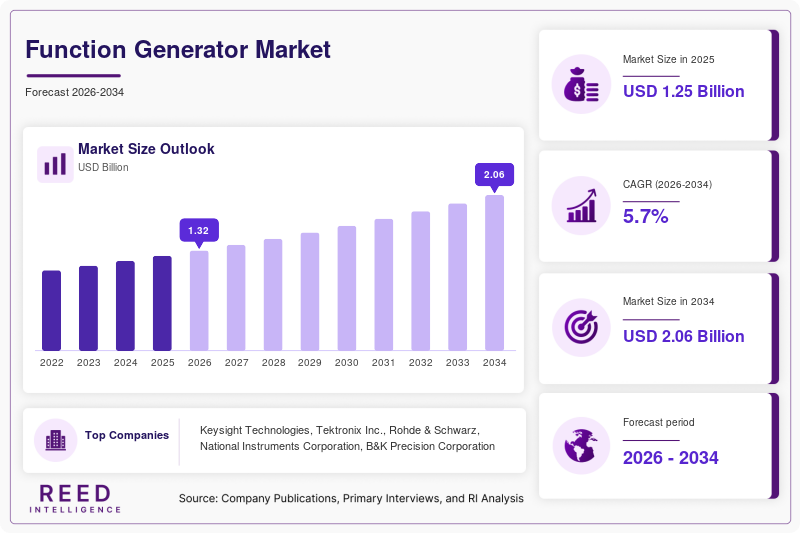
The global Function Generator Market size is experiencing steady expansion, supported by increasing demand across electronics testing, telecommunications, automotive, and research applications. In 2025, the market size is estimated at USD 1.25 billion, rising to approximately USD 1.32 billion in 2026. The market is projected to reach USD 2.05 billion by 2034, registering a compound annual growth rate (CAGR) of 5.7% from 2025 to 2034. This growth trajectory reflects the rising complexity of electronic systems and the need for precise signal generation tools across industries.
One of the primary growth factors is the rapid advancement in consumer electronics and semiconductor technologies. As devices become more compact and multifunctional, manufacturers require high-precision testing equipment such as function generators to validate performance and reliability. Additionally, the expansion of 5G infrastructure and next-generation communication systems is driving demand for signal testing equipment capable of handling high-frequency and complex waveforms.
Key Highlights
- Market size valued at USD 1.25 billion in 2025 and USD 1.32 billion in 2026
- Forecast to reach USD 2.05 billion by 2034 at a CAGR of 5.7%
- Growth driven by electronics testing, 5G deployment, and industrial automation
- Increasing R&D investments supporting demand across academic and industrial sectors
- Technological advancements enhancing functionality and usability
Market Trends
Integration of Arbitrary Waveform Generation and Digital Interfaces
A significant trend in the Function Generator Market is the increasing integration of arbitrary waveform generation (AWG) capabilities with advanced digital interfaces. Modern function generators are evolving beyond basic sine, square, and triangular wave outputs to support highly customizable waveforms. This enables engineers to simulate complex real-world signals more accurately. The integration of digital interfaces such as USB, LAN, and cloud-based connectivity allows seamless control and data sharing across systems. This trend is particularly relevant in research laboratories and advanced manufacturing environments, where precision and flexibility are critical. As industries demand more sophisticated testing solutions, manufacturers are focusing on enhancing waveform resolution, memory depth, and real-time processing capabilities.
Miniaturization and Portable Testing Equipment
Another emerging trend is the miniaturization of function generators, making them more portable and user-friendly. Compact and handheld devices are gaining popularity among field engineers, educators, and technicians who require mobility without compromising performance. These portable units often feature battery operation, touchscreen interfaces, and wireless connectivity, enabling on-site testing and diagnostics. The trend is driven by the increasing need for flexible testing solutions in remote locations, especially in telecommunications and maintenance operations. As industries shift toward decentralized operations, the demand for lightweight, efficient, and portable function generators is expected to increase steadily over the forecast period.
Market Drivers
Expansion of Telecommunications and 5G Infrastructure
The rapid expansion of telecommunications networks, particularly the deployment of 5G technology, is a major driver for the Function Generator Market. Function generators are essential tools for testing signal integrity, frequency response, and modulation techniques in communication systems. With the rollout of 5G networks, there is a growing need for equipment that can handle high-frequency signals and complex waveform patterns. Telecom companies and equipment manufacturers are investing heavily in advanced testing solutions to ensure network reliability and performance. This has led to increased adoption of high-performance function generators capable of supporting wide frequency ranges and advanced modulation features.
Growth in Electronics Manufacturing and Testing
The growth of the global electronics manufacturing sector is another key driver of the market. As electronic devices become more sophisticated, manufacturers require precise testing equipment to ensure product quality and compliance with industry standards. Function generators are widely used in testing circuits, components, and systems during the development and production stages. The increasing demand for consumer electronics, automotive electronics, and industrial control systems is driving the need for reliable testing solutions. Additionally, the rise of electric vehicles and smart devices is further boosting demand for function generators in quality assurance and performance validation processes.
Market Restraint
High Cost of Advanced Function Generators
One of the primary restraints in the Function Generator Market is the high cost associated with advanced and high-performance devices. While basic function generators are relatively affordable, models with advanced features such as arbitrary waveform generation, high-frequency capabilities, and enhanced connectivity options can be expensive. This cost factor can limit adoption among small and medium-sized enterprises, educational institutions, and independent researchers with constrained budgets. The high initial investment, along with maintenance and calibration costs, can pose challenges for organizations seeking cost-effective testing solutions.
The impact of this restraint is particularly evident in developing regions, where budget constraints may hinder the adoption of advanced testing equipment. For example, smaller electronics manufacturers may rely on older or less sophisticated equipment, which can affect testing accuracy and product quality. This, in turn, may limit their competitiveness in the global market. While technological advancements are gradually reducing costs, the price barrier remains a significant challenge for widespread adoption.
Market Opportunities
Increasing Demand in Emerging Economies
Emerging economies present significant growth opportunities for the Function Generator Market. Countries in Asia Pacific, Latin America, and parts of Africa are experiencing rapid industrialization and expansion of electronics manufacturing capabilities. Governments in these regions are investing in infrastructure development, including telecommunications and industrial automation, which is driving demand for testing equipment. As local manufacturers aim to meet global quality standards, the need for reliable and advanced function generators is increasing. Additionally, the growing number of engineering institutions and research centers in these regions is contributing to market expansion.
Advancements in Automotive Electronics and EV Testing
The increasing adoption of electric vehicles (EVs) and advanced automotive electronics is creating new opportunities for the market. Function generators are used extensively in testing automotive control systems, sensors, and communication networks. With the shift toward electrification and autonomous driving technologies, the complexity of automotive systems is increasing, requiring more sophisticated testing solutions. Manufacturers are developing specialized function generators tailored for automotive applications, including high-frequency and multi-channel capabilities. This trend is expected to drive significant demand for function generators in the automotive sector over the forecast period.
Segmental Analysis
By Type
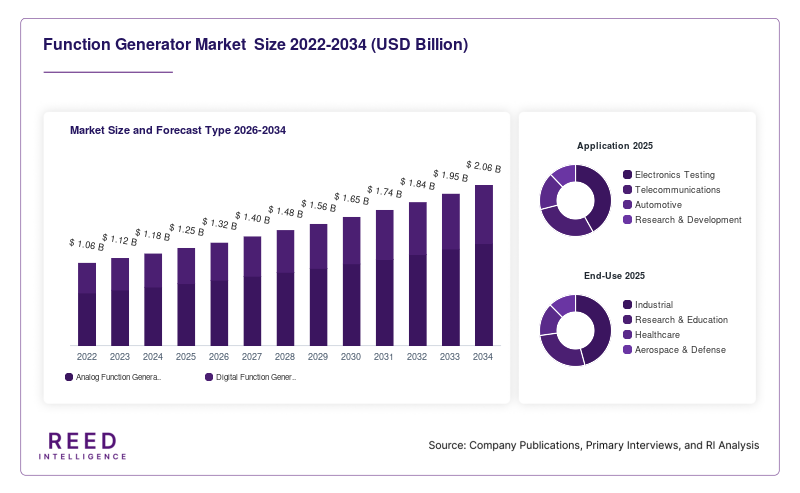
The analog function generators segment dominated the market in 2024, accounting for approximately 58% of the total share. These generators are widely used due to their simplicity, reliability, and cost-effectiveness. Analog devices are preferred in basic testing applications, educational institutions, and small-scale industries where high precision is not critical. Their ease of use and lower cost make them accessible to a wide range of users. Additionally, analog function generators are often used for generating standard waveforms, making them suitable for routine testing and troubleshooting tasks.
The digital function generators segment is expected to be the fastest-growing, with a CAGR of 6.3% during the forecast period. The growth is driven by the increasing demand for advanced features such as arbitrary waveform generation, high-frequency output, and digital interfaces. Digital generators offer greater flexibility and precision, making them suitable for complex testing applications in research and development. The adoption of digital technologies in various industries is further supporting the growth of this segment.
By Application
The electronics testing segment held the largest share in 2024, accounting for around 45% of the market. Function generators are essential tools in testing electronic circuits, components, and systems. The increasing complexity of electronic devices has led to a higher demand for accurate and reliable testing solutions. This segment benefits from the growth of consumer electronics, automotive electronics, and industrial control systems, where function generators are used extensively for validation and quality assurance.
The telecommunications segment is projected to be the fastest-growing, with a CAGR of 6.1%. The expansion of 5G networks and next-generation communication systems is driving demand for advanced testing equipment. Function generators are used to simulate communication signals and test network performance. The increasing need for high-frequency and complex waveform generation is supporting the growth of this segment.
By End-Use
The industrial sector dominated the market in 2024, accounting for approximately 50% of the total share. Industries such as manufacturing, automotive, and aerospace rely on function generators for testing and maintenance of equipment. The adoption of automation and digitalization in industrial processes has increased the demand for reliable testing tools. Function generators are used to ensure the proper functioning of control systems and machinery.
The research and education segment is expected to grow at the fastest rate, with a CAGR of 6.0%. The increasing number of engineering institutions and research laboratories is driving demand for function generators. These devices are essential for experimental setups and training purposes. The growing focus on innovation and technological development is further supporting the growth of this segment.
Regional Analysis
North America
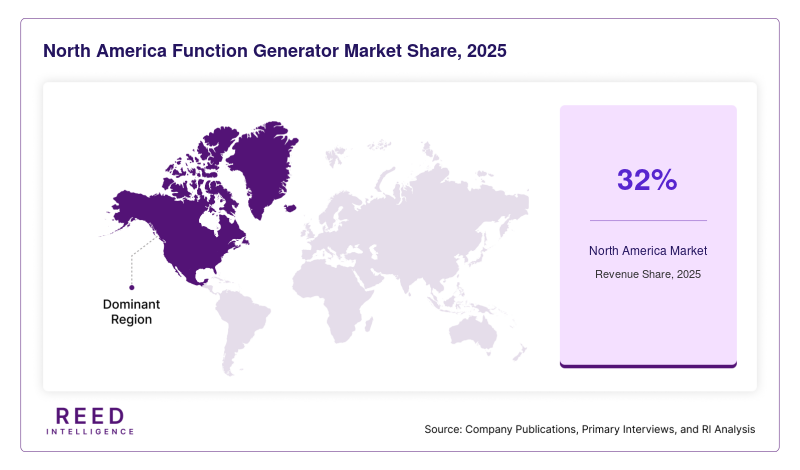
North America accounted for approximately 32% of the Function Generator Market share in 2025, driven by strong demand from the telecommunications, aerospace, and defense sectors. The region is expected to grow at a CAGR of 5.3% during the forecast period. The presence of advanced research facilities and high adoption of cutting-edge technologies contributes to sustained market growth. Additionally, increasing investments in 5G infrastructure and semiconductor development are supporting demand for function generators.
The United States dominates the regional market due to its robust electronics manufacturing base and significant R&D investments. A unique growth factor is the strong presence of defense and aerospace industries, which require precise testing equipment for mission-critical applications. This drives consistent demand for high-performance function generators across various applications.
Europe
Europe held around 25% market share in 2025, with a projected CAGR of 5.1% through 2034. The region’s growth is supported by advancements in industrial automation, automotive electronics, and renewable energy systems. European manufacturers are focusing on improving production efficiency, which increases the need for reliable testing solutions such as function generators.
Germany leads the European market, driven by its strong automotive and industrial sectors. A unique growth factor is the region’s emphasis on Industry 4.0 initiatives, which require advanced testing and simulation tools. This has led to increased adoption of function generators in automated production environments.
Asia Pacific
Asia Pacific is the fastest-growing region, accounting for 28% of the market share in 2025 and expected to grow at a CAGR of 6.5%. Rapid industrialization, expanding electronics manufacturing, and increasing investments in telecommunications infrastructure are key factors driving growth. The region is becoming a global hub for electronics production, boosting demand for testing equipment.
China dominates the market in Asia Pacific due to its large-scale electronics manufacturing industry. A unique growth factor is the government’s focus on technological self-reliance and innovation, which encourages the adoption of advanced testing equipment, including function generators.
Middle East & Africa
The Middle East & Africa region held approximately 8% market share in 2025, with a projected CAGR of 5.0%. Growth in this region is driven by increasing investments in telecommunications infrastructure and industrial development. The adoption of advanced testing equipment is gradually increasing as industries modernize their operations.
The United Arab Emirates is a key market in the region, supported by its focus on smart city initiatives and technological advancement. A unique growth factor is the growing emphasis on infrastructure development, which requires reliable testing and measurement tools, including function generators.
Latin America
Latin America accounted for about 7% of the market share in 2025, with a forecast CAGR of 4.8%. The region is witnessing gradual growth due to increasing industrialization and expansion of the electronics sector. Governments are investing in infrastructure and technology, which supports market development.
Brazil leads the market in Latin America, driven by its growing manufacturing sector. A unique growth factor is the increasing adoption of automation in industrial processes, which requires efficient testing solutions. This is contributing to the steady demand for function generators in the region.
Competitive Landscape
The Function Generator Market is moderately competitive, with several established players focusing on innovation, product development, and strategic partnerships. Leading companies are investing in advanced technologies such as arbitrary waveform generation, enhanced connectivity, and user-friendly interfaces to strengthen their market position.
One of the leading players is Keysight Technologies, which has a strong presence in the global market due to its extensive product portfolio and focus on innovation. The company recently introduced advanced function generators with improved frequency range and digital capabilities, catering to the growing demand for high-performance testing equipment.
Other key players are also focusing on expanding their product offerings and entering emerging markets to increase their market share. Strategic collaborations, acquisitions, and product launches are common strategies adopted by companies to remain competitive in the market.
Key Players
- Keysight Technologies
- Tektronix Inc.
- Rohde & Schwarz
- National Instruments Corporation
- B&K Precision Corporation
- GW Instek
- Rigol Technologies
- Stanford Research Systems
- Good Will Instrument Co., Ltd.
- Teledyne LeCroy
- Aim-TTi
- Siglent Technologies
- Hameg Instruments
- Fluke Corporation
- EXFO Inc.
Recent Developments
- In 2024, Keysight Technologies launched a new series of high-frequency function generators designed for advanced 5G testing applications.
- In 2023, Tektronix introduced compact and portable function generators with enhanced battery life and wireless connectivity.
- In 2024, Rohde & Schwarz expanded its product portfolio by introducing function generators with improved arbitrary waveform capabilities for research applications.
Function Generator Market Segments
Type
- Analog Function Generators
- Digital Function Generators
Application
- Electronics Testing
- Telecommunications
- Automotive
- Research & Development
End-Use
- Industrial
- Research & Education
- Healthcare
- Aerospace & Defense
By Region
- North America
- Europe
- APAC
- Middle East and Africa
- LATAM