Fungal Staining Reagent Market Size, Share & Demand Report By Type (Calcofluor White Stain, Periodic Acid-Schiff (PAS) Stain, Gomori Methenamine Silver Stain, Others), By Application (Clinical Diagnostics, Research Applications), By End-Use (Hospitals & Diagnostic Laboratories, Academic & Research Institutes), By Distribution Channel (Direct Sales, Distributors), By Region & Segment Forecasts, 2025–2034
USD 3950
Market Overview
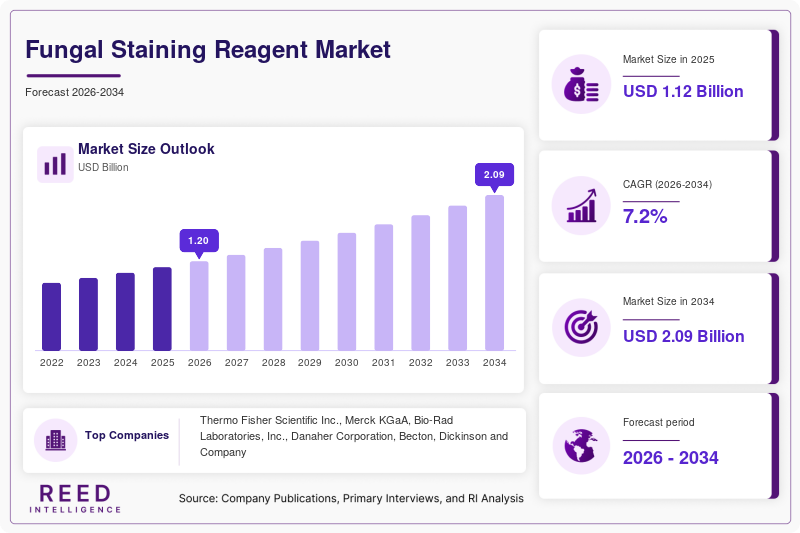
The global Fungal Staining Reagent Market size was estimated at USD 1.12 billion in 2025 and is projected to reach approximately USD 2.08 billion by 2034, expanding at a CAGR of 7.2% during the forecast period (2025–2034). The market growth is primarily supported by the increasing burden of fungal infections worldwide, particularly in immunocompromised populations, alongside rising diagnostic awareness across healthcare systems. Advances in laboratory diagnostics and the growing adoption of histopathology and microbiology testing have further strengthened demand for fungal staining reagents.
A key global factor supporting the growth of the Fungal Staining Reagent Market is the expansion of healthcare infrastructure in emerging economies, which has increased access to diagnostic testing. Improved laboratory capabilities and government-led disease surveillance programs have also contributed to higher testing volumes. In addition, the rise in hospital-acquired infections and the need for accurate pathogen identification continue to drive reagent consumption across clinical laboratories.
Key Highlights:
- North America dominated the market with a share of 38.6% in 2025, while Asia Pacific is projected to grow at the fastest CAGR of 8.6% through 2034.
- By type, Calcofluor white stain accounted for the largest share (34.2%) in 2024, while PAS stain is expected to grow at the fastest CAGR of 8.9%.
- By application, clinical diagnostics led with 46.8% share in 2024, while research applications are projected to expand at a CAGR of 8.4%.
- The United States remained the dominant country, with market values of USD 362 million in 2024 and USD 387 million in 2025.
Market Trends
Increasing Adoption of Fluorescent Staining Techniques
The Fungal Staining Reagent Market is witnessing a shift toward fluorescent staining techniques such as Calcofluor white staining. These methods provide faster detection and higher sensitivity compared to conventional staining techniques. Laboratories are increasingly adopting fluorescence microscopy due to its ability to deliver rapid and accurate fungal identification, particularly in critical care settings. This trend is supported by technological advancements in imaging systems and growing demand for early disease diagnosis.
Integration of Automated Diagnostic Systems
Automation in diagnostic laboratories is reshaping the Fungal Staining Reagent Market. Automated staining platforms and integrated diagnostic systems are being widely adopted to improve workflow efficiency and reduce human error. These systems enable standardized staining procedures, ensuring reproducibility and consistency in test results. The integration of artificial intelligence and digital pathology is further enhancing diagnostic capabilities, allowing faster interpretation of stained samples. This trend is expected to drive demand for compatible and high-quality reagents.
Market Drivers
Rising Prevalence of Fungal Infections
The increasing incidence of fungal infections globally is a major driver of the Fungal Staining Reagent Market. Factors such as the growing number of immunocompromised individuals, including cancer patients and organ transplant recipients, have significantly increased susceptibility to fungal diseases. Additionally, the spread of invasive fungal infections in hospital settings has necessitated improved diagnostic capabilities. This has directly contributed to the rising demand for staining reagents used in laboratory diagnosis.
Growth in Diagnostic Testing and Laboratory
The expansion of diagnostic laboratories and increasing test volumes are fueling the growth of the Fungal Staining Reagent Market. Governments and private healthcare providers are investing in laboratory infrastructure to improve disease detection rates. The increasing focus on early diagnosis and preventive healthcare has also led to higher testing frequency. As a result, demand for staining reagents used in microbiology and histopathology laboratories continues to grow steadily.
Market Restraint
Limited Sensitivity of Conventional Staining Methods
A key restraint affecting the Fungal Staining Reagent Market is the limited sensitivity and specificity of traditional staining techniques. Conventional methods such as potassium hydroxide (KOH) preparation may fail to detect low fungal loads, leading to false-negative results. This limitation can impact clinical decision-making and delay treatment. Additionally, the dependence on skilled laboratory personnel for accurate interpretation of stained samples poses a challenge, particularly in resource-limited settings. The lack of standardization across laboratories further contributes to variability in results. These factors may hinder the adoption of staining reagents in certain regions and limit overall market growth.
Market Opportunities
Expansion in Emerging Markets
Emerging economies present significant growth opportunities for the Fungal Staining Reagent Market. Rapid urbanization, improving healthcare infrastructure, and increasing healthcare expenditure are driving the demand for diagnostic services. Governments in these regions are focusing on strengthening laboratory networks and disease surveillance systems, which is expected to boost reagent consumption. Additionally, rising awareness about fungal infections is encouraging early diagnosis, further supporting market growth.
Development of Advanced Staining Solutions
The development of advanced staining reagents with improved sensitivity and specificity offers promising opportunities for the market. Manufacturers are focusing on innovative formulations that provide faster results and enhanced visualization of fungal structures. The introduction of ready-to-use kits and multiplex staining solutions is expected to simplify laboratory workflows and reduce processing time. These advancements are likely to increase adoption among healthcare providers and research institutions.
Segmental Analysis
By Type
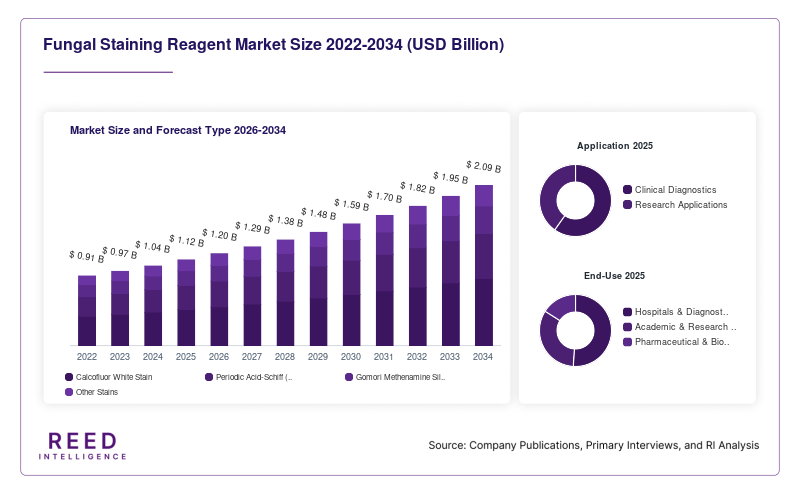
Calcofluor white stain dominated the Fungal Staining Reagent Market with a share of 34.2% in 2024. Its widespread adoption was attributed to its high sensitivity and ability to rapidly detect fungal elements under fluorescence microscopy. The reagent’s effectiveness in identifying a wide range of fungal species made it a preferred choice in clinical laboratories.
Periodic Acid-Schiff (PAS) stain is expected to be the fastest-growing subsegment, with a projected CAGR of 8.9% during the forecast period. Its ability to provide detailed visualization of fungal structures in tissue samples will drive its adoption. Increasing use in histopathology and rising demand for accurate diagnosis will further support its growth.
By Application
Clinical diagnostics accounted for the largest share of 46.8% in 2024 in the Fungal Staining Reagent Market. The segment’s dominance was driven by the high volume of diagnostic tests performed in hospitals and laboratories. The growing prevalence of fungal infections and increasing focus on early diagnosis contributed to its leading position.
Research applications are projected to grow at the fastest CAGR of 8.4% over the forecast period. The increasing focus on fungal biology and drug development is expected to drive demand for staining reagents in research settings. Advancements in molecular biology and microbiology research will further support segment growth.
By End-Use
Hospitals and diagnostic laboratories held the largest share of 52.5% in 2024. The segment’s dominance was attributed to the high volume of patient testing and availability of advanced diagnostic equipment. The increasing burden of infectious diseases further contributed to its growth.
Academic and research institutes are expected to witness the fastest growth, with a CAGR of 8.1% during the forecast period. Rising research activities and funding for infectious disease studies will drive demand for staining reagents in this segment.
By Distribution Channel
Direct sales accounted for the largest share in 2024, driven by strong relationships between manufacturers and healthcare providers. Direct procurement ensured consistent supply and quality assurance, making it a preferred distribution channel.
Online distribution channels are expected to grow at the fastest CAGR of 9.2% during the forecast period. The increasing adoption of e-commerce platforms for laboratory supplies and the convenience of online purchasing will drive growth in this segment.
Regional Analysis
North America
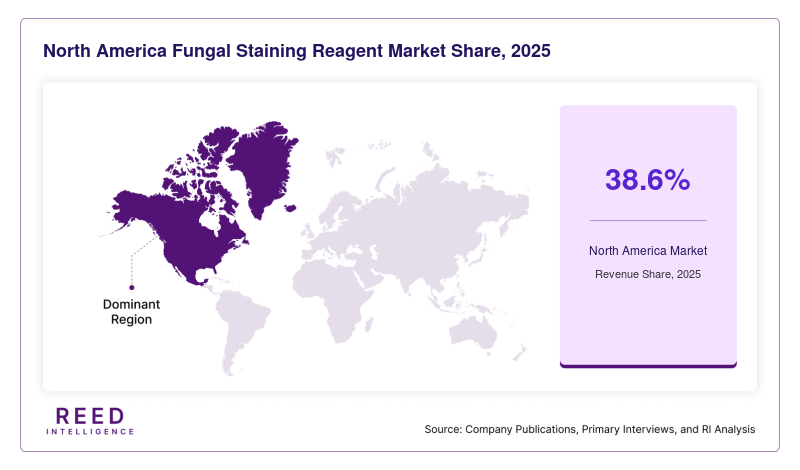
North America accounted for approximately 38.6% of the Fungal Staining Reagent Market share in 2025 and is expected to grow at a CAGR of 6.5% during the forecast period. The region benefited from a well-established healthcare infrastructure and high adoption of advanced diagnostic technologies.
The United States dominated the regional market due to its strong laboratory network and high diagnostic testing rates. The presence of leading diagnostic companies and continuous investment in healthcare innovation supported market growth. Additionally, increasing awareness of fungal infections and rising healthcare expenditure contributed to sustained demand for staining reagents.
Europe
Europe held around 27.4% of the global Fungal Staining Reagent Market share in 2025 and is projected to grow at a CAGR of 6.8% through 2034. The region demonstrated steady growth due to its robust healthcare systems and focus on disease prevention.
Germany emerged as the dominant country in Europe, supported by its advanced laboratory infrastructure and strong research base. The country’s emphasis on clinical research and diagnostic innovation contributed to increased adoption of fungal staining reagents. Additionally, rising cases of fungal infections in healthcare settings supported market expansion.
Asia Pacific
Asia Pacific represented 22.1% of the Fungal Staining Reagent Market share in 2025 and is expected to grow at the fastest CAGR of 8.6% during the forecast period. The region showed rapid growth due to increasing healthcare investments and expanding diagnostic capabilities.
China led the regional market, driven by its large population base and growing healthcare infrastructure. Government initiatives to improve diagnostic services and increasing awareness of infectious diseases contributed to higher demand for staining reagents. The expansion of laboratory networks further supported market growth.
Middle East & Africa
The Middle East & Africa accounted for 6.3% of the Fungal Staining Reagent Market share in 2025 and is projected to grow at a CAGR of 7.1% over the forecast period. The region experienced gradual growth due to improving healthcare access and increasing focus on disease diagnosis.
Saudi Arabia dominated the market in this region, supported by government investments in healthcare infrastructure. The country’s efforts to enhance diagnostic capabilities and expand laboratory services contributed to increased adoption of fungal staining reagents.
Latin America
Latin America held approximately 5.6% of the Fungal Staining Reagent Market share in 2025 and is expected to grow at a CAGR of 7.0% during the forecast period. The region demonstrated moderate growth due to improving healthcare systems and rising awareness of infectious diseases.
Brazil emerged as the leading country in the region, driven by its expanding healthcare sector and increasing diagnostic testing. Government initiatives to improve healthcare access and growing investments in laboratory infrastructure supported market growth.
Competitive Landscape
The Fungal Staining Reagent Market is moderately fragmented, with several global and regional players competing based on product quality, innovation, and distribution networks. Key companies are focusing on expanding their product portfolios and developing advanced staining solutions to strengthen their market position.
A leading player in the market is Thermo Fisher Scientific, which has maintained a strong presence through continuous product innovation and strategic acquisitions. The company recently introduced advanced staining kits designed for improved diagnostic accuracy and workflow efficiency.
Other prominent players are actively investing in research and development to introduce new products and enhance existing offerings. Strategic collaborations with healthcare institutions and research organizations are also being adopted to expand market reach and improve product adoption.
Key Players
- Thermo Fisher Scientific Inc.
- Merck KGaA
- Bio-Rad Laboratories, Inc.
- Danaher Corporation
- Becton, Dickinson and Company
- Abcam plc
- Agilent Technologies, Inc.
- HiMedia Laboratories Pvt. Ltd.
- Hardy Diagnostics
- BioMérieux SA
Recent Developments
- In 2024, Thermo Fisher Scientific launched a new range of fluorescent fungal staining kits to enhance diagnostic efficiency.
- In 2023, Merck KGaA expanded its staining reagent portfolio with improved formulations for histopathology applications.
- In 2024, Bio-Rad Laboratories introduced automated staining solutions compatible with digital pathology systems.
- In 2023, HiMedia Laboratories expanded its manufacturing capacity to meet rising global demand.
- In 2024, Danaher Corporation strengthened its diagnostics segment through strategic partnerships with research institutions.
Fungal Staining Reagent Market Segments
Type
- Calcofluor White Stain
- Periodic Acid-Schiff (PAS) Stain
- Gomori Methenamine Silver (GMS) Stain
- Other Stains
Application
- Clinical Diagnostics
- Research Applications
End-Use
- Hospitals & Diagnostic Laboratories
- Academic & Research Institutes
- Pharmaceutical & Biotechnology Companies
Distribution Channel
- Direct Sales
- Distributors
- Online Channels
By Region
- North America
- Europe
- APAC
- Middle East and Africa
- LATAM