Furan Resin Market Size, Share & Demand Report By Type (Furfuryl Alcohol Resin, Phenol-Furan Resin, Urea-Formaldehyde Furan Resin, Others), By Application (Foundry Binders, Corrosion-Resistant Materials, Refractory Applications,Composite Materials), By End-Use Industry (Automotive Manufacturing, Aerospace and Defense, Industrial Machinery) By Region & Segment Forecasts, 2026–2034
USD 3950
Market Overview
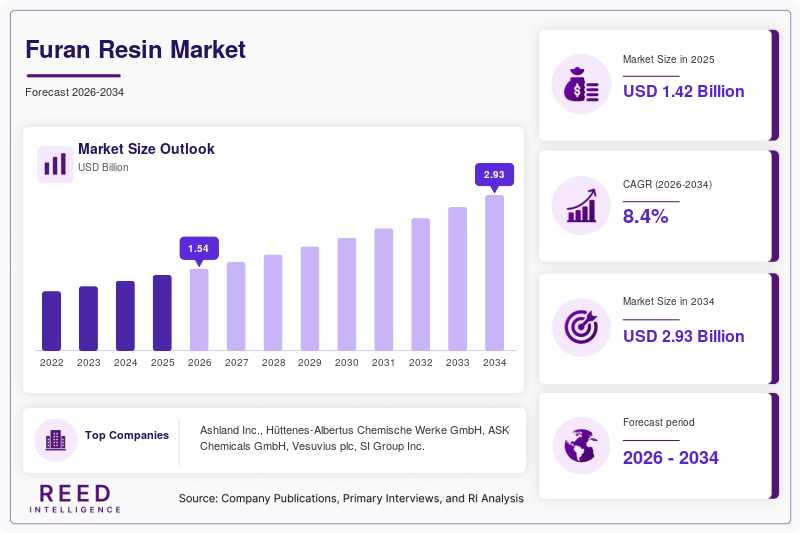
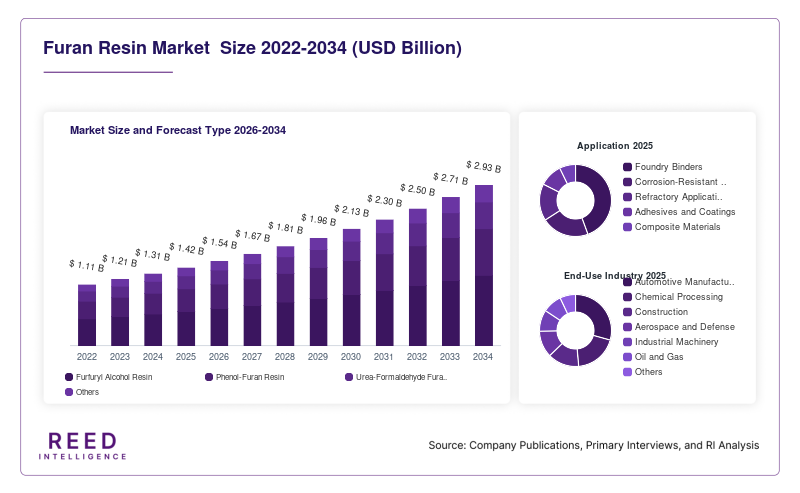
The global Furan Resin Market size was valued at USD 1.42 billion in 2026 and is projected to reach USD 2.71 billion by 2034, expanding at a CAGR of 8.4% during the forecast period from 2026 to 2034. Rising demand for heat-resistant and corrosion-resistant materials across foundry, construction, automotive, and chemical processing industries continues to support long-term market growth. Furan resins are widely used in molding sand binders, refractory applications, and composite materials due to their thermal stability, mechanical strength, and low gas generation characteristics. Manufacturers are increasingly adopting these resins to improve production efficiency and reduce casting defects in metal fabrication processes.
The growing focus on industrial infrastructure development has strengthened the consumption of furan resin products in both developed and emerging economies. Expansion of automotive manufacturing facilities, increased investment in steel production, and rising demand for precision metal casting components are contributing to stable market expansion. In addition, stricter industrial quality standards have encouraged manufacturers to adopt advanced binder systems that improve product consistency and operational durability. The market is also benefiting from technological advancements in low-emission resin formulations designed to comply with environmental regulations.
Key Highlights
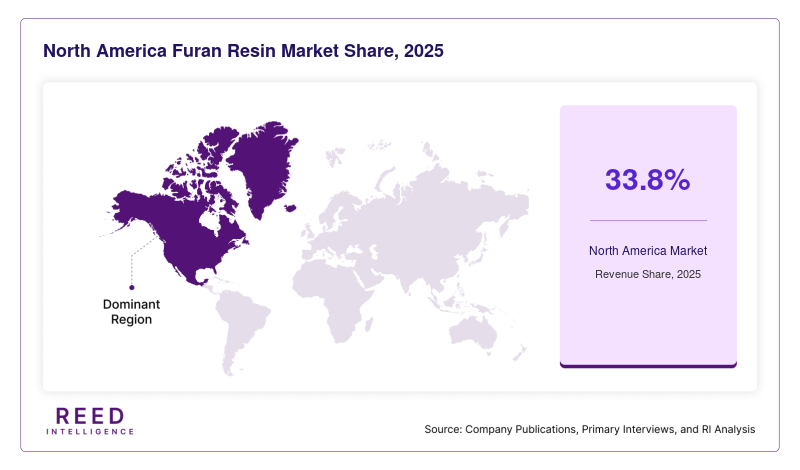
- North America dominated the market with a 33.8% share in 2025.
- Asia Pacific is expected to grow at the fastest CAGR of 10.9% during 2026–2034.
- By type, furfuryl alcohol resin accounted for the largest share of 44.6%.
- while urea-formaldehyde furan resin is projected to grow at a CAGR of 9.8%.
- By application, foundry binders led with a 47.3% share, whereas corrosion-resistant materials are expected to expand at a CAGR of 10.2%.
- By end-use industry, automotive manufacturing held the dominant share of 31.5%, while chemical processing is anticipated to register a CAGR of 9.6%.
- The United States remained the dominant country, with market values of USD 392 million in 2024 and USD 427 million in 2025.
Market Trends
Growing Adoption of Low-Emission Resin Technologies
Industrial manufacturers are increasingly adopting low-emission furan resin technologies to comply with tightening environmental regulations and workplace safety standards. Traditional resin systems often release volatile compounds during the curing and molding process, leading companies to invest in advanced formulations with reduced emissions and improved occupational safety performance. Foundries across North America and Europe are implementing modified furan binder systems that reduce odor generation and improve indoor air quality without affecting casting precision. This trend is supporting innovation among resin producers, who are developing environmentally compliant products suitable for automated casting operations. In addition, customer demand for cleaner production methods is encouraging suppliers to promote sustainable resin alternatives that maintain strength and durability while lowering environmental impact.
Expansion of Advanced Metal Casting Applications
The rapid growth of advanced metal casting operations in automotive, aerospace, and industrial machinery sectors is influencing the expansion of the Furan Resin Market. Manufacturers are using furan-based binders to improve mold integrity, dimensional accuracy, and thermal resistance in high-performance cast components. Demand for lightweight engine parts, industrial pumps, valves, and precision machinery has increased the use of complex casting technologies where furan resins provide operational advantages. Emerging economies are also expanding local foundry capabilities to support domestic manufacturing growth, creating new opportunities for resin suppliers. Increased investment in automated molding systems and robotic casting lines is further strengthening the adoption of high-performance furan resin formulations designed for consistent quality and faster production cycles.
Market Drivers
Rising Demand from the Global Foundry Industry
The continuous expansion of the global foundry industry remains one of the primary growth drivers for the Furan Resin Market. Furan resins are widely utilized as binder systems in sand casting applications because they provide strong mold stability, thermal endurance, and reduced casting defects. Automotive manufacturers, machinery producers, and infrastructure developers are increasing their demand for precision metal components, leading foundries to improve operational efficiency and product quality. As industrial production rises across developing economies, foundries are investing in advanced molding technologies that rely heavily on high-performance resin systems. In addition, increased demand for heavy equipment and industrial machinery is creating stable consumption patterns for furan resins in steel and iron casting operations.
Increasing Infrastructure and Industrial Development Activities
Rapid industrialization and infrastructure development projects across Asia Pacific, the Middle East, and Latin America are contributing significantly to market growth. Governments are investing in transportation systems, manufacturing facilities, energy infrastructure, and construction projects that require durable metal and refractory components produced through advanced casting processes. Furan resin products are gaining preference due to their ability to withstand harsh operating environments and maintain structural integrity under high temperatures. The expansion of industrial manufacturing clusters and special economic zones is also increasing demand for corrosion-resistant materials used in chemical plants and processing units. Furthermore, rising investments in renewable energy facilities and industrial modernization projects are supporting long-term consumption of advanced resin technologies.
Market Restraint
Volatility in Raw Material Prices and Environmental Concerns
Fluctuating raw material prices continue to create challenges for manufacturers operating in the Furan Resin Market. The production of furan resins depends heavily on furfuryl alcohol and other chemical feedstocks whose prices are influenced by agricultural supply conditions, crude oil fluctuations, and international trade dynamics. Sudden changes in raw material costs can affect profit margins and limit pricing flexibility for resin producers. Smaller manufacturers often face operational pressure because they have limited ability to absorb rising procurement expenses. In addition, environmental concerns associated with formaldehyde emissions and hazardous chemical exposure have increased regulatory scrutiny in several countries. Compliance with emission standards and worker safety regulations requires additional investment in production technologies and emission control systems. Some end users are also evaluating alternative binder systems with lower environmental impact, particularly in regions where sustainability requirements are becoming stricter. These factors may slow adoption rates among cost-sensitive industries and create barriers for new market entrants.
Market Opportunities
Development of Bio-Based and Sustainable Resin Formulations
The growing emphasis on sustainable manufacturing practices is creating opportunities for bio-based furan resin formulations. Manufacturers are focusing on renewable feedstock materials and low-toxicity production methods to meet evolving environmental standards and customer expectations. Bio-based furan resins derived from agricultural byproducts are attracting interest from foundries and industrial manufacturers seeking to reduce carbon emissions and improve sustainability reporting. Companies investing in research and development activities are expected to gain competitive advantages through innovative product offerings that combine environmental performance with operational efficiency. In addition, government incentives supporting green industrial materials are encouraging broader adoption of sustainable resin technologies across construction, transportation, and heavy manufacturing sectors.
Expansion of Industrial Manufacturing in Emerging Economies
Emerging economies across Asia Pacific, Africa, and Latin America present substantial growth opportunities for market participants. Rising urbanization, industrial investment, and expansion of domestic manufacturing capabilities are increasing demand for metal casting products and industrial chemicals. Countries such as India, Indonesia, Brazil, and Vietnam are investing heavily in automotive production, industrial machinery, and infrastructure development, creating favorable conditions for furan resin suppliers. International manufacturers are establishing regional production facilities and distribution networks to strengthen market presence and reduce supply chain costs. The increasing adoption of automation in local foundries is also encouraging demand for advanced binder systems that improve efficiency and casting quality. These developments are expected to support long-term revenue growth for global and regional market players.
Segmental Analysis
By Type
Furfuryl alcohol resin emerged as the dominant subsegment within the type category, accounting for 44.6% of the global market share in 2024. This segment continues to maintain strong demand because of its superior thermal resistance, excellent bonding strength, and compatibility with advanced foundry applications. Industrial manufacturers prefer furfuryl alcohol resin for sand casting operations that require high dimensional stability and reduced gas formation during the molding process. The material is widely used across automotive, machinery, and steel manufacturing industries where consistent mold quality is essential for operational efficiency. In addition, the increasing use of automated casting systems has strengthened demand for resin formulations capable of delivering reliable curing performance and improved casting precision. The segment also benefits from growing industrial investments in durable refractory applications and corrosion-resistant materials used in chemical processing equipment.
Urea-formaldehyde furan resin is projected to witness the fastest CAGR of 9.8% during the forecast period due to its cost efficiency and improved curing characteristics. Manufacturers are increasingly adopting this resin type in medium-scale industrial casting applications where balanced performance and affordability are important purchasing factors. The segment is gaining momentum in emerging economies where foundries are expanding production capabilities while maintaining operational cost control. Advancements in formulation technology have also improved the environmental performance of urea-formaldehyde furan resins by reducing emissions and enhancing workplace safety conditions. Furthermore, increasing infrastructure development projects and industrial equipment manufacturing activities are supporting demand for affordable binder systems with stable mechanical properties. Market participants are investing in research initiatives to improve resin durability and compatibility with automated molding technologies, further supporting long-term segment expansion.
By Application
Foundry binders represented the leading application segment and accounted for 47.3% of the market share in 2024. The widespread use of furan resin binders in metal casting operations continues to support segment dominance across global industrial markets. Foundries utilize these binders because they provide strong mold integrity, excellent thermal resistance, and improved dimensional accuracy during casting procedures. Demand from automotive manufacturing, industrial machinery production, and infrastructure development has significantly increased the need for precision casting materials. The segment has also benefited from rising investments in automated molding technologies designed to improve production speed and reduce operational waste. Large-scale foundries are increasingly adopting advanced resin binder systems to enhance casting consistency and minimize product defects. In addition, the expansion of heavy equipment manufacturing and renewable energy infrastructure projects has further increased consumption of high-performance foundry binder materials.
Corrosion-resistant materials are anticipated to register the fastest CAGR of 10.2% during the forecast period due to increasing industrial demand for durable protective materials. Chemical processing facilities, marine infrastructure projects, and industrial storage systems are utilizing furan resin-based corrosion-resistant products because of their ability to withstand harsh operating environments. The segment is experiencing growth as industries focus on extending equipment lifespan and reducing maintenance expenses associated with chemical exposure and extreme temperatures. Industrial operators are investing in advanced lining systems and composite materials to improve operational reliability in aggressive processing environments. Emerging economies are also increasing investments in petrochemical facilities and industrial processing plants that require high-performance corrosion-resistant solutions. Continuous improvements in resin formulation technologies are enabling manufacturers to deliver enhanced chemical stability and mechanical strength, which is expected to support sustained segment growth.
By End-Use Industry
Automotive manufacturing accounted for the largest share of 31.5% within the end-use industry segment in 2024. The automotive sector relies heavily on advanced casting technologies for the production of engine blocks, transmission systems, brake components, and structural metal parts. Furan resin products are widely used in automotive foundries because they improve mold quality, reduce production defects, and support high-volume manufacturing operations. Growing consumer demand for vehicles and the expansion of electric vehicle production facilities have further strengthened market demand. Automotive manufacturers are increasingly focusing on lightweight metal components and precision engineering solutions that require durable binder systems capable of delivering consistent thermal performance. The segment also benefits from rising investments in automated manufacturing lines designed to improve efficiency and product consistency across large-scale production facilities.
Chemical processing is expected to witness the fastest CAGR of 9.6% during the forecast period due to rising demand for corrosion-resistant and heat-resistant industrial materials. Chemical plants, refineries, and industrial processing facilities are utilizing furan resin-based products in protective linings, storage tanks, flooring systems, and specialized equipment components. The increasing focus on operational safety and equipment durability is driving investments in advanced resin materials capable of withstanding aggressive chemical exposure. Expansion of petrochemical and specialty chemical production capacities across Asia Pacific and the Middle East is further supporting segment growth. Industrial operators are also modernizing existing infrastructure to improve production reliability and reduce maintenance costs associated with material degradation. Technological advancements in resin formulations are enabling improved chemical resistance and longer service life, making furan resin products increasingly attractive for demanding industrial applications.
Regional Analysis
North America
North America accounted for 33.8% of the global Furan Resin Market in 2025 and is expected to maintain a stable growth trajectory with a CAGR of 7.6% during the forecast period. The region benefits from a mature industrial manufacturing sector and strong demand for high-performance foundry materials across automotive, aerospace, and heavy equipment industries. Increasing investment in advanced casting technologies and automation systems has strengthened the adoption of furan resin binders in industrial production facilities. Manufacturers are also prioritizing low-emission resin systems to comply with evolving environmental regulations and improve workplace safety standards.
The United States remains the dominant country within the regional market due to its extensive metal casting industry and advanced manufacturing infrastructure. Large-scale automotive production, aerospace component manufacturing, and energy equipment fabrication continue to generate strong demand for high-performance resin systems. Another important growth factor is the modernization of industrial foundries through robotics and digital monitoring technologies. Companies are increasingly integrating automated molding systems that require reliable binder performance, supporting consistent consumption of advanced furan resin products throughout the country.
Europe
Europe represented 27.4% of the global market in 2025 and is projected to expand at a CAGR of 7.9% between 2026 and 2034. Demand for environmentally compliant industrial materials has become a major market driver across the region. Foundries and industrial manufacturers are adopting low-emission furan resin formulations to meet strict environmental and occupational safety standards established by regional regulatory authorities. Growth in precision engineering, renewable energy equipment manufacturing, and industrial machinery production is also contributing to stable market expansion across European countries.
Germany remains the leading contributor to the regional market because of its strong automotive and industrial engineering sectors. The country has a well-established network of advanced foundries that utilize high-quality binder systems for precision casting applications. A unique growth factor supporting the German market is the increasing production of electric vehicle components and lightweight industrial parts. Manufacturers are investing in efficient casting technologies to improve productivity and reduce waste generation, which is increasing demand for durable and thermally stable furan resin formulations.
Asia Pacific
Asia Pacific held 24.9% of the global Furan Resin Market in 2025 and is anticipated to record the fastest CAGR of 10.9% during the forecast period. Rapid industrialization, expanding automotive manufacturing, and increasing infrastructure investments are driving strong regional demand. Countries across the region are witnessing significant growth in steel production, construction equipment manufacturing, and industrial machinery output. The development of new foundries and expansion of manufacturing clusters have created favorable conditions for resin suppliers. Rising adoption of automated casting technologies is also accelerating the use of advanced binder systems with improved operational performance.
China remains the dominant country in Asia Pacific due to its large-scale industrial manufacturing capacity and extensive metal casting operations. The country continues to invest heavily in transportation infrastructure, renewable energy projects, and industrial modernization programs that require durable casting materials. One unique growth factor is the rapid expansion of domestic electric vehicle production facilities, which has increased demand for lightweight cast components and precision engineering solutions. Local manufacturers are also improving production efficiency by adopting high-performance resin technologies compatible with automated manufacturing systems.
Middle East & Africa
The Middle East & Africa region accounted for 7.2% of the global market in 2025 and is forecast to grow at a CAGR of 8.1% through 2034. Industrial diversification initiatives and infrastructure development projects are supporting increased demand for advanced resin materials across the region. Countries are investing in manufacturing facilities, petrochemical complexes, transportation systems, and construction projects that require corrosion-resistant and heat-resistant components. The rising establishment of regional foundries and industrial processing plants is contributing to growing consumption of furan resin products.
Saudi Arabia remains the dominant country in the regional market due to large-scale industrial development and expanding petrochemical activities. Government-led economic diversification programs are encouraging investment in industrial manufacturing and heavy engineering sectors. A distinct growth factor is the increasing construction of oil and gas processing infrastructure, which requires durable refractory and corrosion-resistant materials. Industrial operators are adopting advanced resin systems to improve operational reliability and extend equipment lifespan in harsh environmental conditions.
Latin America
Latin America captured 6.7% of the global Furan Resin Market in 2025 and is expected to grow at a CAGR of 8.4% during the forecast period. Expanding industrial production and infrastructure investments are supporting market development across several countries. Automotive assembly operations, mining equipment manufacturing, and construction projects are increasing the need for precision casting materials and durable industrial components. Regional foundries are also upgrading production technologies to improve efficiency and meet growing quality standards demanded by export-oriented manufacturing sectors.
Brazil continues to dominate the regional market because of its strong automotive manufacturing base and expanding industrial sector. The country has witnessed rising investment in transportation infrastructure and machinery production, which has strengthened demand for metal casting products. A unique growth factor supporting the Brazilian market is the modernization of agricultural equipment manufacturing facilities. Producers are increasingly utilizing high-performance casting materials and advanced binder systems to improve equipment durability and operational efficiency, creating sustained demand for furan resin technologies.
Competitive Landscape
The global Furan Resin Market is characterized by the presence of established multinational manufacturers and regional specialty chemical producers competing through product innovation, capacity expansion, and strategic partnerships. Leading companies are investing in research and development activities focused on low-emission resin technologies, bio-based formulations, and improved thermal performance. Competition is increasing as industrial customers demand environmentally compliant products with higher operational efficiency and durability. Market participants are also expanding regional distribution networks and production facilities to strengthen supply chain capabilities and improve customer responsiveness.
Ashland Inc. remains one of the leading companies in the market due to its extensive product portfolio, global manufacturing presence, and strong relationships with foundry operators. The company recently introduced a modified low-emission furan binder system designed to reduce workplace emissions while improving mold strength and curing consistency. Other major companies are emphasizing acquisitions and collaborations to expand technological capabilities and strengthen market share in emerging economies. Several manufacturers are also focusing on customized resin formulations tailored for automotive, chemical processing, and industrial machinery applications. The competitive environment is expected to intensify further as sustainability regulations and advanced manufacturing technologies reshape customer purchasing preferences.
Key Players
- Ashland Inc.
- Hüttenes-Albertus Chemische Werke GmbH
- ASK Chemicals GmbH
- Vesuvius plc
- SI Group Inc.
- Hexcel Corporation
- Shengquan Group
- Jinan Yamakawa Chemicals Co., Ltd.
- Furmanite Corporation
- Changzhou Furan Resin Co., Ltd.
- DIC Corporation
- Sumitomo Bakelite Co., Ltd.
- Georgia-Pacific Chemicals LLC
- Koppers Inc.
- Kangnam Chemical Co., Ltd.
Recent Developments
- In February 2026, ASK Chemicals GmbH expanded its resin production facility in Asia Pacific to support increasing demand from regional automotive foundries.
- In September 2025, Ashland Inc. launched a low-emission furan resin product line designed for automated molding operations and improved workplace safety.
- In June 2025, Hüttenes-Albertus Chemische Werke GmbH entered a strategic collaboration with a European metal casting company to develop sustainable binder technologies for precision casting applications.
Furan Resin Market Segments
Type
- Furfuryl Alcohol Resin
- Phenol-Furan Resin
- Urea-Formaldehyde Furan Resin
- Others
Application
- Foundry Binders
- Corrosion-Resistant Materials
- Refractory Applications
- Adhesives and Coatings
- Composite Materials
End-Use Industry
- Automotive Manufacturing
- Chemical Processing
- Construction
- Aerospace and Defense
- Industrial Machinery
- Oil and Gas
- Others
By Region
- North America
- Europe
- APAC
- Middle East and Africa
- LATAM