Fuse Link Market Size, Share & Demand Report By Voltage Type (Low Voltage Fuse Links, Medium Voltage Fuse Links, High Voltage Fuse Links), By Application (Industrial Power Distribution, Renewable Energy Systems, Residential Electrical Systems, Commercial Infrastructure, Transportation Systems), By End-Use (Utilities, Industrial Manufacturing, Commercial Buildings, Residential Sector, Electric Vehicle Infrastructure), By Region & Segment Forecasts, 2026–2034
USD 3950
Market Overview
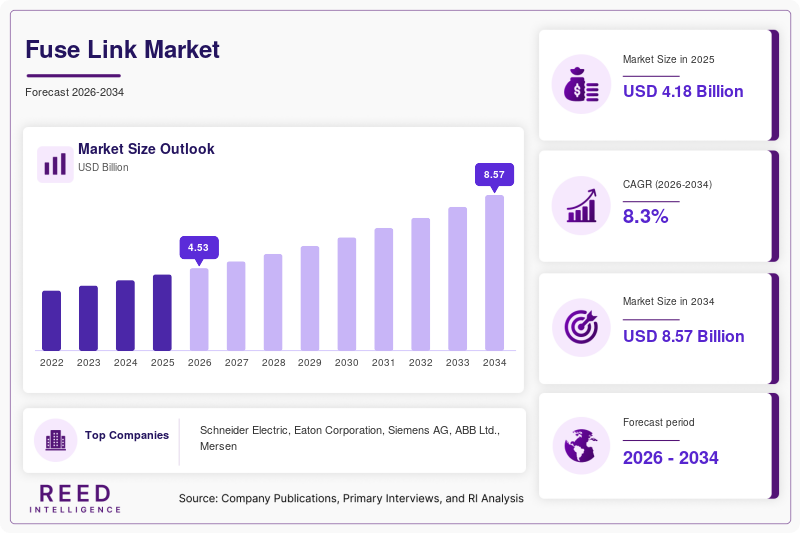
The global Fuse Link Market size was valued at USD 4.18 billion in 2026 and is projected to reach USD 7.92 billion by 2034, expanding at a CAGR of 8.3% during the forecast period from 2026 to 2034. Fuse links are critical electrical protection components used in power distribution systems, industrial equipment, renewable energy installations, residential infrastructure, and transportation networks. The increasing demand for reliable electrical safety systems across utility grids and industrial automation platforms continues to support long-term market expansion. Governments and private utility providers are investing in modern transmission and distribution infrastructure, which has increased the adoption of advanced fuse protection systems in both developed and emerging economies.
The growth of renewable energy projects, particularly solar and wind installations, has also strengthened the need for high-performance fuse links capable of handling fluctuating voltage loads and protecting expensive electrical assets. Rapid industrialization in Asia Pacific and the expansion of electric vehicle charging infrastructure across North America and Europe are further supporting product demand. Manufacturers are increasingly focusing on compact fuse link designs with improved thermal resistance, faster fault interruption capabilities, and extended operational life to meet changing industry requirements.
Key Highlights
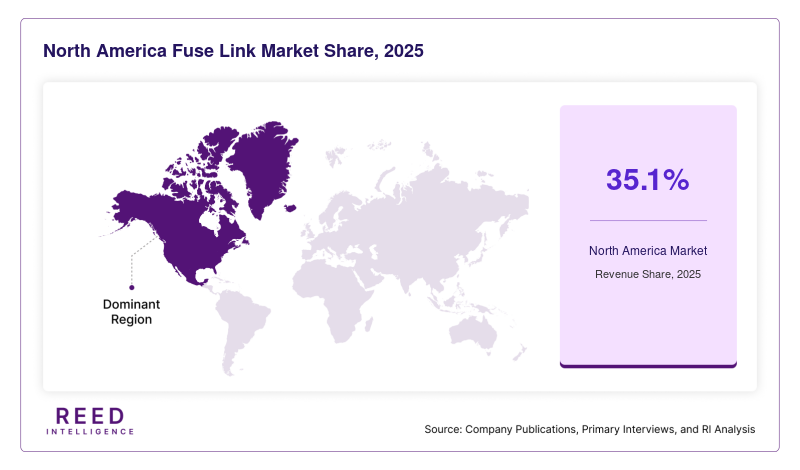
- North America dominated the market with a 35.1% share in 2025, while Asia Pacific is expected to grow at the fastest CAGR of 10.8% during 2026–2034.
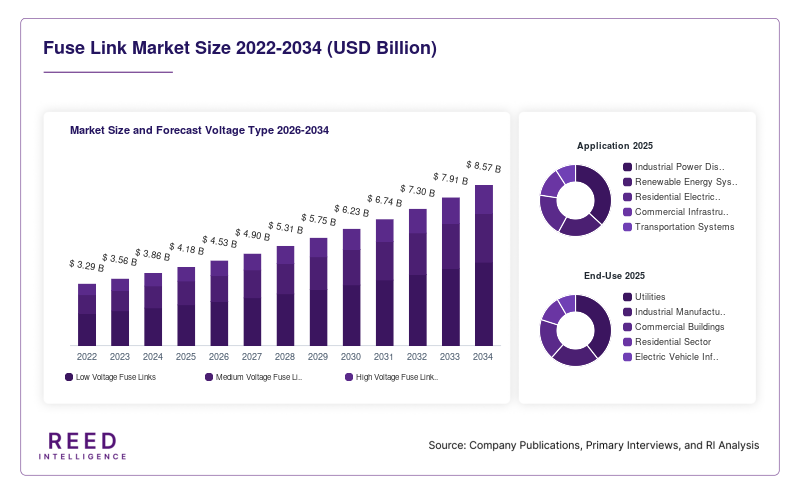
- By voltage type, low voltage fuse links accounted for the largest share of 44.6%, while high voltage fuse links are projected to grow at a CAGR of 10.9%.
- By application, industrial power distribution led with a 39.4% share, whereas renewable energy systems are expected to expand at a CAGR of 11.6%.
- By end-use, utilities accounted for the largest market share of 36.8%, while electric vehicle infrastructure is anticipated to grow at a CAGR of 12.1%.
- The United States remained the dominant country, with market values of USD 760 million in 2024 and USD 825 million in 2025.
Market Trends
Expansion of Smart Grid Infrastructure
The increasing deployment of smart grid infrastructure is influencing product innovation and procurement strategies within the Fuse Link Market. Utility companies across developed economies are modernizing outdated transmission and distribution systems to improve operational reliability, reduce outage frequency, and strengthen grid efficiency. Fuse links are becoming essential components within these modernization programs because they provide rapid fault protection and support uninterrupted electrical flow in complex power networks. Smart grid installations require advanced electrical protection systems capable of operating under varying voltage conditions, creating sustained demand for technologically improved fuse links.
Manufacturers are responding by introducing products with enhanced thermal stability, compact structures, and intelligent monitoring capabilities that align with digital grid management systems. The trend is especially visible in North America and Europe, where utility providers are investing heavily in automated substations and renewable energy integration projects. Increased electricity consumption from urban populations and industrial automation systems is also accelerating the adoption of modern grid protection solutions. As countries continue expanding energy infrastructure investments, smart grid development is expected to remain a major trend supporting long-term market growth.
Rising Integration of Renewable Energy Systems
The growing integration of renewable energy systems is reshaping the operational requirements of electrical protection equipment across global power networks. Solar farms, wind power stations, and energy storage systems require reliable fuse links to protect transformers, converters, and distribution components from overload conditions and electrical faults. Renewable energy installations often experience variable current and voltage conditions, increasing the need for high-performance fuse protection devices capable of maintaining stable operations under fluctuating loads.
Several countries are introducing clean energy targets and carbon reduction policies that encourage investments in renewable infrastructure. These initiatives are increasing the installation of fuse links across utility-scale solar projects, offshore wind facilities, and distributed energy systems. Manufacturers are also developing specialized fuse links with improved interruption capacities for renewable energy applications. Asia Pacific is witnessing particularly strong momentum due to large-scale solar capacity expansion in China and India. The transition toward cleaner energy systems is expected to continue creating significant demand for advanced fuse link technologies throughout the forecast period.
Market Drivers
Increasing Investments in Power Transmission and Distribution Networks
Rising investments in power transmission and distribution infrastructure are supporting strong growth across the Fuse Link Market. Governments and utility operators are upgrading aging electrical systems to improve power reliability, reduce energy losses, and accommodate increasing electricity demand from industrial and residential users. Fuse links play a central role in protecting transformers, switchgear systems, substations, and distribution lines from short circuits and overload conditions, making them essential components within modern electrical networks.
Developing economies are expanding urban infrastructure and rural electrification programs, creating additional opportunities for electrical protection equipment manufacturers. In countries such as India, Brazil, and Indonesia, utility modernization projects are increasing the procurement of low and medium voltage fuse links for grid expansion activities. Developed markets are also replacing obsolete electrical components with more efficient protection systems to comply with updated safety regulations. The combination of rising electricity consumption and infrastructure modernization is expected to maintain stable market demand over the next decade.
Growth in Industrial Automation and Manufacturing Activities
The expansion of industrial automation and advanced manufacturing operations is another important factor driving market growth. Modern manufacturing facilities depend on continuous power supply and efficient equipment protection to maintain production efficiency and reduce operational downtime. Fuse links are widely used in industrial motors, machinery systems, robotics equipment, and control panels to prevent electrical failures and safeguard expensive assets from damage.
Industries including automotive, chemical processing, mining, oil and gas, and electronics manufacturing are increasing investments in automated production systems, particularly across Asia Pacific and Europe. This trend has created consistent demand for durable fuse protection products with higher operational reliability and faster fault interruption capabilities. In addition, the expansion of electric vehicle manufacturing plants and battery production facilities has increased the need for specialized fuse links designed for high-current applications. Manufacturers are introducing industrial-grade fuse links with improved thermal endurance and compact designs to address evolving industrial requirements, further strengthening market growth.
Market Restraint
Volatility in Raw Material Prices and Product Standardization Challenges
Fluctuations in raw material prices continue to create operational and profitability challenges for companies operating in the Fuse Link Market. Fuse links are manufactured using metals such as copper, silver, zinc, and aluminum, along with ceramic and composite insulating materials. Variations in global commodity prices directly affect production costs and pricing strategies for manufacturers. Sudden increases in metal prices can reduce profit margins, particularly for small and medium-sized manufacturers that operate with limited procurement flexibility.
The market also faces challenges associated with product standardization and compliance requirements across different countries and regions. Electrical protection standards vary between North America, Europe, Asia Pacific, and the Middle East, requiring manufacturers to customize fuse link designs to meet local regulations and certification standards. This increases research, testing, and operational costs while extending product development timelines. Smaller companies often struggle to compete with multinational manufacturers that possess stronger regulatory expertise and broader distribution networks. In addition, the availability of low-cost counterfeit products in developing markets affects product reliability and creates pricing pressure for established manufacturers. These factors collectively limit market expansion potential in price-sensitive regions and create barriers for new market entrants.
Market Opportunities
Expansion of Electric Vehicle Charging Infrastructure
The rapid expansion of electric vehicle charging infrastructure presents significant growth opportunities for the Fuse Link Market. Governments worldwide are introducing incentives and regulatory programs to accelerate electric vehicle adoption and reduce carbon emissions. As a result, public and private charging stations are being deployed across urban areas, highways, commercial centers, and residential complexes. Fuse links are essential components in electric vehicle charging systems because they provide protection against overloads, short circuits, and electrical surges.
Fast-charging stations require high-current electrical protection solutions capable of handling substantial power loads while maintaining operational safety. Manufacturers are increasingly developing compact fuse links with improved thermal management capabilities specifically for electric mobility applications. Europe and Asia Pacific are expected to witness substantial infrastructure expansion due to rising electric vehicle sales and supportive government policies. The increasing installation of charging networks in commercial fleets, public transportation systems, and smart cities is expected to create long-term demand for advanced fuse protection technologies during the forecast period.
Growing Demand for Data Centers and Digital Infrastructure
The expansion of data centers and digital infrastructure is creating another promising opportunity for market participants. Cloud computing, artificial intelligence, e-commerce platforms, and digital banking services are increasing global demand for large-scale data processing facilities. Data centers require uninterrupted power supply and highly reliable electrical protection systems to prevent downtime and protect sensitive equipment from electrical faults.
Fuse links are widely used in backup power systems, switchgear assemblies, server racks, and distribution panels within data centers. The rising construction of hyperscale facilities in North America, Europe, and Asia Pacific is expected to strengthen demand for high-performance fuse protection products. In addition, telecommunication infrastructure expansion and the rollout of 5G networks are increasing the need for reliable electrical safety systems. Manufacturers are introducing advanced fuse links with enhanced operational life, compact form factors, and improved energy efficiency to meet the requirements of digital infrastructure operators. The growing dependence on digital technologies and cloud-based operations is likely to support sustained market opportunities over the coming years.
Segmental Analysis
By Voltage Type
Low voltage fuse links accounted for the largest share of the Fuse Link Market in 2024, representing 44.6% of total revenue. These products are widely used across residential buildings, commercial establishments, industrial facilities, and utility distribution networks due to their affordability, reliability, and broad application range. Low voltage fuse links play a critical role in protecting electrical circuits, transformers, motors, and control systems from overload conditions and short circuits. Increasing urbanization and infrastructure expansion in developing economies continue to strengthen demand for low voltage protection devices. The growing adoption of residential automation systems and commercial electrical installations is also supporting segment growth. In addition, utility providers are deploying low voltage fuse links within distribution systems to improve electrical safety and minimize downtime. Their simple installation process, compact design, and cost-effective operation make them suitable for large-scale electrical protection applications across multiple industries.
High voltage fuse links are projected to record the fastest CAGR of 10.9% during the forecast period due to expanding renewable energy infrastructure and transmission network modernization activities. High voltage fuse links are increasingly used in substations, utility transformers, solar farms, and industrial power systems where advanced fault interruption capability is essential. Rising investments in smart grids and long-distance power transmission systems are creating favorable conditions for segment expansion. Countries across Asia Pacific and the Middle East are developing large-scale renewable energy projects that require robust electrical protection systems capable of handling fluctuating voltage loads. Manufacturers are introducing high voltage fuse links with improved thermal endurance, compact dimensions, and enhanced interruption performance to meet evolving utility requirements. Increasing deployment of electric vehicle fast-charging infrastructure and industrial automation systems is also expected to contribute to rapid segment growth over the coming years.
By Application
Industrial power distribution emerged as the dominant application segment in 2024 and accounted for 39.4% of the global market revenue. Industrial facilities rely heavily on fuse links to protect critical machinery, motors, switchgear systems, and control panels from electrical faults and operational disruptions. Sectors such as automotive manufacturing, mining, chemical processing, metal fabrication, and oil and gas continue to increase investments in advanced electrical infrastructure to support automated operations and improve productivity. Fuse links help industrial operators maintain equipment safety, reduce maintenance costs, and minimize unplanned downtime. The expansion of industrial manufacturing facilities across Asia Pacific and Europe has further strengthened segment demand. In addition, rising electricity consumption within industrial environments has increased the importance of dependable circuit protection systems. Manufacturers are focusing on developing industrial-grade fuse links with higher current handling capacity and longer operational life to meet evolving industrial requirements.
Renewable energy systems are expected to witness the fastest CAGR of 11.6% throughout the forecast period due to increasing investments in solar and wind power infrastructure. Fuse links are widely deployed in photovoltaic systems, inverters, battery storage units, and wind turbine installations to ensure operational stability and equipment protection. Governments across North America, Europe, and Asia Pacific are implementing clean energy policies and carbon reduction programs that encourage renewable energy adoption. These initiatives are significantly increasing the need for reliable electrical protection systems capable of operating under variable current and voltage conditions. Manufacturers are developing specialized fuse links designed specifically for renewable energy applications with improved interruption capabilities and thermal resistance. The rapid growth of utility-scale solar farms and offshore wind projects is expected to create sustained demand for advanced fuse protection technologies. Increasing adoption of energy storage systems and hybrid renewable power solutions will further support segment expansion.
By End-Use
Utilities represented the largest end-use segment in 2024, accounting for 36.8% of total market revenue. Utility companies depend on fuse links for protecting substations, transformers, transmission lines, and distribution networks from overload conditions and short circuits. Aging electrical infrastructure across several developed economies has increased investments in grid modernization and replacement programs, which continue to support segment growth. Utility providers are deploying advanced fuse protection systems to improve grid reliability, reduce maintenance costs, and enhance power distribution efficiency. The expansion of smart grid infrastructure and integration of renewable energy capacity into utility networks are also increasing the need for modern fuse link solutions. Countries with rising electricity demand are strengthening transmission and distribution infrastructure, further contributing to market growth. In addition, utilities are increasingly adopting compact and durable fuse links with improved operational efficiency to support long-term infrastructure reliability and compliance with electrical safety regulations.
Electric vehicle infrastructure is anticipated to register the fastest CAGR of 12.1% during the forecast period because of accelerating global electric mobility adoption. Charging stations, battery storage systems, and electric vehicle manufacturing facilities require highly reliable fuse links to protect electrical components from overloads and power fluctuations. Governments are investing heavily in charging infrastructure deployment to support emission reduction targets and transportation electrification initiatives. This trend is particularly visible in Europe, China, and North America, where public and private organizations are rapidly expanding fast-charging networks. Fuse link manufacturers are introducing advanced products with higher current interruption capabilities and improved thermal performance specifically for electric vehicle applications. The increasing production of electric buses, commercial fleets, and passenger vehicles is expected to create additional opportunities for the segment. Growing investment in battery manufacturing plants and energy storage infrastructure will further strengthen long-term demand.
Regional Analysis
North America
North America accounted for 35.1% of the global Fuse Link Market in 2025 and is projected to maintain a stable growth trajectory with a CAGR of 7.9% during the forecast period. The region benefits from well-established electrical infrastructure, high industrial automation adoption, and ongoing investments in smart grid modernization projects. Utility providers across the United States and Canada are upgrading aging transmission systems and integrating renewable energy capacity into existing power grids. These developments continue to increase demand for advanced fuse links capable of supporting complex power distribution networks.
The United States remains the dominant country within the regional market due to strong investments in utility modernization, electric vehicle charging infrastructure, and industrial automation systems. Large-scale renewable energy installations across states such as Texas and California are contributing to increased adoption of high-performance fuse links. The expansion of hyperscale data centers and manufacturing facilities is also supporting product demand. In addition, strict electrical safety standards and infrastructure replacement initiatives are encouraging utilities and industrial operators to procure technologically advanced fuse protection systems.
Europe
Europe represented 27.4% of the global market in 2025 and is expected to expand at a CAGR of 7.6% through 2034. The region continues to experience steady demand due to the modernization of industrial infrastructure and increasing renewable energy deployment. Countries across the European Union are investing in energy-efficient power systems and strengthening grid resilience to support clean energy transition goals. Fuse links are widely used in solar power facilities, industrial automation equipment, railway systems, and commercial infrastructure projects throughout the region.
Germany remains the leading market in Europe because of its advanced manufacturing base and significant renewable energy investments. The country has established strong demand for electrical protection systems within industrial machinery, automotive production plants, and wind energy installations. Growing adoption of electric mobility solutions and expansion of public charging infrastructure are also supporting market growth. European manufacturers are increasingly focusing on environmentally sustainable fuse link materials and compact product designs to comply with regional environmental and energy efficiency standards.
Asia Pacific
Asia Pacific held a market share of 24.8% in 2025 and is projected to record the fastest CAGR of 10.8% during the forecast period. Rapid industrialization, urbanization, and infrastructure development across emerging economies are driving substantial demand for electrical protection equipment. Governments in China, India, South Korea, and Southeast Asia are expanding transmission and distribution networks to support rising electricity consumption from residential, commercial, and industrial sectors. These investments continue to strengthen demand for low and medium voltage fuse links.
China remains the dominant country within the region due to large-scale manufacturing activities, renewable energy expansion, and extensive infrastructure development projects. The country is investing heavily in solar power installations, electric vehicle manufacturing, and industrial automation systems, all of which require reliable electrical protection solutions. India is also emerging as an important growth market because of increasing rural electrification programs and smart city initiatives. The availability of low-cost manufacturing capabilities and strong industrial output further supports regional market expansion.
Middle East & Africa
The Middle East & Africa accounted for 7.2% of the global market in 2025 and is anticipated to grow at a CAGR of 8.1% during the forecast period. Rising investments in utility infrastructure, oil and gas projects, and commercial construction activities are contributing to increasing demand for fuse links across the region. Several countries are strengthening electricity distribution networks to support industrial diversification strategies and population growth. Renewable energy projects, particularly solar installations in Gulf countries, are also increasing the adoption of advanced electrical protection systems.
Saudi Arabia remains the dominant country in the regional market due to substantial investments in industrial development and energy infrastructure modernization. The country’s large-scale smart city projects and renewable energy initiatives are generating additional demand for fuse protection equipment. South Africa is also witnessing growth supported by grid expansion projects and mining sector investments. Regional governments are increasingly focusing on improving electrical reliability and reducing transmission losses, which is encouraging the deployment of modern fuse link solutions across utility and industrial applications.
Latin America
Latin America captured 5.5% of the global Fuse Link Market in 2025 and is forecast to grow at a CAGR of 7.4% through 2034. Infrastructure development programs, urban expansion, and industrial modernization activities are supporting market growth across the region. Several countries are investing in renewable energy capacity and improving transmission infrastructure to address rising electricity demand and reduce dependence on traditional power generation systems. Fuse links are increasingly being deployed in industrial manufacturing facilities, utility substations, and commercial construction projects.
Brazil remains the largest market in Latin America due to ongoing investments in utility infrastructure and renewable energy generation. Expansion of wind and solar projects across the country is increasing the demand for reliable electrical protection devices. Mexico is also contributing to regional growth through industrial manufacturing expansion and automotive production investments. The rising need for stable electricity supply in urban and industrial areas is encouraging utility companies to replace aging electrical systems with modern protection technologies, supporting long-term market development.
Competitive Landscape
The Fuse Link Market remains moderately fragmented, with international and regional manufacturers competing through product innovation, pricing strategies, distribution expansion, and strategic partnerships. Leading companies are focusing on developing advanced fuse links with higher interruption capacities, improved thermal performance, and compact designs to address evolving industrial and utility requirements. Manufacturers are also investing in automation technologies and sustainable production processes to improve operational efficiency and strengthen market positioning.
Schneider Electric emerged as one of the leading companies in the global market due to its strong product portfolio, extensive distribution network, and focus on electrical infrastructure modernization. The company continues to expand its smart grid and renewable energy protection solutions to strengthen its competitive position. Eaton Corporation, Siemens AG, ABB Ltd., and Mersen are also major participants with significant global presence across industrial, utility, and renewable energy applications.
Key Players
- Schneider Electric
- Eaton Corporation
- Siemens AG
- ABB Ltd.
- Mersen
- Littelfuse Inc.
- SIBA GmbH
- Bel Fuse Inc.
- Fuji Electric Co., Ltd.
- Legrand
- General Electric
- Hubbell Incorporated
- SOCOMEC
- DF Electric
- CHINT Group
Recent Developments
- In February 2026, Eaton Corporation introduced a new range of high-speed fuse links designed for electric vehicle fast-charging infrastructure with enhanced thermal management capabilities.
- In August 2025, Schneider Electric expanded its manufacturing facility in India to increase production capacity for industrial and utility fuse protection products.
- In November 2025, Siemens AG launched advanced fuse link solutions for renewable energy systems to support solar and wind power applications with higher interruption performance.
- In March 2026, Mersen announced a strategic partnership with a European renewable energy developer to supply fuse protection systems for large-scale solar installations.
- In January 2026, ABB Ltd. introduced compact medium voltage fuse links aimed at smart grid modernization and urban utility infrastructure projects.
Fuse Link Market Segments
Voltage Type
- Low Voltage Fuse Links
- Medium Voltage Fuse Links
- High Voltage Fuse Links
Application
- Industrial Power Distribution
- Renewable Energy Systems
- Residential Electrical Systems
- Commercial Infrastructure
- Transportation Systems
End-Use
- Utilities
- Industrial Manufacturing
- Commercial Buildings
- Residential Sector
- Electric Vehicle Infrastructure
By Region
- North America
- Europe
- APAC
- Middle East and Africa
- LATAM