Fuse Rails Market Size, Share & Demand Report By Type (DIN Rail Fuse Holders, Modular Fuse Rails, Open Fuse Rails, Enclosed Fuse Rails), By Voltage Range (Low Voltage, Medium Voltage, High Voltage), By End-Use (Industrial Manufacturing, Commercial Infrastructure, Residential Construction, Renewable Energy Infrastructure, Transportation & EV Charging), By Region & Segment Forecasts, 2026–2034
USD 3950
Market Overview
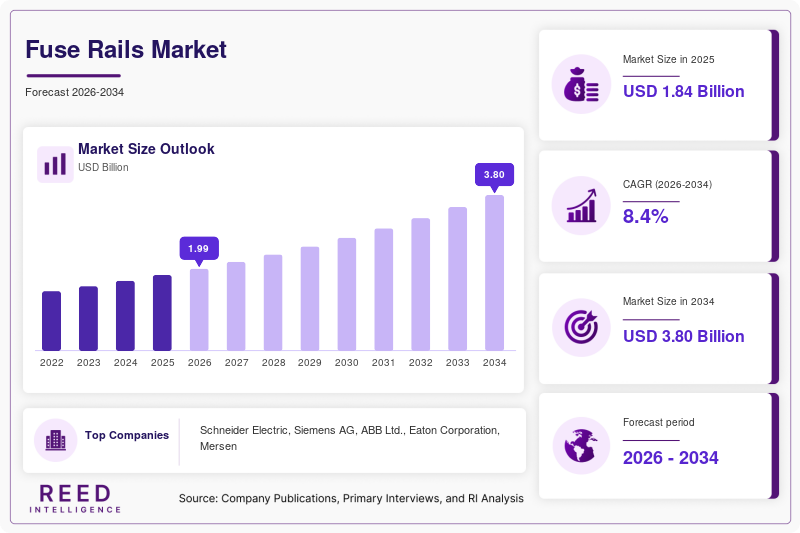
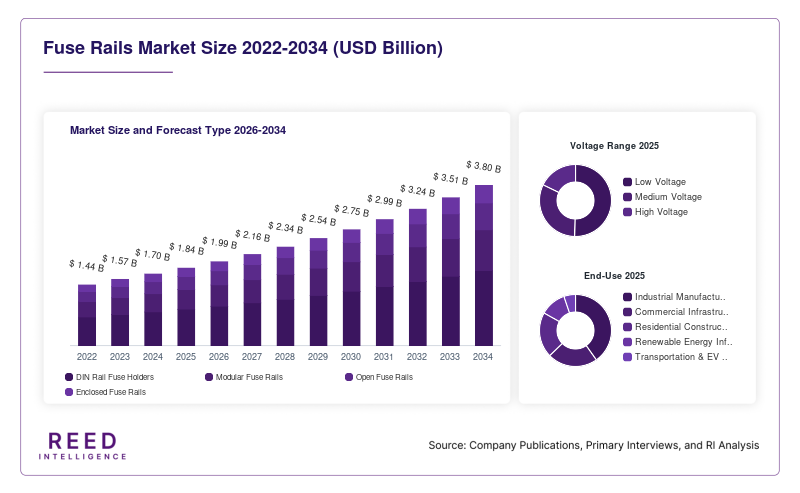
The global Fuse Rails Market size was valued at approximately USD 1.84 billion in 2026 and is projected to reach nearly USD 3.52 billion by 2034, expanding at a CAGR of 8.4% during the forecast period from 2026 to 2034. Fuse rails are increasingly used in industrial automation systems, renewable energy infrastructure, power distribution networks, commercial buildings, and transportation electrification projects. The growing demand for electrical safety systems and compact power management solutions has supported the expansion of the market across developed and emerging economies. Rising investments in grid modernization and smart manufacturing facilities have also increased the installation of modular electrical components, including fuse rails, across utility and industrial environments.
The market is benefiting from the rapid expansion of renewable energy integration projects, particularly solar and wind power installations that require reliable overcurrent protection systems. Manufacturers are focusing on compact fuse rail designs with improved thermal resistance, easier installation methods, and enhanced load-handling capabilities. Digital monitoring compatibility and compliance with evolving industrial safety regulations are further shaping product development strategies. Demand from electric vehicle charging infrastructure and data centers is also contributing to market growth, especially in regions with aggressive energy transition targets
Key Highlights
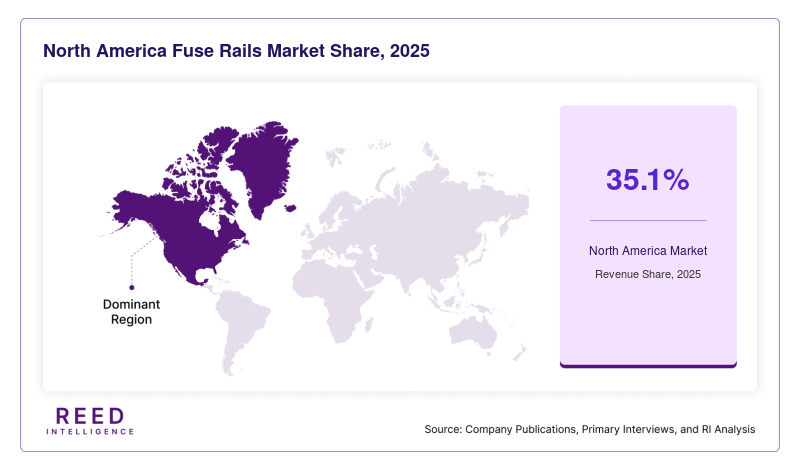
- North America dominated the market with a 35.1% share in 2025.
- Asia Pacific is expected to grow at the fastest CAGR of 10.8% during 2026–2034.
- By type, DIN rail fuse holders accounted for the largest share of 39.4%.
- while modular fuse rails are projected to grow at a CAGR of 11.3%.
- By voltage range, low-voltage fuse rails led with a 48.7% share, whereas medium-voltage fuse rails are expected to expand at a CAGR of 10.6%.
- By end-use, industrial manufacturing held the leading share of 33.6%, while renewable energy infrastructure is projected to grow at a CAGR of 11.7%.
- The United States remained the dominant country, with market values of USD 462 million in 2024 and USD 505 million in 2025.
Market Trends
Integration of Smart Monitoring Capabilities in Fuse Rail Systems
Manufacturers in the Fuse Rails Market are increasingly integrating smart monitoring functions into fuse rail assemblies to improve operational efficiency and electrical safety. Industrial operators are adopting connected electrical systems that can provide real-time monitoring of current flow, temperature fluctuations, and fault conditions. This trend is particularly visible in automated factories, energy management systems, and smart commercial buildings where predictive maintenance has become a major operational requirement. Smart fuse rails equipped with sensor-based diagnostics help reduce downtime and improve fault detection efficiency across complex electrical networks.
The adoption of Industry 4.0 technologies has accelerated demand for intelligent power distribution components that can communicate with centralized monitoring platforms. Companies are introducing fuse rails compatible with industrial communication protocols and cloud-connected monitoring systems. The trend is also supported by rising investments in data centers and utility-scale renewable energy projects, where uninterrupted power protection is essential. These technological improvements are expected to reshape product differentiation strategies among leading market participants during the forecast period.
Expansion of Renewable Energy and EV Charging Infrastructure
The rapid deployment of renewable energy systems and electric vehicle charging networks is creating sustained demand for advanced fuse rail solutions globally. Solar photovoltaic installations, battery storage systems, and EV charging stations require reliable overcurrent protection devices capable of operating under varying electrical loads. Fuse rails are increasingly preferred because they simplify installation procedures and improve space utilization within electrical panels. Governments across Asia Pacific and Europe are supporting clean energy investments, which has positively influenced the installation of power protection infrastructure.
Electric vehicle charging networks are expanding rapidly in urban and highway corridors, creating new opportunities for medium-voltage and modular fuse rail systems. Manufacturers are focusing on products with improved heat dissipation and higher electrical endurance to meet the performance requirements of high-capacity charging stations. Renewable energy developers are also emphasizing standardized electrical safety systems to comply with evolving grid integration regulations. This trend is expected to strengthen long-term market growth prospects across utility, transportation, and commercial infrastructure applications.
Market Drivers
Increasing Industrial Automation and Electrification Projects
The growing adoption of industrial automation systems across manufacturing facilities is a major factor driving the Fuse Rails Market. Modern production plants require advanced electrical distribution systems capable of supporting automated machinery, robotics, and process control equipment. Fuse rails provide organized and compact protection systems that improve operational safety and simplify maintenance procedures. Industries such as automotive manufacturing, chemicals, electronics, and food processing are investing heavily in electrical infrastructure upgrades to improve productivity and reduce operational disruptions.
Industrial electrification initiatives are also contributing to market growth as companies shift toward energy-efficient machinery and digitally controlled production systems. Governments in several countries are supporting domestic manufacturing expansion through infrastructure development incentives and smart factory programs. Fuse rail manufacturers are benefiting from this transition by supplying modular and customizable protection systems suited for industrial environments with varying voltage requirements. The increasing complexity of industrial electrical networks is expected to maintain strong demand for reliable fuse rail solutions over the forecast period.
Rising Investments in Power Distribution and Grid Modernization
Global investments in power distribution infrastructure and grid modernization programs are significantly supporting the growth of the Fuse Rails Market. Aging electrical networks in developed economies require replacement and modernization to improve energy efficiency and grid reliability. Fuse rails play an important role in electrical protection systems used in substations, commercial facilities, and utility distribution panels. Utilities are upgrading transmission and distribution systems to accommodate renewable energy integration and increasing electricity consumption from urbanization and industrial expansion.
Emerging economies are also expanding rural electrification programs and urban power infrastructure projects, creating additional opportunities for fuse rail manufacturers. Smart grid deployment initiatives require advanced protection components capable of handling fluctuating energy loads and distributed power generation systems. Manufacturers are responding by developing products with improved durability, compact dimensions, and enhanced safety standards. Increased spending on infrastructure resilience and energy security is expected to continue driving demand for fuse rail systems across utility and commercial sectors.
Market Restraint
Volatility in Raw Material Prices and Compliance Costs
Fluctuations in the prices of copper, aluminum, engineering plastics, and other industrial raw materials remain a major restraint for the Fuse Rails Market. Manufacturers rely heavily on conductive metals and high-performance insulating materials to produce durable fuse rail systems. Price instability in global commodity markets can significantly impact manufacturing costs and profit margins, particularly for small and medium-sized producers operating in highly competitive regional markets. Supply chain disruptions and geopolitical uncertainties have further increased procurement challenges for electrical component manufacturers.
In addition, compliance with evolving international electrical safety standards and certification requirements increases production and testing expenses. Regulatory frameworks differ across regions, forcing manufacturers to invest in multiple certification processes and product customization strategies. Smaller companies often face difficulties in maintaining competitive pricing while meeting stringent quality expectations. These cost pressures can slow product innovation and delay expansion into price-sensitive emerging markets. The restraint is particularly evident in construction and industrial sectors where procurement decisions are strongly influenced by installation costs and project budgets.
Market Opportunities
Growth Potential in Smart Cities and Urban Infrastructure Projects
The expansion of smart city initiatives across developed and emerging economies presents significant growth opportunities for the Fuse Rails Market. Urban infrastructure projects increasingly require advanced electrical distribution systems that can support intelligent transportation networks, automated lighting systems, surveillance infrastructure, and connected public utilities. Fuse rails provide efficient circuit protection solutions within compact urban electrical installations. Governments are investing heavily in urban modernization programs to improve energy efficiency and infrastructure reliability, creating long-term demand for electrical safety products.
Rapid urbanization in Asia Pacific, the Middle East, and Latin America is accelerating the construction of commercial complexes, residential developments, and transportation systems equipped with advanced electrical networks. Fuse rail manufacturers can benefit by developing modular products tailored for smart infrastructure applications. Integration with digital monitoring systems and energy management platforms is also expected to create new product differentiation opportunities. As urban infrastructure projects prioritize operational efficiency and safety compliance, demand for reliable fuse rail systems is likely to expand steadily.
Increasing Demand from Data Centers and Energy Storage Facilities
The rapid expansion of global data center infrastructure and energy storage facilities is creating attractive opportunities for fuse rail manufacturers. Data centers require highly reliable power distribution systems capable of supporting uninterrupted operations and protecting sensitive electronic equipment from electrical faults. Fuse rails are increasingly used in compact server room electrical panels and backup power systems because they improve installation efficiency and maintenance accessibility.
The growing adoption of battery energy storage systems for renewable energy integration is also contributing to market opportunities. Energy storage facilities require advanced overcurrent protection systems that can manage variable energy loads and high-capacity electrical connections. Manufacturers are developing fuse rails with improved thermal performance and high-current capabilities to address these requirements. Cloud computing expansion, artificial intelligence infrastructure growth, and renewable energy deployment are expected to sustain long-term demand for advanced fuse rail systems across industrial and commercial applications.
Segmental Analysis
By Type
DIN rail fuse holders represented the dominant subsegment in the Fuse Rails Market and accounted for nearly 39.4% of the market share in 2024. These products are widely adopted in industrial control panels, commercial electrical systems, and utility applications because of their standardized installation process and compact structure. DIN rail fuse holders simplify electrical panel organization and reduce installation complexity, making them highly preferred among industrial contractors and maintenance professionals. The increasing deployment of automation equipment and smart electrical distribution systems has further strengthened demand for this segment. Manufacturers are also focusing on enhanced thermal management features and durable insulating materials to improve product reliability in high-load industrial environments. Rising investments in commercial buildings and manufacturing infrastructure continue to support the strong position of DIN rail fuse holders within the global market.
Modular fuse rails are expected to emerge as the fastest-growing subsegment, registering a CAGR of 11.3% during the forecast period. These systems are gaining popularity due to their flexibility, scalability, and ease of integration within modern electrical distribution networks. Modular fuse rails allow operators to customize circuit protection systems according to changing industrial and commercial requirements. Growing demand for energy-efficient electrical systems and compact panel designs is accelerating adoption across renewable energy facilities, data centers, and EV charging stations. Manufacturers are increasingly developing lightweight and high-current modular products suitable for smart infrastructure applications. The trend toward decentralized power generation and digitalized energy management systems is also contributing to rising demand for modular fuse rail configurations globally.
By Voltage Range
Low-voltage fuse rails accounted for the largest share of approximately 48.7% in 2024 due to their extensive use in residential, commercial, and industrial electrical distribution systems. These fuse rails are commonly installed in control panels, switchboards, and building electrical networks to provide reliable overcurrent protection. Rising urbanization and commercial construction activities have increased the installation of low-voltage electrical systems worldwide. Industrial facilities also prefer low-voltage fuse rails because they offer cost-effective protection solutions with simplified maintenance procedures. Manufacturers are focusing on compact designs, improved insulation performance, and compliance with modern electrical safety regulations. Increasing investments in smart buildings and automation infrastructure are expected to sustain strong demand for low-voltage fuse rail systems across global markets.
Medium-voltage fuse rails are projected to witness the fastest growth, expanding at a CAGR of 10.6% during the forecast period. Growth in this segment is strongly linked to rising investments in renewable energy integration, utility modernization, and transportation electrification projects. Medium-voltage systems are increasingly used in substations, industrial power distribution networks, and utility infrastructure requiring high-capacity electrical protection. Renewable energy plants and battery storage systems also rely on medium-voltage fuse rails to manage fluctuating power loads efficiently. Manufacturers are introducing advanced products with improved heat resistance and higher electrical endurance to support demanding operational conditions. Expansion of grid infrastructure projects and growing electricity consumption in emerging economies are expected to further accelerate segment growth.
By End-Use
Industrial manufacturing held the leading share of nearly 33.6% in 2024 within the Fuse Rails Market. Manufacturing facilities require reliable electrical protection systems to support automated machinery, robotics, and high-capacity production equipment. Fuse rails are widely used in industrial environments because they improve operational safety, reduce downtime, and simplify maintenance procedures. Industries such as automotive, electronics, chemicals, and food processing are increasingly investing in advanced electrical infrastructure to enhance production efficiency. The transition toward smart factories and digitally connected manufacturing systems has further increased the demand for modular and high-performance fuse rail solutions. Manufacturers serving this segment are emphasizing durability, thermal stability, and compatibility with automated control systems to meet evolving industrial requirements.
Renewable energy infrastructure is anticipated to register the fastest CAGR of 11.7% during the forecast period. The growing installation of solar farms, wind power plants, and battery storage facilities is significantly increasing demand for advanced electrical protection systems. Fuse rails are essential components in renewable energy distribution panels because they help protect sensitive equipment from overloads and short circuits. Governments worldwide are promoting clean energy projects through supportive policies and infrastructure investments, creating favorable conditions for market expansion. Manufacturers are developing specialized fuse rail systems designed for high-temperature and outdoor operating conditions commonly found in renewable energy installations. Increasing adoption of distributed energy generation systems is expected to maintain strong growth momentum for this segment.
Regional Analysis
North America
North America accounted for approximately 35.1% of the global Fuse Rails Market share in 2025 and continues to represent one of the most mature regional markets. The region is projected to grow at a CAGR of 7.6% during the forecast period due to increasing investments in industrial automation, smart grid development, and commercial infrastructure modernization. Demand for advanced electrical safety systems is rising across manufacturing plants, utility networks, and data centers. Strong adoption of modular electrical components and high compliance standards continue to support product innovation and replacement demand throughout the region.
The United States remains the dominant country in North America due to extensive investments in renewable energy infrastructure and electric vehicle charging networks. Industrial modernization programs and expansion of cloud computing facilities have increased demand for reliable power protection systems. Government incentives supporting grid resilience and clean energy integration are also encouraging utilities to upgrade aging electrical infrastructure. Canada is witnessing growing demand from mining and energy sectors, further contributing to regional market expansion.
Europe
Europe represented nearly 27.4% of the global Fuse Rails Market in 2025 and is expected to grow at a CAGR of 7.9% through 2034. The region benefits from strong regulatory frameworks emphasizing electrical safety, energy efficiency, and sustainable industrial practices. Countries across Europe are upgrading utility distribution systems to support renewable energy integration and decentralized power generation. Demand for compact and energy-efficient fuse rail systems is increasing in commercial buildings, transportation infrastructure, and industrial facilities.
Germany remains the leading country in the European market because of its advanced manufacturing sector and strong renewable energy deployment. The country’s industrial automation initiatives and large-scale smart factory investments continue to create demand for sophisticated electrical protection components. France and the United Kingdom are also contributing to market growth through railway electrification projects and expansion of EV charging infrastructure. Increasing investments in offshore wind energy systems are further supporting regional demand for medium-voltage fuse rail solutions.
Asia Pacific
Asia Pacific held around 23.6% of the global Fuse Rails Market in 2025 and is anticipated to register the fastest CAGR of 10.8% during the forecast period. Rapid industrialization, urban infrastructure development, and rising electricity consumption are key growth contributors in the region. Governments are heavily investing in smart city projects, renewable energy systems, and industrial manufacturing expansion. The increasing construction of commercial complexes and residential developments has accelerated the demand for low-voltage fuse rail systems across electrical distribution applications.
China dominates the Asia Pacific market due to its large-scale industrial production capacity and extensive electrical infrastructure investments. The country is witnessing rapid growth in renewable energy installations, electric vehicle manufacturing, and smart grid deployment projects. India is also emerging as a strong growth market because of rising urbanization and government-led electrification initiatives. Southeast Asian countries are increasing investments in manufacturing and transportation infrastructure, creating additional opportunities for fuse rail suppliers operating in the region.
Middle East & Africa
The Middle East & Africa region accounted for approximately 7.2% of the global Fuse Rails Market share in 2025 and is projected to expand at a CAGR of 8.1% through 2034. Infrastructure modernization and industrial diversification initiatives are supporting demand for advanced electrical protection systems. Gulf countries are investing in smart utilities, renewable energy facilities, and commercial construction projects, which require reliable power distribution solutions. Increasing energy demand and ongoing urban development activities are also contributing to market expansion across the region.
Saudi Arabia remains the dominant market in the Middle East & Africa region due to large investments in industrial zones, transportation infrastructure, and energy diversification projects. The country’s focus on renewable energy generation and smart city development has increased demand for modular fuse rail systems. South Africa is witnessing steady growth in mining and utility infrastructure projects that require robust electrical safety components. Regional governments are also emphasizing grid stability improvements, supporting long-term market opportunities for fuse rail manufacturers.
Latin America
Latin America captured nearly 6.7% of the global Fuse Rails Market in 2025 and is expected to grow at a CAGR of 7.4% during the forecast period. The region is experiencing rising demand for electrical infrastructure modernization and industrial automation systems. Expansion of commercial construction activities and renewable energy projects is creating demand for compact and efficient fuse rail products. Countries across the region are investing in utility upgrades to improve energy reliability and reduce power transmission losses.
Brazil continues to dominate the Latin American market because of ongoing investments in industrial manufacturing and renewable energy generation. The country’s expanding solar and wind power sectors require advanced electrical protection systems capable of supporting fluctuating energy loads. Mexico is also contributing to regional market growth through automotive manufacturing expansion and commercial infrastructure development. Increasing foreign investments in industrial projects and power distribution networks are expected to sustain demand for fuse rail systems across the region.
Competitive Landscape
The Fuse Rails Market is moderately fragmented, with global and regional manufacturers competing through product innovation, safety compliance, pricing strategies, and distribution network expansion. Leading companies are focusing on modular product development, smart monitoring integration, and expansion into renewable energy and industrial automation applications. Strategic partnerships with utility providers and industrial equipment manufacturers are also becoming increasingly common across the industry.
Schneider Electric remains one of the leading companies in the market due to its broad electrical distribution portfolio and strong global distribution presence. The company recently expanded its smart electrical infrastructure solutions portfolio with advanced modular protection systems designed for energy-efficient commercial buildings.
Key Players
- Schneider Electric
- Siemens AG
- ABB Ltd.
- Eaton Corporation
- Mersen
- Legrand
- Littelfuse Inc.
- Phoenix Contact
- WAGO GmbH
- Fuji Electric
- Hager Group
- Weidmüller
- SOCOMEC
- CHINT Group
Recent Developments
- In March 2025, Schneider Electric introduced a next-generation modular fuse rail platform designed for industrial automation systems with improved thermal management and enhanced circuit protection efficiency.
- In January 2025, Siemens AG launched smart fuse rail solutions integrated with digital monitoring technology for renewable energy plants and commercial power distribution networks.
- In September 2024, ABB Ltd. expanded its medium-voltage fuse rail portfolio for electric vehicle charging infrastructure and utility grid modernization projects across Europe and Asia Pacific.
- In June 2024, Eaton Corporation increased production capacity at its Asia Pacific manufacturing facilities to address rising demand for low-voltage fuse rail systems in industrial applications.
Fuse Rails Market Segments
Type
- DIN Rail Fuse Holders
- Modular Fuse Rails
- Open Fuse Rails
- Enclosed Fuse Rails
Voltage Range
- Low Voltage
- Medium Voltage
- High Voltage
End-Use
- Industrial Manufacturing
- Commercial Infrastructure
- Residential Construction
- Renewable Energy Infrastructure
- Transportation & EV Charging
By Region
- North America
- Europe
- APAC
- Middle East and Africa
- LATAM