Fused Panel Mounted Disconnect Switch Market Size, Share & Demand Report By Type (Fused Disconnect Switches, Non-Fused Disconnect Switches), By Application (Industrial, Commercial, Residential), By End-Use (Energy & Utilities, Manufacturing, Transportation, Infrastructure) By Region & Segment Forecasts, 2025–2034
USD 3950
Market Overview
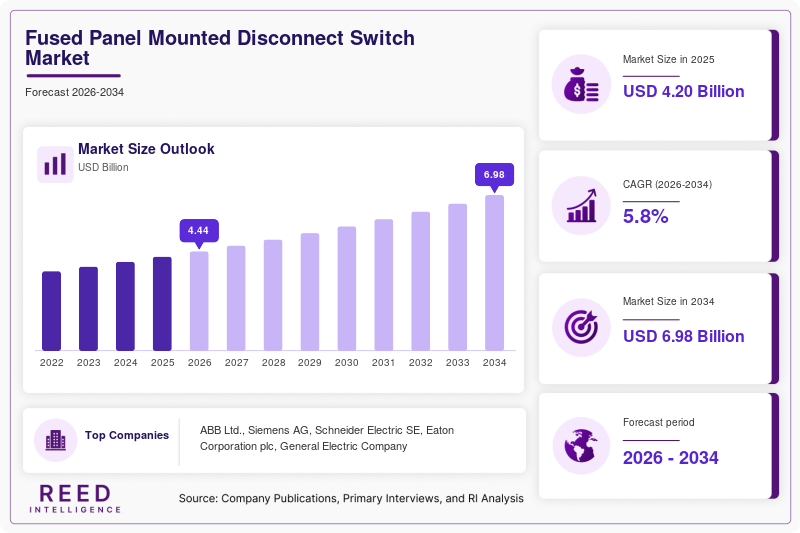
The Fused Panel Mounted Disconnect Switch Market size is estimated at USD 4.2 billion, with growth continuing into 2026 where it is projected to reach USD 4.5 billion. Over the forecast period from 2025 to 2034, the market is expected to achieve a compound annual growth rate (CAGR) of 5.8%, ultimately reaching approximately USD 7.4 billion by 2034.
Fused panel mounted disconnect switches play a critical role in electrical infrastructure by providing a safe means to isolate circuits during maintenance or emergency conditions. Their integration with fuse protection enhances system reliability, making them essential in environments requiring high safety standards such as manufacturing facilities, renewable energy plants, and commercial buildings.
Key Highlights
- Market size is estimated at USD 4.2 billion in 2025, reflecting steady demand across industrial and commercial sectors. Continued infrastructure expansion and modernization of electrical systems are supporting this baseline growth.
- The market is expected to reach USD 7.4 billion by 2034, indicating consistent long-term expansion. Increasing investments in power distribution and safety systems are contributing to this upward trajectory.
- The industry is projected to grow at a CAGR of 5.8% during 2025–2034, driven by stable demand across multiple end-use sectors. This growth rate reflects gradual adoption of advanced disconnect switch technologies.
- Industrial automation and the expansion of renewable energy projects are key demand drivers. These sectors require reliable electrical isolation solutions to ensure operational safety and efficiency.
Market Trends
Integration of Smart Monitoring Capabilities
A significant trend in the fused panel mounted disconnect switch market is the integration of smart monitoring and IoT-enabled features. Manufacturers are increasingly embedding sensors and communication modules into disconnect switches to enable real-time monitoring of electrical parameters such as voltage, current, and temperature. This shift aligns with the broader trend of digital transformation in industrial environments, where predictive maintenance and remote diagnostics are becoming essential.
Smart disconnect switches allow facility managers to detect faults early, reduce downtime, and enhance operational efficiency. These solutions are particularly valuable in industries such as manufacturing and energy, where uninterrupted power supply is critical. Additionally, the integration of smart features supports compliance with advanced safety standards and improves overall system transparency. As industries continue to adopt Industry 4.0 practices, the demand for intelligent disconnect switches is expected to increase steadily.
Growing Preference for Compact and Modular Designs
Another notable trend is the growing preference for compact and modular disconnect switch designs. With space constraints becoming a common challenge in modern electrical installations, especially in urban and commercial settings, manufacturers are focusing on developing smaller yet highly efficient products. Modular designs allow for easy installation, scalability, and maintenance, making them attractive for both new installations and retrofit projects.
These compact solutions are particularly beneficial in renewable energy applications, where space optimization is crucial. Moreover, modular switches enable customization based on specific voltage and current requirements, enhancing their versatility across various industries. This trend is also supported by advancements in materials and engineering techniques, which allow for improved performance without increasing the physical footprint. As a result, compact and modular designs are becoming a standard feature in the market.
Market Drivers
Expansion of Industrial Automation
The rapid expansion of industrial automation is a key driver of the fused panel mounted disconnect switch market. Industries such as manufacturing, oil and gas, and food processing are increasingly adopting automated systems to enhance productivity and efficiency. These systems require reliable electrical components to ensure safe operation, particularly during maintenance or fault conditions.
Fused disconnect switches provide essential protection by isolating circuits and preventing electrical hazards. As automation systems become more complex, the need for advanced safety solutions grows accordingly. Furthermore, the integration of robotics and control systems increases the demand for high-performance disconnect switches that can handle varying load conditions. This trend is expected to continue as industries invest in modernization and digital transformation initiatives.
Increasing Renewable Energy Installations
The global shift toward renewable energy sources is another major driver of market growth. Solar and wind energy projects require robust electrical infrastructure, including disconnect switches, to ensure safe operation and maintenance. Fused panel mounted disconnect switches are widely used in photovoltaic systems and wind turbines to isolate circuits and protect equipment.
Governments worldwide are promoting renewable energy adoption through incentives and regulatory frameworks, which is accelerating the deployment of new projects. This, in turn, drives demand for reliable electrical components. Additionally, the need for grid integration and energy storage systems further supports the adoption of disconnect switches. As renewable energy capacity continues to expand, the market for fused panel mounted disconnect switches is expected to grow significantly.
Market Restraint
High Initial Installation and Maintenance Costs
One of the primary restraints affecting the fused panel mounted disconnect switch market is the relatively high initial installation and maintenance costs associated with these systems. Advanced disconnect switches, particularly those with smart monitoring capabilities, require significant investment in both hardware and integration. This can be a barrier for small and medium-sized enterprises that operate with limited budgets.
In addition to installation costs, ongoing maintenance and periodic inspections are necessary to ensure optimal performance and compliance with safety standards. These requirements can increase the total cost of ownership over time. For example, industries operating in harsh environments may need to replace components more frequently, adding to operational expenses.
This cost factor can lead some organizations to delay upgrades or opt for lower-cost alternatives that may not offer the same level of safety and reliability. As a result, market growth may be constrained in price-sensitive regions. However, advancements in manufacturing processes and economies of scale are expected to gradually reduce costs, mitigating this restraint over the long term.
Market Opportunities
Growth in Electric Vehicle Infrastructure
The rapid development of electric vehicle (EV) infrastructure presents a significant opportunity for the fused panel mounted disconnect switch market. Charging stations require reliable electrical systems to ensure safe and efficient operation. Disconnect switches play a crucial role in isolating circuits during maintenance and protecting equipment from electrical faults.
As governments and private companies invest heavily in EV charging networks, the demand for high-quality electrical components is expected to rise. This includes both public charging stations and private installations in residential and commercial settings. Additionally, the integration of renewable energy sources with EV infrastructure further increases the need for advanced disconnect switches.
Manufacturers can capitalize on this opportunity by developing products specifically designed for EV applications, including compact and high-performance solutions. The continued growth of the EV market is likely to create sustained demand for fused panel mounted disconnect switches.
Emerging Markets and Infrastructure Development
Emerging economies are witnessing rapid urbanization and infrastructure development, creating new opportunities for market expansion. Countries in Asia Pacific, Latin America, and Africa are investing in power generation, transmission, and distribution networks to support economic growth. This includes the construction of commercial buildings, industrial facilities, and residential complexes.
These developments require reliable electrical systems, including disconnect switches, to ensure safety and efficiency. Additionally, governments in these regions are implementing stricter safety regulations, further driving demand for high-quality components. The increasing adoption of renewable energy and smart grid technologies in emerging markets also supports market growth.
Companies that expand their presence in these regions and offer cost-effective solutions tailored to local requirements can gain a competitive advantage. As infrastructure development continues, the fused panel mounted disconnect switch market is expected to benefit significantly from these opportunities.
Segmental Analysis
By Type
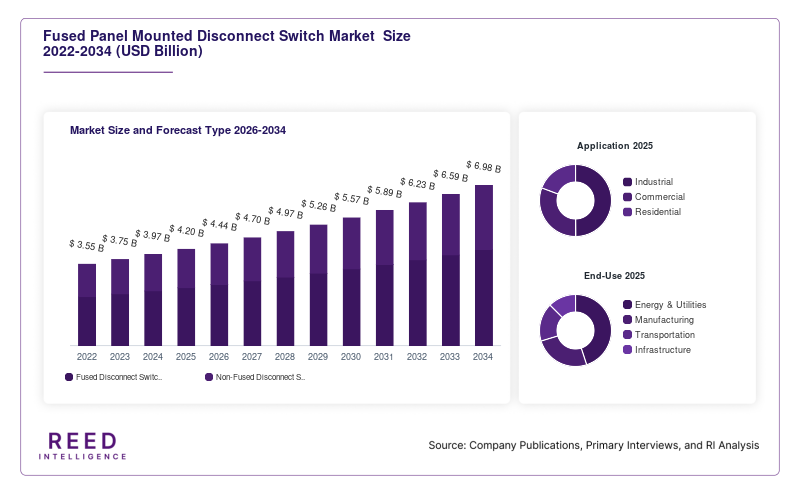
The fused disconnect switches segment dominated the market in 2024, accounting for approximately 62% of the total share. These switches are widely used due to their ability to provide both circuit isolation and overcurrent protection. Industries prefer fused switches for their reliability and compliance with safety standards. The increasing demand for efficient electrical protection systems in industrial and commercial applications further supports the dominance of this segment.
The non-fused disconnect switches segment is expected to be the fastest-growing, with a CAGR of 6.3% during the forecast period. Growth is driven by their cost-effectiveness and suitability for applications where overcurrent protection is provided separately. These switches are increasingly used in renewable energy systems and residential applications, where flexibility and scalability are important factors.
By Application
The industrial application segment held the largest share in 2024, accounting for approximately 48% of the market. The widespread use of disconnect switches in manufacturing, oil and gas, and power generation industries drives this dominance. These sectors require reliable electrical systems to ensure safety and operational efficiency, making fused panel mounted disconnect switches essential components.
The commercial application segment is expected to grow at the fastest rate, with a CAGR of 6.1%. Growth is driven by increasing construction of commercial buildings, including offices, shopping centers, and data centers. The need for reliable power distribution and safety systems in these facilities supports the adoption of disconnect switches.
By End-Use
The energy and utilities segment dominated the market in 2024, accounting for approximately 44% of the total share. The expansion of power generation and distribution networks drives demand for disconnect switches in this segment. The increasing adoption of renewable energy further supports growth, as these systems require reliable electrical components.
The transportation segment is expected to be the fastest-growing, with a CAGR of 6.7%. Growth is driven by the development of electric vehicle infrastructure and railway electrification projects. These applications require advanced electrical systems to ensure safety and efficiency, creating opportunities for fused panel mounted disconnect switches.
Regional Analysis
North America
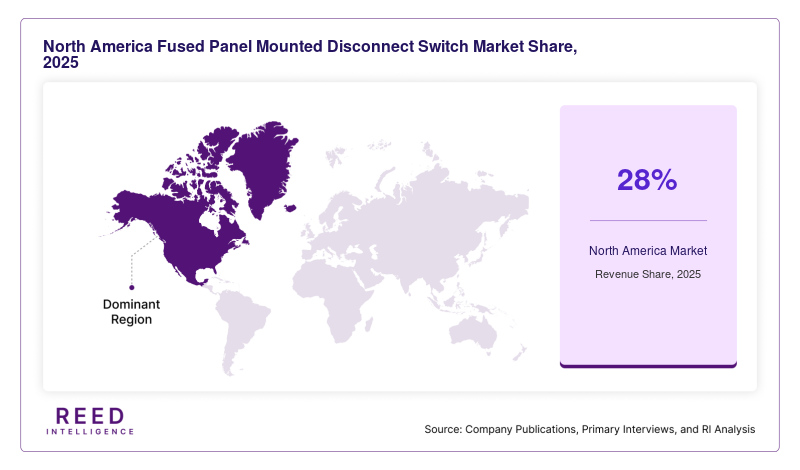
North America accounted for approximately 28% of the global market share in 2025, with a projected CAGR of 5.2% during the forecast period. The region’s growth is driven by strong industrial infrastructure and the presence of advanced manufacturing sectors. The increasing adoption of automation and smart technologies further supports demand for fused panel mounted disconnect switches.
The United States dominates the North American market due to its extensive industrial base and strict safety regulations. A unique growth factor in this region is the rapid expansion of data centers, which require reliable electrical systems to ensure uninterrupted operations. This trend is expected to sustain demand for disconnect switches in the coming years.
Europe
Europe held a market share of around 24% in 2025, with a forecast CAGR of 5.0%. The region’s growth is supported by stringent safety standards and increasing investments in renewable energy projects. Countries across Europe are focusing on upgrading their electrical infrastructure to meet evolving regulatory requirements.
Germany leads the European market, driven by its strong industrial sector and commitment to renewable energy. A unique growth factor in this region is the emphasis on energy efficiency and sustainability, which encourages the adoption of advanced electrical components, including fused disconnect switches.
Asia Pacific
Asia Pacific is the largest market, accounting for approximately 32% of the global share in 2025, with a CAGR of 6.5%. Rapid industrialization, urbanization, and infrastructure development are key drivers of growth in this region. The increasing demand for electricity and expansion of manufacturing industries further support market expansion.
China dominates the Asia Pacific market due to its large-scale industrial activities and investments in renewable energy. A unique growth factor is the government’s focus on smart grid development, which requires advanced electrical components to ensure efficiency and reliability.
Middle East & Africa
The Middle East & Africa region held a market share of about 8% in 2025, with a projected CAGR of 5.6%. Growth in this region is driven by investments in energy infrastructure and industrial development. The increasing adoption of renewable energy projects also contributes to market expansion.
Saudi Arabia is a key market in this region, supported by large-scale infrastructure projects and industrial diversification initiatives. A unique growth factor is the development of smart cities, which require advanced electrical systems, including fused panel mounted disconnect switches.
Latin America
Latin America accounted for approximately 8% of the global market share in 2025, with a CAGR of 5.4%. The region’s growth is driven by increasing investments in power generation and distribution infrastructure. Economic development and urbanization further support demand for electrical components.
Brazil dominates the Latin American market due to its large industrial base and growing energy sector. A unique growth factor in this region is the expansion of renewable energy projects, particularly in wind and solar power, which drives demand for disconnect switches.
Competitive Landscape
The fused panel mounted disconnect switch market is characterized by the presence of several established players focusing on innovation, product development, and strategic partnerships. Companies are investing in research and development to introduce advanced products with enhanced safety features and smart capabilities.
One of the leading players in the market is ABB Ltd., which has a strong global presence and a comprehensive product portfolio. The company recently introduced a new range of smart disconnect switches designed for industrial applications, enhancing its competitive position. Other major companies are also focusing on expanding their distribution networks and entering emerging markets to increase their market share.
Competition in the market is driven by factors such as product quality, pricing, and technological innovation. Companies are also emphasizing sustainability and energy efficiency to align with evolving industry trends.
Key Players
- ABB Ltd.
- Siemens AG
- Schneider Electric SE
- Eaton Corporation plc
- General Electric Company
- Mitsubishi Electric Corporation
- Rockwell Automation, Inc.
- Fuji Electric Co., Ltd.
- Larsen & Toubro Limited
- Havells India Ltd.
- Legrand SA
- Hager Group
- WEG S.A.
- Socomec Group
- CHINT Group
Recent Developments
- In 2024, a leading manufacturer launched a new line of compact fused disconnect switches designed for renewable energy applications.
- In 2025, a major company expanded its production facility in Asia Pacific to meet growing regional demand.
- In 2025, a global player introduced IoT-enabled disconnect switches with real-time monitoring capabilities, enhancing product innovation in the market.
Fused Panel Mounted Disconnect Switch Market Segments
Type
- Fused Disconnect Switches
- Non-Fused Disconnect Switches
Application
- Industrial
- Commercial
- Residential
End-Use
- Energy & Utilities
- Manufacturing
- Transportation
- Infrastructure
By Region
- North America
- Europe
- APAC
- Middle East and Africa
- LATAM