Fusion Biopsy Market Size, Share, Growth & Demand Report By Type (MRI-Ultrasound Fusion Biopsy, Cognitive Fusion Biopsy, Transperineal Fusion Biopsy), By Application (Prostate Cancer Diagnosis, Focal Therapy Planning, Active Surveillance Monitoring), By End Use (Hospitals, Diagnostic Imaging Centers, Ambulatory Surgical Centers), By Region & Segment Forecasts, 2026–2034
USD 3950
Market Overview
The global Fusion Biopsy Market size is estimated at USD 1.82 billion in 2026, and it is projected to reach USD 3.94 billion by 2034, growing at a CAGR of 10.2% (2026–2034). The growth is primarily supported by rising global prostate cancer incidence and the shift from conventional biopsy methods to MRI-ultrasound fusion techniques, which offer higher diagnostic accuracy and reduced false-negative rates.
One global factor significantly supporting the Fusion Biopsy Market growth is the increasing integration of multiparametric MRI (mpMRI) in clinical workflows, enabling precise lesion targeting and improved clinical outcomes. This technological advancement has strengthened the adoption of fusion-guided biopsy systems across hospitals and diagnostic centers.
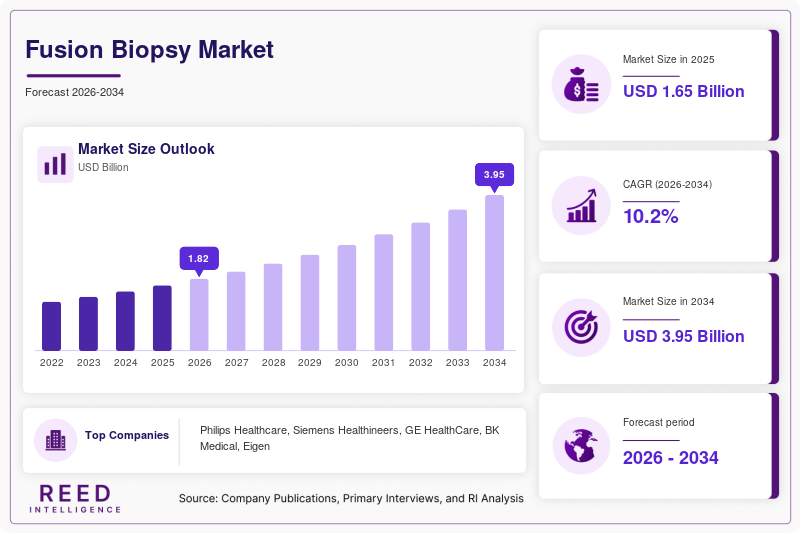
Key Highlights:
- Dominant region share (2025): North America held 38.5% of the global Fusion Biopsy Market
- Fastest-growing region CAGR: Asia Pacific is projected to grow at 13.4% CAGR
- Leading subsegment (Type): MRI-Ultrasound Fusion Biopsy dominated with 42% share
- Fastest-growing subsegment (Application): Prostate cancer diagnostics expanding at 12.1% CAGR
Market Trends
Integration of Artificial Intelligence in Biopsy Systems
The Fusion Biopsy Market is increasingly influenced by AI-driven imaging platforms that enhance lesion detection accuracy and automate image fusion processes. AI algorithms are being embedded into MRI-US fusion devices to reduce operator dependency and improve biopsy precision. This trend is reducing procedural time and increasing diagnostic confidence among clinicians, thereby strengthening the adoption rate of advanced biopsy systems globally.
Shift Toward Outpatient and Ambulatory Diagnostic Settings
Another key trend in the Fusion Biopsy Market is the shift from hospital-based procedures to outpatient and ambulatory surgical centers. This transition is driven by cost efficiency, reduced hospitalization time, and improved patient comfort. Portable fusion biopsy systems and compact imaging devices are increasingly being deployed in diagnostic centers, enabling faster workflow and higher patient throughput. Additionally, reimbursement support for minimally invasive diagnostic procedures is further accelerating this transition.
Market Drivers
Rising Prevalence of Prostate Cancer
A major growth driver in the Fusion Biopsy Market is the increasing global burden of prostate cancer. Aging male populations, lifestyle changes, and improved screening programs have led to higher detection rates. Fusion biopsy techniques provide superior accuracy compared to conventional methods, reducing repeat procedures and improving early-stage cancer diagnosis. This has significantly boosted demand for advanced imaging-guided biopsy systems across hospitals and diagnostic centers.
Technological Advancements in Imaging-Guided Biopsy
Continuous innovation in MRI-ultrasound fusion platforms, real-time navigation systems, and 3D imaging technologies is propelling the Fusion Biopsy Market. These advancements allow precise targeting of suspicious lesions and improve cancer detection rates. Integration of robotics and software-driven navigation tools further enhances procedural accuracy, leading to increased clinical adoption and expansion of the market footprint across developed and emerging economies.
Market Restraint
High Cost of Fusion Biopsy Systems
One of the primary restraints affecting the Fusion Biopsy Market is the high cost associated with advanced fusion imaging systems and related software platforms. The installation of MRI-compatible biopsy systems requires significant capital investment, limiting adoption in cost-sensitive regions. Additionally, maintenance expenses and training requirements for healthcare professionals further increase operational costs. This creates a barrier for small and mid-sized diagnostic facilities, especially in developing economies where healthcare budgets are constrained.
Market Opportunities
Expansion in Emerging Healthcare Infrastructure
The Fusion Biopsy Market presents strong opportunities in emerging economies where healthcare infrastructure is rapidly improving. Countries in Asia Pacific and Latin America are investing heavily in cancer diagnostics and hospital modernization. This expansion is expected to increase the installation of advanced biopsy systems in tertiary care centers and diagnostic laboratories, creating significant growth potential.
Growth in AI-Based Diagnostic Platforms
Another major opportunity in the Fusion Biopsy Market lies in AI-powered diagnostic platforms that enhance image interpretation and procedural efficiency. AI integration enables automated lesion detection and reduces human error, making fusion biopsy procedures more reliable. As healthcare providers increasingly adopt digital pathology and precision medicine approaches, demand for AI-enabled biopsy systems is expected to rise substantially.
Segmental Analysis
By Type
MRI-Ultrasound Fusion Biopsy represented the dominant subsegment with approximately 42% share of the Fusion Biopsy Market in 2025. This dominance is attributed to its high diagnostic accuracy and widespread clinical acceptance in prostate cancer detection workflows. The Fusion Biopsy Market continues to see strong demand for MRI-based targeting systems due to their ability to identify clinically significant lesions.
The fastest-growing subsegment is transperineal fusion biopsy systems, projected to expand at a 12.6% CAGR during the forecast period. Growth is driven by reduced infection risk and improved sampling precision compared to traditional transrectal approaches. Increasing clinical preference for safer biopsy techniques is expected to accelerate adoption.
By Application
Prostate cancer diagnostics dominated the application segment with 61% share in 2025, reflecting the high prevalence of prostate-related disorders globally. The Fusion Biopsy Market is strongly concentrated in this application due to the superior accuracy of fusion-guided procedures in detecting clinically significant tumors.
The fastest-growing application is kidney and bladder cancer diagnostics, projected to grow at 11.8% CAGR, driven by rising urological cancer incidence and expanding use of image-guided biopsy techniques in complex anatomical regions.
By End-Use
Hospitals accounted for the dominant share of 54% in the Fusion Biopsy Market in 2025, supported by availability of advanced imaging infrastructure and skilled professionals. The Fusion Biopsy Market in hospitals is strengthened by high patient inflow and integration of advanced diagnostic platforms.
Diagnostic centers represent the fastest-growing end-use segment with a projected 12.3% CAGR, driven by increasing outpatient diagnostic procedures and cost-effective service models. Expansion of standalone imaging centers is further boosting adoption.
By Technology
MRI-Ultrasound fusion systems held the dominant position with 45% share in 2025, while electromagnetic tracking systems are the fastest-growing segment at 12.0% CAGR, driven by improved real-time navigation accuracy and reduced procedural complexity.
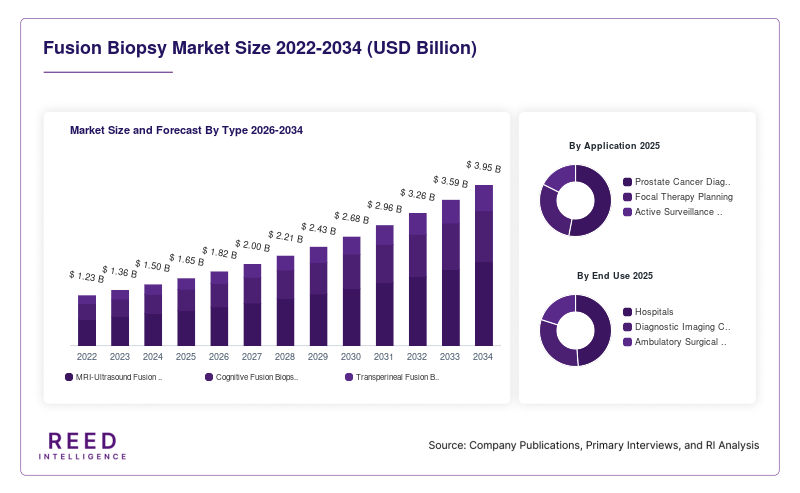
Regional Analysis
North America
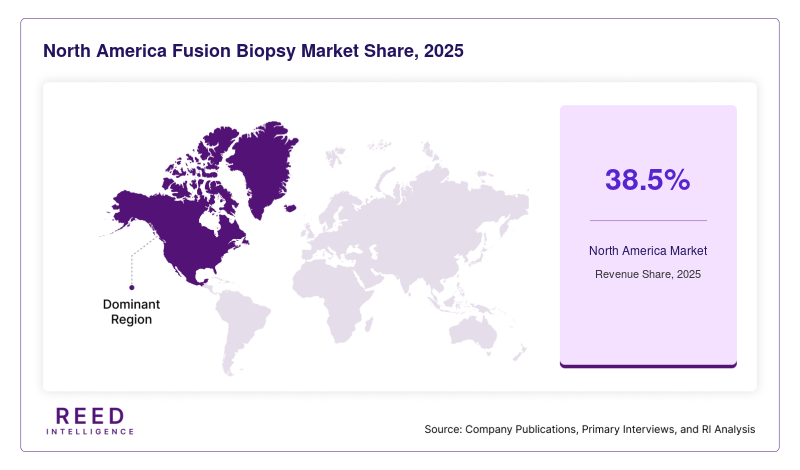
North America accounted for approximately 38.5% share of the Fusion Biopsy Market in 2025, and it is expected to expand at a 10.8% CAGR from 2026 to 2034. The region continues to dominate due to high adoption of advanced cancer diagnostic technologies and strong healthcare expenditure. The Fusion Biopsy Market in North America is strongly influenced by the widespread availability of MRI-ultrasound fusion systems and favorable reimbursement frameworks.
The United States remains the dominant country in this region, driven by advanced healthcare infrastructure, early adoption of robotic-assisted biopsy systems, and strong clinical research initiatives. Increasing prostate cancer screening programs and the presence of major medical device manufacturers further support regional expansion.
Europe
Europe held around 27.4% share of the Fusion Biopsy Market in 2025, and it is projected to grow at a 10.5% CAGR during the forecast period. The region benefits from strong public healthcare systems and increasing awareness of early cancer detection. The Fusion Biopsy Market in Europe is driven by rising adoption of minimally invasive diagnostic procedures across Germany, France, and the United Kingdom.
Germany leads the regional market due to its advanced diagnostic imaging infrastructure and strong hospital network. Government-backed cancer screening initiatives and increasing investment in medical imaging technologies continue to support market growth across Western Europe.
Asia Pacific
Asia Pacific captured approximately 22.1% share of the Fusion Biopsy Market in 2025, and it is expected to grow at the highest 13.4% CAGR through 2034. Rapid healthcare infrastructure development, rising cancer prevalence, and increasing medical tourism are key contributors. The Fusion Biopsy Market in this region is expanding due to growing adoption of advanced imaging systems in China, India, and Japan.
China is the dominant country in this region, supported by large patient pools, government healthcare investments, and rapid expansion of private diagnostic centers. India is also emerging strongly due to increasing awareness of early cancer detection and improving access to advanced biopsy technologies.
Middle East & Africa
Middle East & Africa accounted for 6.2% share of the Fusion Biopsy Market in 2025, and it is projected to grow at a 9.6% CAGR during 2026–2034. Growth is driven by increasing healthcare modernization initiatives and rising incidence of cancer cases. The Fusion Biopsy Market in this region is supported by hospital infrastructure development in Gulf countries.
Saudi Arabia leads the regional market due to strong government investment in healthcare transformation programs and increasing adoption of advanced diagnostic imaging systems in tertiary hospitals.
Latin America
Latin America held around 5.8% share of the Fusion Biopsy Market in 2025, and it is projected to grow at a 9.9% CAGR during the forecast period. The region is witnessing steady improvements in diagnostic healthcare services and rising awareness of early cancer detection. The Fusion Biopsy Market in Latin America is primarily driven by Brazil and Mexico.
Brazil is the dominant country due to expanding private healthcare facilities and increasing adoption of advanced imaging-based diagnostic tools. Government initiatives to improve cancer screening programs further support market development.
Competitive Landscape
The Fusion Biopsy Market is moderately consolidated with key players focusing on technological innovation, strategic collaborations, and product expansion. Major companies include Elekta AB, Koninklijke Philips N.V., GE HealthCare, Siemens Healthineers, and Koelis. Among these, Siemens Healthineers holds a strong position due to its advanced MRI-guided biopsy platforms and continuous software upgrades.
Recent developments include expansion of AI-integrated biopsy navigation systems and partnerships with hospitals to deploy next-generation imaging solutions. Companies are also investing in portable fusion biopsy platforms to increase accessibility in outpatient settings. Competitive strategies primarily focus on improving diagnostic accuracy, reducing procedure time, and expanding geographic reach within the Fusion Biopsy Market.
Key Players List
- Siemens Healthineers
- GE HealthCare
- Koninklijke Philips N.V.
- Elekta AB
- Koelis
- Medtronic plc
- Canon Medical Systems
- Hitachi Ltd.
- Olympus Corporation
- B. Braun Melsungen AG
- Karl Storz SE & Co. KG
- iCAD Inc.
- Invivo Corporation
- Esaote SpA
- Aurora Imaging Technology
Recent Developments
- In 2025, several manufacturers expanded AI-powered MRI-ultrasound fusion platforms to enhance lesion detection accuracy.
- Hospitals in North America increased adoption of robotic-assisted biopsy systems to improve procedural efficiency.
- Asia Pacific saw increased deployment of portable fusion biopsy systems in diagnostic centers.
- European healthcare providers integrated cloud-based imaging solutions for remote diagnostic collaboration.
- Key players introduced next-generation electromagnetic tracking systems to improve real-time navigation accuracy.
Fusion Biopsy Market Segments
By Type
- MRI-Ultrasound Fusion Biopsy
- Cognitive Fusion Biopsy
- Transperineal Fusion Biopsy
By Application
- Prostate Cancer Diagnosis
- Focal Therapy Planning
- Active Surveillance Monitoring
By End Use
- Hospitals
- Diagnostic Imaging Centers
- Ambulatory Surgical Centers
By Region
- North America
- Europe
- APAC
- Middle East and Africa
- LATAM