Galactosidase Market Size, Share & Demand Report By Type (Alpha-Galactosidase, Beta-Galactosidase), By Application (Food & Beverages, Pharmaceuticals, Animal Feed, Biotechnology), By Source (Microbial, Plant-Based, Animal-Based), By End-Use Industry (Food Processing, Pharmaceutical Industry, Biotechnology Industry, Animal Feed Industry), By Region & Segment Forecasts, 2025–2034
USD 3950
Market Overview
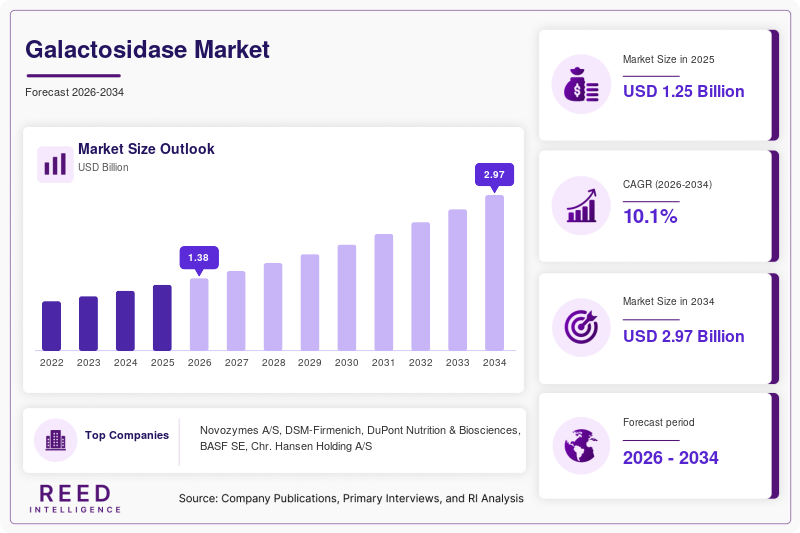
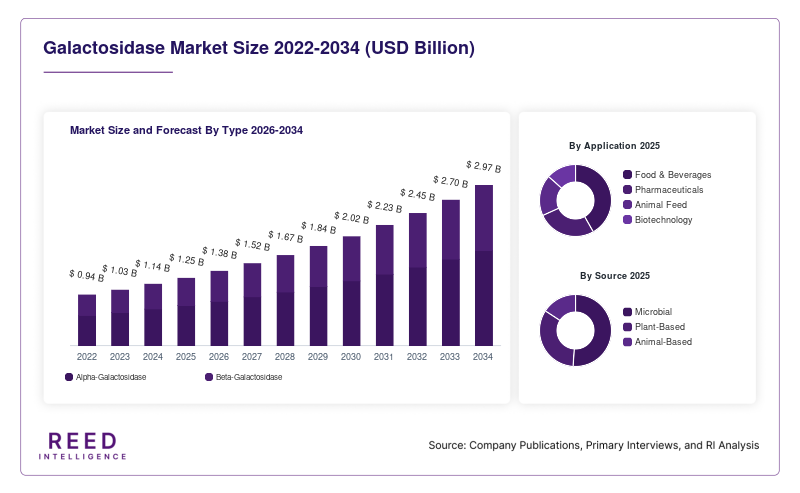
The Galactosidase Market size was valued at approximately USD 1.25 billion in 2025 and is projected to reach USD 2.95 billion by 2034, expanding at a CAGR of 10.1% from 2025 to 2034. The market is experiencing steady growth due to increasing applications in food processing, pharmaceuticals, and biotechnology industries. Galactosidase enzymes, particularly beta-galactosidase, are widely used for lactose hydrolysis in dairy products, enabling the production of lactose-free foods and beverages.
A key global factor supporting the growth of the Galactosidase Market is the rising prevalence of lactose intolerance worldwide. Consumers are increasingly shifting toward lactose-free dairy products, which has significantly boosted the demand for galactosidase enzymes. Additionally, the growing focus on digestive health and functional foods has contributed to the expansion of enzyme-based solutions in food manufacturing.
Key Highlights:
- North America dominated the Galactosidase Market with approximately 34% share in 2025, while Asia Pacific is expected to grow fastest at a CAGR of 11.2%.
- By type, beta-galactosidase led the market, while microbial galactosidase is projected to grow fastest at a CAGR of 10.8%.
- By application, food & beverages held the largest share, whereas pharmaceuticals are anticipated to grow at a CAGR of 11.0%.
- United States remained the dominant country, with a market value of USD 380 million in 2025 and an estimated USD 410 million in 2026.
Market Trends
Expansion of Lactose-Free Dairy Products
The Galactosidase Market is witnessing strong growth due to the increasing demand for lactose-free dairy products. Consumers with lactose intolerance are seeking alternatives that offer the nutritional benefits of dairy without digestive discomfort. Galactosidase enzymes play a critical role in breaking down lactose, enabling manufacturers to produce a wide range of lactose-free milk, cheese, and yogurt products.
Advancements in Enzyme Technology
Technological advancements in enzyme production are shaping the Galactosidase Market. Innovations in genetic engineering and fermentation processes are improving enzyme stability, activity, and cost efficiency. These advancements are enabling manufacturers to develop high-performance galactosidase products tailored for specific industrial applications.
Market Drivers
Rising Demand for Functional and Digestive Health Products
The growing awareness of digestive health is driving the demand for enzyme-based solutions, including galactosidase. Consumers are increasingly incorporating functional foods and supplements into their diets, supporting market growth.
Growth of Dairy Processing Industry
The expansion of the dairy industry is a key driver for the Galactosidase Market. The increasing production of dairy products, particularly in emerging economies, is boosting the demand for enzymes used in processing and quality enhancement.
Market Restraint
High Production and Processing Costs
The Galactosidase Market faces challenges due to the high costs associated with enzyme production and processing. Advanced technologies and specialized equipment are required to produce high-quality enzymes, which can increase operational expenses.
These costs can limit the adoption of galactosidase in price-sensitive markets. Additionally, the need for stringent quality control and regulatory compliance further adds to production costs. Manufacturers must focus on optimizing production processes to reduce costs and improve affordability.
Market Opportunities
Expansion in Plant-Based Dairy Alternatives
The growing popularity of plant-based dairy alternatives presents significant opportunities for the Galactosidase Market. Enzymes are used to improve the taste and digestibility of plant-based products, supporting their adoption among health-conscious consumers.
Increasing Use in Biotechnology Applications
The biotechnology sector offers promising growth opportunities for galactosidase enzymes. They are used in research and industrial processes, including biofuel production and genetic studies. The expansion of biotechnology applications is expected to drive market growth.
Segmental Analysis
By Type
Beta-galactosidase dominated the Galactosidase Market in 2025, accounting for approximately 62% of the total share. Its widespread use in lactose hydrolysis and dairy processing has supported its dominance.
Microbial galactosidase is expected to be the fastest-growing subsegment, registering a CAGR of 10.8%. The growth factor lies in its high efficiency and suitability for industrial applications.
By Application
Food & beverages accounted for the largest share of approximately 55% in 2025, driven by the increasing demand for lactose-free products. Galactosidase enzymes are essential for dairy processing and product development.
Pharmaceuticals are expected to grow at the fastest CAGR of 11.0%. The use of enzymes in drug formulation and therapeutic applications is driving growth in this segment.
By Source
Microbial sources held the largest share of approximately 58% in 2025, as they offer high efficiency and scalability in enzyme production.
Plant-based sources are projected to grow at a CAGR of 10.6%. The increasing demand for natural and sustainable products is supporting this growth.
By End-Use Industry
Food processing industry dominated the market with a share of around 52% in 2025, driven by the widespread use of enzymes in dairy production.
Biotechnology industry is anticipated to grow at a CAGR of 10.9%. The expanding applications of enzymes in research and industrial processes are supporting growth.
Regional Analysis
North America
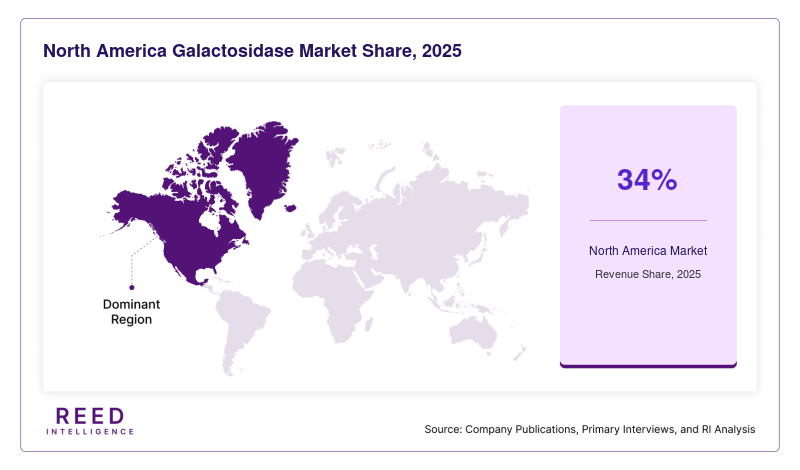
North America accounted for approximately 34% of the Galactosidase Market share in 2025 and is expected to grow at a CAGR of 9.5% during the forecast period. The region’s strong focus on health and wellness products has supported market growth.
The United States dominated the regional market due to high demand for lactose-free dairy products and advanced food processing technologies. The presence of leading enzyme manufacturers has further contributed to market expansion.
Europe
Europe held nearly 28% share of the Galactosidase Market in 2025 and is projected to grow at a CAGR of 9.2%. The region’s well-established dairy industry has supported the demand for galactosidase enzymes.
Germany emerged as the dominant country, driven by its strong food processing sector and focus on innovation. The increasing demand for functional foods has contributed to market growth.
Asia Pacific
Asia Pacific represented around 24% of the market share in 2025 and is anticipated to grow at a CAGR of 11.2%. The region’s expanding population and rising disposable income have supported market growth.
China led the regional market, driven by increasing dairy consumption and growing awareness of lactose intolerance. Government support for food processing industries has also contributed to market expansion.
Middle East & Africa
The Middle East & Africa accounted for approximately 7% share in 2025 and is expected to grow at a CAGR of 8.8%. The market is gradually developing due to increasing demand for processed food products.
The Saudi Arabia dominated the region, supported by growing investments in food processing industries. The demand for lactose-free products has contributed to market growth.
Latin America
Latin America held nearly 7% share of the Galactosidase Market in 2025 and is projected to grow at a CAGR of 9.7%. The region is experiencing growth due to increasing dairy consumption.
Brazil emerged as the dominant country, driven by its large dairy industry. The adoption of enzyme-based solutions has supported market growth.
Competitive Landscape
The Galactosidase Market is characterized by the presence of global enzyme manufacturers focusing on innovation and product development. Companies are investing in research to improve enzyme efficiency and expand application areas.
Novozymes A/S is a leading player in the market, known for its advanced enzyme solutions. The company has recently introduced new galactosidase products designed to enhance lactose-free dairy production.
Other players are focusing on strategic collaborations and expanding their production capacities to meet growing demand. The competitive landscape is shaped by continuous innovation and technological advancements.
Key Players List
- Novozymes A/S
- DSM-Firmenich
- DuPont Nutrition & Biosciences
- BASF SE
- Chr. Hansen Holding A/S
- Kerry Group plc
- Amano Enzyme Inc.
- Advanced Enzyme Technologies Ltd.
- Enzyme Development Corporation
- Creative Enzymes
- Biocatalysts Ltd.
- AB Enzymes GmbH
- Megazyme Ltd.
- Codexis Inc.
- Specialty Enzymes & Probiotics
Recent Developments
- Novozymes A/S launched new enzyme solutions for lactose-free dairy.
- DSM-Firmenich expanded its enzyme product portfolio.
- DuPont introduced advanced enzyme technologies for food processing.
- Chr. Hansen invested in research for enzyme innovation.
- Kerry Group developed new functional ingredient solutions.
Galactosidase Market Segments
By Type
- Alpha-Galactosidase
- Beta-Galactosidase
By Application
- Food & Beverages
- Pharmaceuticals
- Animal Feed
- Biotechnology
By Source
- Microbial
- Plant-Based
- Animal-Based
By End-Use Industry
- Food Processing
- Pharmaceutical Industry
- Biotechnology Industry
- Animal Feed Industry
By Region
- North America
- Europe
- APAC
- Middle East and Africa
- LATAM