GameFi Market Size, Share & Demand Report By Component (Game Platforms, In-Game Assets), By Game Type (Play-to-Earn Games, Move-to-Earn Games, Metaverse Games) By Region & Segment Forecasts, 2026–2034
USD 3950
GameFi Market Size
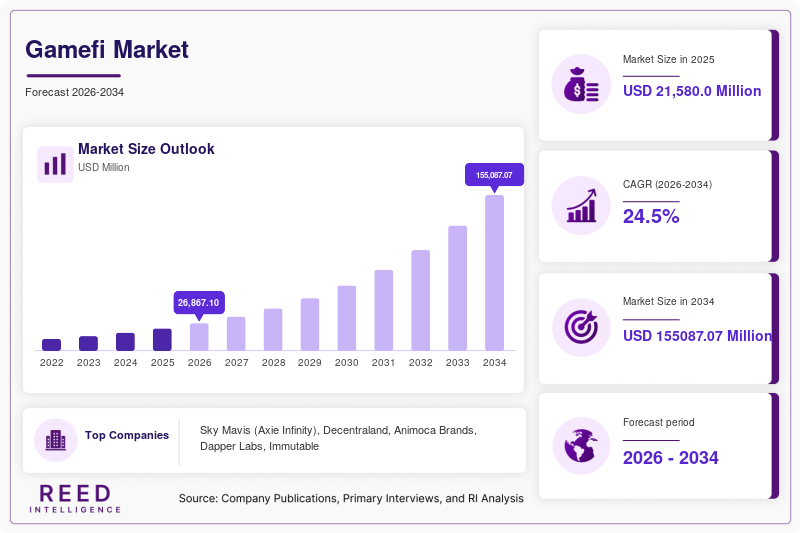
The GameFi market size is projected at USD 26,850.0 million in 2026 and is expected to hit USD 156,020.0 million by 2034 with a CAGR of 24.5% during the forecast period. The increasing adoption of blockchain-based gaming platforms, the growing demand for player-owned digital assets, and the rising integration of decentralized finance mechanisms in gaming ecosystems underpin market expansion. This report delivers a comprehensive analysis of the GameFi market, including segmentation by component and game type, competitive dynamics, and regional growth patterns, equipping stakeholders with critical intelligence to navigate this transformative gaming landscape. The GameFi market continues to demonstrate significant growth potential, fueled by the expanding Web3 gaming ecosystem, the increasing demand for tokenized in-game assets, and continuous innovation in play-to-earn and move-to-earn models.
GameFi Market Key Takeaways
- Dominant Region: North America leads the GameFi market with a 36% share, while Asia-Pacific is the fastest-growing region with a projected CAGR of 28.5% through 2034.
- Dominant Segment: The Game Platforms component dominates the market with a 62% share, while the Play-to-Earn Games type is the leading segment with a 48% share.
- Emerging Country: China is projected to reach USD 18,500.0 million by 2034, expanding at a CAGR of 26.8%.
- Key Drivers: The increasing adoption of blockchain technology, the growing demand for player-owned economies, and the rising investment in Web3 gaming infrastructure are driving market growth.
The GameFi market encompasses a comprehensive ecosystem of blockchain-based gaming platforms, decentralized applications, and tokenized in-game assets that combine gaming with financial incentives. These platforms enable players to earn cryptocurrency and non-fungible tokens through gameplay, creating player-owned economies. Globally, the GameFi industry has attracted significant investment, with an estimated 3,500 active GameFi projects operating worldwide in 2025. In terms of revenue, Game Platforms accounted for roughly 62% of the total market share, driven by the proliferation of play-to-earn and metaverse gaming platforms, while In-Game Assets followed with a 38% share, particularly driven by the growing market for NFTs and tokenized gaming items. The market is further characterized by a penetration rate exceeding 25% among blockchain-savvy gamers in developed economies, whereas emerging markets represent a rapidly growing adoption frontier due to increasing cryptocurrency adoption and the appeal of play-to-earn income opportunities. The Play-to-Earn Games segment remains the largest application area, with Move-to-Earn and Metaverse Games representing significant growth opportunities. This GameFi market growth is underpinned by the global shift toward decentralized gaming economies and the increasing mainstream acceptance of blockchain technology.
GameFi Market Trends
Emergence of Web2.5 Gaming Models Combining Traditional and Blockchain Gaming
The GameFi market is witnessing a significant trend toward the emergence of Web2.5 gaming models that combine traditional gaming experiences with blockchain infrastructure without forcing users into speculative token economies. This shift is driven by the need to attract mainstream gamers who are interested in gameplay quality rather than financial speculation. Studios such as Fumb Games, Mythical Games, and Wemade are pioneering this approach, generating substantial revenue while leveraging blockchain for improved profit margins and enhanced player engagement. The adoption of Web2.5 models has increased by 35% year-over-year, with over 45% of new blockchain gaming projects incorporating elements of this hybrid approach. This GameFi market trend is supported by the growing recognition that sustainable gaming economies require engaging gameplay as the foundation, with blockchain serving as an enhancement rather than the primary value proposition.
Growing Focus on Sustainable Tokenomics and Player Retention
The increasing focus on sustainable tokenomics and player retention strategies is a major trend shaping the GameFi market. The development of economic models that balance player rewards with long-term token value stability is gaining traction, driven by the lessons learned from earlier play-to-earn models that suffered from hyperinflation and player attrition. Platforms are implementing dual-token systems, staking mechanisms, and governance features to create more resilient economies. This GameFi market trend is supported by the growing understanding that token price stability and genuine utility are essential for long-term player engagement. The integration of traditional gaming progression systems alongside token-based rewards is enhancing player retention and creating more balanced gaming experiences.
GameFi Market Drivers
The GameFi market's expansion is primarily driven by the increasing adoption of blockchain technology and the growing demand for player-owned gaming economies. The global blockchain gaming market has attracted over USD 15 billion in cumulative investment, with significant funding flowing into game development, infrastructure, and platform creation. The rising demand for play-to-earn opportunities has been a major driver, particularly in emerging markets where gaming income can supplement traditional earnings. The increasing integration of NFTs and digital collectibles in gaming has further fueled market demand, with over 65% of new GameFi projects incorporating NFT-based assets. The growing interest from traditional gaming companies and venture capital firms has also supported market growth. Additionally, the development of improved blockchain infrastructure and scaling solutions has reduced barriers to entry and enhanced user experiences.
GameFi Market Restraints
Despite favorable growth prospects, the GameFi market faces significant constraints, primarily related to the volatility of cryptocurrency markets and the resulting instability in token-based gaming economies. The market experienced a 67% decline in total market capitalization in 2025, with funding decreasing by over 55% year-over-year, reflecting the challenges facing the sector. The complexity of blockchain technology and the steep learning curve for new users can also limit adoption among mainstream gamers. The market's growth is further tempered by the challenges of balancing engaging gameplay with sustainable tokenomics, as many earlier play-to-earn models prioritized earning potential over game quality. Additionally, the regulatory uncertainty surrounding cryptocurrency and NFT-based gaming in various jurisdictions can create compliance challenges.
GameFi Market Opportunities
The GameFi market presents significant opportunities in the rapidly expanding segment of mobile-first blockchain gaming, where accessible and engaging experiences can reach broader audiences. The development of cross-chain gaming platforms and interoperability solutions represents another promising avenue, enabling seamless asset transfers between different blockchain ecosystems. Emerging opportunities also exist in the integration of traditional gaming IP with blockchain technology, leveraging established brands and audiences. Furthermore, the growing interest from institutional investors and traditional gaming companies offers potential for significant capital inflow and mainstream adoption. The expansion of GameFi into emerging markets with high mobile penetration and cryptocurrency adoption presents a fertile ground for market growth.
Challenges in GameFi Market
The GameFi market grapples with persistent challenges related to the need to deliver engaging gaming experiences that can compete with traditional AAA titles while maintaining sustainable token economies. The complexity of designing economic systems that balance player rewards with long-term token stability presents ongoing challenges, as evidenced by the struggles of many early play-to-earn projects. The market is also contending with the challenge of attracting and retaining mainstream gamers who may be skeptical of blockchain technology and cryptocurrency. Moreover, the need for improved user experience and reduced technical barriers poses challenges for broader adoption. The regulatory landscape for cryptocurrency and NFT-based gaming remains uncertain in many jurisdictions, creating compliance challenges for market participants.
GameFi Market Segmentation Analysis
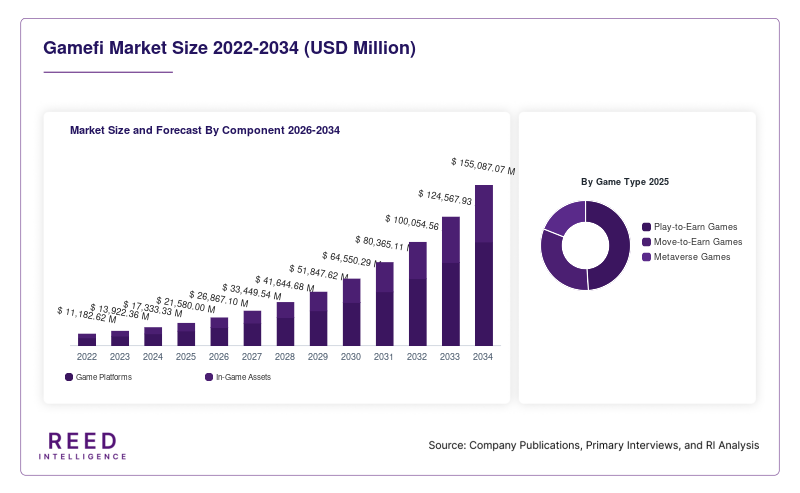
The GameFi market is segmented by Component and Game Type to provide a comprehensive market perspective. By Component, Game Platforms dominate with a 62% market share, driven by the proliferation of play-to-earn and metaverse gaming platforms. The Game Type segment is led by Play-to-Earn Games, which accounts for 48% of the market, followed by Metaverse Games at 32%, and Move-to-Earn Games at 20%.
By Component
Game Platforms represent the largest segment in the GameFi market, commanding a 62% share, with revenue exceeding USD 16,647 million in 2025. These include blockchain-based gaming platforms, decentralized game stores, and metaverse worlds. Technical specifications include blockchain integration, transaction speed, and user interface. The market's Game Platforms segment is driven by the proliferation of play-to-earn and metaverse gaming platforms, which serve as the foundation for the entire GameFi ecosystem.
In-Game Assets capture a 38% share of the GameFi market, with revenue of USD 10,203 million in 2025. These include NFTs, virtual land, in-game currencies, and tokenized gaming items. Technical specifications include smart contract standards, interoperability, and scarcity mechanisms. The market's In-Game Assets segment is driven by the growing demand for player-owned digital assets that can be traded, sold, or utilized across multiple gaming platforms.
By Game Type
Play-to-Earn Games dominate the GameFi market, accounting for 48% of sales, representing USD 12,888 million in 2025. These games reward players with cryptocurrency or NFTs for completing in-game activities and achieving milestones. Usage penetration exceeds 55% among blockchain gamers. The market's Play-to-Earn Games segment is characterized by its focus on economic incentives and player rewards, appealing to users seeking income opportunities through gaming.
Metaverse Games account for 32% of the GameFi market, with revenue of USD 8,592 million in 2025. These games offer immersive virtual worlds with tokenized land, assets, and experiences, enabling players to socialize, create, and trade. The segment is growing at a significant rate, driven by the increasing interest in virtual real estate and digital identity. The market's Metaverse Games segment is characterized by its focus on social interaction, user-generated content, and persistent virtual economies.
Move-to-Earn Games represent 20% of the market, with revenue of USD 5,370 million in 2025. These games reward players for physical activity, such as walking or running, combining fitness tracking with blockchain-based rewards. The segment's growth is fueled by the increasing focus on health and wellness and the appeal of earning while exercising. The market's Move-to-Earn Games segment is characterized by its integration of fitness data and tokenized rewards for physical activity.
GameFi Market Regional Analysis
North America GameFi Market
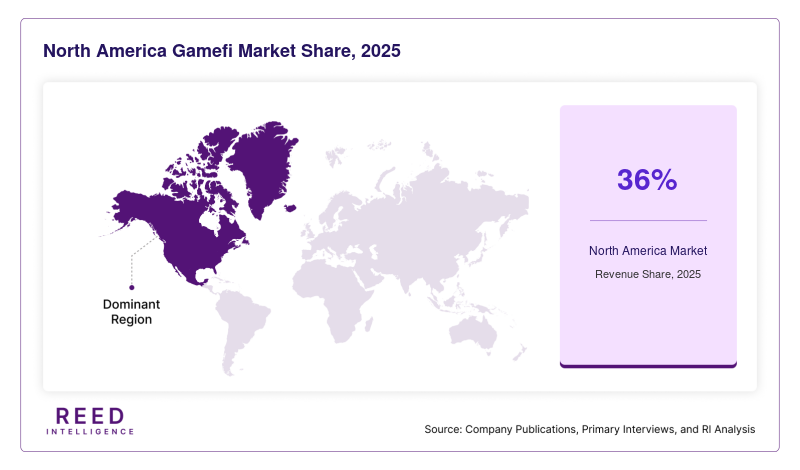
Leads the GameFi market, commanding a 36% share, with revenue of USD 9,666 million in 2025. The United States is the primary driver, accounting for 85% of regional demand, driven by a strong gaming culture, high cryptocurrency adoption, and significant venture capital investment. The North American market is characterized by its focus on innovation and the presence of leading GameFi studios and infrastructure providers.
Asia-Pacific GameFi Market
Represents the second-largest and fastest-growing market, capturing a 32% share with revenue of USD 8,592 million in 2025. China, Japan, South Korea, and Southeast Asian countries are the primary drivers, accounting for 68% of regional demand, fueled by a massive gaming population, high mobile penetration, and increasing cryptocurrency adoption. The Asia-Pacific market is projected to grow at the fastest CAGR of 28.5% through 2034, driven by the popularity of play-to-earn models and the region's leadership in mobile gaming.
Europe GameFi Market
Accounts for 22% of the global GameFi market, with revenue of USD 5,907 million in 2025. Germany, the United Kingdom, and France are the primary drivers, accounting for 58% of regional demand, driven by a strong gaming industry, increasing blockchain adoption, and growing venture capital interest. The European market is projected to grow at a significant CAGR, supported by innovation and regulatory clarity in key markets.
Latin America and Middle East & Africa GameFi Market
Together account for the remaining 10% of the GameFi market, with Brazil and the UAE leading their respective regions. Both regions are projected to grow at CAGRs exceeding 26%, driven by increasing cryptocurrency adoption, mobile gaming penetration, and the appeal of play-to-earn income opportunities in emerging economies.
Top players in GameFi Market
- Sky Mavis (Axie Infinity)
- Decentraland
- Animoca Brands
- Dapper Labs
- Immutable
- Gala Games
- WEMIX (Wemade)
- The Sandbox
- Somnium Space
- Radio Caca
- Illuvium Labs
- Splinterlands
- Gods Unchained (Immutable)
- Mythical Games
- Fumb Games
Gamefi Market Segments
By Component
- Game Platforms
- In-Game Assets
By Game Type
- Play-to-Earn Games
- Move-to-Earn Games
- Metaverse Games
By Region
- North America
- Europe
- APAC
- Middle East and Africa
- LATAM